
If your lobby guard copies Emirates ID numbers into a book anyone at the desk can read, this is for you. If your site has no guard or receptionist at the desk, it is not.
What are a lobby guard's duties at a Dubai tower?
At the desk of an office or residential tower, the guard's duties are short:
- Greet the visitor and ask whom they are visiting.
- Confirm the host approved the visit.
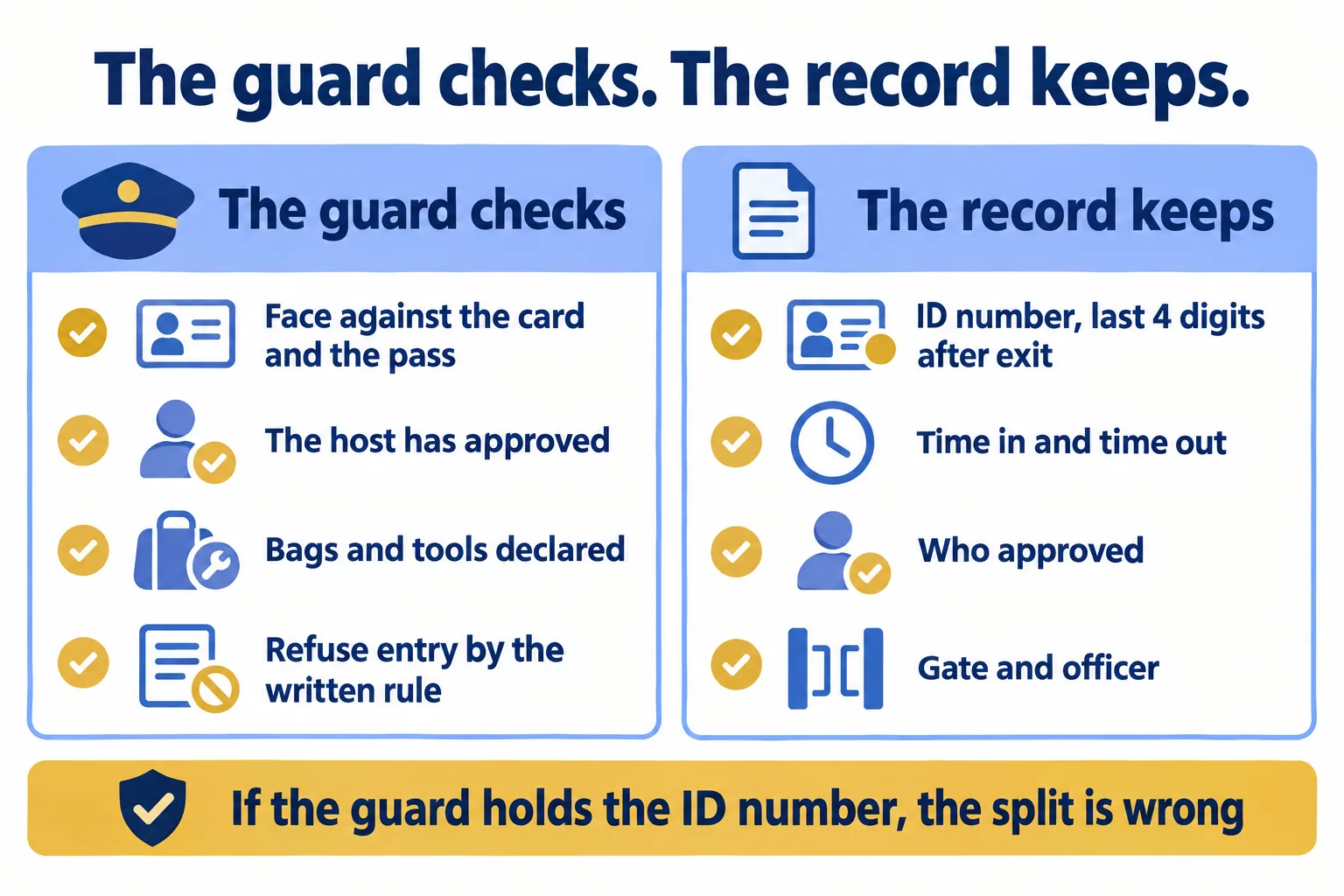
- Match the face to the ID card and to the pass.
- Check bags, tools and equipment going in and out.
- Refuse entry when the written rule says so, and call the supervisor.
- Record each exit, and hand over the open items at shift change.
Notice what is missing from that list: copying the ID number. In many Dubai lobbies it is still the guard's first move, and it is the one job the guard should not be doing.
Why does the guard end up holding ID numbers?
Because nobody wrote down what to record, so the guard records everything. Bianca Gracias, a UAE lawyer and managing partner at Crimson Legal, described it on LinkedIn in October 2025: "I cringe everytime they write my EID Number in this blue aged log book (after checking my digital ID)." She added that "every security guard I have asked about data privacy practices knows zero about it", and that in one building "the security guard left his book open with all this visitor personal data visible."
A reply under her post put the cause plainly: "The security personnel just did what they had been told to do, would most likely have had no idea WHY." Another reader asked for the fix in one line: "There should be no reason they can't just take your name and match it visually against your ID, with no further personal identifiers being logged."
The guard is not the problem. The post orders are. CGuardPro, a US vendor that sells software to guard companies, makes the same point about the front desk: "An officer facing a confident visitor with an unclear situation and no written rule will default to letting them through." The same holds for what gets written down. With no rule, the guard copies the whole card.
Which checks belong to the guard?
The ones only a person standing at the desk can make.
The face. Does the person in front of you match the photo on the card and on the pass? No book or screen does that for you.
The approval. Did the host approve this visit, through the channel the post orders name, such as a call to the host's office line? A visitor saying the host is expecting them is not an approval. A tenant's WhatsApp to the guard's phone is a weak channel too: the message can be gone by the time anyone asks about it. The Marina Towers post orders, written by a US guard company for a residential tower, go further: "Do not accept any pre-determined guest lists or verbal instructions from residents."
The items. Bags, tools and equipment that go in, and the same items coming out.
The refusal. When the rule says no, the guard says no and calls the supervisor. The rule has to be written, or the guard guesses. The post orders should also name who backs the guard when a tenant or owner insists, such as the duty building manager, so the refusal is the building's decision and not the guard's.
The exit. Each visitor leaves through a check, not just past the desk. CGuardPro's warning fits most towers: "Most logs record arrivals faithfully and departures haphazardly."
What should the record keep instead?
The parts a person should not carry in a book or on a phone:
- The ID number, and only for as long as the visit needs it.
- The time in and the time out.
- Who approved the visit.
- Which gate, and which officer checked the visitor.
- Anything refused, with the reason.
CGuardPro calls the log "primarily an investigative and evidentiary record". That is the test for what goes in it. CGuardPro's own example is a tenant asking who visited the fourteenth floor between 3 and 5 p.m. on a date last month. The answer should come from the record, not from a guard paging through a book.
What should the guard never hold?
Orb, a visitor-system vendor writing for Indian sites, lists the desk habits that "can become a data breach". Four of them are familiar in Dubai lobbies:
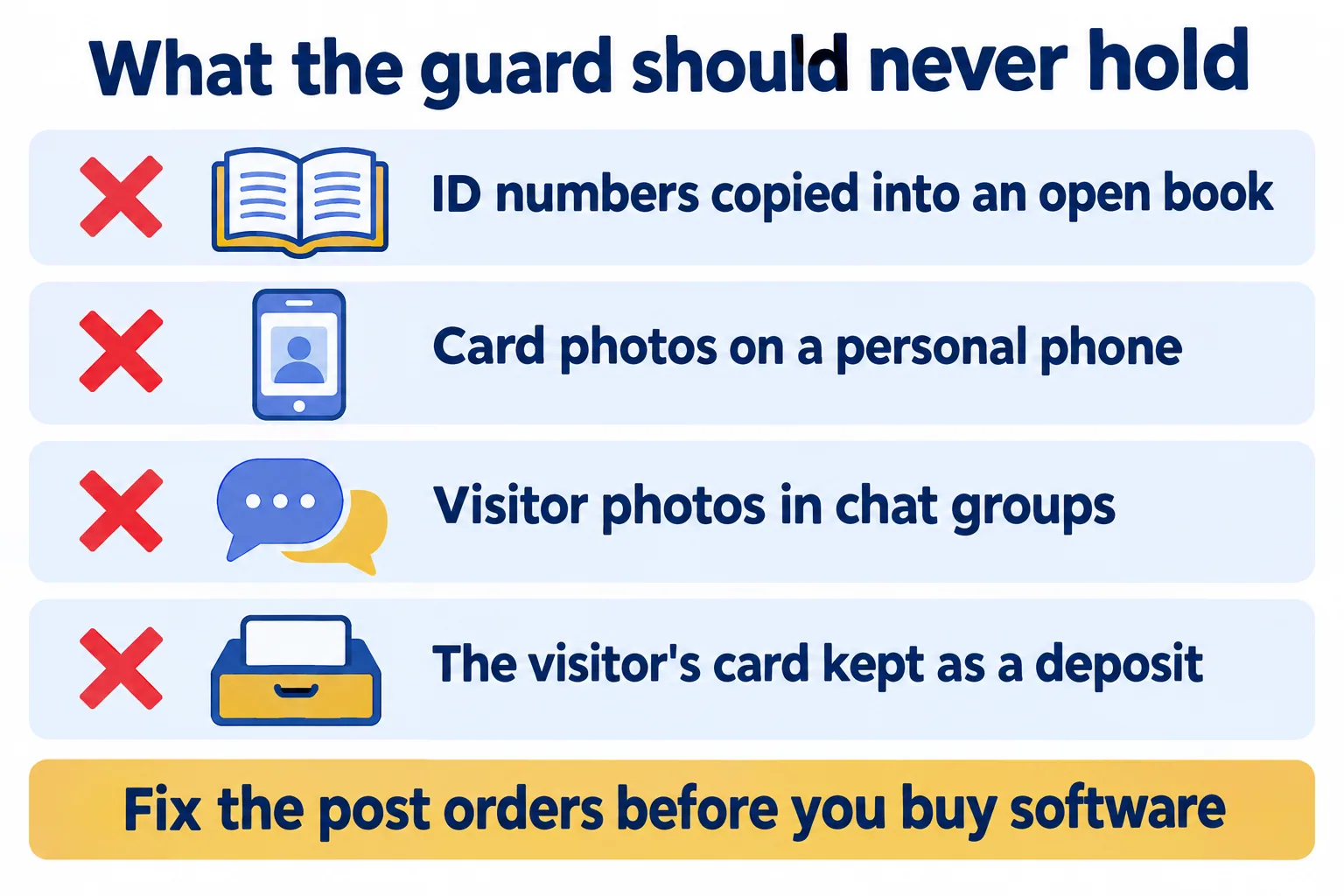
- ID numbers copied into a book left open on the counter.
- Photos of ID cards on the guard's personal phone.
- Visitor photos shared in chat groups.
- The visitor's ID card kept as a deposit for the pass.
The fourth is a rule question, and our post on the visitor log book quotes the UAE Government portal on holding a visitor's card. In Dubai, private guards are licensed by the Security Industry Regulatory Agency (SIRA). Its implementing bylaw, Resolution No. (1) of 2026, says an individual security service provider must "maintain the confidentiality of any information to which he may have access in the course of performing his duties." That is a duty on the guard. The post orders are how the building helps the guard keep it. Confirm with your adviser how the bylaw applies to your site.
When are a guard and a short book enough?
When one door has one receptionist who knows every visitor, the guard's checks and a short book cover the job. Keep the book to the name, company, host, time in and time out. No ID numbers, no phone numbers. Name the person who locks the old books and shreds them.
Once you run a tower, contractors use the service lift, or a tenant has asked who was inside on a given day, the book stops answering the questions you get.
The page test we run on the lobby book
Before we suggest any software, we ask the building manager for ten minutes with the lobby book:
- Open it at a random page.
- Count the full ID numbers on that page.
- Count the lines that have a time out.
- Ask the guard where last year's book is.
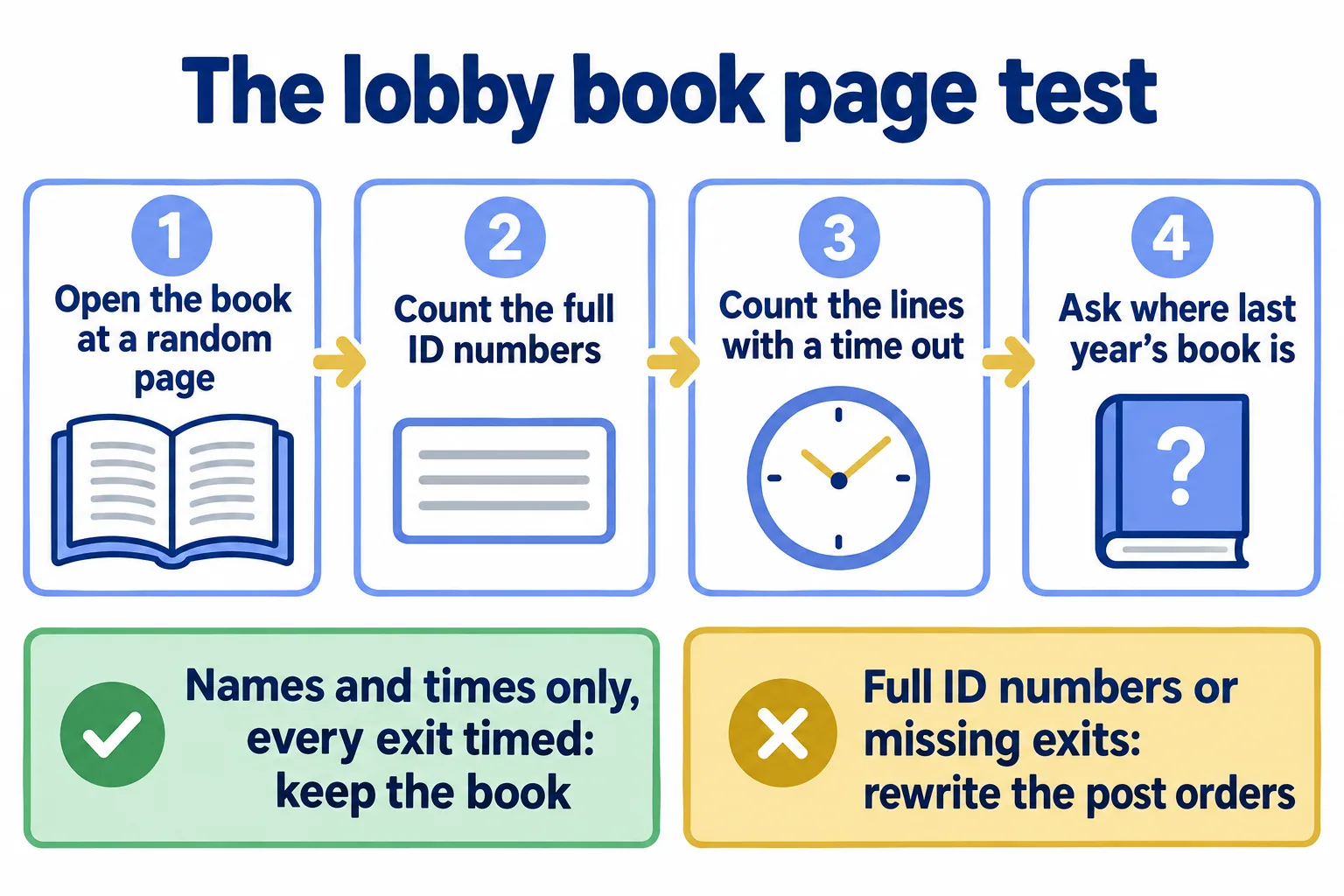
Names and times only, every exit timed, and a named place for old books: keep the book. Repeat the test once a week on a night-shift page, so the check covers the shifts you never see. Full ID numbers, missing exits, or "the guard would know": the post orders need rewriting first. Software bought before the orders change only moves the same habits onto a screen.
Six lines to add to the post orders
When the guards come from a contracted security company, the post orders are agreed between that company and the building or facilities manager. These six lines are what we ask managers to add:
- Check the face against the card and the pass, then hand the card back.
- Write the name, company and host. Do not write the ID number.
- No approval from the host, no entry. Verbal lists from tenants do not count.
- No photos of ID cards or visitors on personal phones.
- Record every exit and every refusal, with the time.
- At shift change, close every open entry or hand it over by name.
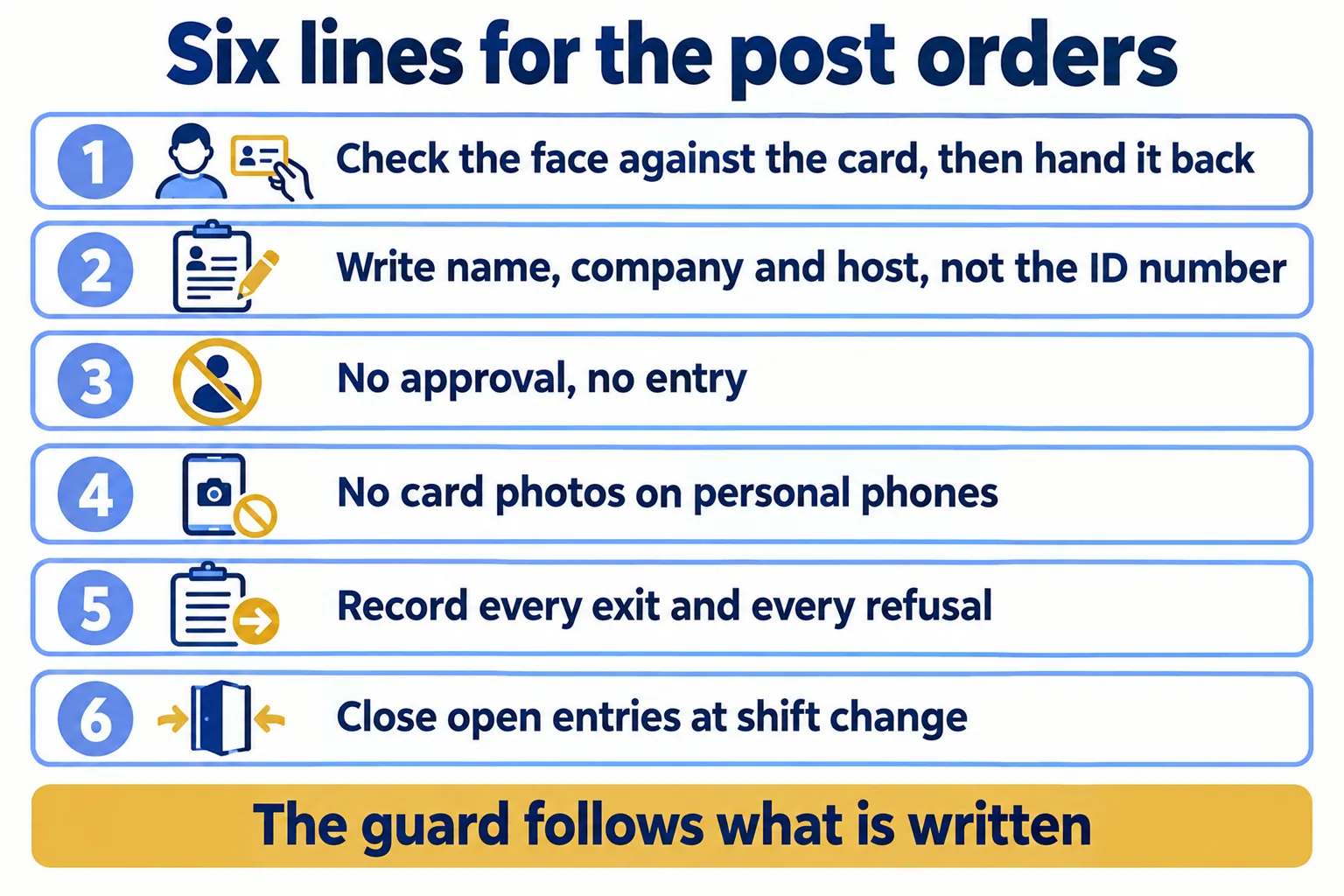
Brief them at each shift handover, in the language the guards read first. Line 2 is the one that changes the book on day one. If your site does need contractor ID numbers, keep them with the contractor approval the building manager already holds, not in the lobby book. If a line is hard for the guard to follow without a system, that is the point where a system earns its place.
What Mindcat Lobby does at the gate, and what it does not
Mindcat Lobby takes the record side of the split. The guard scans the back of the Emirates ID or passport and the pass fills itself, so nobody copies a number by hand. At the gate the guard scans the pass QR and takes a live photo. The screen shows it beside the ID and the pass photo; the guard ticks both matches and checks the declared items, and the gate and the officer go on the record. A gate record is not edited afterwards.
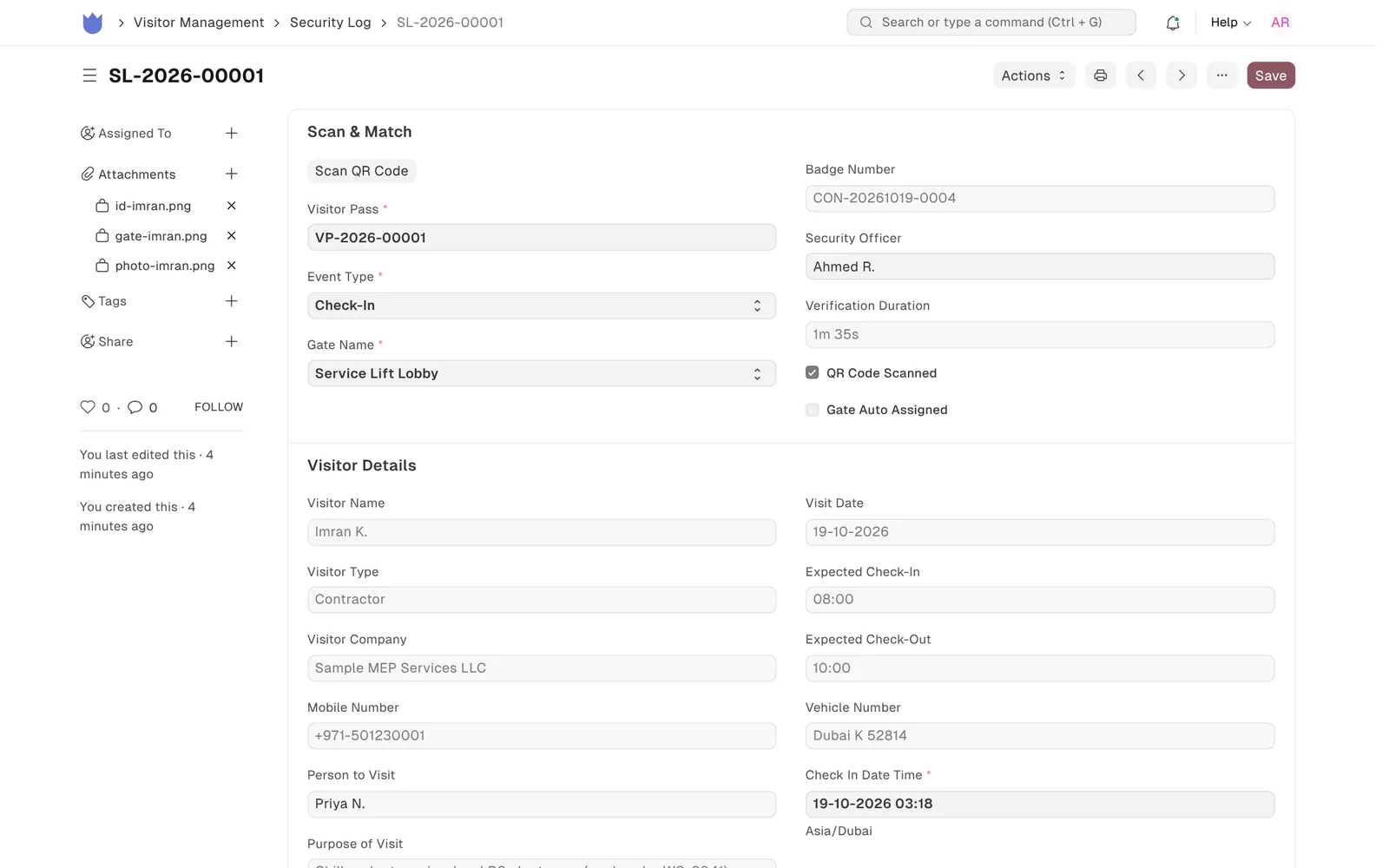
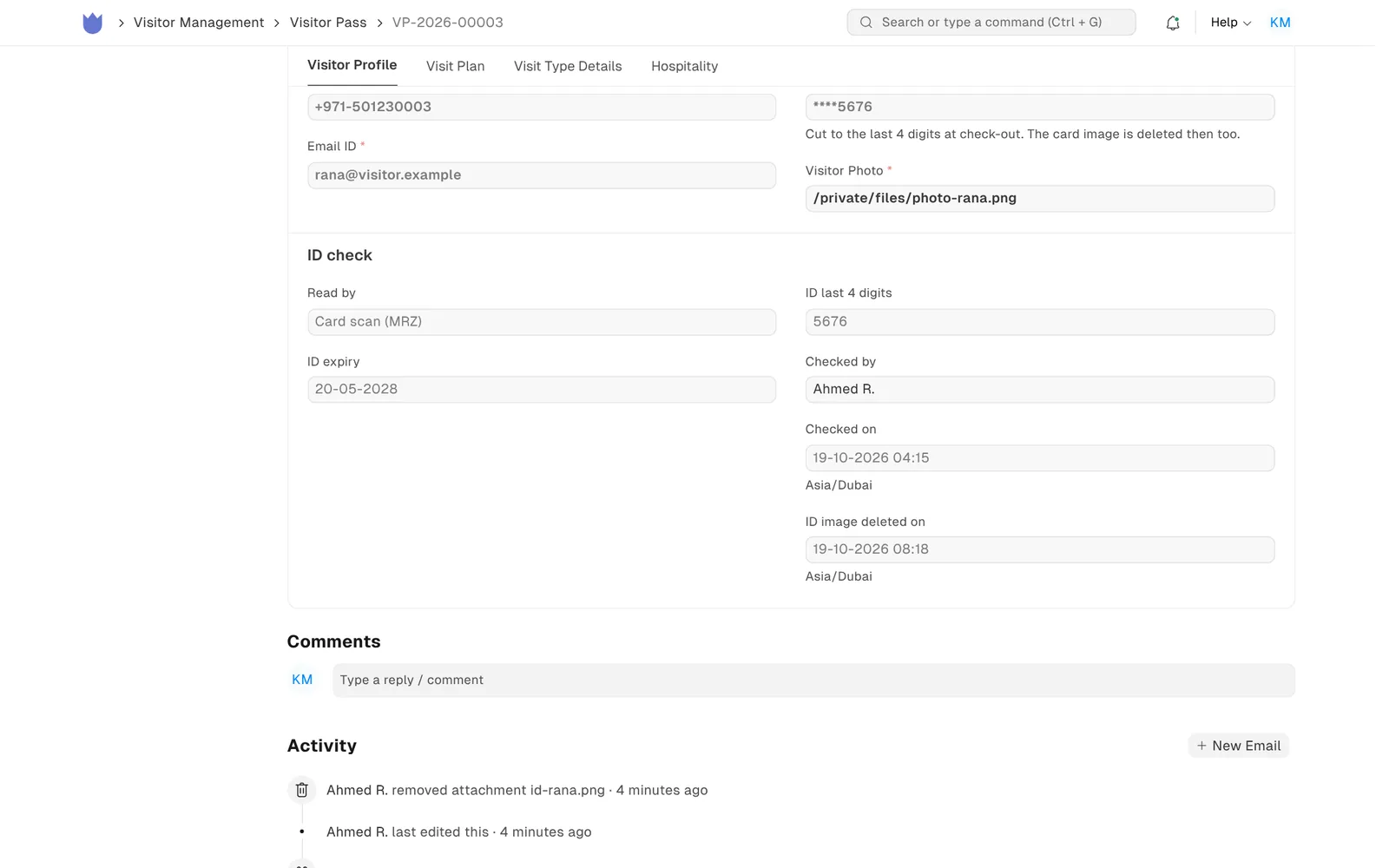
When the visitor checks out, the card image is deleted and the number is kept as its last 4 digits, with who checked it and when. A site can choose to keep images for a set number of days instead. The Today list shows who is Inside, who Left, who is Expected and who is waiting To approve, and a watchlist blocks or warns on a listed ID at check-in.
If your guards type the number today because the card will not scan, our post on reading the Emirates ID sets out the reader, camera and typing options.
What it does not do: we don't supply or manage guards, and Lobby has no patrol tour, checkpoint or incident-report module. The pass does not open doors or turnstiles. There is no self check-in kiosk; guards and receptionists check visitors in. Reading the Emirates ID chip is on request, subject to approval, and not part of the app today. Iqama, Saudi national ID and other GCC IDs are added during setup. Screens are partly in Arabic, and pass labels print in English.
What would it cost?
Lobby is priced per site a month: AED/SAR 1,490 for each of sites 1 to 3, with a minimum of AED/SAR 3,790 a month for your own copy hosted by us in the UAE or Saudi Arabia. One tower pays the minimum. Setup for one site is AED/SAR 7,900 once. Guards, receptionists, hosts and managers log in free, and there are no per-visitor or per-scan fees. Cameras, tablets and printers are yours. Prices exclude VAT; the full bands are on the Lobby page, and towers run by one manager are covered on our property management page.
This is not for a site with no guard or receptionist at the desk: there is nobody to make the checks.
We call our method Scan, check, delete: the card scanned at the counter, the face checked against the pass, and the card image deleted at check-out. Tell us how many towers or sites you run, their gates and how visitors get in today. We reply with the setup plan and the monthly price per site, in AED or SAR. Tell us about your towers.
