

If your tower's service entrance runs on a paper gate pass and a guard's memory, and the community's portal only covers the community gate, this is for you. It is not for a building whose community portal already issues and checks every pass at your own door.
Who checks a contractor at a Dubai tower?
Two different people, at two different doors.
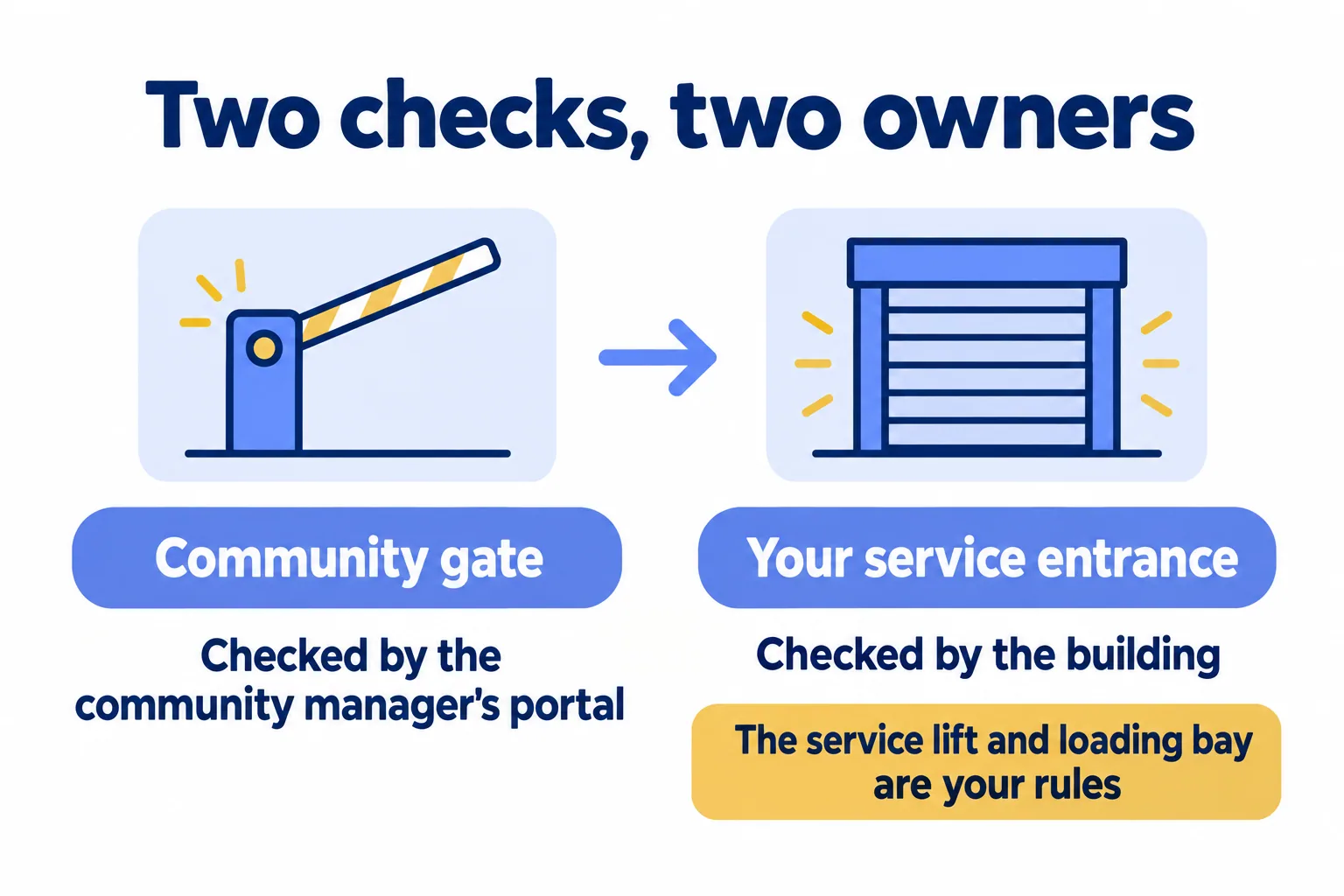
Altix, a smart-lock seller, puts the split plainly in its September 2026 guide to Dubai communities: "The gate is the community manager's." Then: "The door is yours." In an Emaar community, it says, "since 1 July 2021 only contractors holding a digital permit get in". Damac communities issue a QR pass through the Damac Living app that is scanned at the barrier. Nakheel runs its own access permits.
So a contractor working in your tower may pass two checks. The first is the community's, at the barrier. The second is the building's, at the loading bay or the service lift lobby. The second one is where paper usually survives.
What does the community portal already cover?
More than many building managers assume, and less than they hope.
Dubai Holding Community Management's FAQ says general visitors, standard deliveries and routine service providers such as cleaners, pest control and AC technicians do not need a permit. Each must still be "registered in VMS before access is granted", and visitors present valid identification. Emergency contractors need no permit either, but they too are registered in its visitor system.
The portals also set the pace of a job. A contractor, Benstead, quotes Nakheel's guidance as three to four working days ahead for a long-term access request, with approval typically taking one to two days, and passes issued "against named individuals and specific vehicles". Altix says an Emaar long-term permit needs the resident to approve it on the portal: "If you ignore the email, the permit doesn't issue."
What none of that covers is your service lift. Corvana, a renovation firm, looked through the published rulebooks and found that "None of the published Dubai rulebooks, Emaar's, Dubai Holding's or Nshama's, sets a service-lift booking rule." The lift, the loading bay slot and who walks the crew up are the building's rules. If the building writes them anywhere, it is on its own pass.
Where does a paper gate pass still sit?
At the door the community does not watch. Usually that is the loading bay, the service lift lobby, or a back gate the guard opens for deliveries.
The paper book does one job well: it shows a name was written down. It does badly at everything a manager asks later. Platinum Guard Force, a Dubai security firm, describes the gap: "A delivery rider is waved through at 6:40 pm because the guard recognizes the jacket, not the person. There is no name, no unit number and no record."
Residents feel the other side. A Damac Hills tenant wrote on a complaints site in May 2026 that their movers were stopped at the gate, and "Only after the moving company had already arrived did the security suddenly inform me that the owner himself needed to send the email request." When the rule lives in a guard's head, the crew finds it out on the day.
Moves are the biggest service-entrance traffic in a residential tower, and the permit usually sits with the community. Dubai Holding's FAQ, for one, asks for a move permit through its Community App at least 48 hours ahead. The building still decides the service lift slot and who walks the movers up.
On our Lobby page we describe the usual result on multi-site contracts: each guard post keeps its own book and sends a weekly photo of it on WhatsApp, "so the question about last Tuesday takes a day".
Which pass does your service entrance need?
Here is how we decide.
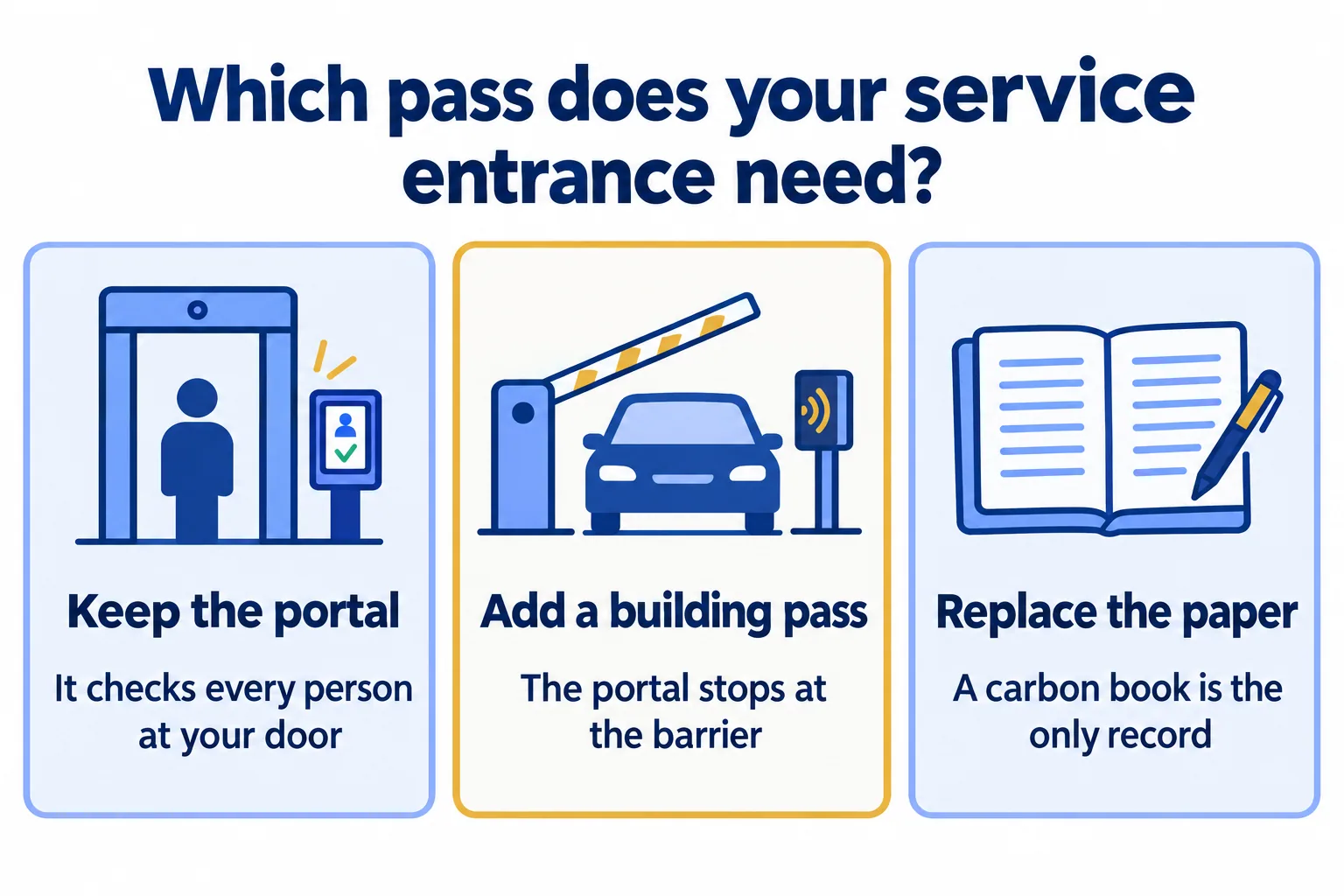
Keep the portal alone when the community's or developer's portal issues a pass for every person who uses your service entrance, and a guard checks that pass at your own door as well as at the barrier. Ask the community manager for the week's list of who came to your building. If they can send it, you do not need a second pass. Adding one only doubles the guard's work.
Add a building pass when the portal stops at the barrier. The crew is approved to enter the community, but at your loading bay the guard writes them in a book, phones the unit, and has no idea which job they came for. Here the building's own pass is where your rules live: the service lift slot, the gate for each kind of visitor, the tools going up and coming down. Agree first who signs off a pass: the owners' association, the management company or the FM contractor.
Replace the paper when the carbon book is the only record at all, which is common in standalone towers outside a gated community. A pass tied to the job, checked at the gate and closed at check-out gives the manager a list at the end of the week instead of a stack of pages.
Before we recommend anything, we run one test. It needs one call to the guard post.
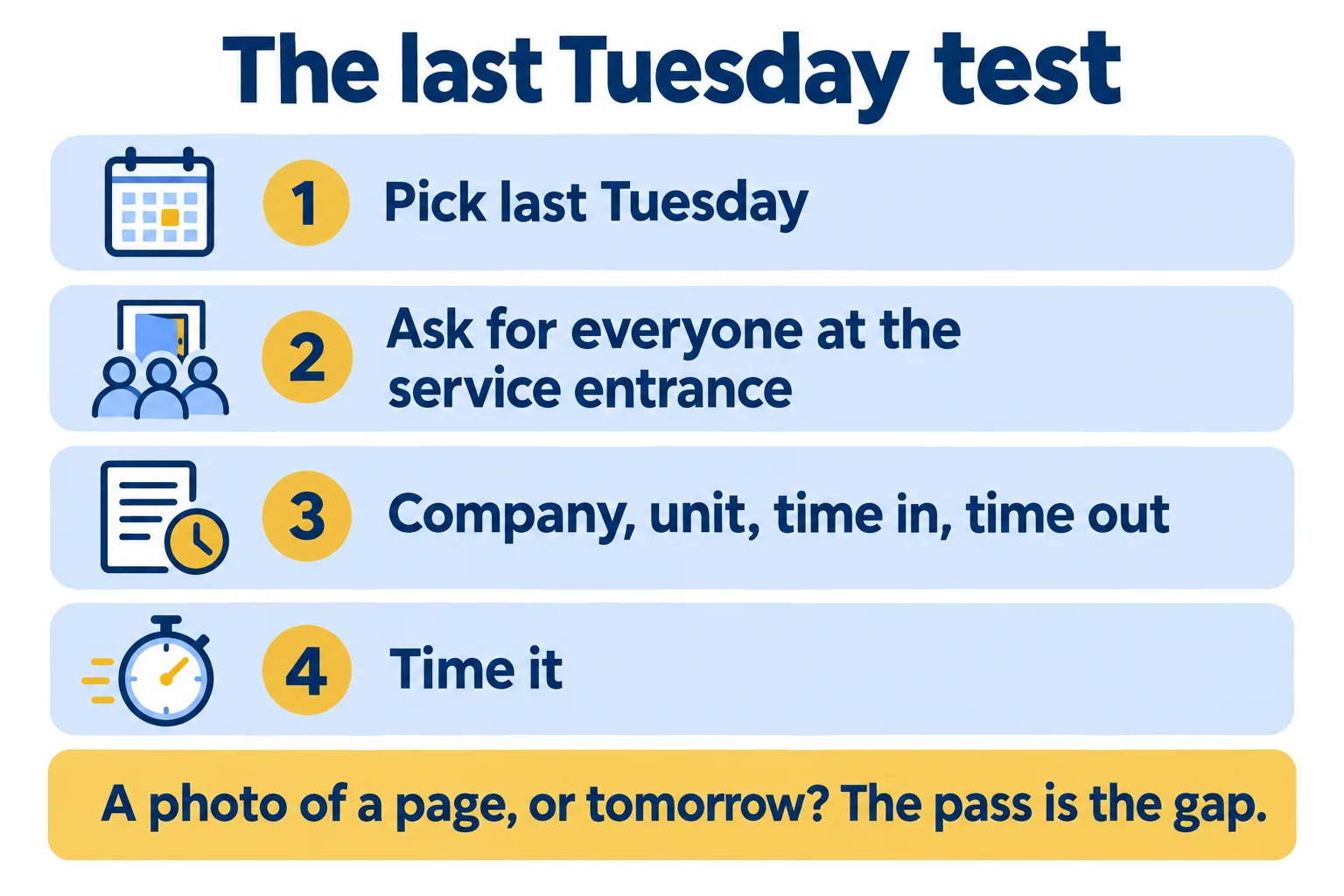
- 01Pick last Tuesday, an ordinary working day.
- 02Ask the guard post for everyone who used the service entrance or loading bay that day.
- 03For each person, ask for the company, the unit or job they came for, the time in and the time out.
- 04Time it. If the answer is a photo of a page, missing exit times, or tomorrow, the building's pass is the gap.
If the community portal answers the test for you, stop there. If it answers only for the barrier, you know which door needs work.
What should the building's own pass hold?
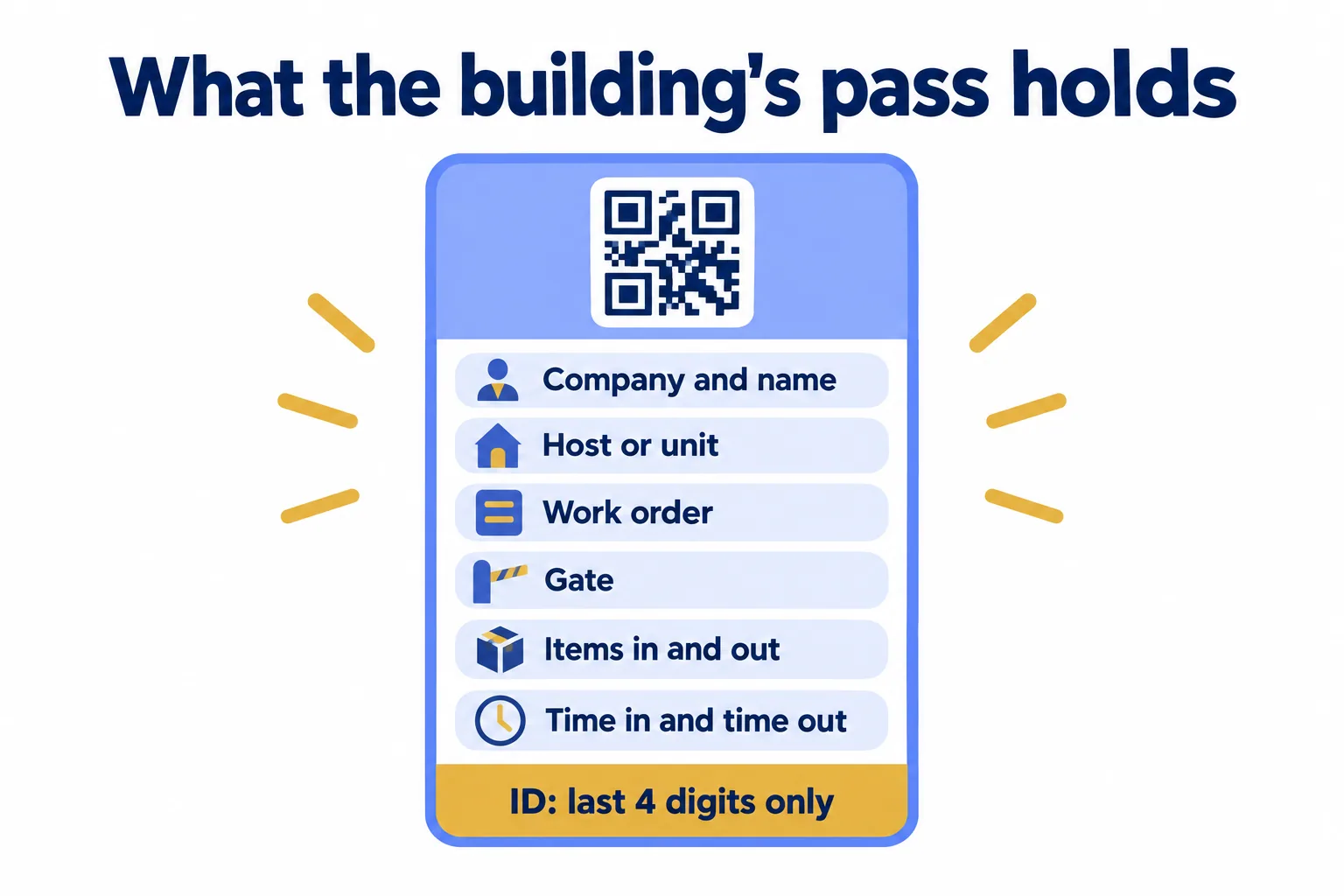
Whatever you use, paper or software, the pass at your service door should carry:
- The company and the person's name, and the host or unit they came for.
- The job: a work order number, or a delivery reference.
- The gate: service lift lobby for contractors, loading bay for suppliers.
- Items declared on the way in and checked on the way out, such as tools or equipment.
- Time in and time out, and the guard who checked each.
- The ID type and the last 4 digits of the number. Not a photocopy of the card, and never the card itself.
Read the card and hand it back. Our post on the visitor log book or a scanned pass sets out the UAE rule on holding a visitor's card and its source. A fit-out crew that is on site for weeks raises a different question, one pass for the job or a new one each morning, which our post on the contractor pass answers.
What does Mindcat Lobby do here, and what does it not do?
Each pass carries the company, host, purpose, the work order and a QR code. You set the gate per visitor type: contractors to the service lift lobby, suppliers to the loading bay. At the gate the guard scans the pass QR, takes a live photo, compares it with the ID, and ticks the declared items. Check-out is the same screen, and a gate record is not edited afterwards. The manager gets the daily visitor log and a count per gate.
The ID is read from a photo of the back of an Emirates ID or a passport's photo page, tested on specimen cards; we test your camera and the cards you see most during setup. At check-out the card image is deleted and the number kept as its last 4 digits.
What it does not do: it does not replace the community's or developer's permit, and it does not read the Emirates ID chip or sign people in with UAE PASS. Both are on request, subject to approval from the issuing authority, and neither is part of the app today. Invitations go by email, not WhatsApp. There is no self check-in kiosk, and we do not sell or connect turnstiles or barriers.
The work order itself lives in Mindcat Maintain: Maintain holds the job a contractor comes for, Lobby holds the pass at the door. For managers of several buildings, our facilities management page shows the same pass rules across every site.
What would it cost?
Here is what the Lobby page says today. You pay per site a month, and a tower with a lobby and a loading bay is one site. Sites 1 to 3 are AED/SAR 1,490 each, sites 4 to 10 are 1,190, and the price falls to 890 above 30 sites. Logins for guards, receptionists, hosts and managers are free.
Every client gets its own copy. Hosted by us in the UAE or Saudi Arabia, the monthly minimum is AED/SAR 3,790, so one tower pays 3,790, not 1,490. Three towers pay AED 4,470 a month. One-time setup for one site is AED/SAR 7,900, and 14,900 for 2 to 5 sites. Cameras, tablets and badge printers are not in the price. Prices exclude 5 percent UAE VAT and 15 percent Saudi VAT. See the full price list.
Tell us how many towers or sites you run, their gates and how visitors get in today. We reply with the setup plan and the monthly price per site, in AED or SAR.
