

If you were told to keep every company paper for years and the only index is the person who filed them, this is for you. It is not for an office with a few folders and one person who uses them, or for a team that needs approval steps and retention rules enforced by software.
How long do UAE companies keep their papers?
Longer than most offices think, and the periods stack.
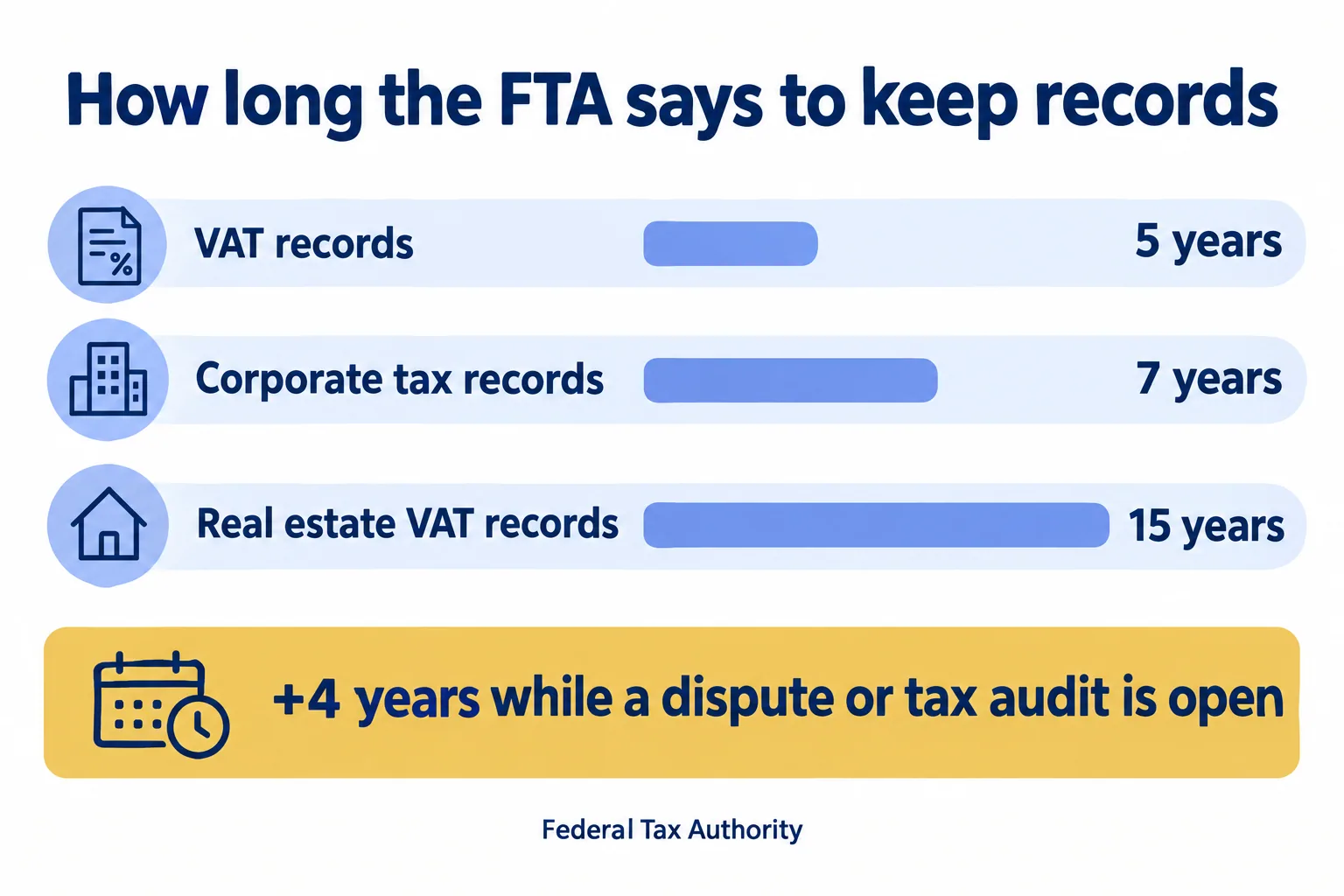
The Federal Tax Authority's VAT guide says VAT records "must be kept for a minimum of 5 years after the end of the tax period", and records relating to real estate "for a period of 15 years". Its corporate tax FAQ says records "should be kept for at least seven years following the end of the relevant Tax Period".
Then the clock can stop running out. Cabinet Decision No. 74 of 2023, Article 3, adds 4 more years while a dispute with the FTA is open or a tax audit is under way, and 1 more year after a voluntary disclosure made in the fifth year.
So "five years and then shred" is the wrong rule for most companies. Plan on seven years or more, and on finding any one paper inside that time.
The papers in question are wide, too. Article 2 of the same decision lists the books, and then "correspondence, invoices, licences and contracts related to the Business". That is most of what sits in the store room.
Does the law say where you keep them?
No. It says how long, and that you can produce the record when asked.
Article 3 says records are kept "in a way that enables the Authority" to verify your tax. Article 4 says you can meet the duty in two ways: keep the originals, or keep the information in photocopy or electronic form. The copy has to be identical to the original and available for the whole period, and "an easily readable copy" has to be produced when the FTA asks.
A box in a store room meets that. So does a system. The law leaves the choice to you, which is why the real question is a working one: how often do people need these papers, and what happens when they cannot find one?
When are box files and an index enough?
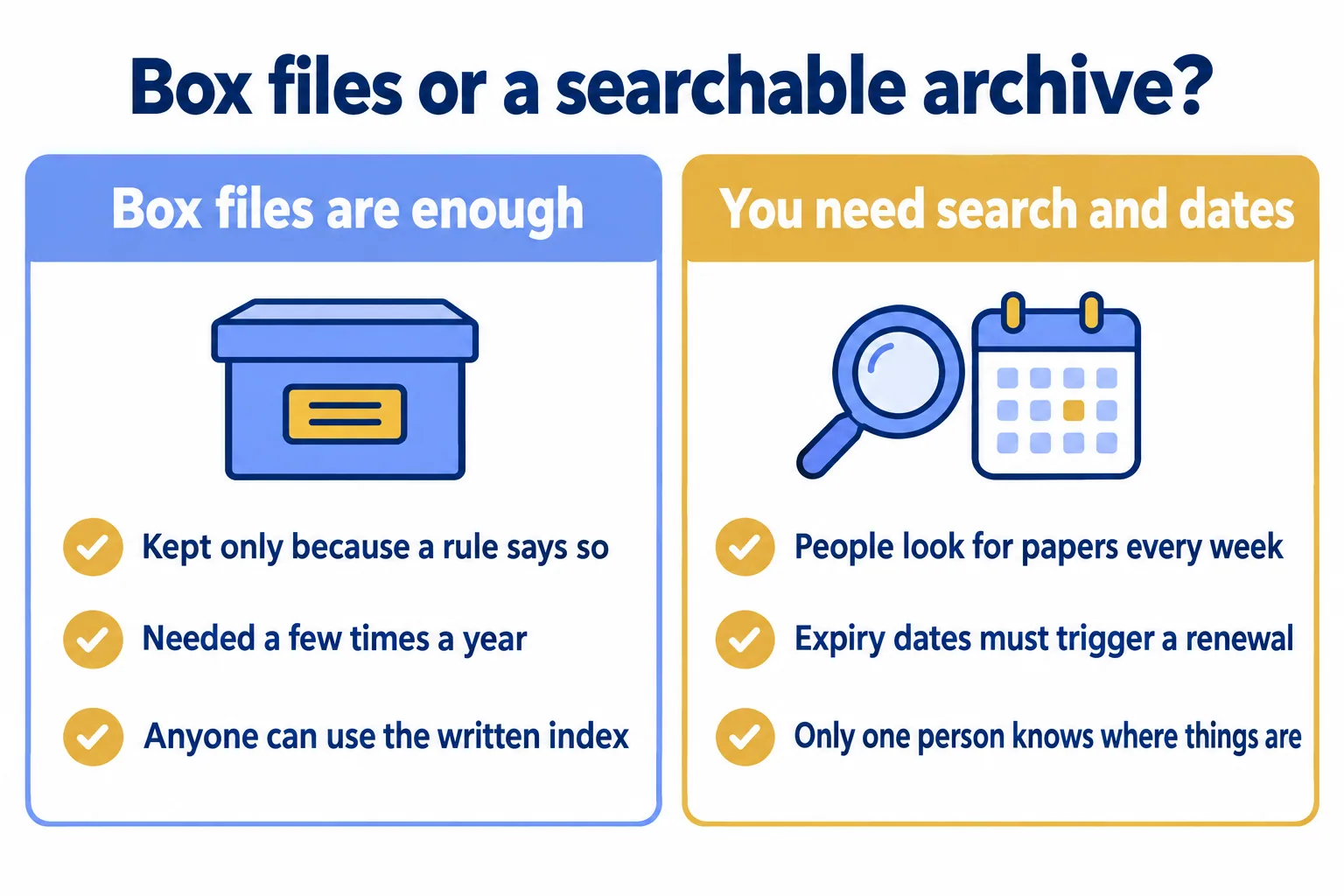
Keep the box when all four of these are true:
- The papers are kept only because a rule says so. Old invoices, closed years, finished contracts.
- Nobody needs a given paper more than a few times a year.
- No date on the paper has to trigger anyone. Nothing in the box expires and needs renewing.
- The index is written down, and someone other than the person who filed the papers can use it.
That last point is the one that fails quietly. Back Office FZLLC, a Dubai records company, puts the fix simply: build a list of what is inside every box, so people "check the list first to see which box holds the file". Number the boxes, write the year and the type on each, keep the list in one shared file, and you have a working archive for very little money.
A software archive for papers nobody opens is money spent on the wrong problem.
When does the archive need search and dates?
Move to a searchable archive when any one of these is true:
- People look for papers every week. A bank wants last year's contract today, an auditor wants three invoices, a client wants a copy of their licence.
- A date on a paper has to trigger someone: a trade licence, an Emirates ID, a tenancy contract, a power of attorney. A box cannot remind you.
- The person who knows where things are is about to leave, or goes home on leave for a month.
- The same paper exists in three places and nobody is sure which copy is current.
SKIMBOX, a UAE systems firm, describes the usual answer to "where is that signed contract?" as "a chain of guesses. Someone emailed it. It might be on the shared drive. The original went to the accountant, unless it is in the cabinet behind reception."
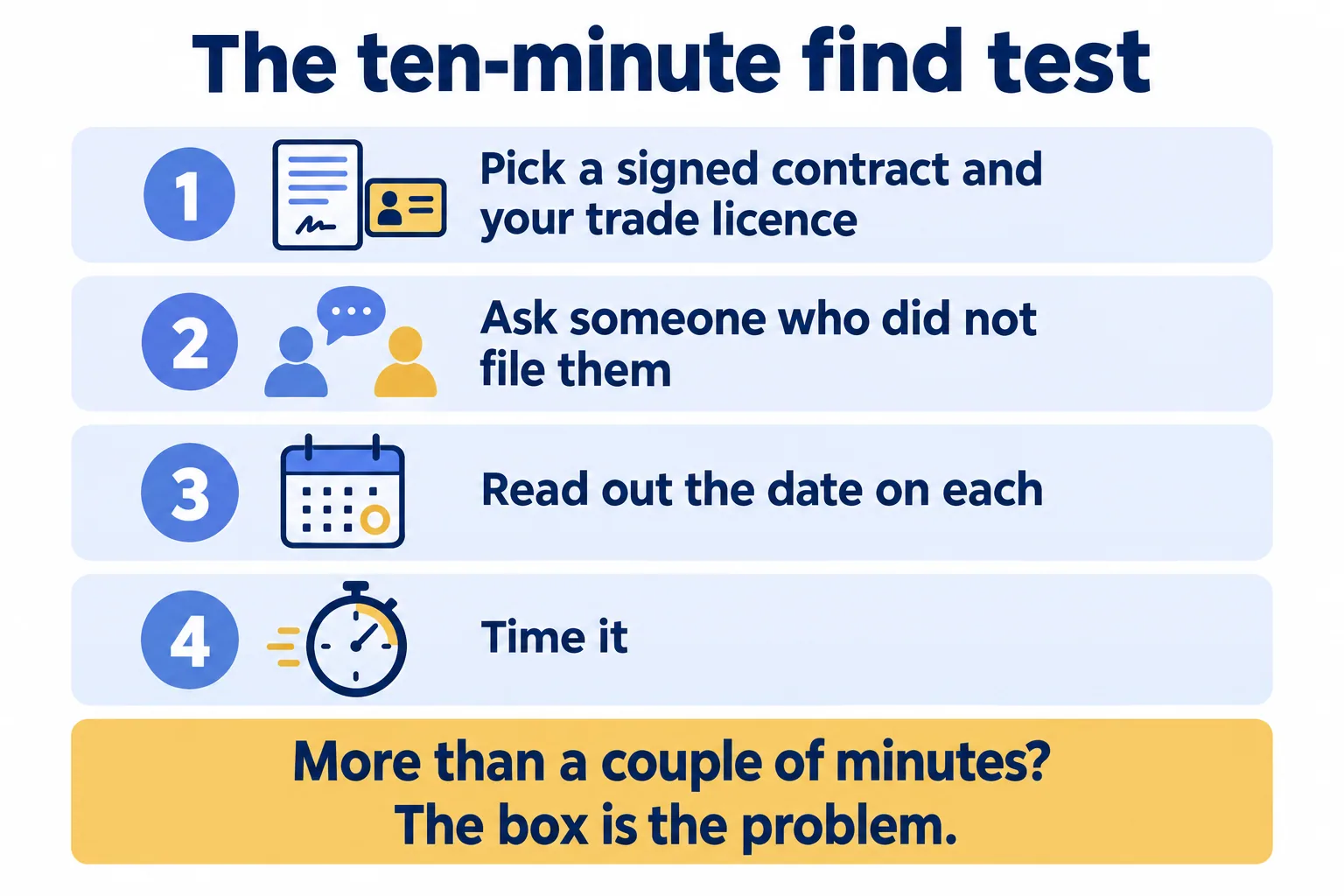
Here is the test we run before we recommend anything. It takes ten minutes.
- 01Pick two papers: one signed contract from last year, and your current trade licence.
- 02Ask someone who did not file them to find each one. Not the PRO, not the office manager who set up the boxes.
- 03Ask them to read out the date that matters on each: the contract's end date, the licence's expiry date.
- 04Time it. If either takes more than a couple of minutes, or nobody can say whether it is the current copy, the box is the problem.
SKIMBOX uses a stricter bar, "under a minute", and adds: "Most owners assume yes. Watch someone try it and it usually is not."
What about the shared drive and a spreadsheet of expiry dates? That middle option works while one person owns the spreadsheet, every paper has one folder, and nobody needs to search inside a scan. It breaks when the same paper sits in three folders, the person who updates the dates goes on leave, or the paper you need is an Arabic scan that the drive cannot read.
Weigh the box honestly, too. It costs shelf space or off-site storage, and the hours people spend looking. If the test passes and the store room is not needed for anything else, the box is the cheaper answer.
Can a scan replace the paper?
For tax records, the FTA text allows it, on its conditions: identical to the original, kept for the whole period, and a readable copy on request. A blurry phone photo of page one of five does not meet that. A complete, legible scan with every page does.
For everything else, such as a contract you may need in court or a title deed, the answer depends on the document and who asks for it. Ask your lawyer before you let an original go. Our own page says the same: Vault keeps the scan, its date and its history, and the paper original stays with you.
So scanning is not really the decision. The decision is whether a scan will be complete, readable and findable for seven years or more.
What goes in first?
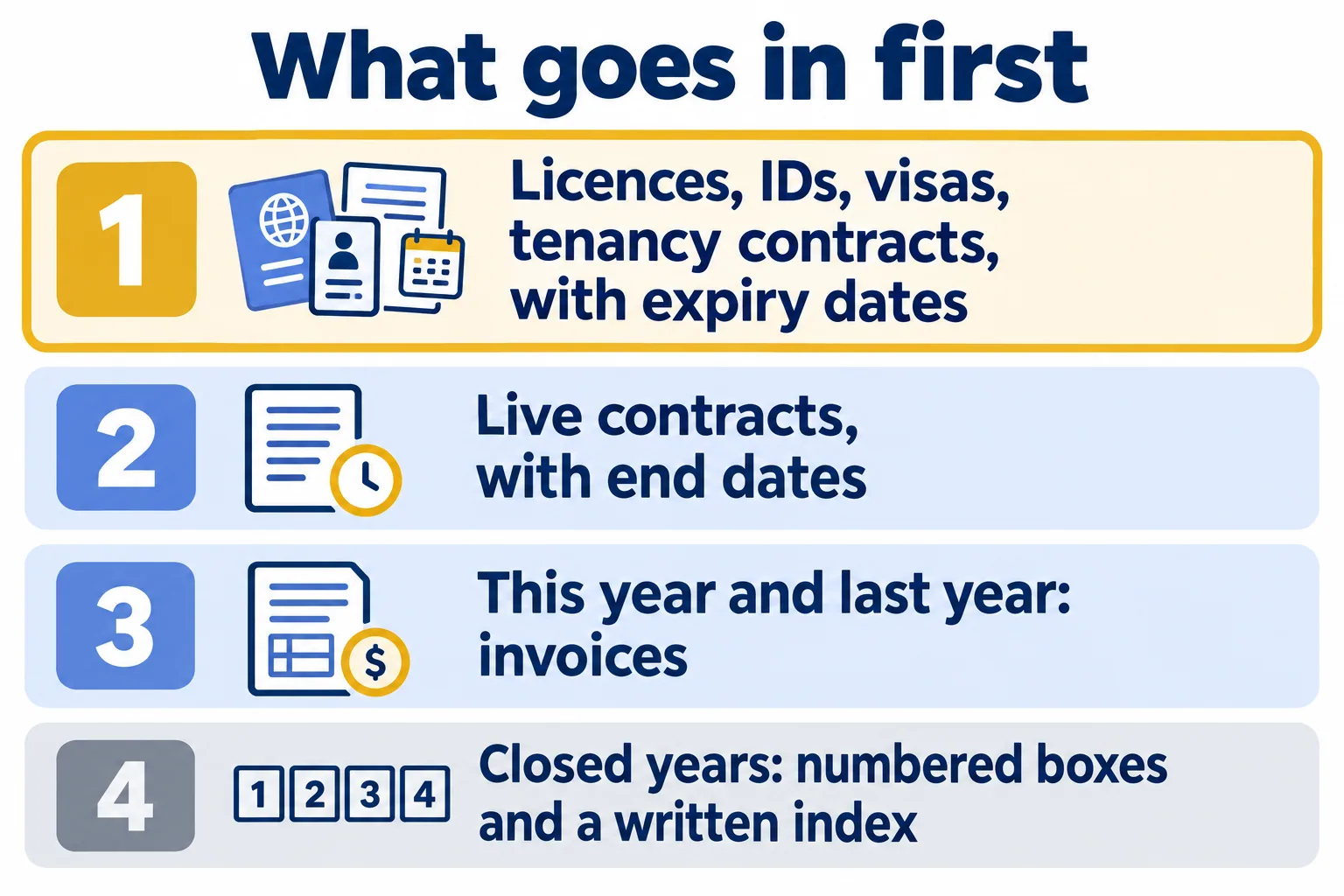
Not the whole store room. Start with the papers people look for and the papers with dates:
- Current trade licences, IDs, visas, tenancy contracts and powers of attorney, each with its expiry date.
- Live contracts with clients and suppliers, with their end dates.
- This year's and last year's invoices, which auditors and banks ask for most.
Before anything is scanned, take out staples and clips, and put each paper in a folder named for its client or type. Whoever does the scanning, your own staff or a records company, works faster from labelled folders, and the index is right the first time.
The closed years can stay in numbered boxes with a written index until someone asks for them. Our post on reading Arabic text from scans covers what to test before you scan Arabic papers at volume. If the hard problem is drawing revisions and transmittals, that is document control, a different job, covered in our post on drawings and dates.
What does Mindcat Vault do here, and what does it not do?
Vault keeps the original file and a searchable PDF copy for as long as you keep them, with who added or changed what. Each paper gets a client, a type, labels and your own fields, such as the expiry date. A saved list shows everything expiring in the next 90 days, and a rule emails your desk 30 days before each date. You choose which people or groups can open each paper.
Two things are switched on during setup, not on day one: Arabic text reading on scans, and the reminder email, which goes out once we connect your mail. Clean scans read well; faint or skewed ones get some words wrong, so we test your own papers in setup. The screens are partly in Arabic today.
What it does not do: it does not decide what the law requires you to keep, and it has no automatic retention rule that deletes papers when a period ends. It has no client portal and no approval workflow. It reads and files what your team scans; it does not sort a backlog on its own.
If the paper still needs signing, that is Mindcat Sign. Vault files the signed copy and its date. For a PRO or typing centre, it holds every client's licences and IDs on one record each, which our post on trade licence renewal dates walks through.
What would it cost?
Here is what the Vault page says today. You pay per user a month, in bands: AED/SAR 59 for users 1 to 5, then AED/SAR 39 for users 6 to 20. A user is anyone who signs in during the month, and there are no per-page fees. The shared option has a minimum of AED/SAR 449 a month, so a 3-person office pays 449, and 15 users pay AED 685.
The quick start, which we set up for you on the shared plan for up to 20 users, is AED/SAR 2,500, fixed. Scanning a paper archive is not in the user price; we quote it separately. Prices exclude 5 percent UAE VAT and 15 percent Saudi VAT. See the full price list.
Tell us how many people need access, what papers you hold and which dates you track. We reply with the setup plan and the monthly price per user, in AED or SAR.
