

If your guards copy Emirates ID numbers into a book nobody locks, this is for you. It is not for one small office that only needs an iPad sign-in: a global plan costs less, and we say so below.
What do the UAE rules say about the card and the book?
Two things, and neither is a ruling on your building.
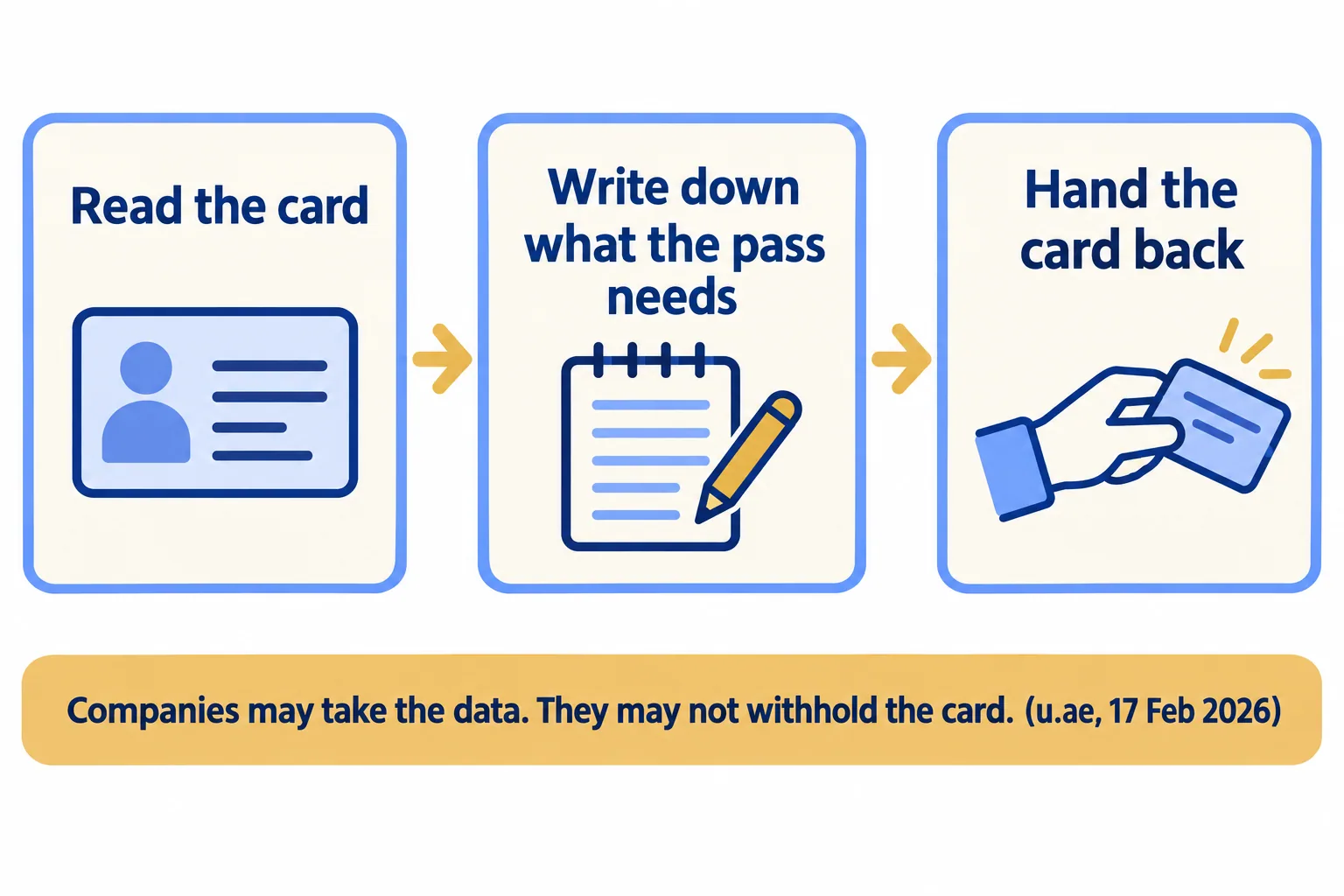
The first is about the card. The UAE Government portal says it is "against the law to seize the Emirates ID card of other people". It adds that companies "are not allowed to withhold the Emirates ID cards of their employees or their customers and visitors", and that they "are allowed to take the personal data on the ID cards." The page was updated on 17 February 2026. So the rule for a gate is: read the card, write down what the pass needs, hand the card back.
Depositing the card at the desk was common enough to make the news. In 2016 a reader told Emirates 24|7: "Every time I go for a meeting in a building on Sheikh Zayed Road or Jumeirah Lakes Towers, I am asked to deposit my Emirates ID and only then I am given a visitor pass." Check your gate rules against the portal's wording.
The second is about the data. Article 5 of Federal Decree-Law No. 45 of 2021 says personal data must be "sufficient and limited to what is necessary" for its purpose, "kept securely", and not kept "after the purpose of its processing has been exhausted", unless the person's identity has been concealed. A paper book holds names and ID numbers for as long as the shelf does. It has no access log, no retention period and no way to blank an old line.
A Dubai data-protection post on LinkedIn in October 2025 put it as a visitor would: "Are their blue log books even stored securely?" and "The security guard left his book open with all this visitor personal data visible." That is one resident's account. It tells you what the question will sound like when a tenant asks it.
When is the paper book enough?
When five things are all true. You run one small building. Few contractors come through, so the book is mostly guests. Nobody asks "who is inside right now" at 6 pm, because nobody needs the answer. The old books are locked up with a named keeper who shreds them after a set period. And tenants do not ask what you keep.
That last point is the one that fails first. Ask where last year's book is. If the answer is a name and a locked cabinet, the book is a working system. If the answer is "the guard would know", it is not.
This week, find the oldest book you still hold, and write down where it is, who can open that place and when it will be shredded. Set the shredding period with your adviser; Article 5 gives no number of days. Then stay on paper, and stay honest about it: write only the name, the company, the host and the times. Do not copy the ID number unless something needs it.
When should a tower move to a scanned pass?
When any one of these is true.
You run towers or several sites, and you have contractor traffic: fit-out crews, AC servicing, suppliers at the loading bay. A contractor needs a pass that names the work, the gate and the hour, and a book gives you a name and a signature.
You need a live list of who is inside. In an occupied tower during Ramadan, fit-out crews work through the night after iftar. By suhoor the book has their check-ins and check-outs only for the ones who remembered.
You cannot say who holds the old books. This is the legal exposure in plain form: ID numbers on paper nobody owns.
You answer to a tenant, an owner or a client who will ask what you keep and for how long. A scanned pass can answer with a setting. A book can answer with a promise.
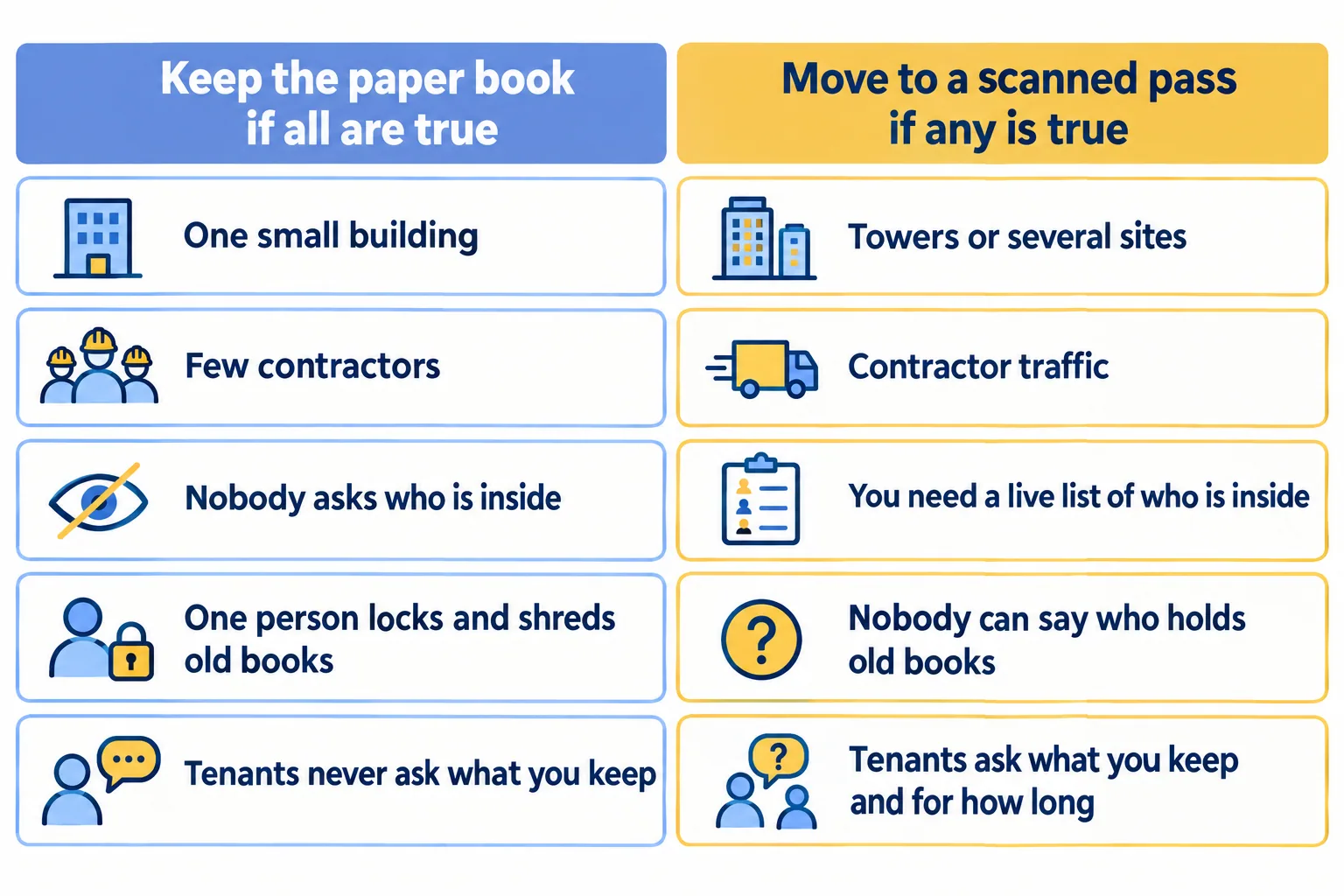
Our rule, so you can argue with it: keep the book when all five conditions above hold. Move to a scanned pass when any one check in this section is a yes. In both cases the card is read and handed back, never held.
What should the new pass keep, and what should it delete?
Keep what the pass needs: name, company, host, gate, times, and who checked the visitor. Delete the picture of the card.
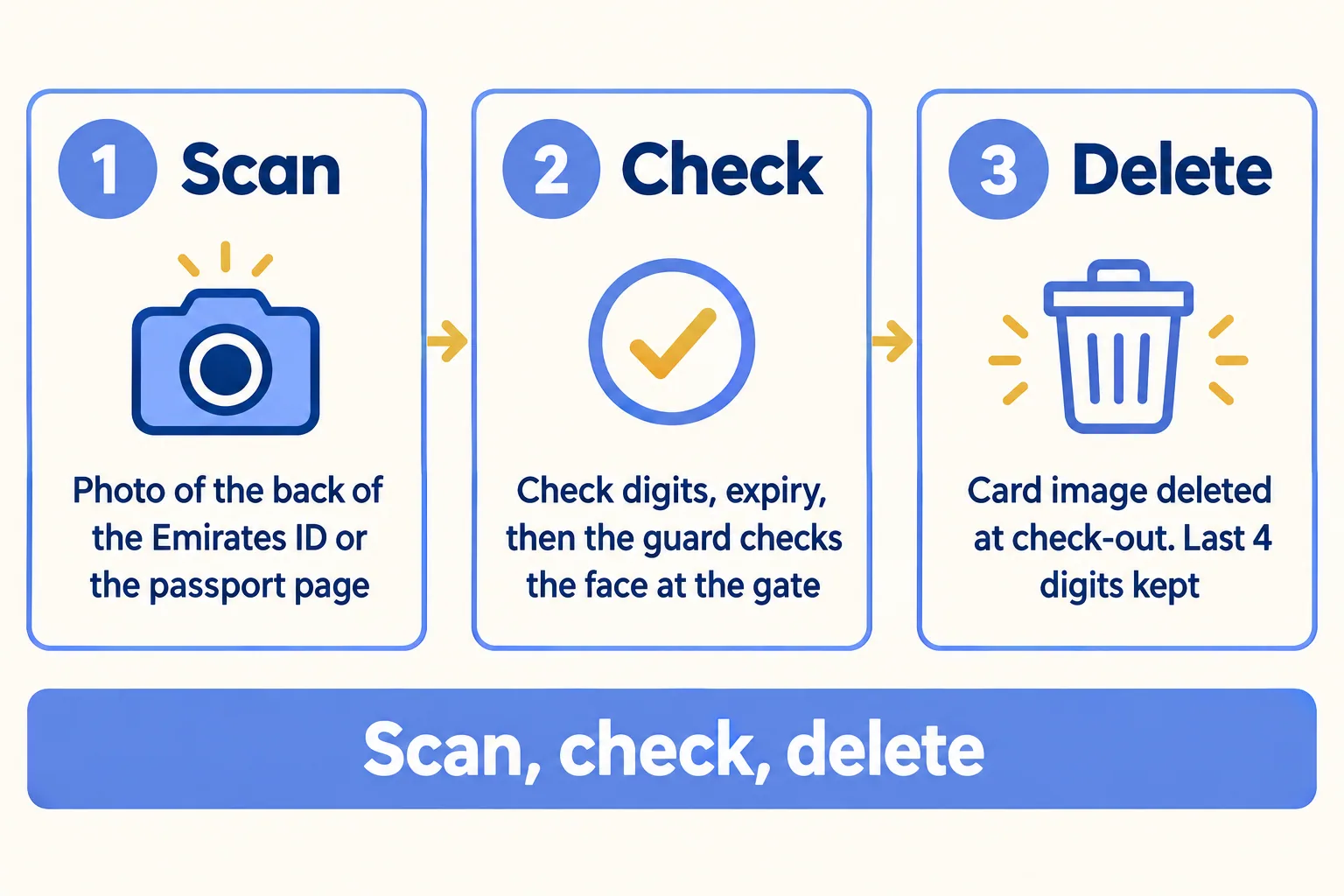
In Lobby the guard photographs the back of an Emirates ID, or a passport's photo page, at the counter. The name, ID type, number, nationality and expiry fill in, the card's own check digits are checked, and an expired card is flagged. We tested the scan on specimen cards, and we test your own cards and camera during setup. If a card will not read, the guard types the number and the app checks its format.
At check-out the card image is deleted and the number is kept as its last 4 digits, with who checked it and when. A site can keep images for a set number of days instead. Anonymising older records after the period you choose is switched on during setup. We call the method Scan, check, delete.
What is not there today: it does not read the chip in the card. Iqama, the Saudi national ID and other GCC IDs are added during setup. The screens switch to Arabic and run right to left, while the visitor pass labels stay in English until setup. There is no self check-in kiosk, no WhatsApp invitation and no turnstile or door-access link.
What does it cost, and when is it too much?
Every client gets a copy of Lobby of its own, in the UAE or Saudi Arabia, or in your own cloud. The price is per site a month: AED 1,490 for sites 1 to 3, AED 1,190 for 4 to 10, AED 990 for 11 to 30 and AED 890 above 30. Logins are free and visitors never need an account. The monthly minimum is AED 3,790 for your own copy hosted by us, so one tower never pays only AED 1,490.
Three towers pay 3 × 1,490 = AED 4,470 a month. Ten pay 3 × 1,490 + 7 × 1,190 = AED 12,800. One-time setup for 2 to 5 sites is AED 14,900. Cameras, tablets and badge printers are not in the price, and there are no per-visitor or per-scan fees. All prices exclude 5 percent UAE VAT.
The global tablet tools cost less than that for three towers. Their price lists are in the comparison table on the Lobby page, checked on 14 October 2026. If you run one small building and only need a sign-in, use one of them. What the extra cost buys is a copy that is yours alone, the card read on a server in the UAE or Saudi Arabia, Gulf ID types, contractor passes with your own gates, and the setup done for you.
Tell us how many towers or sites you run, their gates and how visitors get in today. We reply with the setup plan and the monthly price per site, in AED or SAR. If your book is enough, we say so. For the other side of the gate, our page for facilities management shows how a contractor's pass names the work and the bay.
