

If your branches report a score and nobody can say how many answers it rests on, this is for you. If nobody is named to act on a low score within the week, choose neither question yet and name the owner first.
Which question should a service centre ask?
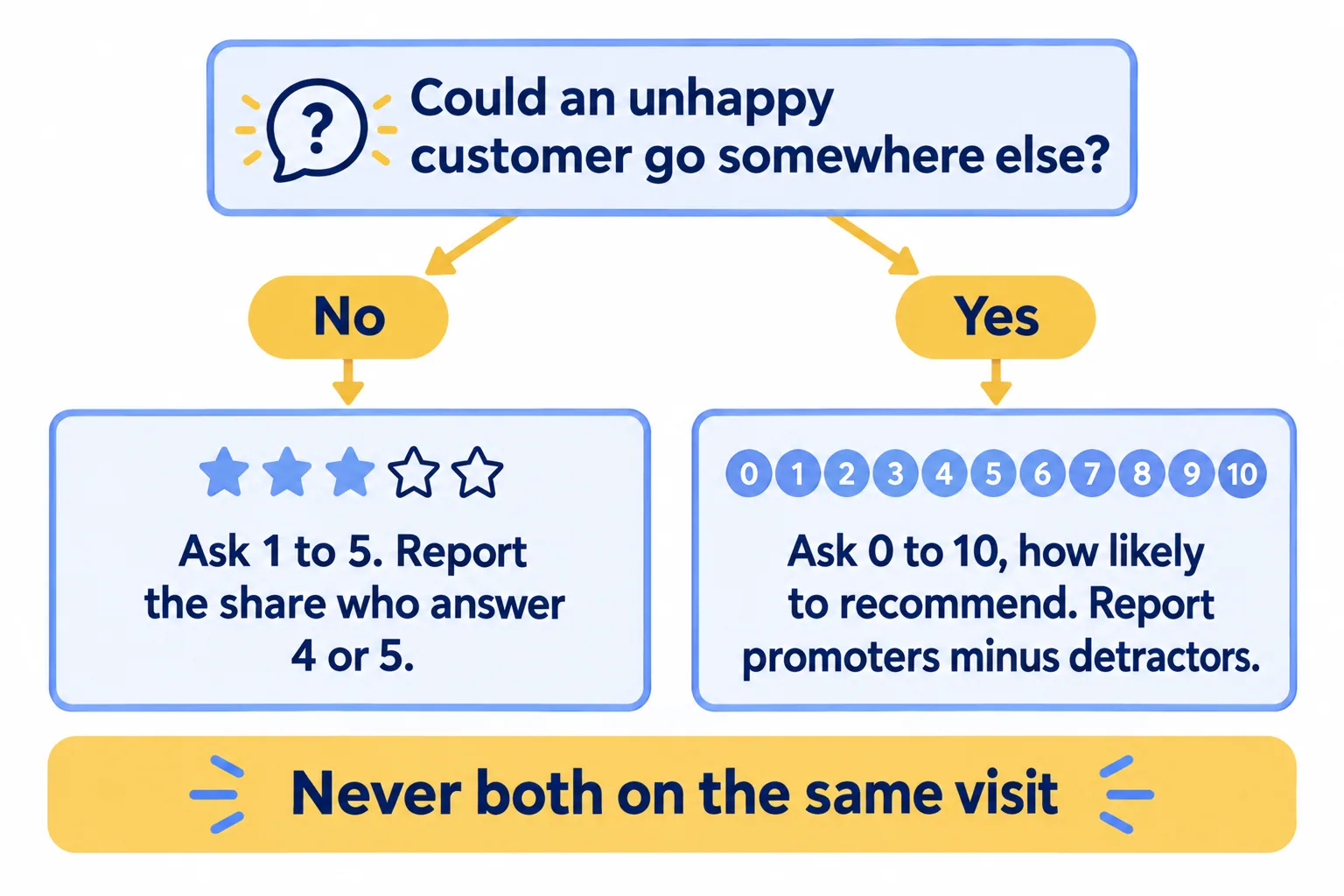
Ask one question, chosen by one test: if a customer was unhappy, would they have somewhere else to go?
If the answer is no, because the centre is the only place to renew a licence or the visit is a transaction at a counter, ask for a rating from 1 to 5 and report the share who answer 4 or 5. This is usually called CSAT.
If the answer is yes, because patients or customers can book with a competitor next week, ask the 0 to 10 "how likely are you to recommend us" question. Report promoters (9 or 10) minus detractors (0 to 6). That is the NPS score, and it runs from -100 to +100. Track it over quarters, not days.
Never put both on the same visit. Two scales on one phone screen produce a tired answer to each, and then two numbers that disagree.
This is our rule, so you can argue with it. In the UAE, the Dubai Happiness Meter asks one question with three faces, not either scale, so it does not settle the choice. The Saudi government guide below takes a side, and it lines up with the rule.
What does the Saudi government guide say?
Saudi Arabia's Ministry of Human Resources and Social Development published a guide to adopting a beneficiary-centred approach. Its experience team wrote it and Adaa, the national centre that measures public bodies' performance, reviewed it. It is version 1.0, dated 5 October 2021.
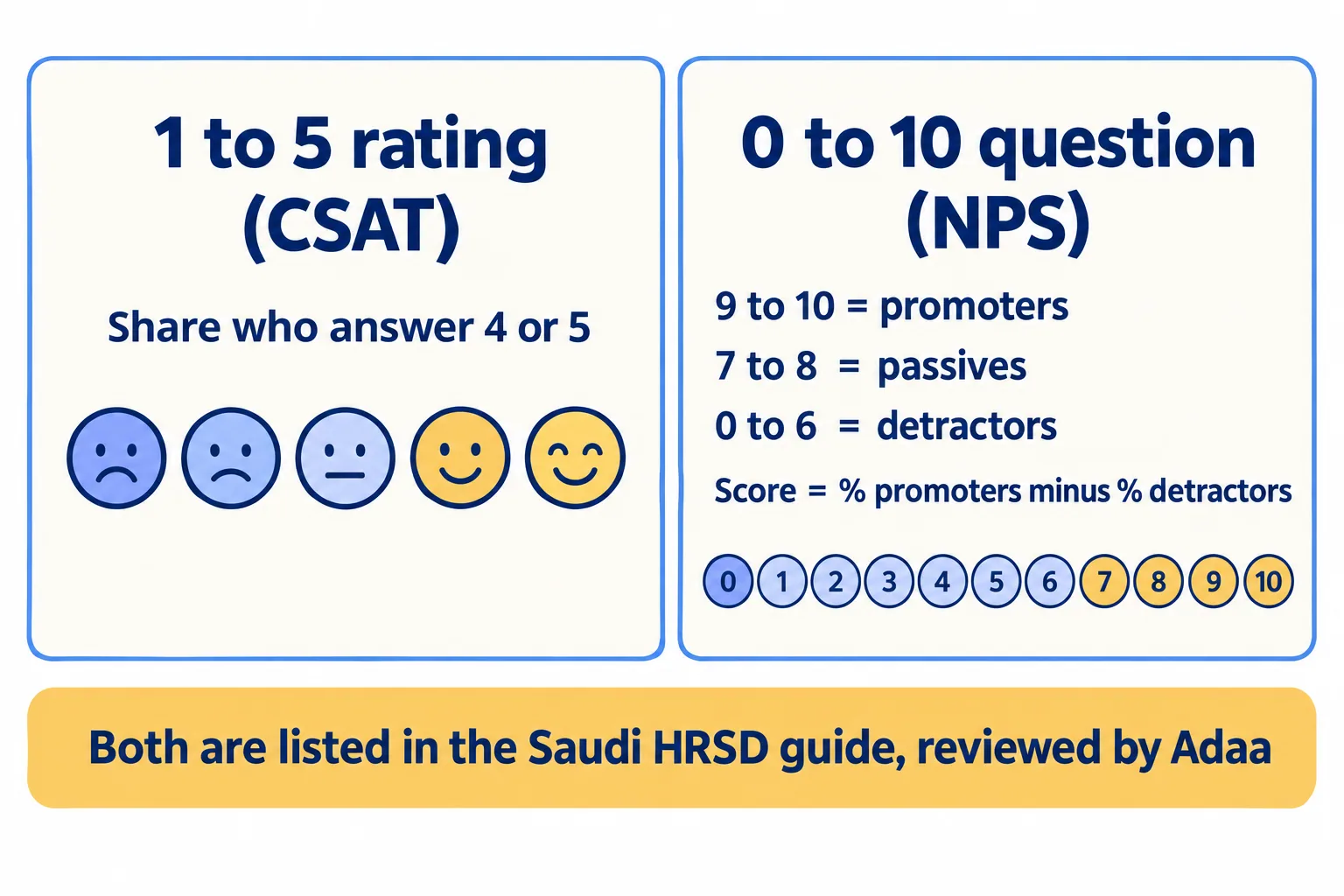
Slide 41 is titled "satisfaction indicators approved by the National Centre for Measuring the Performance of Public Bodies". It lists two. The first is CSAT: "the share of beneficiaries whose experience exceeded the expectations set for a service or a trip through its steps", usually measured on a five-point scale and calculated as the number rating the service 4 or 5 divided by all participants. The second is NPS: 9 to 10 are promoters, 7 to 8 are passives, 0 to 6 are detractors, and the score is the percentage of promoters minus the percentage of detractors.
Then it takes a side. For NPS it says the measure is only slightly suitable for the government sector, because the idea of loyalty does not apply to beneficiaries' dealings with government services. For CSAT it says the measure is the more suitable one for the government sector when measuring satisfaction.
This is guidance for public bodies. It does not bind a private clinic group or a contractor running a centre, and we do not present it as a rule for one. Adaa's own page names surveys as one of three tools, beside mystery beneficiaries and focus groups, and measures at two levels: one visit's path and the whole entity.
The same guide has a rule about counts. On slide 24, under minimum sample, it says results are not analysed at the third level when the sample is under 30 beneficiaries. It also suggests measuring quarterly, half-yearly or yearly. That is a floor for a government measurement, not a comfort level for a branch. The next section shows why.
How many answers does a score need?
More than most branch reports admit, because a score is an estimate.
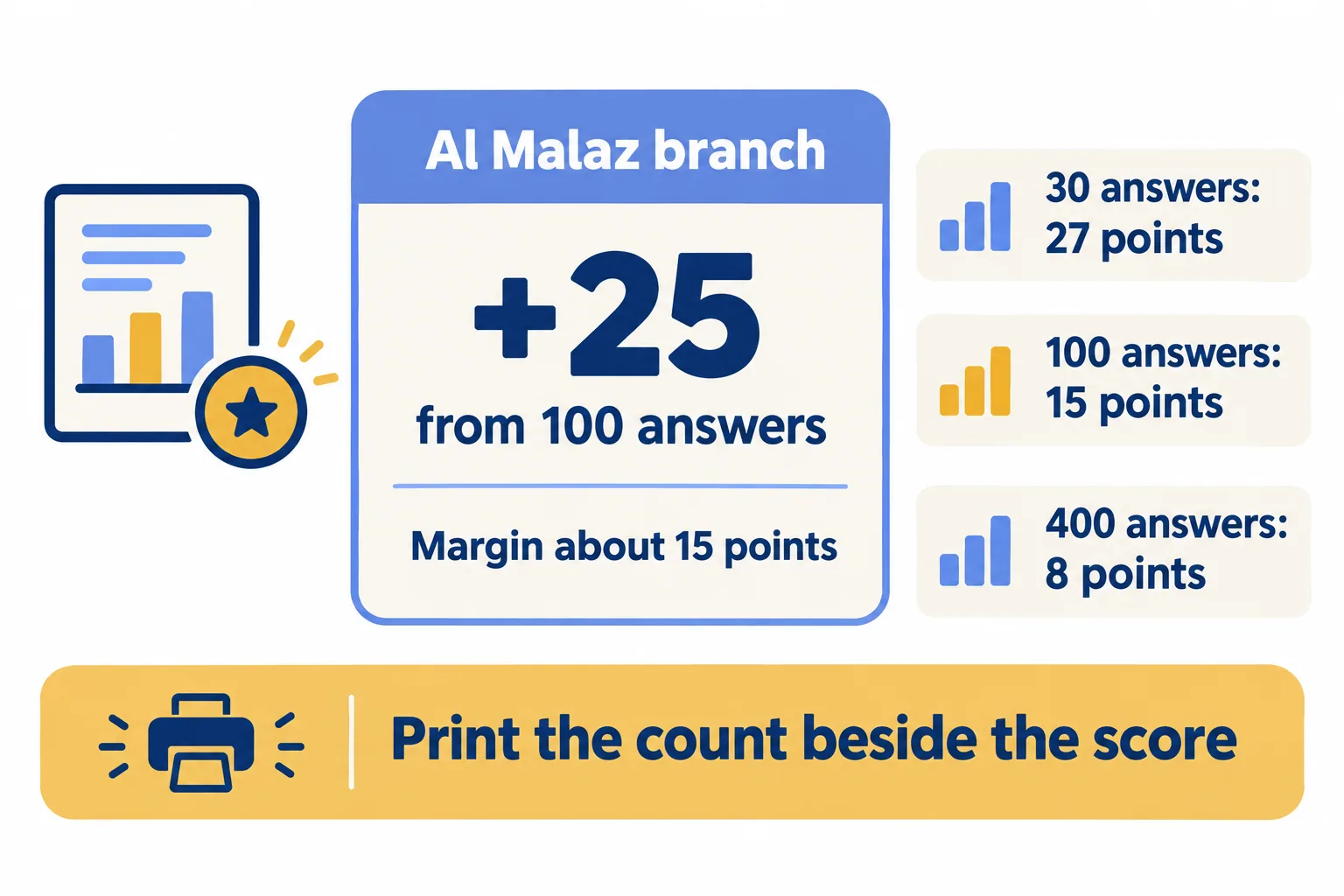
Take one branch with 45 percent promoters and 20 percent detractors. Its NPS is +25. Use the standard formula for the 95 percent margin, 1.96 × √((P + D − (P − D)²) ÷ n), where P and D are the promoter and detractor shares and n is the number of answers. The margin is about 27 points at 30 answers, about 15 at 100, and about 8 at 400. The same +25 can mean "somewhere between -2 and +52" or "between +17 and +33". That arithmetic is ours, from the formula that Zunoform also shows.
Margin on a +25 NPS (45% promoters, 20% detractors), points either way
A CX lead on the Qualtrics community put the worry plainly: "I will be presenting customer NPS results to executives, and at times breaking out by region, segment, etc. I am looking for a fairly straightforward way to gut check when a drill-down goes too far." The thread was about roughly 50 answers at an 8 percent response rate.
Our rule for the report: print the number of answers next to every score, and do not rank two branches whose margins overlap. This week, take your last branch report and add a column for the count. If a branch has fewer than 30 answers, show the count and no score.
Then name the owner. On Monday that person reads the week's comments from the lowest-scoring branch, calls the branch manager, and writes down one change to try before the next report. A low score with no named reader is the case where we say to wait.
What does Mindcat Surveys do today, and what is left out?
At Mindcat, we call the method Every branch scored. Visitors scan a code at the counter and answer on their phone in Arabic or English. Both question types are there: 1 to 5 style rating questions and the 0 to 10 scale. Statistics show a chart for each question, filtered by branch, service or date, and you export the answers to Excel or CSV. For the 1 to 5 rating, the chart shows how many chose each answer, and the share who chose 4 or 5 is the two top bars added together, or one formula on the export.
What is not there today:
- The statistics view shows the 0 to 10 spread, not an NPS figure. The score comes from the export.
- A QR code and link per survey work on day one. One code per branch that records the branch is set up during setup.
- Reminders go out when someone on your team presses send. There is no schedule.
- WhatsApp and SMS invitations are not tracked per person. You can paste the link into WhatsApp.
- UAE PASS and Nafath are not supported. Admin screens are partly in Arabic.
A survey of your own does not replace a regulator's or authority's own measurement of your service. It gives your team the answers to the questions you choose.
What does it cost?
You pay per survey editor per month: anyone who signs in to build surveys, send invitations or read results. People who answer never count, and there are no per-response fees. Editors 1 to 3 cost AED 99 each, 4 to 10 cost AED 69, 11 to 25 cost AED 49 and 26 and up cost AED 35. The shared plan has a monthly minimum of AED 499, so a team of 3 pays AED 499, not AED 297.
A quality team with 10 editors pays 3 × 99 + 7 × 69 = AED 780 a month. For up to 3 editors the quick start is AED 2,500, a fixed package we set up for you. Larger teams are set up with us, from AED 3,900 for 4 to 10 editors. Email sent through a relay, if you have no mail server of your own, is billed at cost. Prices exclude 5 percent UAE VAT.
If one person sends one survey a year and nobody asks how many answered, a free form tool is enough. If you report a score by branch to a regional manager, a board or a regulator, the count and the owner matter more than the tool.
Tell us who you survey, how many branches, and how many people build surveys and read results. We reply with the setup plan and the monthly price per survey editor, in AED or SAR. Our pages for public services and clinics show the same flow for a service centre and for a clinic group.
