

If your service centre's rating screen is green but you cannot say which question to fix first, this is for you. It is not for a team where nobody reads the comments after the faces are tapped. Start by naming who reads them.
What does the Happiness Meter give a service centre?
A free, simple rating, and a dashboard you do not run. Digital Dubai's Happiness Meter lets a visitor mark one of three cases: satisfied, neutral or dissatisfied. A service centre gets a native app for its tablets, and a website can show the same three choices.
A 2019 ITU case study of the programme, written when it was run by Smart Dubai, adds the detail. Later versions ask for a very short reason, and visitors can optionally comment and rate attributes such as centre appearance. Results are recorded by entity, channel and time, down to individual counters. Digital Dubai says the host sees a comparison with other entities that does not name them.
On the Partners Portal, the service is listed as free, for government, semi-government and private entities, with a valid trade licence required and a delivery time of 14 working days. The programme is Dubai's, so we did not check whether an entity outside Dubai can join. Terms change, so read the portal page before you plan around it.
That is a good deal. If your centre is in Dubai and not yet a host, it is the cheapest thing in this post.
What does a survey of your own add?
Your questions, your branches and your copy of the answers. The Meter's questions and dashboard belong to the programme. A sample shows where that matters.
Here is a sample, not a client. A service centre with three branches sees 90 percent of faces green. The quality lead still has to answer a simple question from the manager: is the wait too long, or is it the form people are asked to fill in? The Meter's list of attributes may cover part of that, and it is the programme's list, not yours. A survey you write can ask which service the visitor came for, how long the wait felt, whether the staff were clear and whether the requirements were clear, in Arabic or English, with the branch recorded on each answer. That is the answer to "what do you fix": the question the faces cannot ask.
A survey is also what you reach for outside Dubai, where the Meter may not apply. The UAE government's Global Star Rating System rates service centres from 2 to 7 stars on independent evaluation. A survey of your own does not feed that rating or award stars. It is an input for your team.
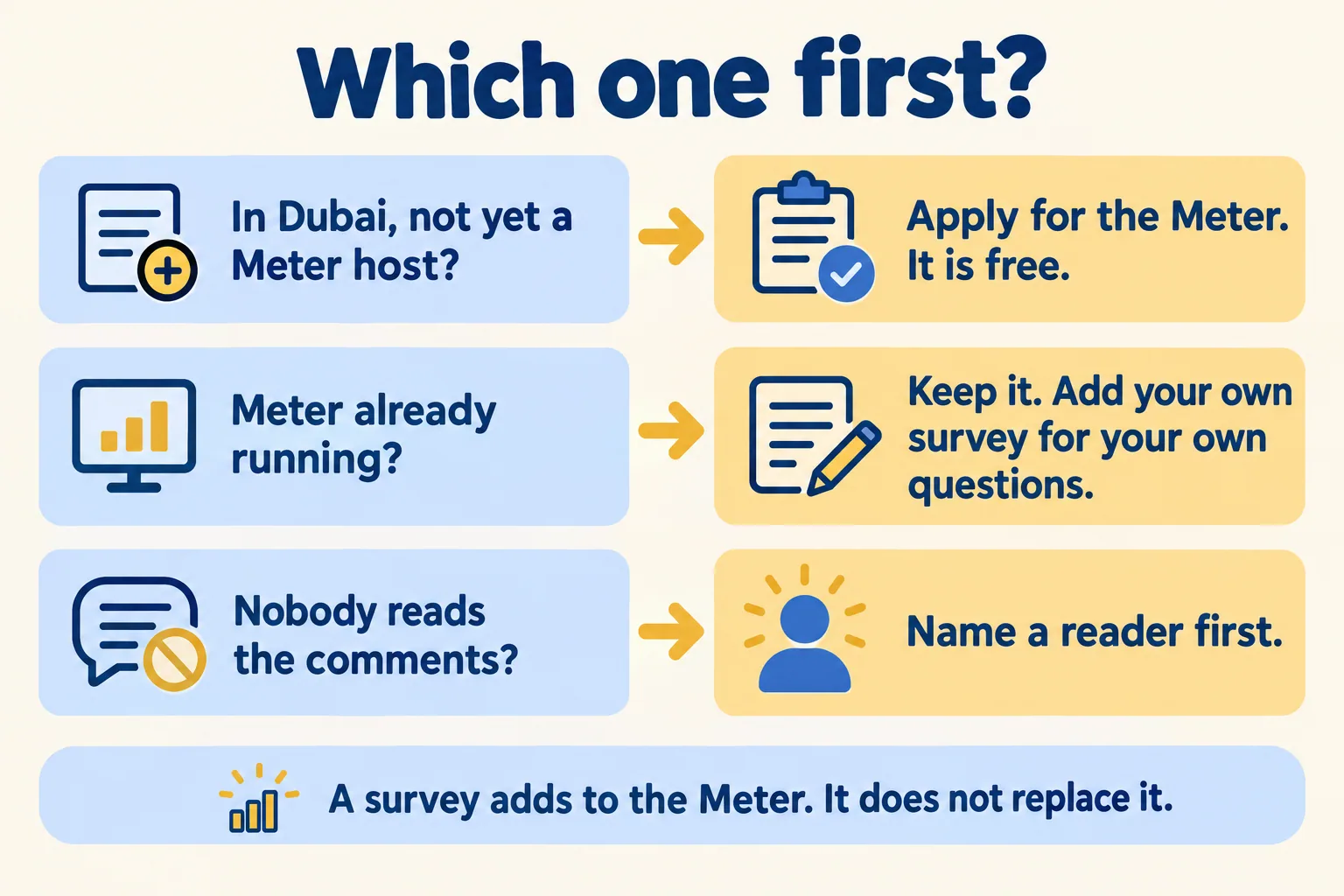
Which one do you start with?
Use this rule.
The words that matter are "add" and "keep". A survey does not replace the Meter, the Star Rating System or any regulator's survey, and it does not connect to them. Those keep running.
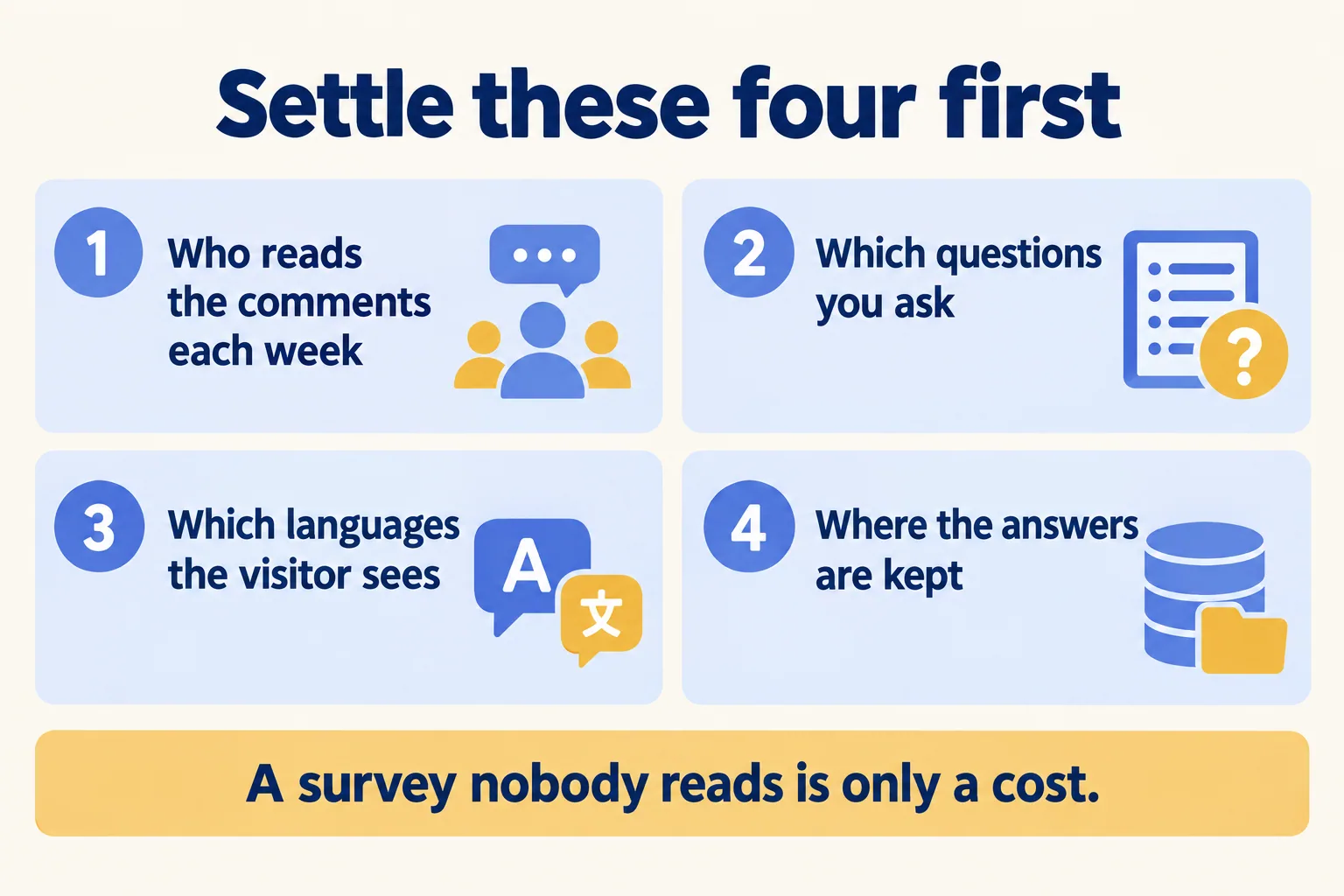
Before either goes live, settle four things: who reads the comments each week, which questions you ask, which languages the visitor sees, and where the answers are kept. The last one is a question for any tool, ours included.

What does Mindcat Surveys do today, and what is left out?
Mindcat Surveys is a satisfaction survey we host and run for you. Visitors scan a code at the counter and answer on their phone, in Arabic, English or both. You see the answers for each question, filtered by branch, service or date, and you export them. Answers stay in the UAE or in Saudi Arabia, or on your own servers. See the public services page for how teams use it.
What is left out matters here:
- Results by branch need the branch recorded on each answer. We set up one code per branch during setup. It is not something you switch on yourself today.
- Reminders are sent when a person presses send, only to people who have not answered. There is no schedule.
- Invitations by WhatsApp or SMS are not tracked per person. Email invitations are.
- Statistics show the 0 to 10 spread, not an NPS figure. The score comes from the export.
- The admin screens are partly in Arabic. Most of the admin text is in Arabic, but the survey editor still aligns Arabic questions to the left. Visitor survey pages run right to left.
A bad answer does not open a task for a named person. Someone on your team reads the results and acts, which is why the first line of this post asks who that is. We do not tell you that a survey makes anyone compliant, approved or rated. It collects and counts answers. If your visitors talk to you on WhatsApp, you can paste the survey link into a chat, but those invitations are not tracked per person.
What does it cost?
You pay per survey editor per month. An editor is anyone who signs in to build surveys, send invitations or read results. People who answer are free, and there are no per-response or per-survey fees.
The rate drops in bands: AED 99 for editors 1 to 3, then AED 69 for 4 to 10. The shared plan has a minimum of AED 499 a month, so a team of three pays AED 499, not 3 × 99. At 10 editors the page works it out: 3 × 99 + 7 × 69 = AED 780 a month.
Up to 3 editors on the shared plan, the quick start is a fixed package we set up for AED 2,500, one time. From 4 editors, we set it up with you in writing. Email sent through a relay, if you have no mail server of your own, is billed at cost. Prices exclude 5 percent UAE VAT, and annual prepay takes 15 percent off.
What happens on the first call?
We call the method Every branch scored. You tell us who you survey, how many branches you have and how many people build surveys and read results. We reply with the setup plan and the monthly price per survey editor, in AED or SAR. If you are in Dubai and not yet on the Meter, we will say so and send you to apply for it first. If you have a reader for the comments and questions of your own to ask, tell us who you survey.
