

If your branch managers say service is fine and your complaints say otherwise, this is for you. It is not for a centre with no written service standard to test against: write the standard first, and start with the survey.
What does each method tell you?
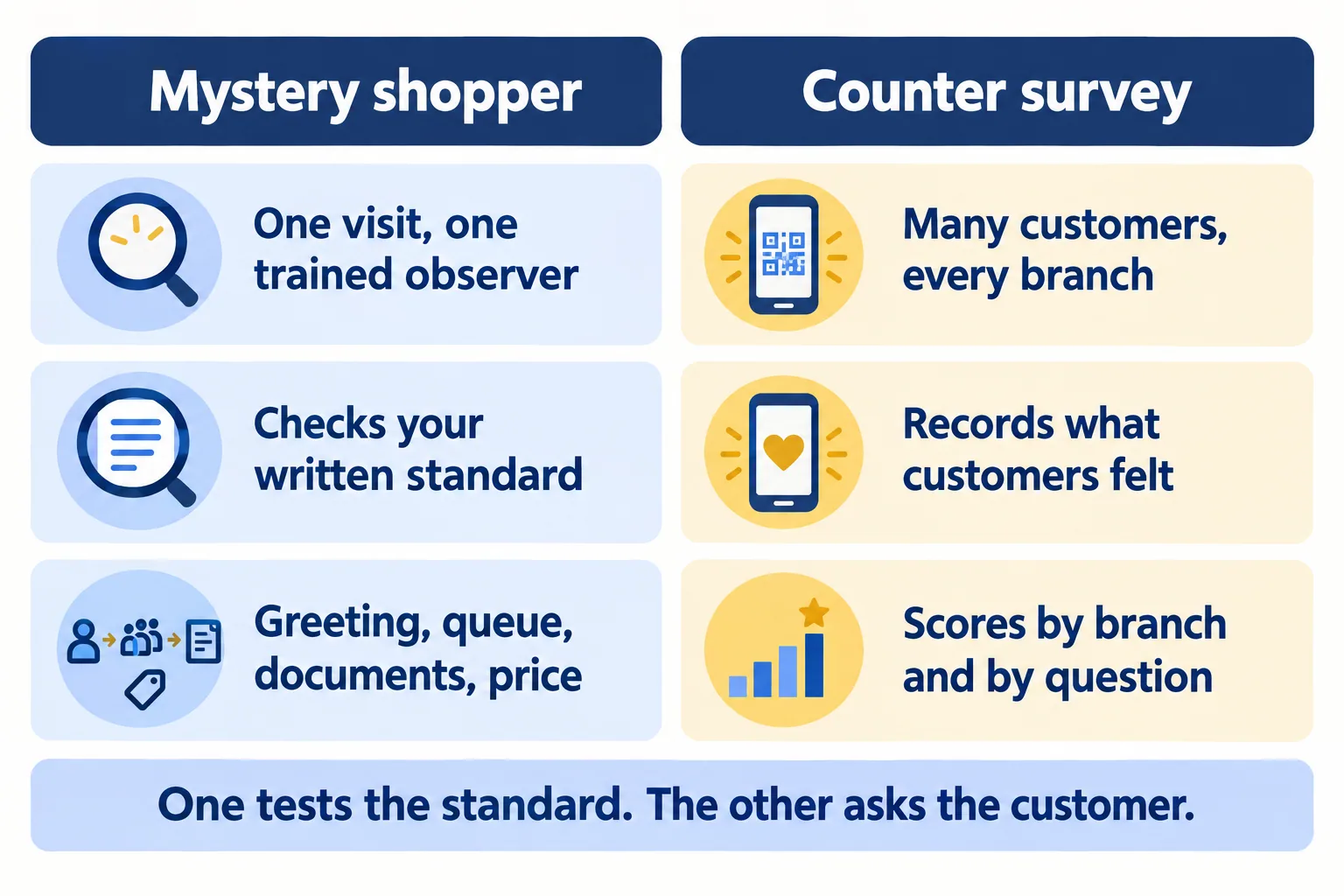
A mystery shopper tells you whether your own standard was followed. A counter survey tells you what customers felt.
Adaa, the Saudi national centre that measures public bodies, lists both in its beneficiary experience work. Its mystery beneficiary tool assesses an entity's compliance with service standards and checks for gaps in how a service is delivered. Its surveys are predefined questions that measure the beneficiary's satisfaction with the service. A third tool, focus groups, asks a small group why a problem keeps happening.
Dubai's own government runs the observation half in the open. The Mohammed bin Rashid Majlis mystery shopper initiative asks trained residents to observe and document practices in government and private services, and to report with images and video. The shopper has no authority to contact the organisation directly.
A Dubai mystery-shopping firm described the same work to Khaleej Times in 2020. It covers "integrity checks, price consistency", and one common finding is that many cashiers do not hand out the bill at the end of a transaction. "Most mystery shoppers are given extensive training," the paper reported, before they go.
None of that is about what the customer felt. That is the survey's job.
How do you choose which one first?
Ask one question: what do you need to find out?
Our rule has three lines, so you can argue with it.
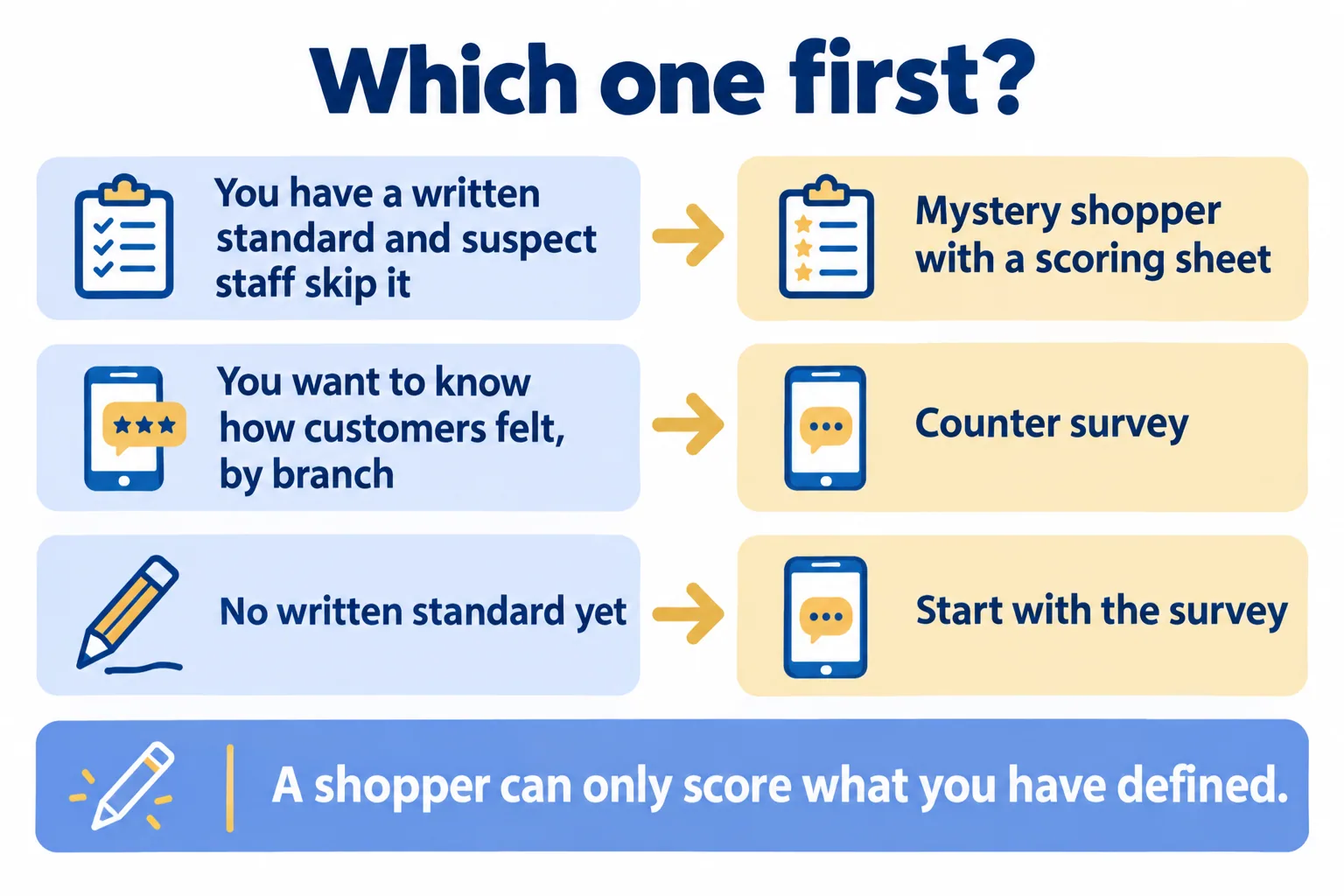
- You have a written standard and suspect staff do not follow it: greeting, queue time, documents checked, the right price quoted. Send a mystery shopper with a scoring sheet built from that standard.
- You want to know how customers felt, and how that differs by branch and week. Run a counter survey.
- You have no written standard yet. Start with the survey. A shopper can only score what you have defined, and until you define it, you are paying someone to hold an opinion.
Do the second method when the first shows a gap you cannot explain. A survey that shows one branch scoring low in the morning rush tells you where to send a shopper. A shopper who finds the bill was not handed over tells you what to ask in the next survey.
Adaa treats the two as partners too. Its own FAQ says that where evaluation data is in doubt, it validates the result with its other tools: mystery shoppers, surveys and focus groups.
What does a mystery visit miss?
It gives you one visit, and one visit is one person's afternoon.
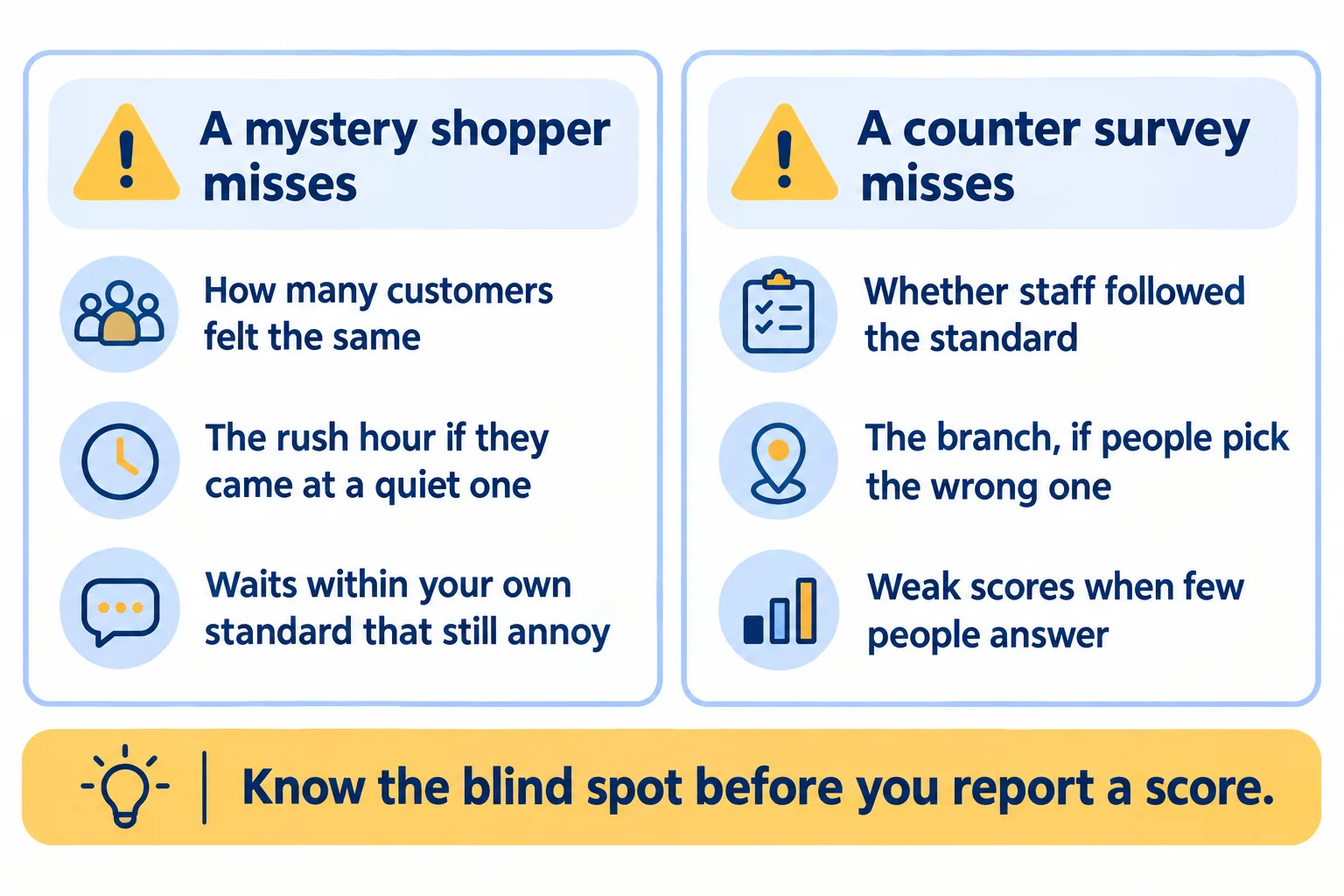
A shopper arrives at a single branch at a single hour. The report is a careful description of that visit against your sheet. It is not a customer score, and it should never be printed as one. If the shopper lands on the one quiet hour of the week, the report says the counter is fine. Your complaints come from the rush.
A shopper also cannot tell you how the customer felt about a wait that was within your own standard. If your standard allows ten minutes and customers expect five, the visit passes and the customer is still annoyed.
What does a counter survey miss?
It cannot check whether your staff followed the standard.
A customer does not know your sheet. They tell you whether they felt looked after, not whether the greeting used the right words or the documents were checked in the right order. A survey also depends on people answering, and a branch with few answers gives a weak score. Our post on how many answers a branch score needs sets out the numbers.
Branch attribution fails quietly too. One multi-branch survey vendor, OnlinePoll, writes that with a standard form, "customers frequently pick the wrong store" from a dropdown. The fix is a code on the stand at each counter, so the branch is known before the first question.
What does Mindcat Surveys cover, and what is left out?
Mindcat Surveys covers the survey side. Mystery visits are run by specialist firms; we cover the survey side.
Visitors scan the code on the stand at the counter and answer on their phone, in Arabic or English. You see the results by branch and by question. The quick start includes our five-question satisfaction survey template in Arabic and English and a QR code and link for each branch from your branch list. One code per branch that records the branch is set up during setup. We call the method Every branch scored.
What is not there today: reminders on a schedule (someone on your team presses send), tracked WhatsApp or SMS invitations, and an NPS figure on the statistics screen, which shows the 0 to 10 spread. Mindcat Surveys is your own feedback by branch. It does not stand in for the measurement run by Adaa, the Star Rating or the Department of Health.
What does it cost?
You pay per survey editor a month. An editor is anyone who signs in during the month to build surveys, send invitations or read results. The people who answer never count, and there are no per-response or per-survey fees.
Editors 1 to 3 cost AED 99 each, falling to AED 69, AED 49 and AED 35 in the higher bands. The shared plan, your own separate copy on our UAE servers, has a monthly minimum of AED 499, so a team of 3 pays AED 499, not AED 297. A team of 10 editors pays AED 780 a month.
The quick start for up to 3 editors is a fixed AED 2,500. It is a package we set up for you, with your logo on every survey page and recorded training in Arabic and English. Above 3 editors we set it up with you, starting at AED 3,900. Email sent through a relay, if you have no mail server of your own, is billed at cost. Prices exclude 5 percent UAE VAT.
A paper card or a free form tool costs nothing extra, and for one branch and one survey a year it is enough. What the extra buys is a result you can split by branch, in Arabic and English, kept on a server in the UAE.
Tell us who you survey, how many branches and how many people build surveys. We reply with the setup plan and the monthly price per editor, in AED. If a mystery shopper is what you need first, we say so.
