
If contractors walk your service corridors with a sticker nobody can read, or with nothing at all, this is for you. If you run one floor and your receptionist walks every visitor to the host, you can skip the badge.
What is a badge for once the visitor leaves the desk?
A badge is a note for whoever meets the visitor after reception: the guard at the service lift, the tenant in the corridor, the engineer in the plant room. If nobody past the desk ever reads it, the badge does nothing, however good the printer.
Castatus, a US visitor-system vendor, lists three jobs a badge does: it tells staff the person was checked in, tells the visitor where they may go, and tells security what to ask if something looks wrong. Its verdict on the cheapest option: "A blank 'VISITOR' sticker does the first job badly and the others not at all."
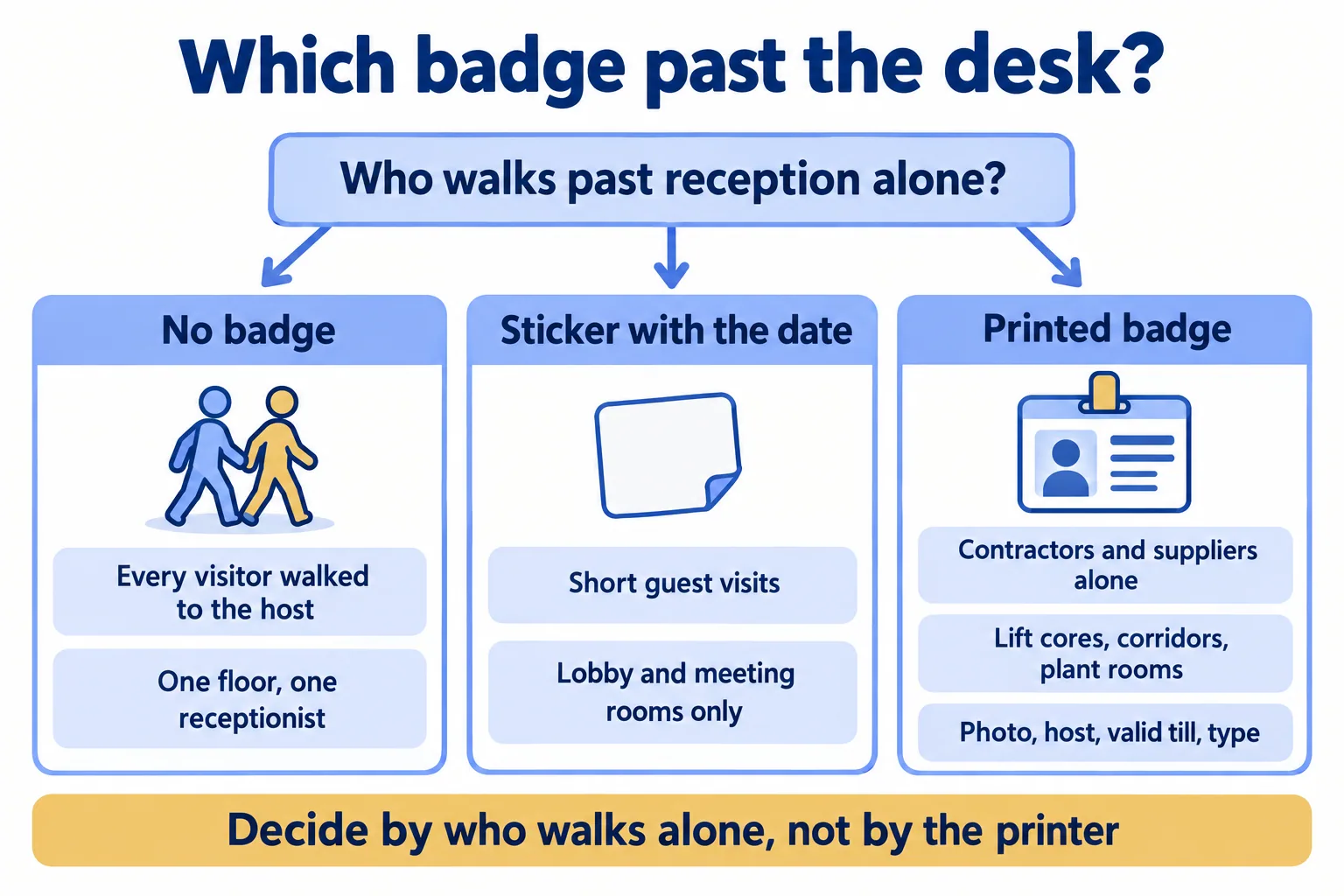
So the useful question is not sticker or card. It is who walks past reception alone, and who would have to read the badge.
When is no badge the right answer?
When every visitor is walked. A one-floor office where the receptionist takes each guest to the host and back has no one past the desk who needs to read a badge. The receptionist is the badge.
The same holds for a tower floor run by one tenant, as long as the tenant collects its guests from the lift lobby. The building's job ends at the lobby check; the tenant's job is the walk.
When is a sticker enough?
For guests who stay in the lobby, the lift and a meeting room for an hour or two. A sticker with the date and the visitor type on it tells a tenant at a glance that the person was checked in today. Print or stamp the date at the desk, so every sticker carries it.
Front-desk managers know how stickers fail. In a 2017 thread for museum staff, one wrote: "Stickers don't always stick to clothing. You will find stickers on the floor, stuck to wall, signs and other areas they shouldn't." Another site supervisor wrote that "front line staff are constantly picking them up." A third said they use stickers "without problems." All three are museums, not towers, but the pattern carries: stickers suit short visits where the sticker only has to last until the meeting ends.
What a sticker cannot carry well is a face, a host and an end time a guard can read from a few metres away.
When does a visitor need a printed badge?
When contractors and suppliers move through the building without an escort: service lift lobbies, lift cores, corridors, riser rooms, the B2 plant room. In those places the person who meets them is usually a guard or an engineer who has never seen them before.
That person needs four answers at a glance:
- Who is this? A photo taken at check-in, the name and the company.
- Who let them in? The host, so anyone can call and check.
- What kind of visit? The visitor type in a colour that reads across a corridor: contractor, supplier, customer, candidate, VIP.
- Until when? The date and the time the visit ends.
Where guards read Arabic first, the photo and the type colour carry most of the meaning, so make both large.
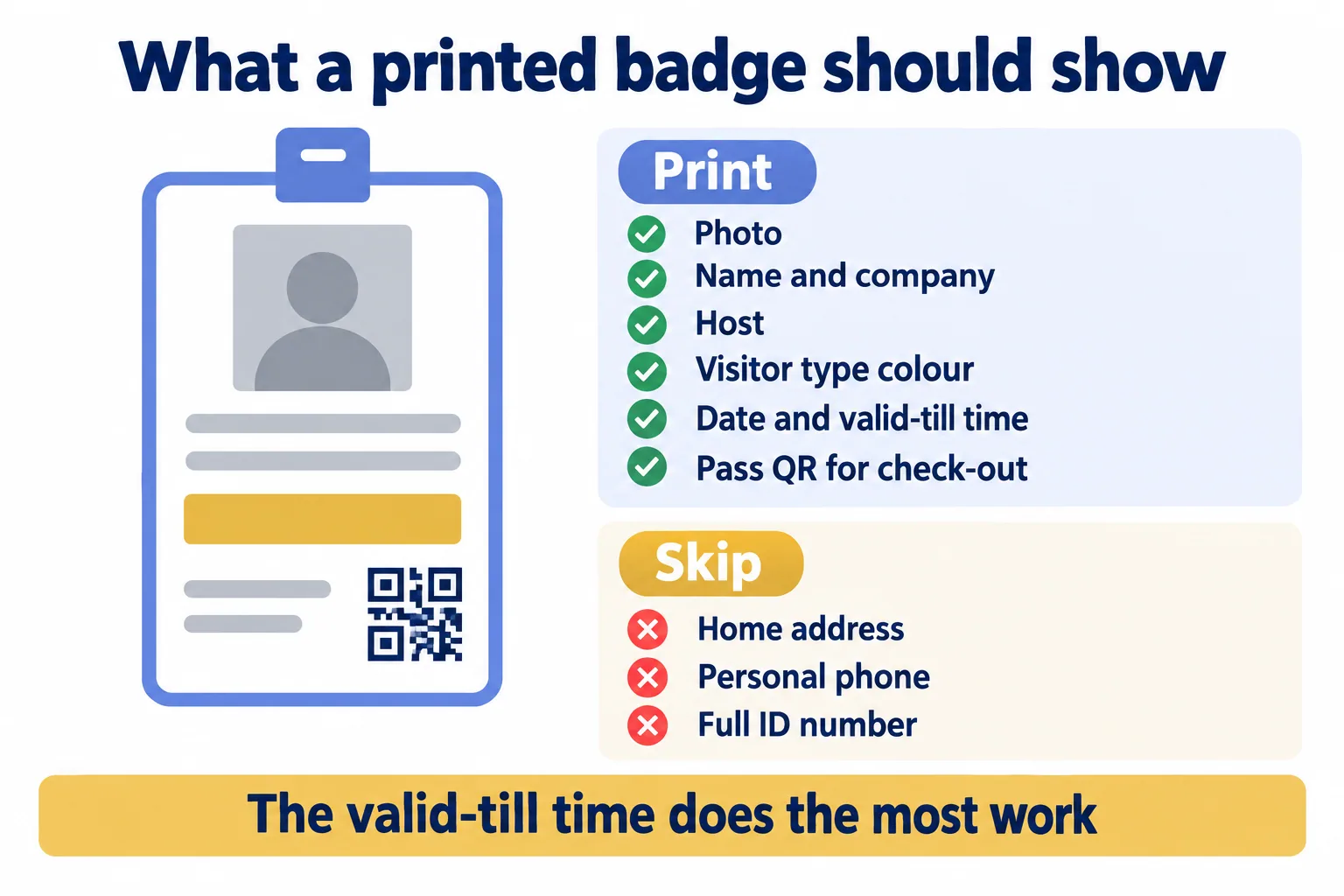
Leave off what the badge does not need. Castatus says the home address and personal phone never belong on a badge. It also warns against QR codes "that link to the visitor's full record", because a badge can be photographed and posted online. We agree with the warning, and we answer it below: the QR on our badge carries the pass for the guard's gate check, and the card image behind it is deleted at check-out.
If the building's service entrance still runs on a paper gate pass, read who owns that door first. The badge comes after the pass.
Why the valid-till time matters more than the plastic
Castatus puts it plainly: "A badge with no date or expiration is functionally a permanent badge." Visitors keep badges, and a kept badge can walk back in tomorrow.
There are two ways to stop that, and a tower should pick one on purpose:
- Collect it at the exit. It works where every visitor leaves through one desk. The museum thread shows the weak point: "quite a few are not returned" to the baskets at the exits.
- Make it expire. Print the date and valid-till time large. Badgezoo, a badge vendor, gives the guard's rule: treat yesterday's badge as expired, send the person to reception, confirm the host and issue a new one. Castatus also sells self-expiring label stock that shows a "VOID" pattern after about 24 hours, for buildings that want the badge itself to time out.
A tower usually has more than one way out (the main lobby, the loading bay, the car park lift), so collection fails quietly. There, the printed valid-till time does the work, and the guard's habit of reading it matters more than the badge stock.
For a fit-out crew on site for weeks, the end time is a choice between one pass for the job and a new one each morning. Our post on the contractor pass sets out how we decide.
The 20-minute test we run at the service lift
Before we suggest any badge, we ask the facilities manager to run one test. Stand at the service lift for twenty minutes on a weekday morning. For every person who passes, ask two questions:
- Could the guard tell, at a glance, whether this person is a visitor or works here?
- For each visitor, could the guard tell until when they are allowed in?
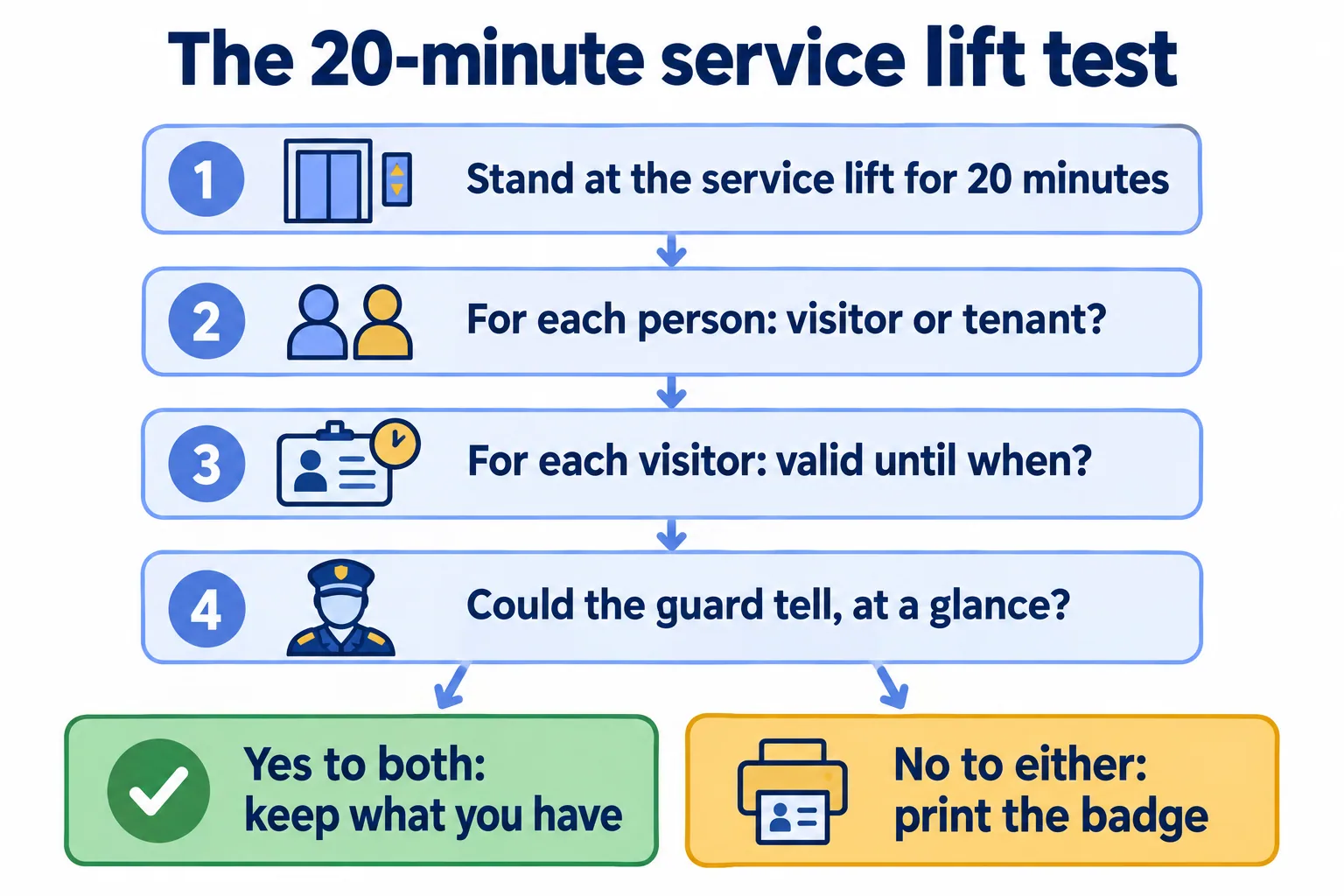
Two yeses: keep what you have, whatever it is. A no to either: the visitors who reach that lift need a printed badge with a photo and an end time, and the guard needs to be told to read it. If your guards come from an outsourced security company, put that in the post orders and repeat it at each shift handover: check the photo, check the time, send anyone past their time back to reception. If nobody but staff passes in twenty minutes, the badge question belongs to the main lobby, not the service lift.
What Mindcat Lobby prints, and what it does not
Mindcat Lobby prints a badge at the counter after the gate check. It shows the visitor's photo, company, host, purpose, date, valid-till time and the pass QR, tagged with the visitor type. The sample below is a contractor for chiller plant service on level B2, with the work order on the badge.
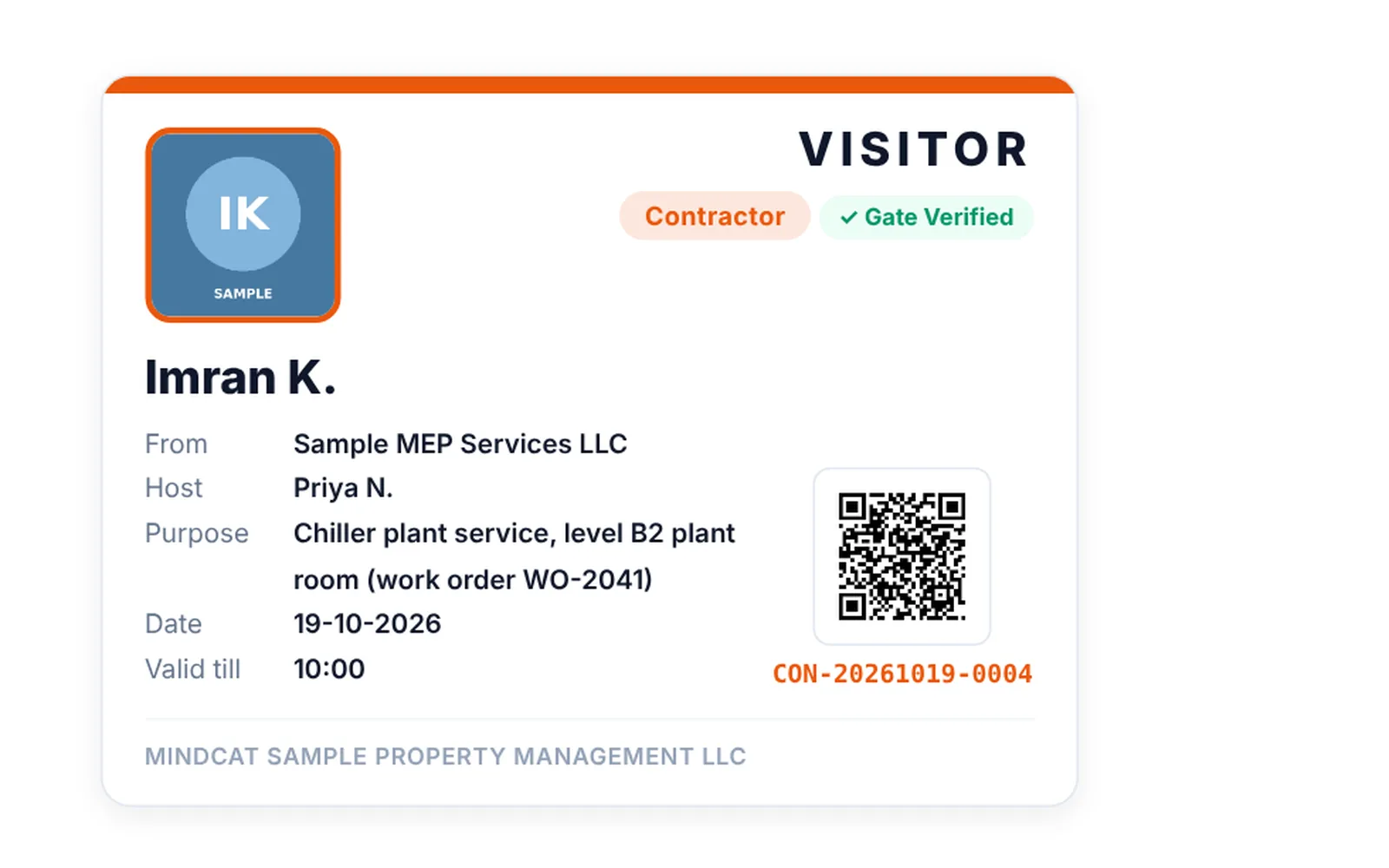
The badge also replaces the old habit of keeping a visitor's Emirates ID at the desk as a deposit: our post on the visitor log book sets out the UAE rule on holding a visitor's card. The guard scans the same QR at check-out. When the visitor checks out, the card image is deleted and the ID number is kept as its last 4 digits, with who checked it and when. The badge layout and the visitor types are set for each site during setup. The work order itself lives in your maintenance system; if that is Mindcat Maintain, the badge only carries its reference.
What it does not do: the badge does not open doors, turnstiles or barriers, because we don't sell or connect access-control hardware. There is no self check-in kiosk; guards and receptionists check visitors in. We don't sell badge printers or label stock, and the badge labels print in English today.
What would it cost?
Lobby is priced per site a month: AED/SAR 1,490 for each of sites 1 to 3, with a minimum of AED/SAR 3,790 a month for your own copy hosted by us in the UAE or Saudi Arabia. One tower pays the minimum. Setup for one site is AED/SAR 7,900 once, and covers the badge layout, your gates and visitor types, and the card scan tested on your camera. Guards, receptionists and hosts log in free, and there are no per-visitor fees. Printers, cameras and tablets are yours. Prices exclude VAT; the full bands are on the Lobby page, and towers run by one manager are covered on our property management page.
This is not for a one-floor office with a receptionist who knows every visitor: keep the walk to the host.
We call our method Scan, check, delete: the card scanned at the counter, the face checked against the pass, and the card image deleted at check-out. Tell us how many towers or sites you run, their gates and how visitors get in today. We reply with the setup plan and the monthly price per site, in AED or SAR. Tell us about your towers.
