

What did Salesforce say about existing customers?
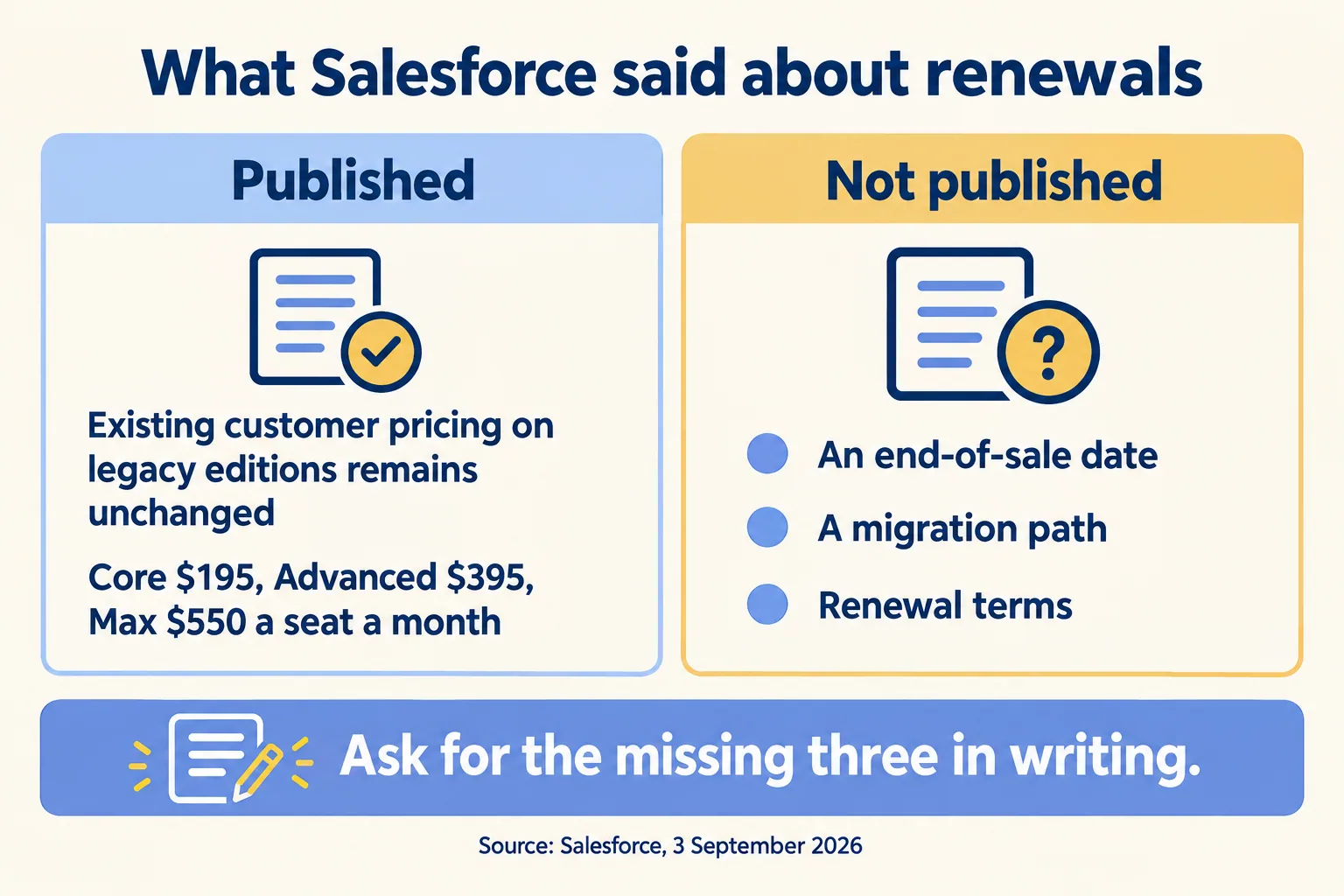
One sentence, and a disclaimer. If your renewal is within a quarter, note that the Sales pricing page no longer lists the edition your org is on. On 3 September 2026 Salesforce launched Core, Advanced and Max editions for Agentforce Sales, Agentforce Service and Agentforce Industries. Its announcement says: "Existing customer pricing on legacy editions remains unchanged."
It then adds that pricing and packaging are subject to change, and that availability "may vary by region and is governed by customer agreements."
Read what is not there. The announcement gives no end-of-sale date for Enterprise or Unlimited, no migration path, and no renewal terms. Whether you can renew on your current edition at all is one of the unpublished answers. The pricing page we read on 6 October lists Starter, Pro, Core, Advanced and Max and does not list Enterprise or Unlimited. Salesforce Ben reported on the day that replacing Enterprise and Unlimited was possible but not confirmed. We have not seen a renewal quote written on the new editions, so everything below is read from Salesforce's pages and arithmetic, not from a contract.
What does Core cost over Enterprise?
About $20 more per seat per month, and $45 more for Advanced over Unlimited. Core lists at $195 and Advanced at $395 per user per month, billed annually. Salesforce's announcement does not print the old prices. SalesforceDevops.net, on 14 September, puts Enterprise at $175 and Unlimited at $350 after the August 2025 increase. Salesforce's own notice from June 2025 gave that increase as "an average of 6%". Treat $175 and $350 as reported, and check them against your own order form. If you are on Agentforce 1 Edition, the picture is simpler. Salesforce says you can upgrade to Max at no extra cost, with up to $500 in added value, and Max keeps the $550 price.
That makes Core about 11 percent above Enterprise and Advanced about 13 percent above Unlimited, roughly double the 2025 average. The percentage looks small. Multiplied by your seats, it is not.
Most orgs pay below list. If your discount carries over to the new list, the percentages hold and the dollars shrink in proportion. Take a made-up 25 percent discount on both prices: the Core gap becomes $15 a seat a month, $180 a year, or $36,000 at 200 seats. If the discount does not carry over, the gap grows. Whether it carries over is the first thing to ask, and the answer is a negotiation, not a calculation. These figures are US dollar list. The pricing page also lists euro, pound and other currencies, so use the one on your order form.
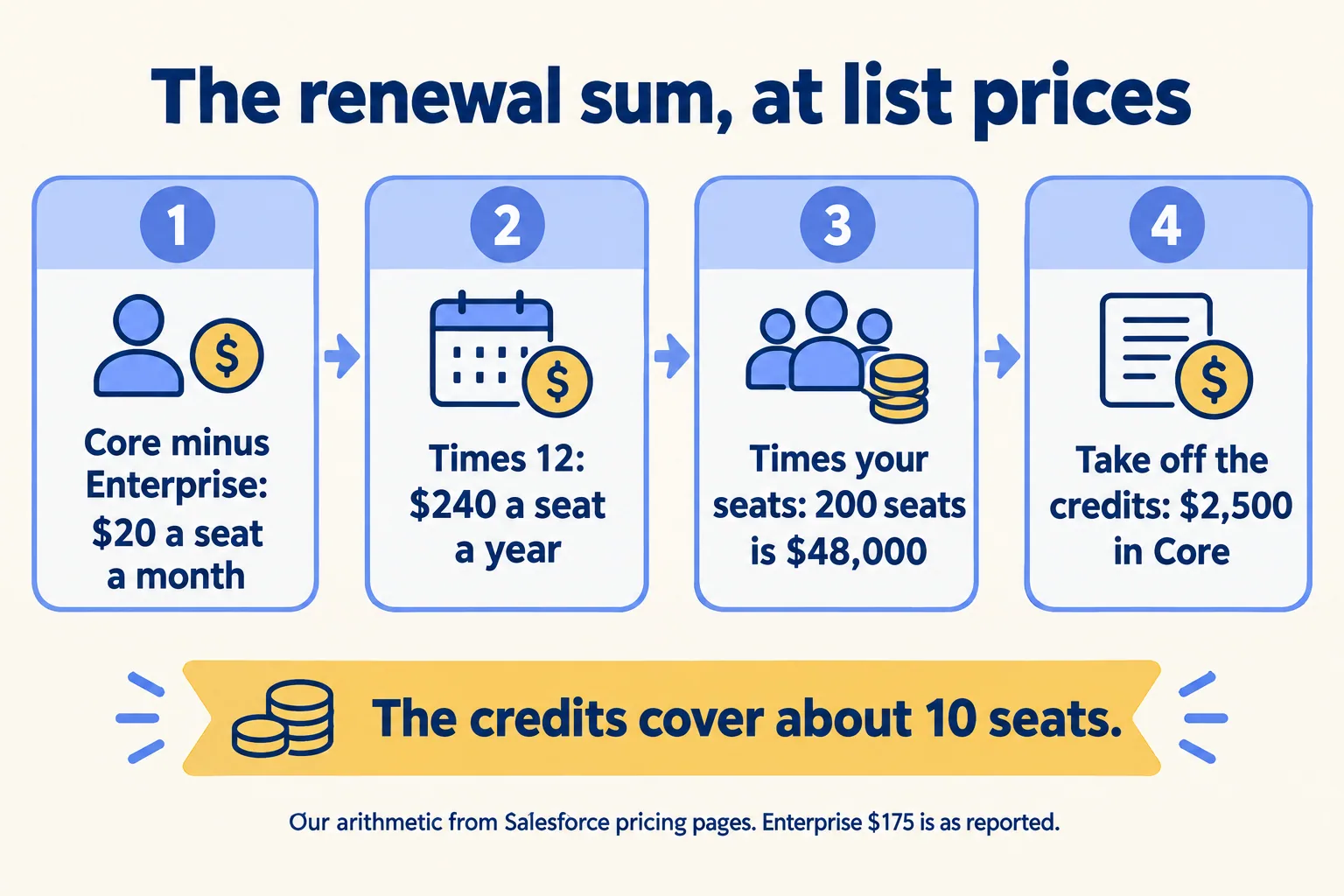
Do the included Flex Credits cover the difference?
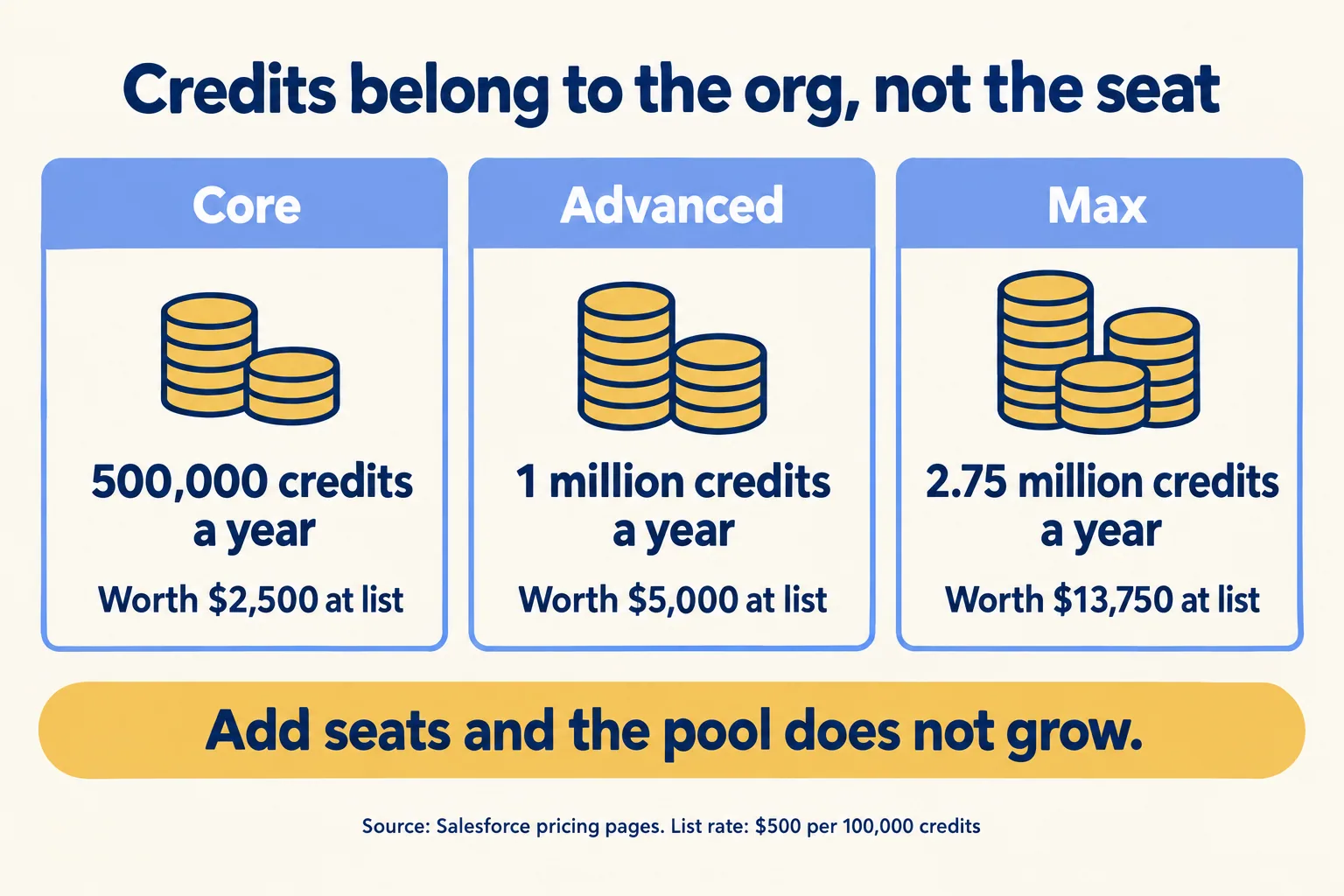
For about 10 seats, and no more. Core includes 500,000 Flex Credits per org per year, Advanced 1 million and Max 2.75 million. Salesforce sells credits at $500 per 100,000 on its Agentforce pricing page, so at list the pools are worth $2,500, $5,000 and $13,750.
A pool that belongs to the org does not grow with your seats, and the uplift does. Divide $2,500 by $240 and you get 10.4. Core's credits cover the Core uplift for about 10 seats. Advanced's $5,000 covers $540 a seat for about 9. At 200 seats the Core pool offsets about 5 percent of the extra cost, and at 1,000 seats about 1 percent. This is our arithmetic, at list.
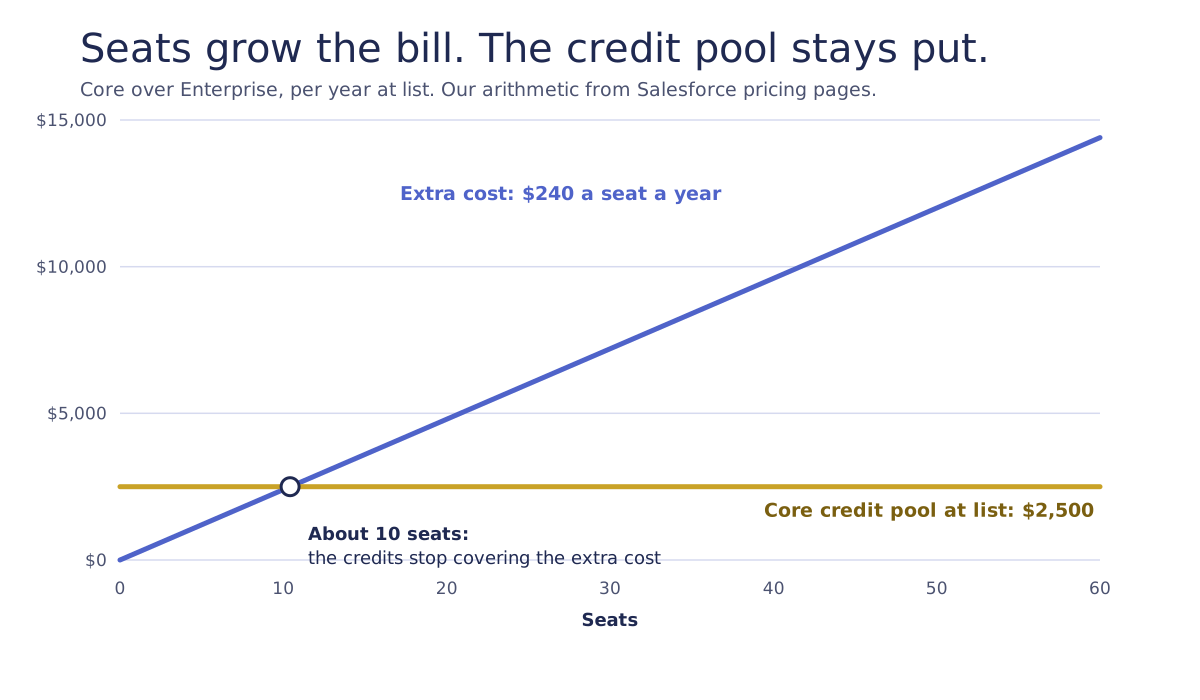
Share of the Core uplift the credit pool covers
One caution runs the other way. A credit you would never have bought is worth nothing to you, whatever the list rate says. If you have no agent that spends them, count the pool as zero. If you were already planning to buy credits, count it in full. For what a standard action consumes, see what Agentforce costs after Dreamforce, and for what Salesforce says about billing agent calls, see Salesforce will bill agent calls.
What does the bundle include that you may already pay for?
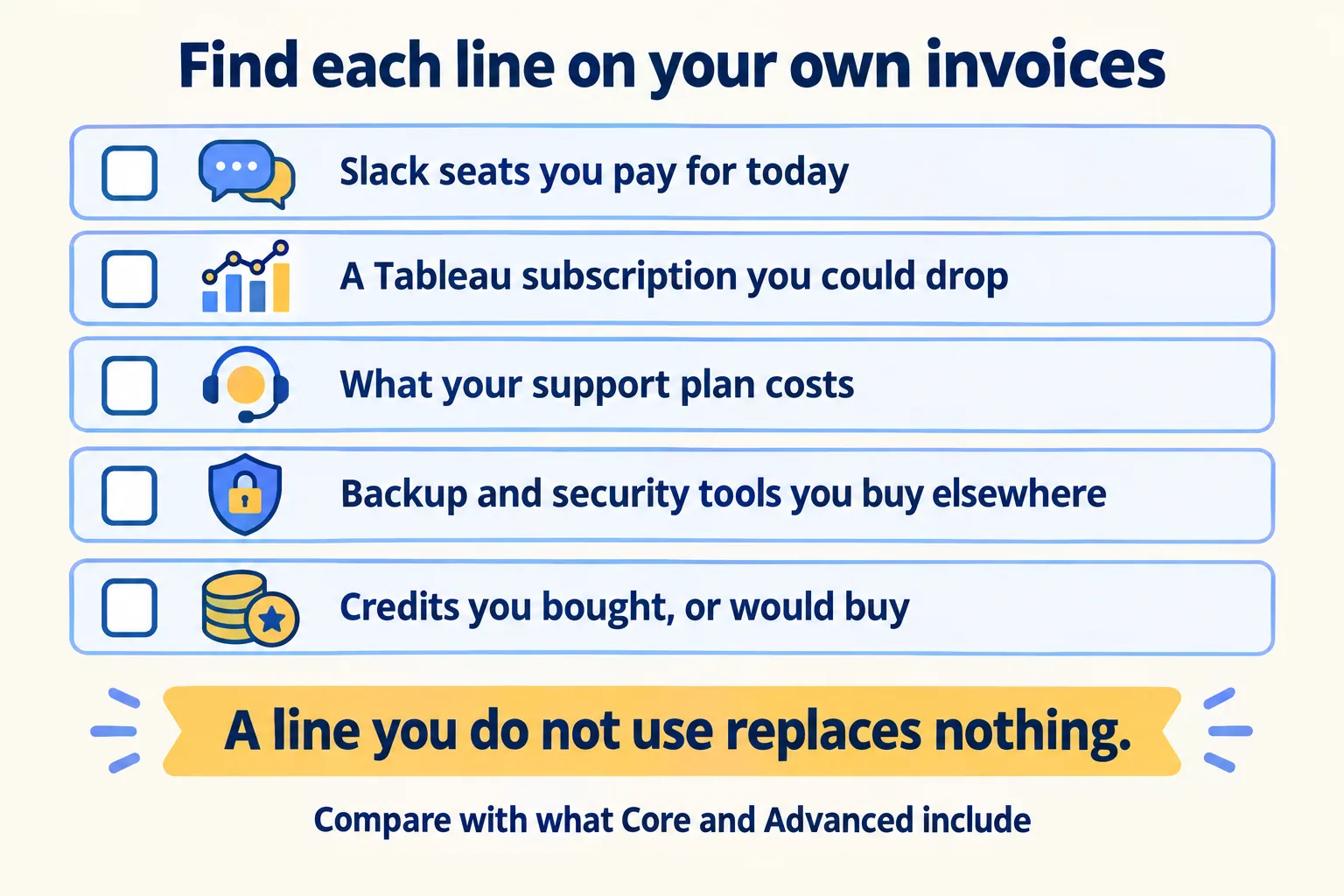
Five lines to look up, and Core includes four of them. Only your invoices say what each is worth. Salesforce's announcement says every tier includes Agentforce capabilities, Slack and Slackbot, embedded analytics, data security and a Premier Success Plan. The pricing page names the pieces. Here is what to look up for each one.
The sum is short. Add what you pay today for each line you will keep using. Subtract it from the yearly uplift in the first table. What is left is what you are paying extra for features you would not otherwise buy. With the credit pool counted at list, a 200-seat org needs the other lines to replace about $19 a seat a month to break even on Core, and about $43 on Advanced. We counted the credits at list; if you value them at zero, the figures are $20 and $45. A line you do not use replaces nothing.
Where does Salesforce's own page disagree?
In two places we could see on 6 October, and one caution. The announcement says Momentum is "included in Core, Advanced, and Max Editions." On the Sales pricing page, one table's Momentum row reads "Coming Soon" under Core and Advanced. The announcement says every edition includes Agentforce capabilities. The same page marks its Agentforce for Sales row "Available for purchase" on Core and Advanced, and lists the package under Max. The caution is the announcement's own closing line, which tells customers to base decisions "on products and services currently available."
Salesforce prices an Agentforce add-on for Sales at $125 per user per month on its Agentforce pricing page. If that is the add-on the pricing grid points to, Advanced plus the add-on is $520 a seat against $550 for Max. We could not confirm that the add-on is the one the grid means, and Max also adds more credits and Slack Enterprise+. Ask for the Advanced-plus-add-on quote next to the Max quote, so the $30 gap is a number on paper.
None of this is a scandal. A pricing page and an announcement written the same week will differ. It does mean that "Core includes X" belongs in your contract, not in a screenshot.
What should you get in writing before you sign?
Five answers, from your account executive, before the renewal date.
- Can I renew on Enterprise or Unlimited, and at what price per seat?
- Does my current discount carry over to Core or Advanced?
- If I add seats mid-term, are they sold at the legacy price or at Core?
- Which lines in the new edition replace lines on my current invoices, and can I remove the old ones?
- Is there a date after which my legacy edition cannot be renewed?
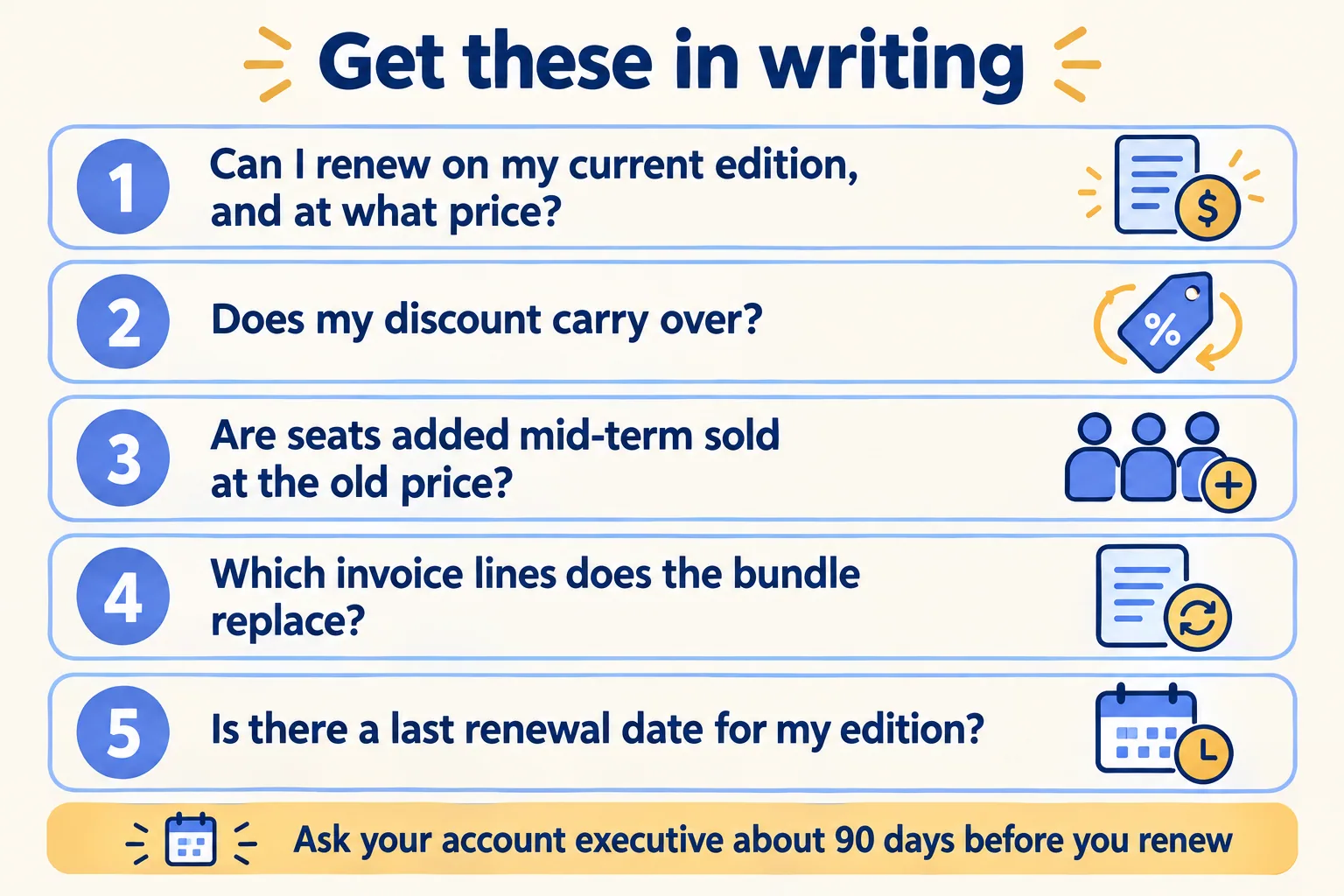
Ask around 90 days out, while the seat count can still change. That timing is our rule of thumb, not Salesforce's. If you are already inside 90 days, ask the five questions now. They cost nothing, and the answers shape how hard you press on the seat count.
What would we do first?
We would count before we compare. We have been a Salesforce partner since 2010, and at Mindcat we start any license review by reading what already exists in the org, then writing down what to keep, fix, or stop. The first read is our free assessment: a certified expert reads the org for unused seats, security gaps and the next process, and you get a written note with no obligation after it. You can see a sample note, on an invented org, before you send anything. The same read looks at what is stuck, such as automations and sharing that slow the week, which is the part a license count cannot show. Bigger work starts with our 48-hour read, two days in the org, the tickets and the last statement of work, and we do not fix-price work we have not assessed. Fixed prices come after, once the process is clear (see fixed pricing). A short situation on the form is enough to start the free assessment.

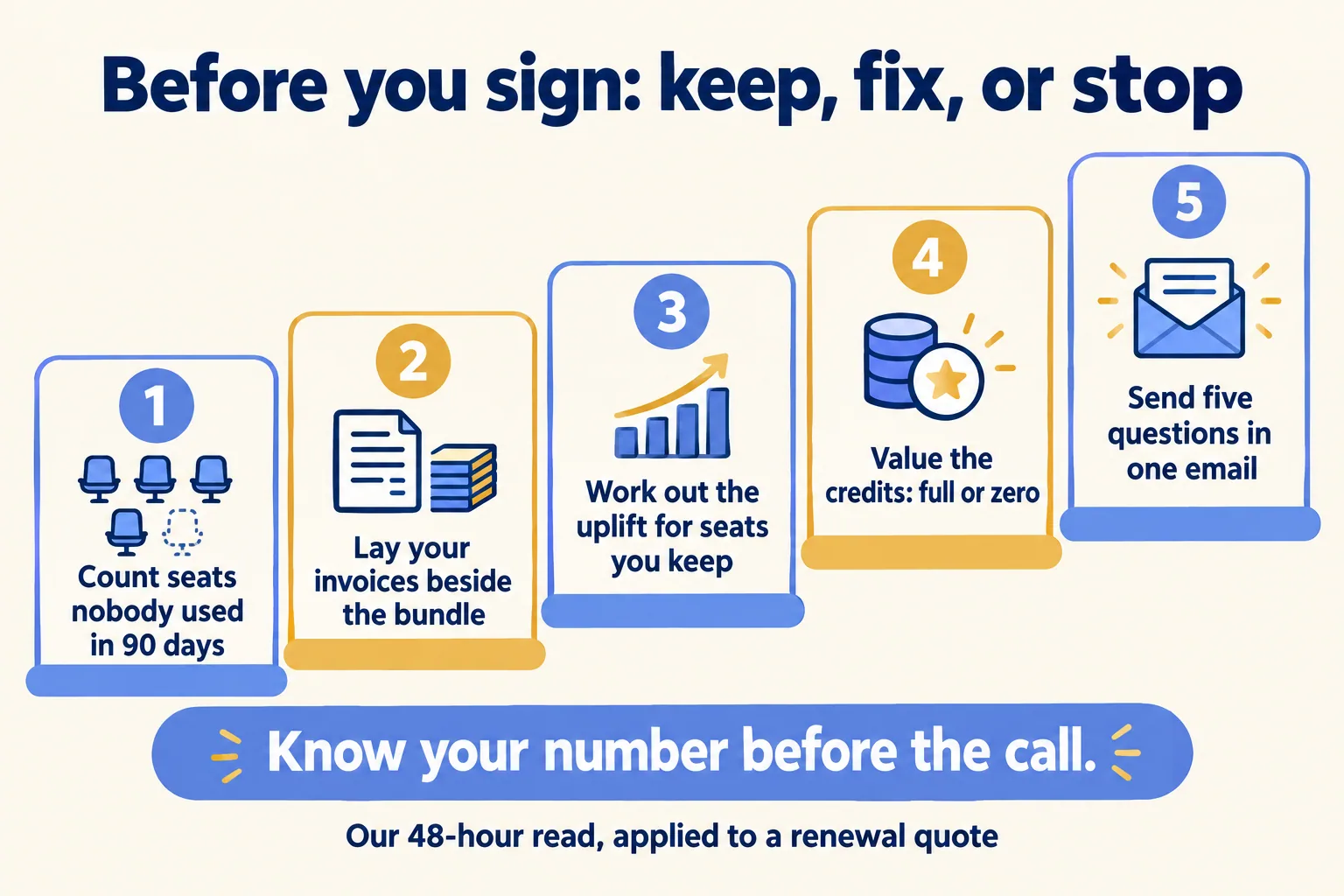
- 01Export your licenses by user and last login date. Mark the seats nobody has used in 90 days, and set aside integration and API-only users first.
- 02Put your current Slack, Tableau, support and backup invoices beside the worksheet above.
- 03Work out the yearly uplift for the seats you will actually keep, using the first table.
- 04Decide the credit pool's value: full if you will use it, zero if you will not.
- 05Send the five questions to your account executive and ask for the Core, Advanced and Max quotes in one document.
Seats nobody uses cost more under the new price than under the old one. Take an example, with made-up numbers. If 30 of your 200 seats have not logged in for 90 days, that is 15 percent of the org. At the reported $175 Enterprise list those 30 seats are $63,000 a year, and at Core's $195 they are $70,200. Dropping them does more for the bill than any argument about edition names, and it is a count you can do this week from your own login history. Check first that an "inactive" user is not an integration or API-only login. Removing one of those is how an integration starts failing without anyone noticing. We would not recommend a move to Core or Advanced from this page. We would recommend knowing your number before the conversation starts.
Before you sign, get the five answers in writing, starting with the edition you can renew on and whether your discount carries over.
