

What will Salesforce charge for?
Every successful call a registered agent makes to Salesforce, whether it arrives over the Model Context Protocol (MCP) or a direct API. Salesforce calls the unit a Headless Platform Interaction, tracks it in Digital Wallet, and will bill it in Flex Credits. That comes from Salesforce's own help article of 17 September, and Salesforce Ben reported it on 22 September.
The scope is a registered agent and successful calls. An integration that never registers as an agent is not in scope. Salesforce has not said how it treats failed calls or retries.

There is no price yet. The rate card lists the Headless Platform Interaction multiplier as "TBA". Until Salesforce publishes it, nobody can compute what one agent task costs.
Salesforce Ben says cost hits hardest for teams that bring an outside AI tool into Salesforce. They already pay Claude's or ChatGPT's provider, and Flex Credits add a second bill on the Salesforce side. Its technical content writer Tim Combridge questioned the scope, noting the model applies to agentic API usage more broadly, not just Salesforce-hosted MCP.
What is billed today, and what is not?
The new agent-call meter is not live, though Agentforce actions and Data 360 queries run through MCP already draw Flex Credits. The table separates three usage types that carry three different dates.
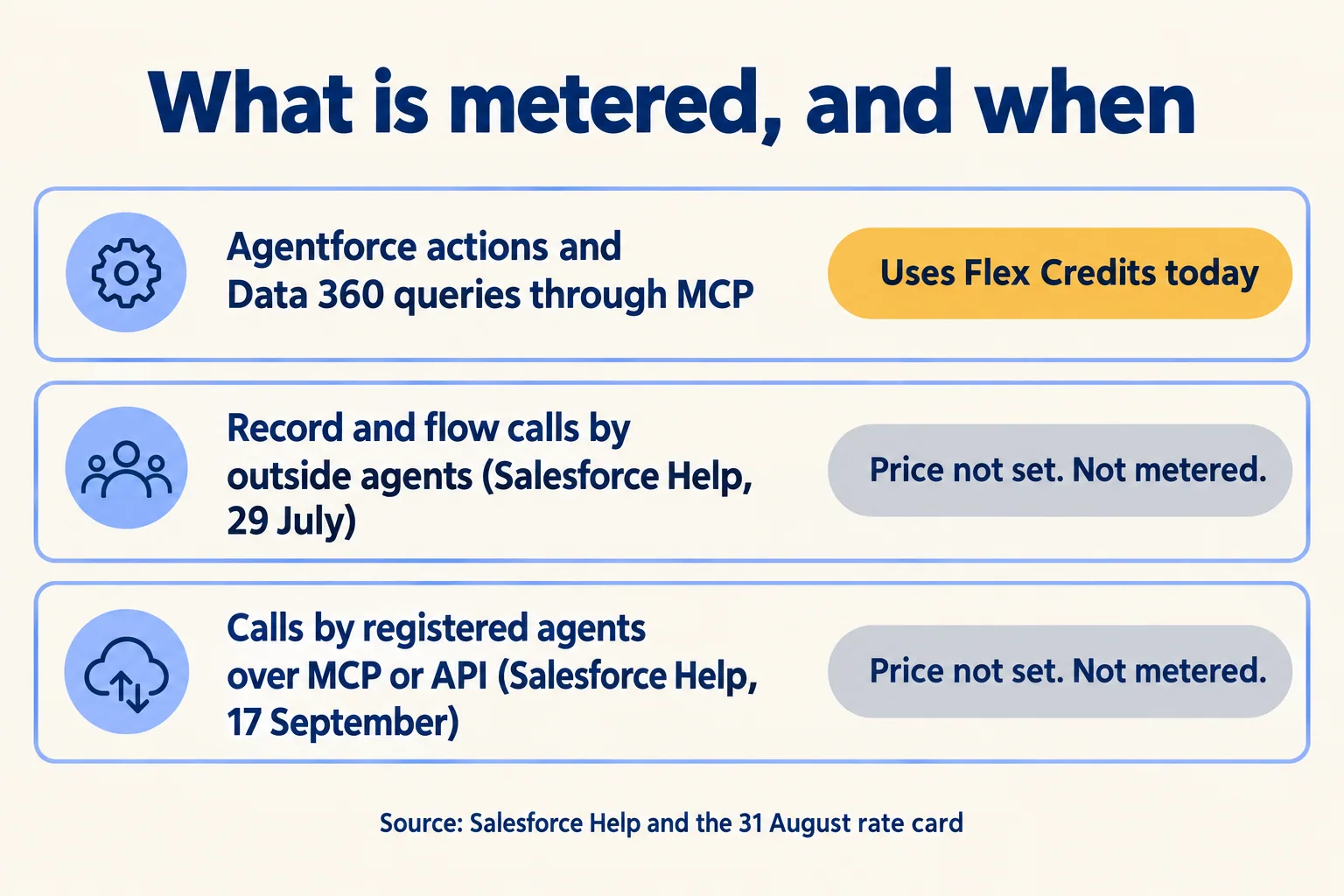
Metering waits on two things: Salesforce publishes a numeric multiplier, then gives 30 days' notice. The 17 September article says Salesforce is targeting November for the new registration controls and the billing model, but it does not give a metering date.
Agent-call metering applies only in active production orgs. Sandboxes, scratch orgs and Developer Edition orgs do not incur it, so you can trace an agent's calls without paying for them. Other Flex Credit usage types still have sandbox multipliers: a standard Agentforce action is 20 credits in production and 16 in a sandbox.
Which agents get metered?
Salesforce will meter the agents you register. Under a feature it calls Agentic Identity, an admin registers each agent on the platform and gives it its own identity and a narrower permission set than a person would have. In Salesforce's words, the same registration step that gives an agent its identity "is what makes that agent's activity visible, governable, and billable."
Traditional integrations stay out. Salesforce says their pricing and security options "stay exactly as they are today."
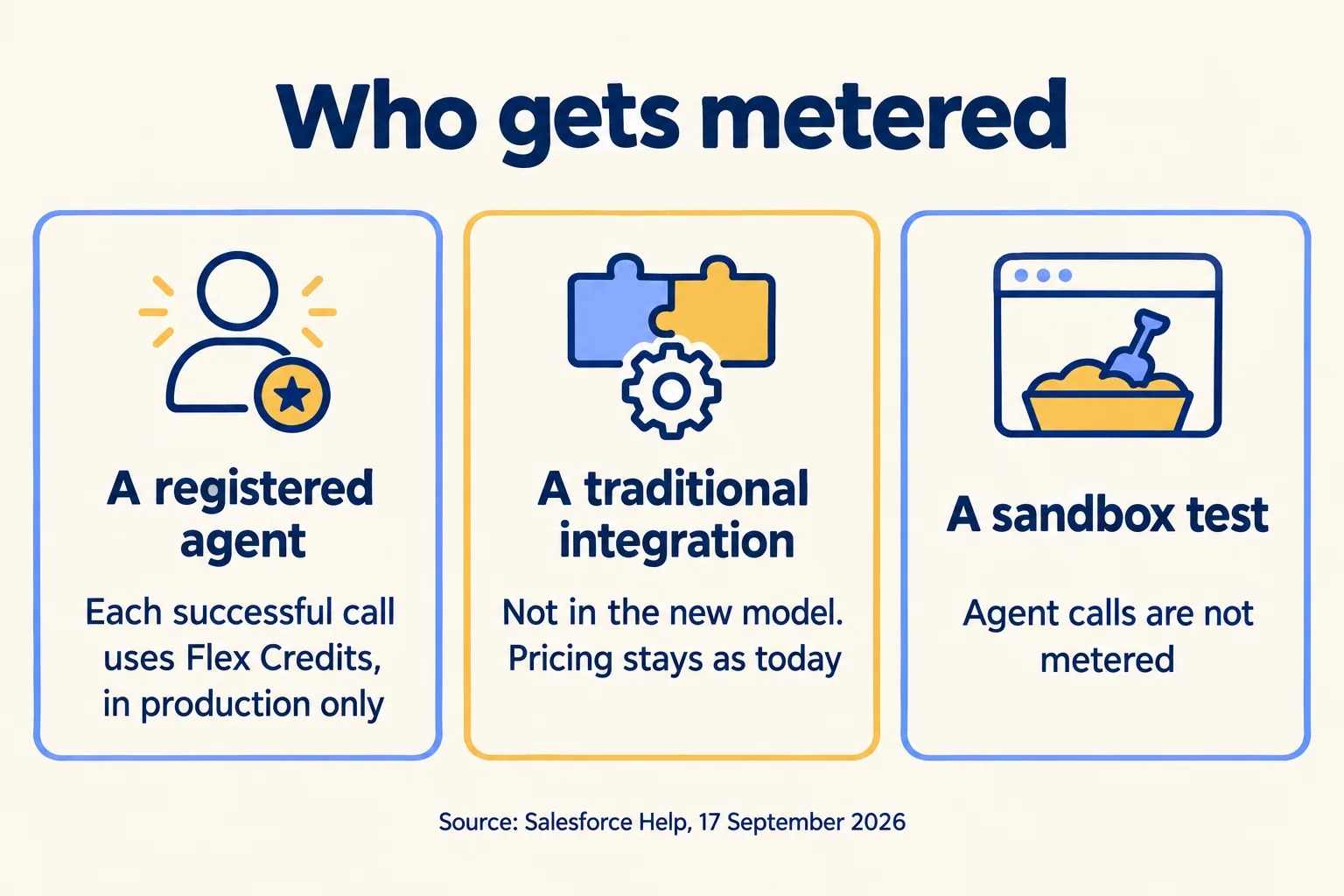
Each group has its own deadline:
- Existing customers using agents with APIs register those agents and move to the new billing model at renewal.
- New purchasers who buy on or after 17 September register every agent that uses Salesforce APIs within three months of Salesforce's notice that Agentic Identity is available.
- Anyone using a Salesforce MCP server, existing or new, registers within three months of that notice. If both apply to you, plan for the earlier date.
- Enabling billing needs an org that can consume Flex Credits, which means buying Salesforce Foundations (listed at $0) or another qualifying SKU.
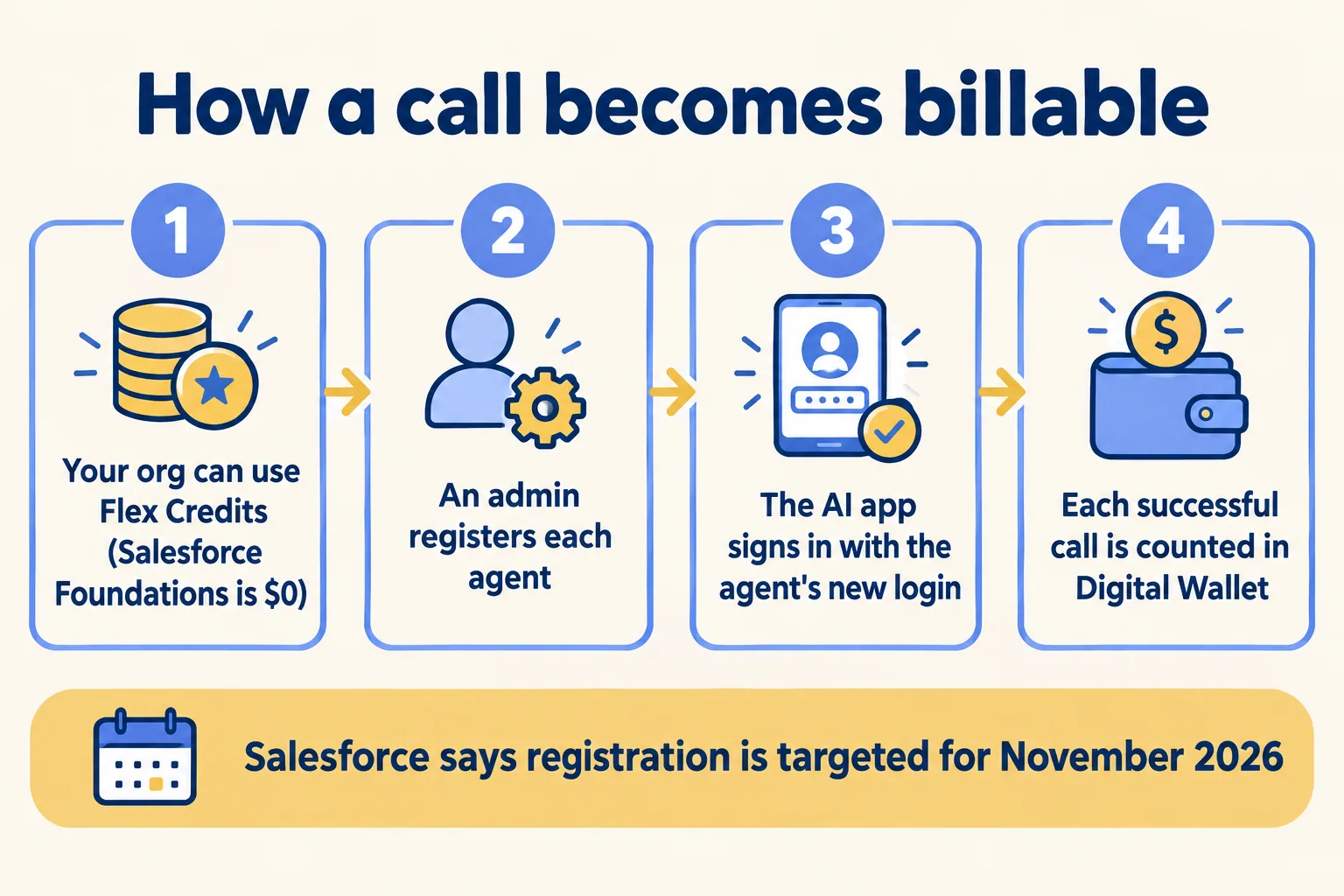
The renewal contract fixes what counts as an agent, when you register, and what you pay per interaction.
What does security need before it approves the write?
If security will not approve write access under a person's login, registration may be your way out once it ships. Give them a packet they can sign. In our post on Salesforce hosted MCP servers we noted that every call runs as the person who signed in, so the record shows the signed-in person as the actor. Registration gives the agent an identity and a narrower permission set of its own, which is one missing piece for "who acted?". Salesforce is targeting November for it.
Salesforce's help article describes no single switch that stops a registered agent. Ask for one. This is the packet we would put in front of security:
Then the order matters. Start read-only, run the agent in shadow mode so it proposes a write and a person applies it, and open one write at a time behind a reviewer, as in our spec-driven engineering guide. Registration names the agent on each call. A reviewer still approves each write.
What do the new editions change?
On 3 September Salesforce changed seat prices and credit pools. It announced Core, Advanced and Max editions for Agentforce Sales, Service and Industries. Salesforce says each bundles Agentforce, Slack, embedded analytics, data security and Premier Success Plans. The prices below are for Sales and Service; Industries pricing follows later this fall.
Salesforce says existing customers keep their legacy pricing. CIO reported the earlier prices as $175 for Enterprise and $350 for Unlimited, so Core lists about 11% higher and Advanced about 13% higher, though CIO notes Slack, Tableau Next and other items were sold separately before. The announcement does not say whether Enterprise and Unlimited are still sold to new buyers, so ask.
Subscription Insider reports that for Core and Advanced the credits are allocated to the organization for the year, and do not grow with every seat. Salesforce's rate card says Flex Credits must be used before the order end date and do not roll over, and that the entitlement is the one in the Usage Details table on your order form.
Whether agent calls will draw on this pool is not settled. Salesforce's announcement says only that Max editions will later include an allocation for Headless 360 capacity. Our Agentforce pricing post covers how actions and resolutions use the same credits today.
How far do the included credits go?
The answer depends on an unpublished multiplier, and on whether these pools cover agent calls at all. A Flex Credit costs half a cent ($500 per 100,000), and a standard Agentforce action uses 20. The table divides each edition's included credits by three multipliers. These are not forecasts.
Agent calls each edition's included credits would cover, at three multipliers
The spread is 20 to 1, so the multiplier alone decides whether your agent program fits inside the included credits.
To get your own number, count calls per task. Run the agent in a sandbox and record how many MCP or API calls one finished task makes. If the multiplier applies per call, as Salesforce's wording suggests, multiply by tasks per month and by the multiplier once it exists.
What to put in writing before you renew
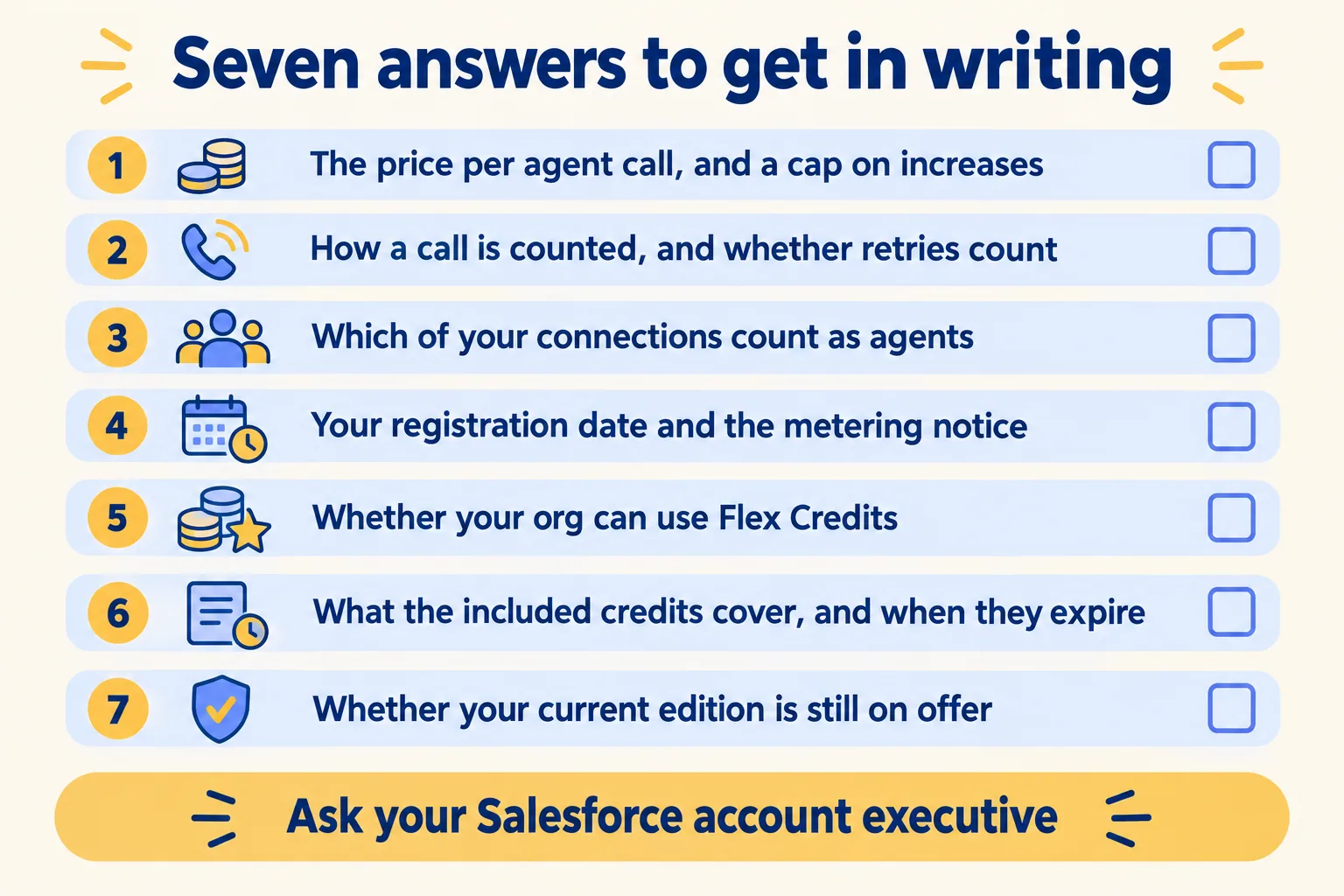
Get answers to these seven in an email from your account executive, or better, in the order form. Each covers a point Salesforce has not settled.
- 01What is the Headless Platform Interaction multiplier, and is it fixed for the term? Salesforce's rate card says multipliers may be updated from time to time, so ask for a cap on increases.
- 02How is a call counted? Confirm that only successful calls from registered agents are billed, and that retries and failed calls are not.
- 03Which of our connections will be classed as agents and which as traditional integrations? List each connector by name.
- 04What is the registration date for our contract, and how much notice do we get before metering starts?
- 05Do we have Salesforce Foundations or another SKU that lets the org consume Flex Credits?
- 06What do the included credits cover, and do they expire at the order end date? Ask for rollover or conversion into other products.
- 07Are Enterprise or Unlimited still available to us at renewal, and at what price against Core and Advanced?
The Register reported on 21 September that Gartner warned in January that all-you-can-eat agreements might not be available at renewal, and advised negotiating limits on price increases if Salesforce moved customers to contracts with defined usage allowances. Salesforce denied it is moving away from capped agreements. Raise it in the same conversation.
What we would do first
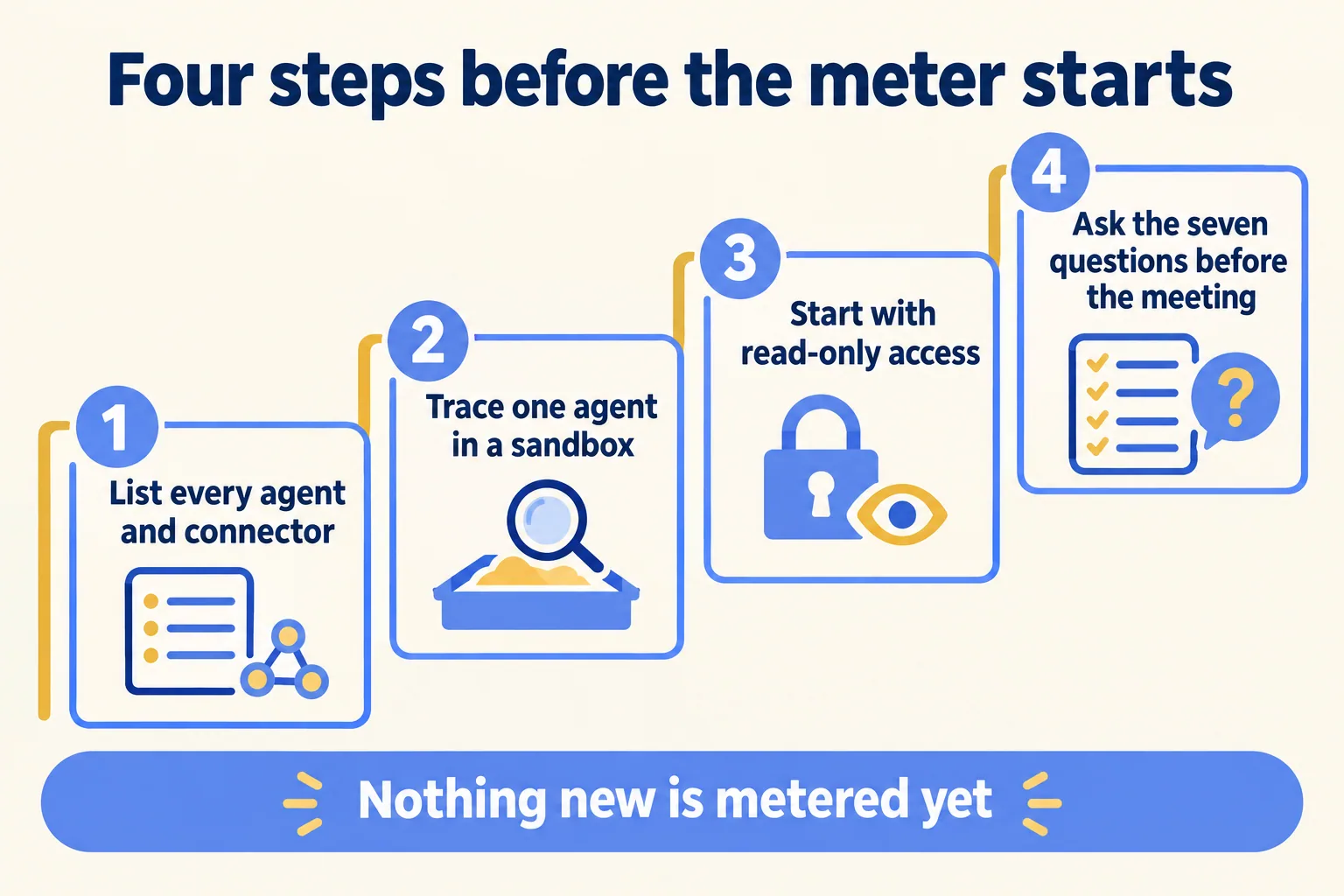
Nothing new is metered yet, so measuring costs nothing. Start here.
- List every agent and connector that reaches your org, including ones a team set up on its own. Registration works per agent, so the list comes first.
- Trace one agent in a sandbox. For each call record the endpoint, whether it reads or writes, the object, and whether it succeeded. Calls per finished task is the number you multiply by the multiplier later.
- Keep the first connection read-only, as we describe in our MCP post. Fewer write calls mean a shorter log and a smaller bill.
- Ask the seven questions before the renewal meeting.
We do not know the multiplier, the notice date, whether registration changes how a sign-in is scoped, or how Salesforce will classify every connector. We will update this post when Salesforce publishes them. We run more than 200 agents in production, and the pilots buyers bring us stall at the same place: security will not approve the write. The packet above is how we get past it. Our First Agent in Production work starts with one process someone runs by hand today, and puts an agent on it with a reviewer on the exceptions.
