

What does Agentforce cost after Dreamforce 2026?
Four units. Salesforce now bills Agentforce per action, per resolved service session, per conversation, or per user. The rate card behind them changed on 31 August 2026, and at Dreamforce Salesforce told buyers that service agents are now charged only when the customer's issue is resolved. Pick the unit that matches how your process ends.
Picking the unit first is how a pilot gets the wrong budget. Finance asks for a monthly number, someone opens the price page, and the pilot gets a budget built on the wrong unit. Start from the case instead: how many actions one case takes, and how often the agent finishes it alone.
Which pricing unit fits which process?
Match the unit to how the work ends. A process with a clear customer outcome suits a per-resolution price. A process with a countable, short chain of actions suits per-action. Employees who work with an agent all day suit a flat fee per person.
- 01Customer-facing service with a clear resolved or unresolved end: Help Agent at $2 per resolution.
- 02Internal or back-office work with a short chain of actions, such as triage, updates or routing, below the break-even in the next section: Flex Credits.
- 03A named team that uses agents inside Salesforce all day: the $125 flat fee, once each person passes 1,250 actions a month.
- 04Anything that writes to a system of record: price it last, after shadow mode shows how many actions a real case takes.
The third rule is plain arithmetic. At $0.10 an action, $125 buys 1,250 actions, about 60 a working day. A rep who asks an agent for a handful of summaries a day will not get there. A team that routes every case through one will.
Agentforce may not be the right runtime for the process at all. Our Agentforce or custom agents comparison settles that with three questions about where the work already lives.
When is per-action cheaper than per-resolution?
When a conversation takes fewer actions than 20 times the resolution rate. On Flex Credits a conversation costs its action count times $0.10. On Help Agent, you pay $2 only for the share of conversations that resolve, so the average cost per conversation is the resolution rate times $2. The two meet where actions equal 20 times the resolution rate.
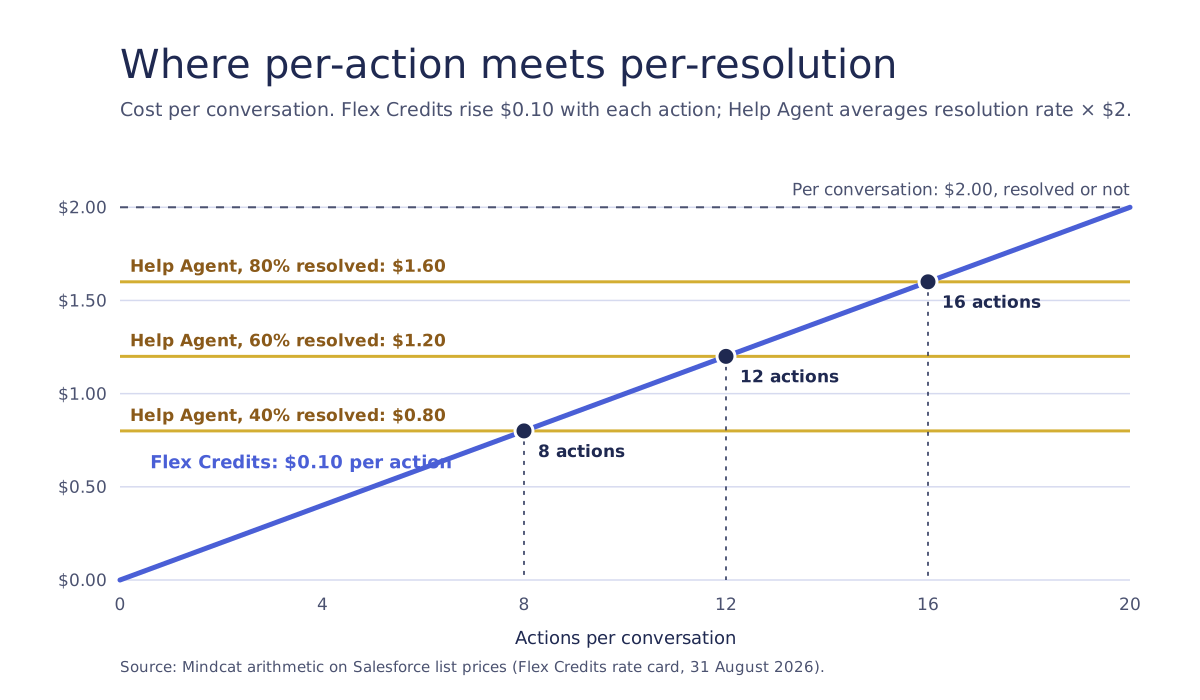
Break-even actions per conversation
Take 5,000 service conversations a month. With 4 actions each on Flex Credits, the bill is $2,000. On Help Agent at a 60% resolution rate, 3,000 sessions bill at $2, which is $6,000. The per-conversation model charges all 5,000, which is $10,000.
Monthly cost at 5,000 conversations, USD
Help Agent pricing includes something the table leaves out. Salesforce says the actions and Data 360 queries inside a resolved Help Agent session are included, so you are not forecasting consumption on top. For a CFO who wants one number per resolved case, that can be worth the premium.
What counts as a resolution?
Salesforce defines it, and a silent session counts. A Help Agent session is billable when it has at least two turns, the final feedback is not explicitly negative, and it ends without an escalation to a human, or with explicitly positive feedback. When the customer gives no feedback, escalation decides: no escalation means resolved.
When a Help Agent session bills as resolved
- 01Two turns or moreThe session has at least two turns between the customer and the agent.Salesforce rule
- 02Feedback not negativeThe final feedback is not explicitly negative. No feedback at all passes.Salesforce rule
- 03No escalationThe session ends without a handoff to a human, unless the feedback was explicitly positive.Salesforce rule
- 04Billed: $2400 Flex Credits. Messaging caps at two hours and voice at ten minutes per resolution.Your bill
So a customer who gives up and closes the tab can cost $2. Messaging sessions are capped at two hours and voice at ten minutes, so a resolved 12-minute call bills as two resolutions.
Measure the same cases from your side: reopen rate within seven days, repeat contacts from the same customer, and CSAT on sessions that billed. If your reopen rate on "resolved" sessions climbs, the resolution count is overstating what the agent did.
What does the price page leave out?
The person on the exceptions, and the gate on the write. Every unit above prices the agent's work. None of them prices the reviewer who handles what the agent should not decide, or the engineering that keeps an agent from writing the wrong value to a record.

Pilots stall here. Security will not approve write access until someone can say who reviews exceptions and how a bad write gets caught. We put that in the spec before the agent goes live, following our spec-driven engineering guide, and we map the write path against the five planes of the architecture.
Budget the process as three lines: the Agentforce unit, the reviewer's hours on exceptions, and the build of the write path. Only the first line is on the price page, and the other two decide whether the agent leaves the sandbox. Our Agentforce implementation page covers how we scope all three in the first week.
