

If your lift contractor bills every month and nobody at the desk remembers seeing him, this is for you. It is not for a building with one lift and a contractor that already emails dated reports with test results and closed defects.
Lift contracts in Dubai towers often renew with the calendar year, so December is when the question arrives. The lift stopped twice in November, the owners ask what the contractor has been doing, and the file holds twelve sheets with a date and a set of initials on each. Before you sign the renewal, we run one count.
Does anyone at the desk remember seeing him?
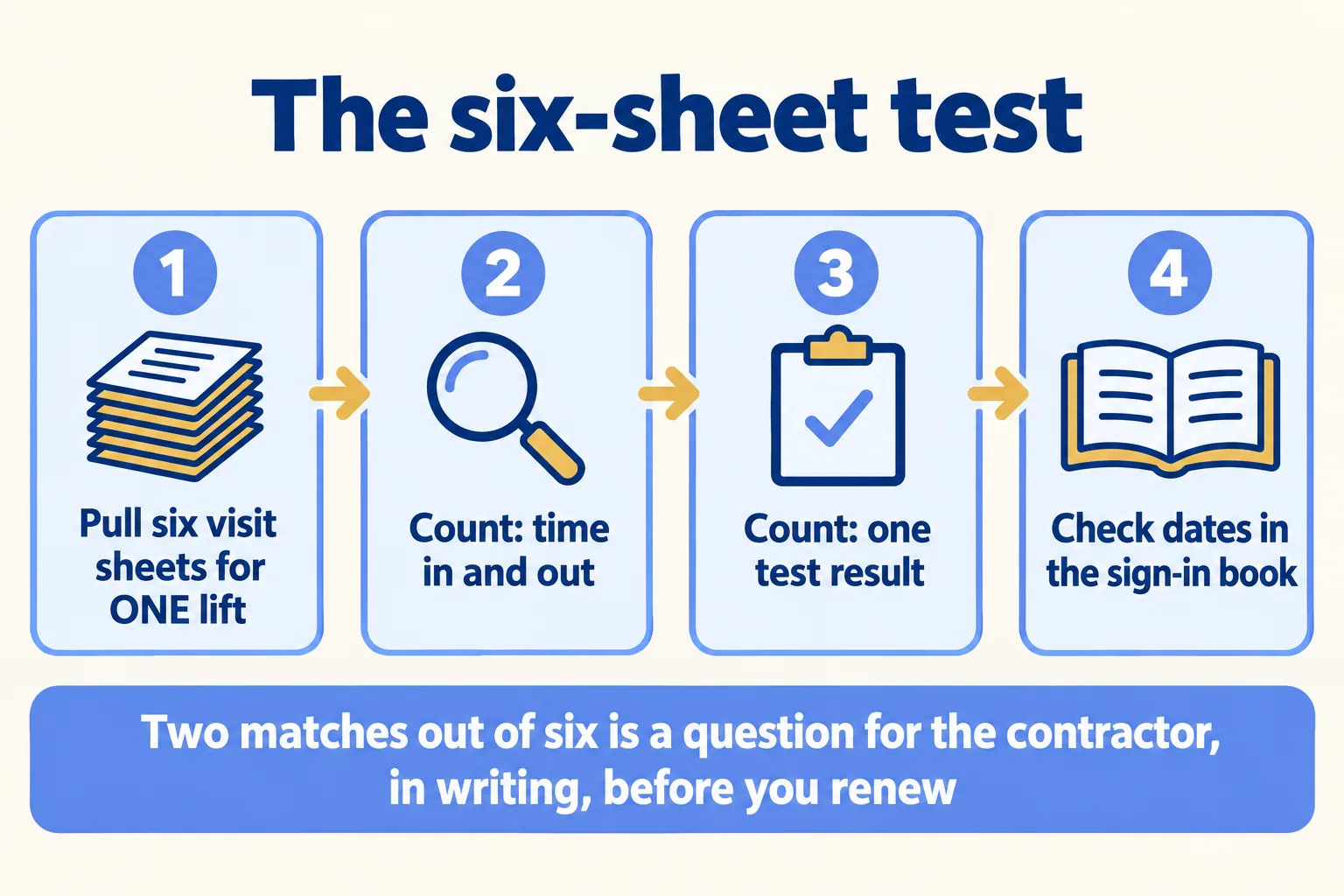
Take one lift. Pull its last six visit sheets and count three things on each:
- A time in and a time out. Not just a date.
- At least one test result. Safety gear, governor, emergency lighting, door protection: a result, not a tick.
- A defect with the date it was closed. Or an honest "none found".
Then take those six dates to the lobby and open the sign-in book for the same days. In most towers the lift technician never signs it, because he carries a permanent contractor card and comes up from the basement, so the record you want is the access-card report. Ask whoever runs your access system for the entries on those six dates for that contractor's cards. If the building has no pass system at all, the fallback is the supervisor's own diary and the service lift booking sheet.
The rows above are a sample to show the shape of the count. Put your own six visits in their place, then read the total the way we do: five or six complete sheets and you keep his logbook. Three or four and the missing lines go into the contract at this renewal. Two or fewer and it goes to the owners committee with a request for an explanation before anyone signs. None of that is proof of anything by itself; it is the question to put to the contractor in writing before the renewal, not after.
What should a lift visit sheet show?
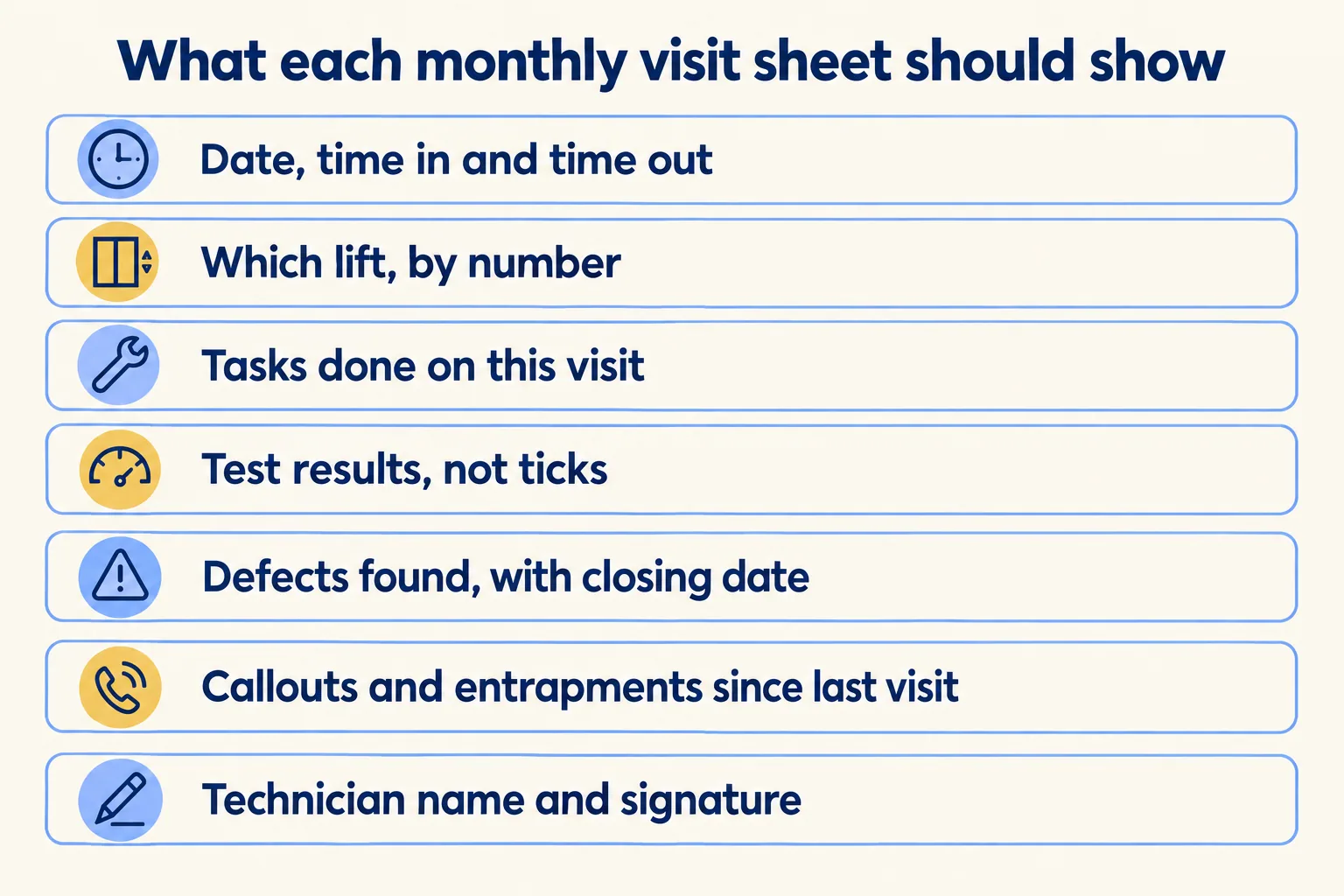
Enough that a second technician could pick up the lift tomorrow without asking anyone. Lift consultants who audit buildings for a living are blunt about the two lines that matter most. LML Lift Consultants' list of warning signs (25 September 2026) says to "ask Technicians to sign in and out where possible, then compare their hours on site with the minimum hours stipulated in the Maintenance Agreement", and adds that if an agreement does not specify minimum hours, "that's already a warning sign". On tests it is shorter still: records "should either be in the logbook within the Machine Room or controller cabinet, or available electronically. If they can't be produced, the tests may not have been done."
Your lift's manual and your maintenance agreement set the tasks and their intervals. Where the agreement and a generic checklist differ, follow the agreement, and ask for the minimum hours to be written into it at renewal.
What does Dubai ask you to hold?
The monthly visit is your contract. The certificate is the Emirate's, and it is separate.
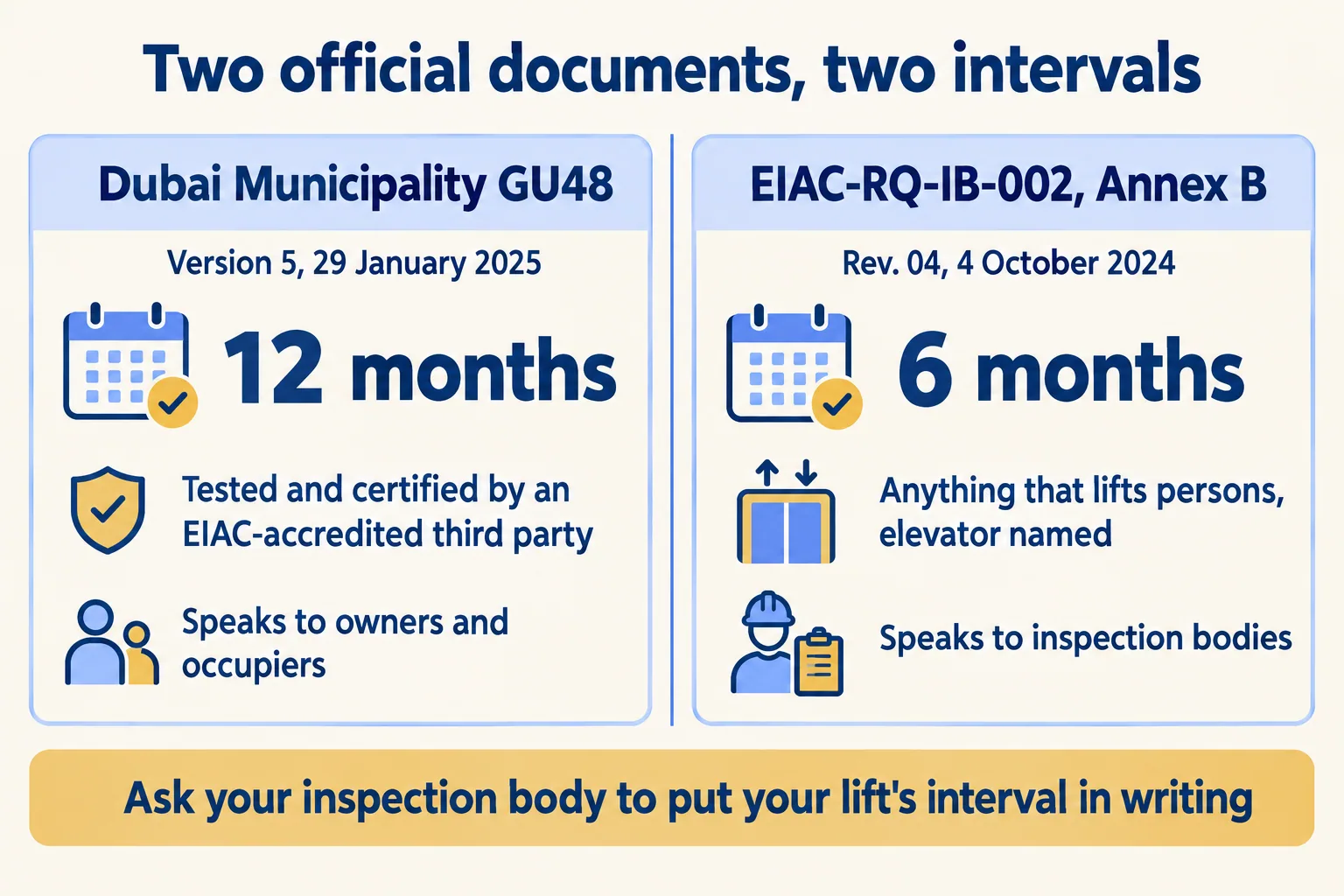
Dubai Municipality's technical guideline GU48 (DM-HSD-GU48-ECLA2, version 5.0, issued 29 January 2025) says lifts and other lifting equipment "shall be tested and certified by a third party accredited by Emirates International Accreditation Center (EIAC) once every 12 months". The accredited body issues its certificate after examination and test, and only once repairs have been carried out, naming the serial number, the technical details, the tests done and the safe working load. Repairs the third party identifies "shall be carried out by the owner/occupier immediately". The safe working load is displayed on the equipment, and the "compliance certificate shall be kept at the site".
Then there is the number that catches building managers out. EIAC's own accreditation requirements for inspection bodies (EIAC-RQ-IB-002, Issue 1, Rev. 04, 4 October 2024) open Annex B by saying that "any Equipment (what so ever) utilized to lift persons shall be inspected within a period not greater than 6 months", and the table that follows lists the elevator in exactly that row, at "every six (6) months". Escalators and passenger conveyors sit on the next row at six months without the load test.
A Dubai lift firm reading the same two documents (3 November 2026) reaches the practical answer: ask the accredited inspection body to record the applicable schedule for each unit in writing. It also notes that GU48's scope names factories, construction sites, hotels and other workplaces, without listing residential towers one by one, so a building manager should ask the inspection body or the Municipality how it applies to their building. Put the answer in the lift's file with the certificate, and diary the expiry date the day you receive it.
Who answers for the lift in a jointly owned tower?
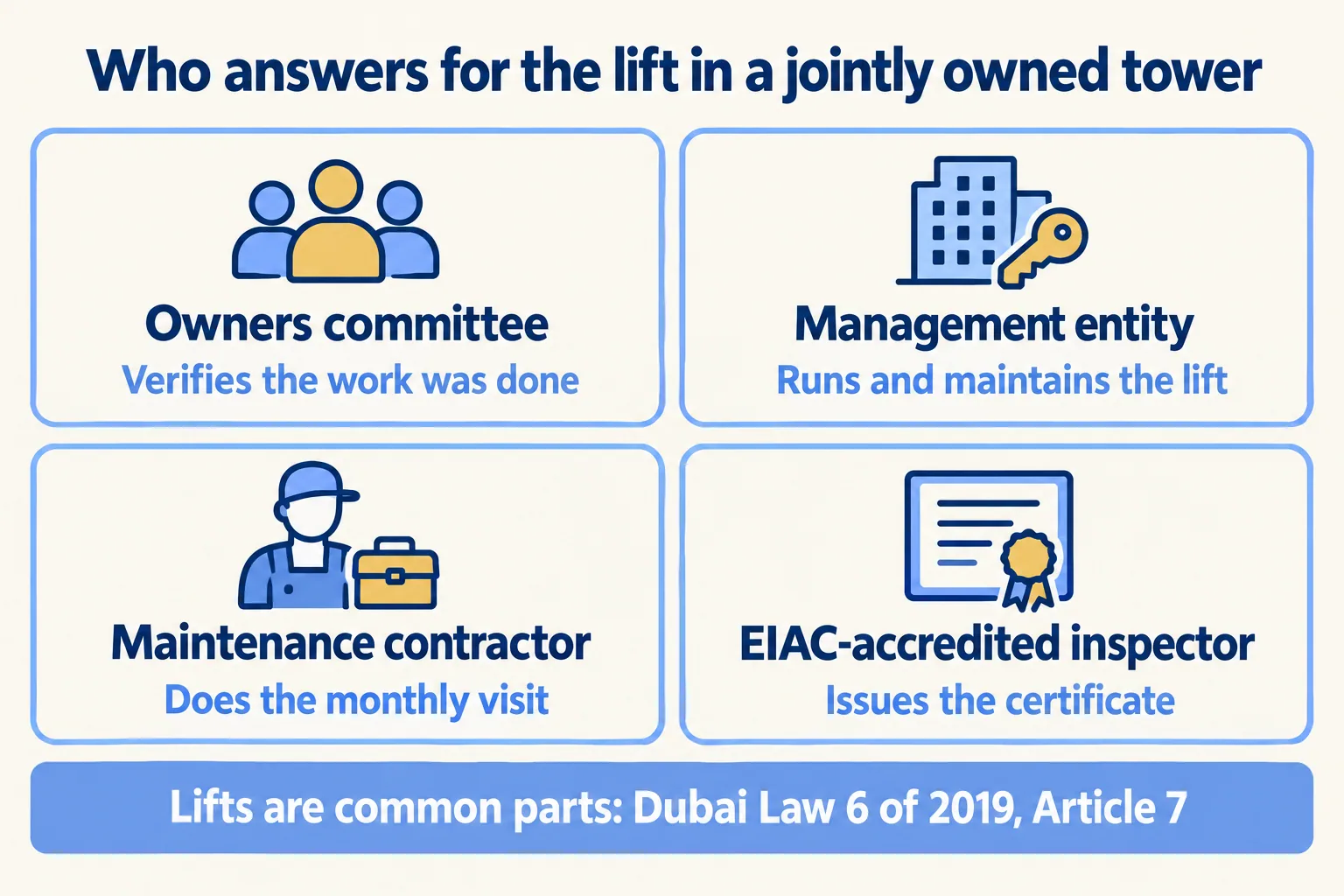
Not the contractor. Dubai Law No. 6 of 2019 on jointly owned real property lists, in Article 7, the common parts of a building, and item 5 of that list reads "elevators, tanks, pipes, generators, chimneys, ventilation fans and ducts, air compressor units, and mechanical ventilation systems". Article 24 gives the owners committee the duty to "verify that the Management Entity undertakes the management, operation, maintenance, and repair of the Common Parts", and to review the annual maintenance budget.
So when the owners committee meets and asks what the lift AMC bought this year, the person who has to answer is the management entity, not the lift firm. The six sheets are what that answer is made of. This is general guidance on published law rather than legal advice: confirm your building's position with RERA or your legal adviser before you rely on it.
Why elevator maintenance goes unseen
Because almost all of it happens in a machine room nobody else enters.
An incident consultant writing in Elevator World (September 2022) describes what he finds when he investigates injuries: "a task that should take an hour is recorded complete in 15 min", and of the written maintenance records, "99% of the time, these written records are blank or only sporadically filled in". He traces it to route loading, where remote monitoring let companies assign hundreds of units to a mechanic instead of the 70 to 90 he knew as a superintendent.
A US elevator consultancy's guide to checking the same thing (21 March 2026) names the test this post is built on: "Compare the dates on your service reports to your building access control system, visitor logs, or security check-in records." Its other tell is the one you can read in ten minutes: service reports that recycle the same sentences month after month, where "legitimate maintenance reports include specific observations". Both publishers write about North America and Australia, so read them as practitioner experience, not a Dubai rule. The check costs you nothing either way, because the sign-in book is already at your desk.
How we decide: his logbook, or your own record
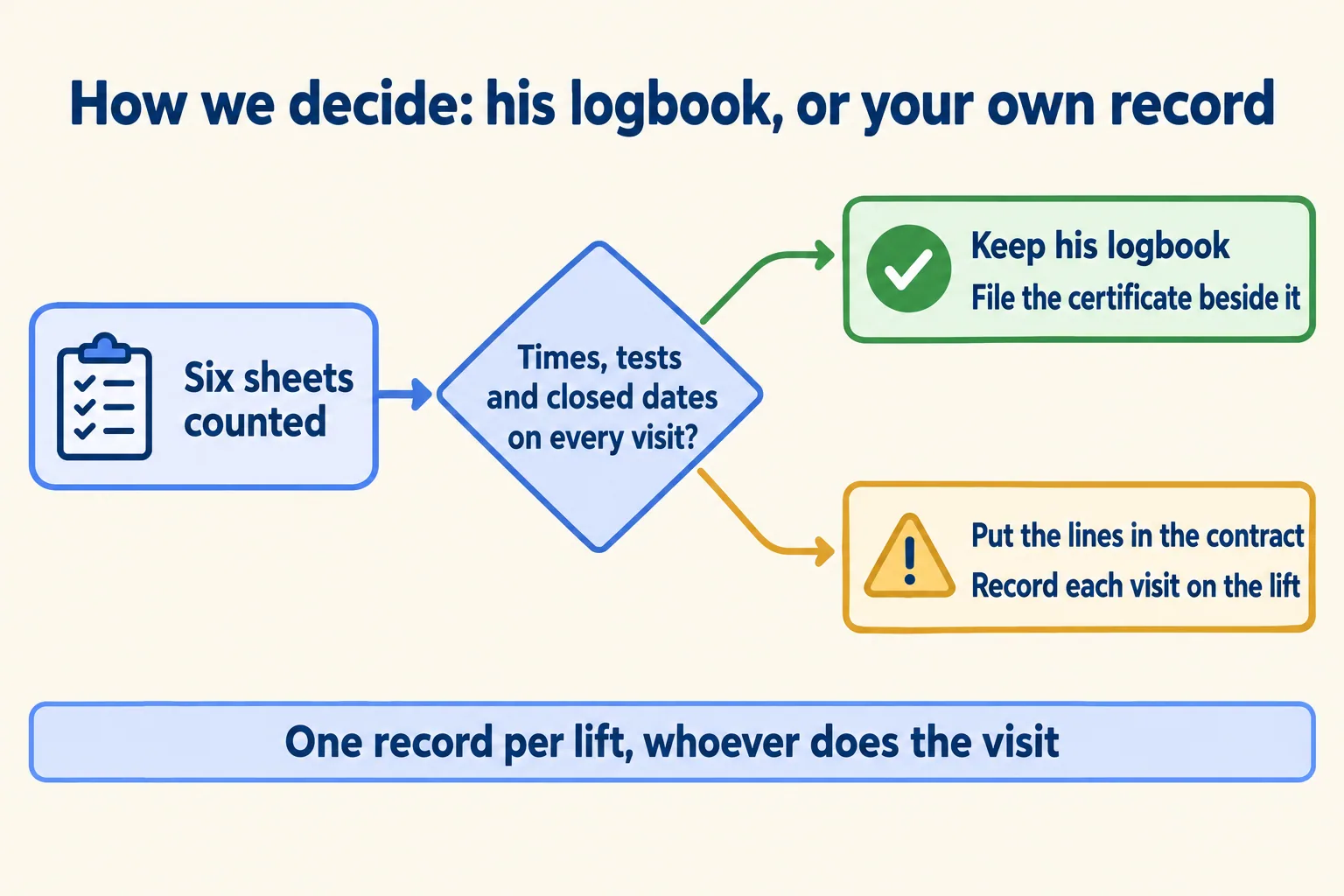
Our rule: keep the contractor's own logbook when every monthly visit in it shows a date, time on site, the tasks done and any defect with the date it was closed, and the current certificate from the accredited inspection body is on site. Move the visits onto a record of your own, one per lift, when the sheets read the same month after month, when breakdowns and entrapments live only in a WhatsApp group, or when last year's inspection findings have no closed date.
- 01Pull one lift's last six visit sheets.
- 02Count the sheets that show a time in and out, at least one test result, and defects with closed dates.
- 03Check those six dates against the lobby sign-in book or access records.
- 04Times, tests and matching dates: keep his logbook. Gaps, or repeated sheets: the visits go on your own record.
The contract is the cheaper fix and it comes first. A contractor told which lines to fill usually fills them, and the renewal is the moment he is listening. Four things are worth adding before you sign, and they come straight out of the count above: the minimum hours per lift per visit, so "regularly and systematically" stops meaning whatever the route allows; the lines each visit sheet must carry, listed in the table above; the response time you expect for a callout and for a trapped passenger, written as hours and minutes rather than "promptly"; and the rule for parts, so each one on the sheet is marked in scope or charged. Send them in the same email that asks the inspection body to confirm your interval in writing. Last year's sheets tell you which of these your contractor is already meeting.
When the contractor is the lift's maker, the sheet comes out of its own system in its own format and no account manager will redesign it for one building. Ask instead for the four lines as an annex to the renewal, delivered as a monthly summary per lift, and keep the PDF as it is. If the answer is that the report cannot change, the lines move to your side: your supervisor reads the PDF once a month and puts the date, the hours, the tests and any open defect on the lift's own record. That is five minutes a lift, and it is the version of this that survives a change of contractor. Where a building needs its own record is when the lifts outnumber the people who remember them: four lifts, three AMC firms, and a committee meeting once a quarter. The same question across the fire, lift and chiller contractors is worked through in our post on whose system should hold the AMC reports, and the chiller version of this count, where the missing lines are readings rather than times, is in what a chiller visit report must show.

What Mindcat Maintain keeps on the lift
Each lift is an asset, and the monthly visit is a job on it. In Mindcat Maintain a preventive schedule raises the lift's visit on its date at the interval your AMC contract sets, so the visit that slipped in July is visible in July, not at the renewal. The technician fills in the job's checklist on a phone: values, pass or fail checks and notes. The AMC contractor's technicians get their own logins, so the firm that does the work is the firm that records it, and a tenant's report of a lift stuck between floors becomes a job on the same lift. WhatsApp requests join once we connect your WhatsApp Business account during setup. That is the method we call "Complaint to closed job": every complaint and every scheduled visit ends as a closed job with its history on the asset.
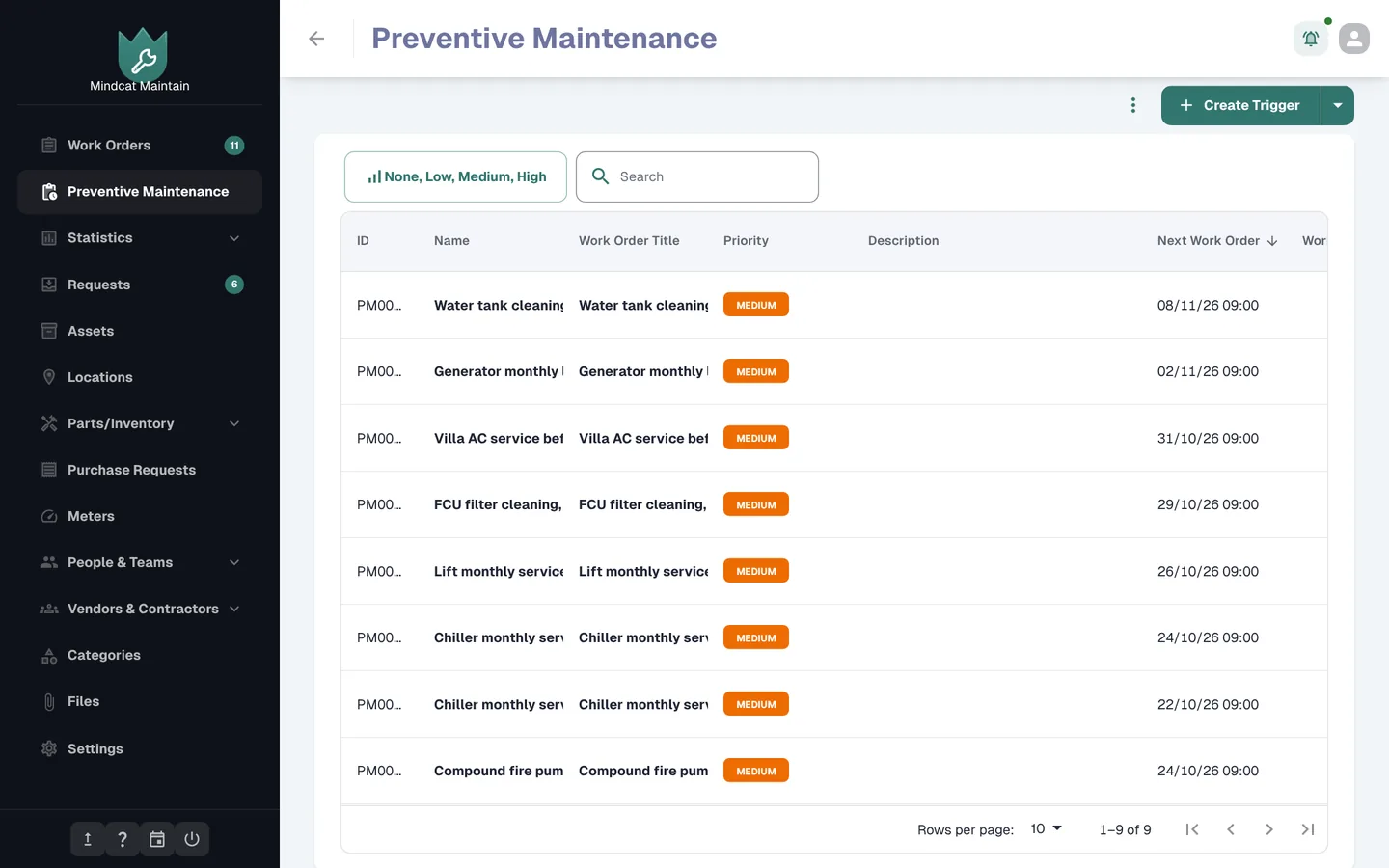
What it does not do: read the lift controller, the remote monitoring feed or the building management system. The visit data is typed by the technician or your supervisor. It does not inspect or certify a lift either, because only an EIAC-accredited third party does that. Keeping the inspection dates and checklists on each lift works on day one; attaching the certificate file, the contractor's PDF or photos to the lift needs the maker's feature licence, which we bill at cost, as do vendor and contract records for your AMC firms.
Maintain holds the building's lifts, chillers, pumps and tanks and the visits on them. The laptops, phones and licences your staff carry belong in Mindcat Assets. Our facilities management page shows the FM setup with sample data. If the sign-in check is the part that keeps failing because the desk uses a paper book, that is a visitor and contractor pass question, not a maintenance one.
Who should not start here?
A building with one lift and a contractor that already emails dated reports with test results and closed defects. File them against the lift, diary the certificate expiry, and spend the money elsewhere. Also a tower that has no maintenance agreement yet: Maintain runs the schedule your contract sets, it does not write the contract.
What does it cost?
From the live Maintain page. The price is per technician a month, graduated: technicians 1 to 10 cost AED/SAR 149 each, 11 to 30 cost AED/SAR 99, 31 to 100 cost AED/SAR 69, and 101 and up cost AED/SAR 49, each band applying only to the technicians inside it. Requesters, meaning tenants and staff who only raise requests, are free. The page's worked example counts technicians and supervisors together, so a supervisor who assigns or closes jobs is a paid seat and a resident reporting a stuck lift is not. If you give the AMC contractor's technicians logins so they record their own visits, those are paid seats too, on your subscription. A building that would rather not carry them keeps the seats to its own supervisor, who puts the visit on the lift's record from the contractor's sheet.
Every plan has a monthly minimum, and a building team checking one or two AMC contractors sits in the smallest one. The shared plan, up to 10 technicians, has a minimum of AED/SAR 2,649 a month. Your own copy hosted by us in the UAE or Saudi Arabia has a minimum of AED/SAR 5,699. The page's worked example runs 30 technicians at 10 × 149 + 20 × 99 = AED 3,470, which still pays the AED 5,699 minimum, and that minimum covers up to 62 technicians.
The maker's feature licence is billed at cost at USD 15 per technician a month, its list price, and it covers photos and files on jobs, the request portal, the PM calendar, vendors and contractors, and more than 5 users. The quick start, which we set up for you on the shared plan up to 10 technicians, is AED/SAR 2,500, fixed, and it includes our PPM schedule template for chillers, lifts, pumps, tanks and fan coil units. Larger teams get managed setup to a written plan, from AED/SAR 5,900 a month. Prices exclude 5% UAE VAT and 15% Saudi VAT.
Set that against a renewal you sign without knowing what the last year bought. Tell us how many technicians you run, which buildings they cover and how complaints reach them today. We reply with the setup plan and the monthly price per technician, in AED or SAR.
