
If every complaint about a leak or an AC goes to a contractor's WhatsApp and you only hear back when the tenant calls again, this is for you. This is not for you if nobody on your side owns the job list once the contractor says it is done: no system fixes that.
What is a CMMS, and who is it for?
A CMMS is software that holds your buildings and equipment, schedules planned maintenance, turns requests into work orders and records what each technician did. The letters stand for computerized maintenance management system. It runs the schedule you load. It does not decide how often a chiller, lift or pump needs service.
It is built for a team that does the work. Technicians close jobs on a phone, supervisors see what is open. If your AMC firm sends the technicians and writes the report, the person closing jobs is not on your system at all.
Adoption is the weak point even where a system exists. In Limble's State of Maintenance Report (September 2026, 686 US maintenance and operations professionals), reported by Plant Engineering on 23 October 2026, "just 39% report consistent use across the entire team". Leaders surveyed estimate their teams complete "just 54% of scheduled preventive maintenance". It is a vendor-run US survey, so take it as a warning about habits, not a Gulf number.
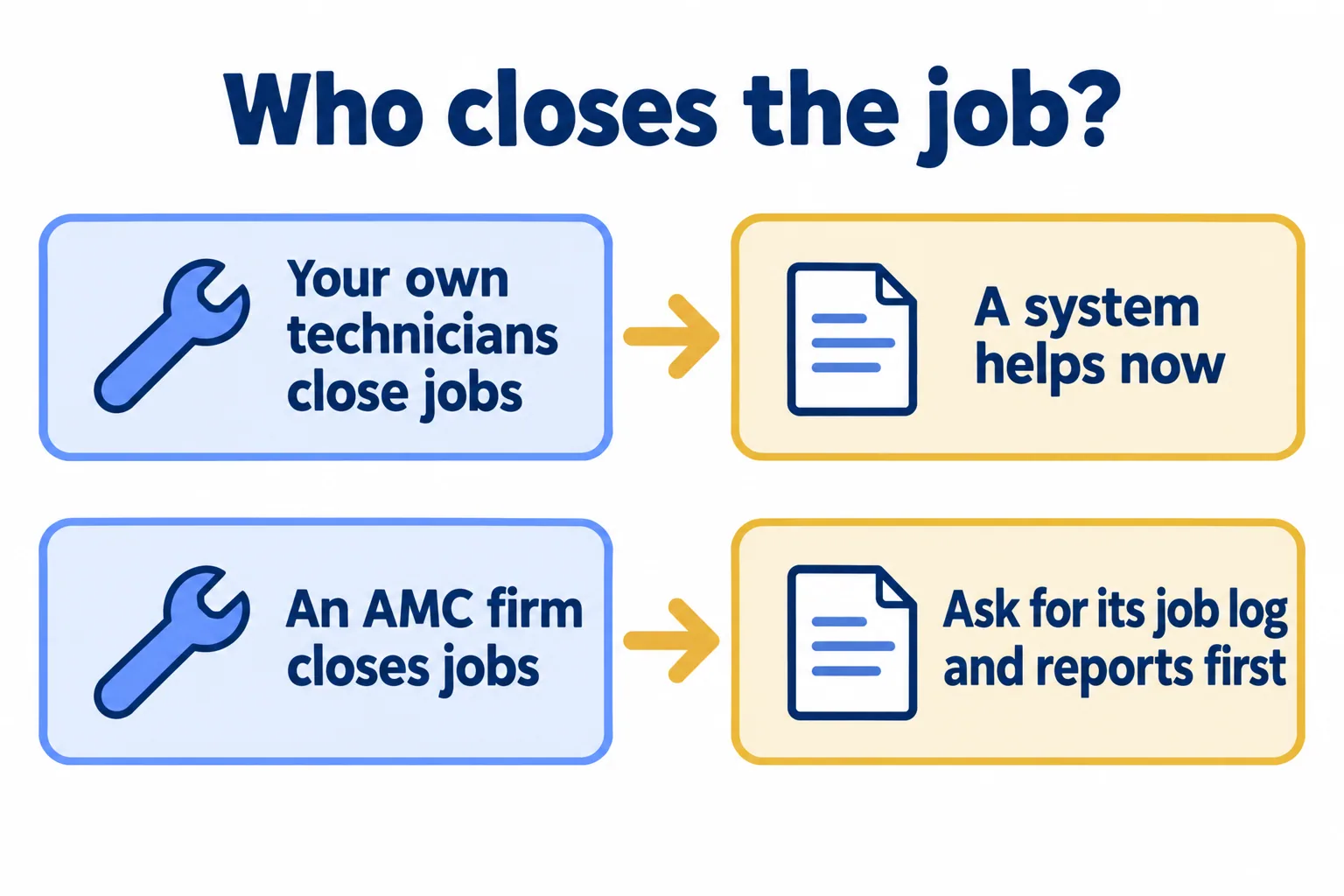
Who closes the jobs in your building?
That one question decides what you buy first. If your own supervisors and technicians close jobs and you cannot say which request is open, a system helps now. If an AMC or maintenance firm closes them, the record you need already exists, in the contractor's hands.
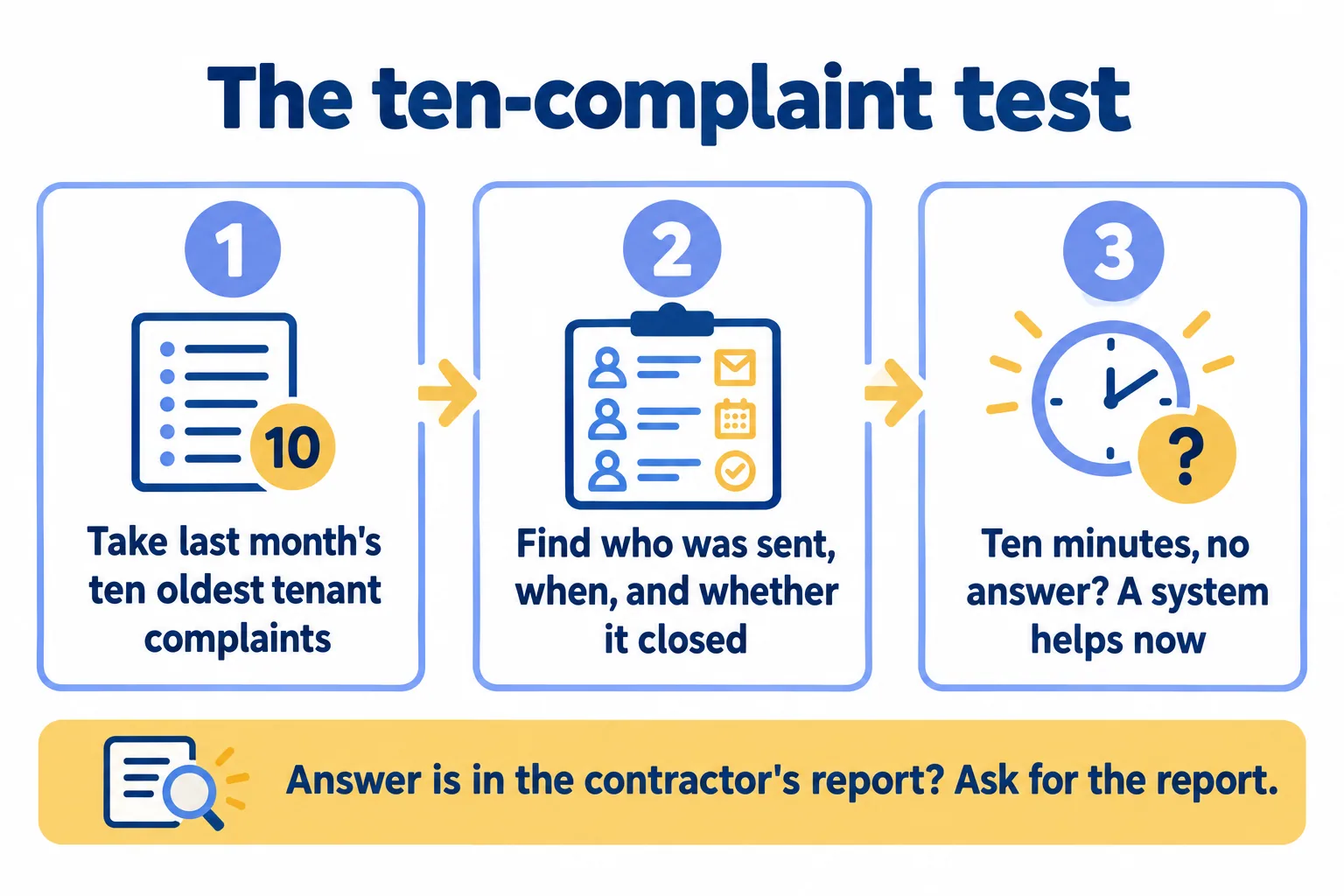
Test it in ten minutes. Take last month's ten oldest tenant complaints. For each one, find who was sent, when, and whether the job closed.
- 01Pull last month's ten oldest tenant complaints.
- 02For each, find who was sent, when they went and whether it closed.
- 03If you cannot find the answers in your own files in ten minutes, a system helps now.
- 04If the answers sit in the contractor's report, ask for the report first.
Why do vendors say buy first?
Read the top results for "CMMS" and you will be told to buy. UpKeep's guide (updated 7 September 2026) calls a CMMS "the best starting point for smaller businesses or maintenance-first teams" and says cloud systems "commonly deploy in one to four weeks". UpKeep sells one, so that is a sales position, and for a team that runs its own technicians it is a fair one.
A property manager is a different buyer. Visitt, another vendor (blog updated 20 April 2026), makes the point from the other side: a CMMS stores vendor certificates and renewal dates, but it "doesn't validate coverage against lease requirements". It tracks the maintenance. It does not run leasing, tenants or the contract.
So when someone else does the repairs, the first purchase is a better contract, not a tool.
What do you ask your AMC firm for?
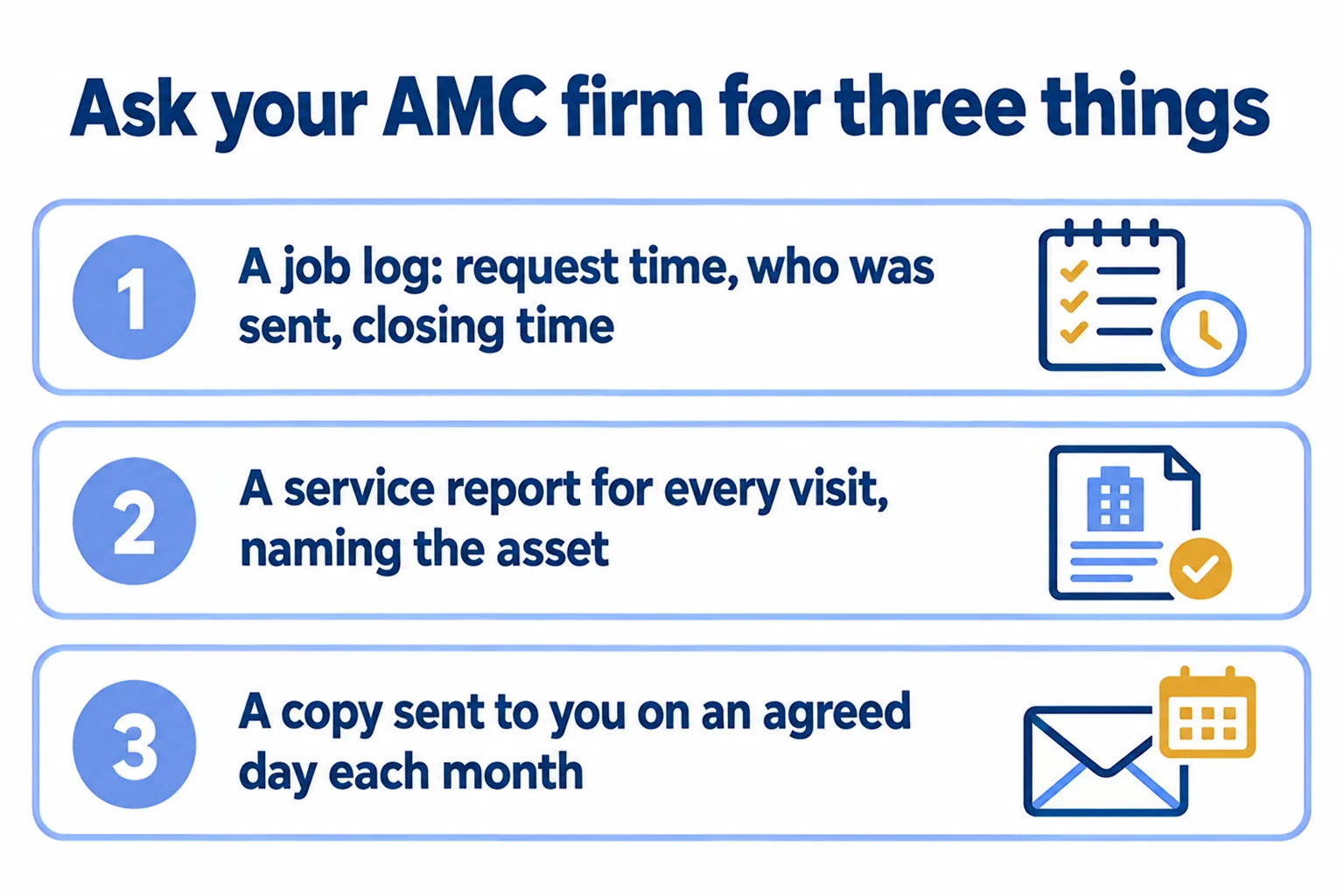
Put three lines in the contract, or in a letter at renewal:
- 01A job log: the request time, who was sent and the closing time, for every complaint.
- 02A service report for every visit that names the asset it covers.
- 03A copy delivered to you on an agreed day each month, in a format you can file.
With those three you can answer a tenant without phoning the contractor. Which AMC reports to hold and when to move contractors onto your own system is covered in our post on AMC reports. If the real question is when to load a schedule, read calendar first or system first once and do not repeat it here.
How do we decide with a property manager?
Our method is called Complaint to closed job. We start with the ten-complaint test on your own complaints. We read who closes jobs today, what the contractor's reports contain and where a complaint is lost between the tenant and the technician. Then we say whether your first problem is the contract or the system.
If the contract is the gap, we tell you to ask for the job log and report, and we do not quote. Maintain does not write your maintenance plan or decide your service intervals; it runs the schedules you give it. Teams with no maintenance routine yet are the first group the Maintain page turns away.
What does Maintain cost?
Here is what the Maintain page says today. You pay per technician a month, and supervisors and admins count as technicians. Tenants and staff who only raise requests are free.
- Technicians 1 to 10: AED or SAR 149 each. 11 to 30: 99. 31 to 100: 69. Above 100: 49.
- The shared plan, hosted by us in the UAE, has a minimum of AED/SAR 2,649 a month. A property manager with 3 supervisors who log in comes to 3 x 149 = 447, which is below the minimum, so the minimum is the price. That is arithmetic on the page's list, not a quote. Your own copy, hosted by us in the UAE or Saudi Arabia, has a minimum of AED/SAR 5,699.
- The quick start is a fixed AED/SAR 2,500 that we set up, for the shared plan up to 10 technicians. Larger teams are a managed setup, with prices on the page.
The maker's feature licence (photos and files, the request portal, the PM calendar, vendors and contractors, and more than 5 users) is USD 15, about AED 55, per technician a month at the maker's list price, billed at cost. WhatsApp Business messages and SMS are also billed at cost. WhatsApp request intake is connected during setup, not on day one. Prices exclude 5 percent UAE VAT and 15 percent Saudi VAT.
Tell us how many technicians and supervisors close jobs and which buildings they cover. We reply with the setup plan and the monthly price per technician. If a better AMC contract is all you need, tell us anyway and we will say so.
