

If three AMC companies report to you in three formats, this is for you. The question is whose system holds the record of what they did to your tower, and you can settle it with one rule. This is not for you if nobody owns the job after the contractor's visit. Name that person first.
Who holds the record for fire, lifts and chillers?
Three different people, and only one of them is you if you do nothing. An annual maintenance contract (AMC) is a contractor's promise to visit and service your equipment. What it leaves behind is a report, and the report sits where the contractor puts it.
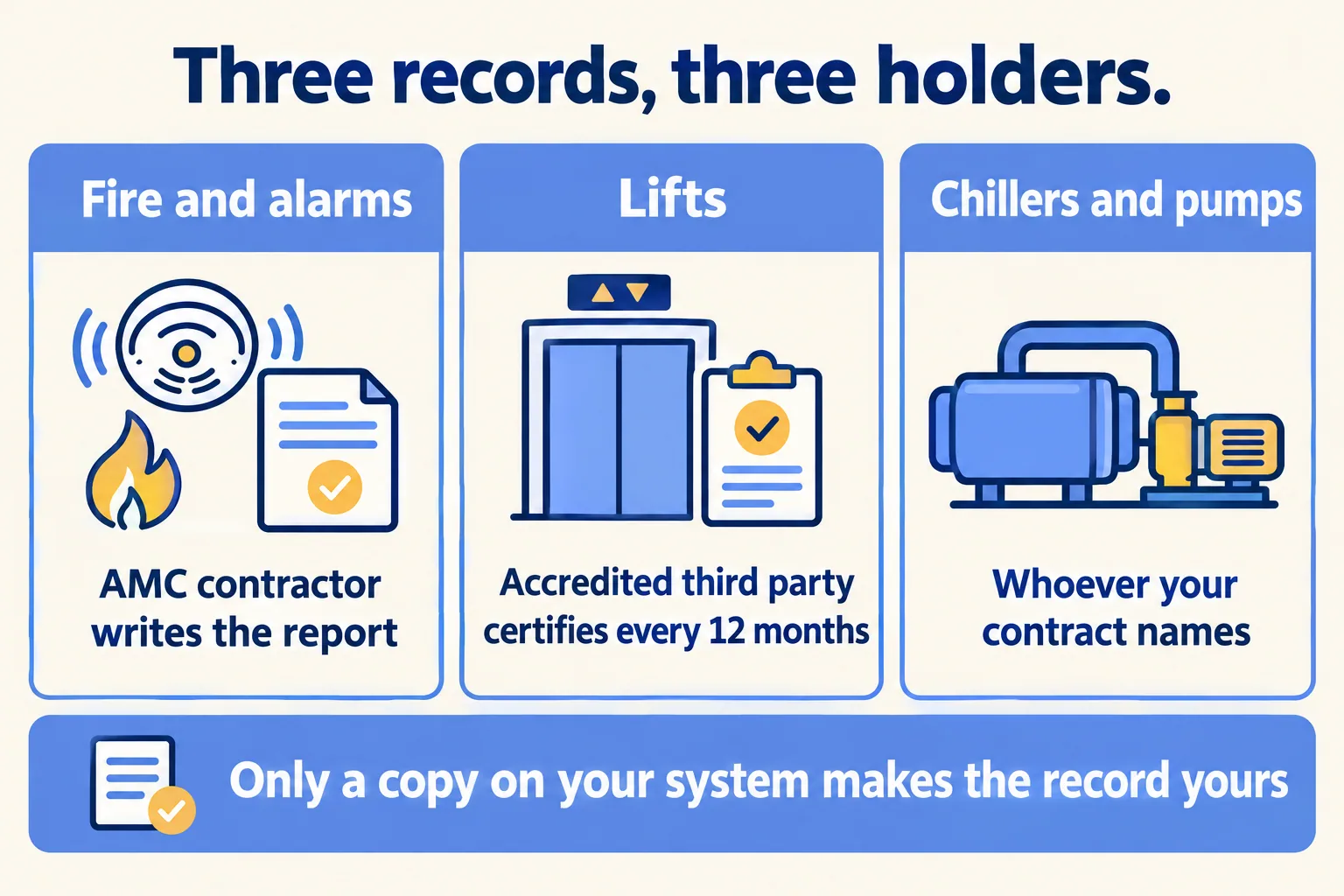
- Fire and life safety. The AMC contractor. The Ministry of Interior's service page for approval of an annual maintenance contract describes site follow-up "during the contract period 3-4 times a year" and "preparation of a detailed report on the status of installed devices". The report is the contractor's work product.
- Lifts. An accredited third party. Dubai Municipality's guideline DM-HSD-GU48-ECLA2 (version 4.0, 9 May 2024) says lifts are "tested and certified by a third party accredited by Emirates International Accreditation Center (EIAC) once every 12 months". The certificate is "kept at the site".
- Chillers and pumps. Whoever your AMC says. No public rule names the holder, so the contract does.
What must an AMC report contain?
For fire systems, the state names the shape of it. We read the Ministry of Interior page on 20 October 2026. It describes the contract as covering maintenance, installation, supervision of network installation, fire extinguishing and alarm networks, site follow-up "3-4 times a year", and "a detailed report on the status of installed devices". It does not give a template. Read the page itself for current fees and requirements before you sign or renew, because it can change.
So the minimum is a dated visit, the devices checked and their status. That is also what you want on your own file. A report that says "visit completed" with no device list does not tell you which detector was replaced.
Why does the contractor see alarms before you do?
Because the alarm system is built that way. Hassantuk, the fire alarm monitoring system, says on its overview page: "Maintenance alarms are automatically routed to the building's maintenance company." Its FAQ says maintenance issues "are sent to relevant service providers with a workorder", and that "SLA breaches are escalated to Civil Defence for appropriate action". The overview adds that "Every building owner is responsible for the payment of installation and fixed annual subscription fees."
Read those together. The owner pays for the system. The alarms that signal a fault go to the contractor, with a work order. Scheduled maintenance has to be reported to Hassantuk in advance, with the tag ID and duration, so the contractor also tells the system when it is working on yours.
If the contractor keeps those work orders, you may never see how many faults it closed in a year, how long each took, or whether any breached its service level. You find out when someone asks. This is our reading of the Hassantuk pages, not legal advice, so confirm with the contractor what trail they hold.
What is the rule for whose system?
Keep it simple. This is our decision rule, not a study.
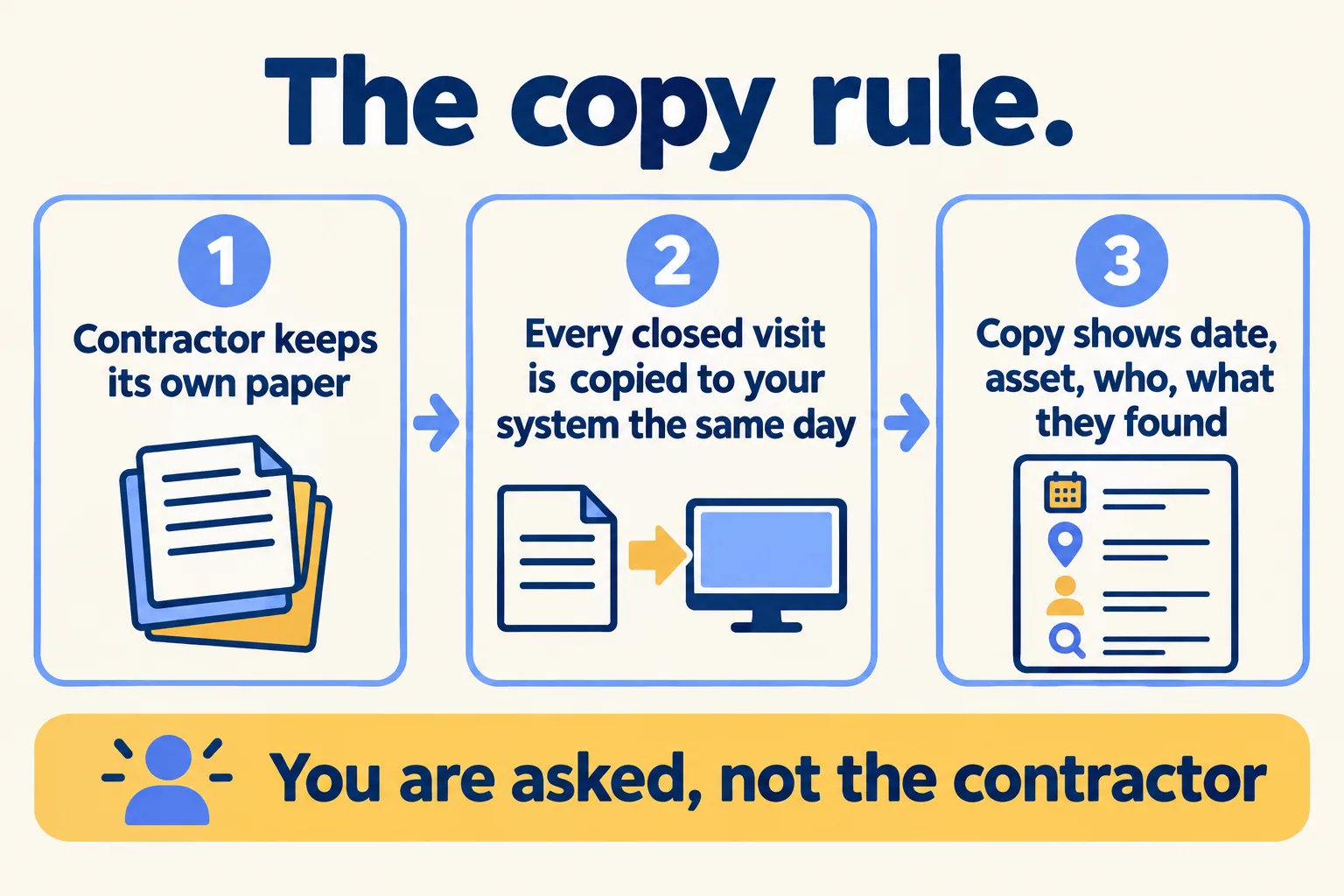
The contractor keeps its own paper for its own work. You require a dated copy of every closed visit on your system the day it closes. Why: the duty to maintain the building and the inspector's question both land on the owner, not on the contractor. Dubai Law No. 3 of 2026 on the quality and safety of buildings makes owners answerable for periodic maintenance of buildings under 20 years old, as we read in our earlier post. The lift guideline puts repairs on "the owner/occupier immediately".
Then the second half, which tells you when the rule needs a system and when it does not.
When is the contractor's paper enough?
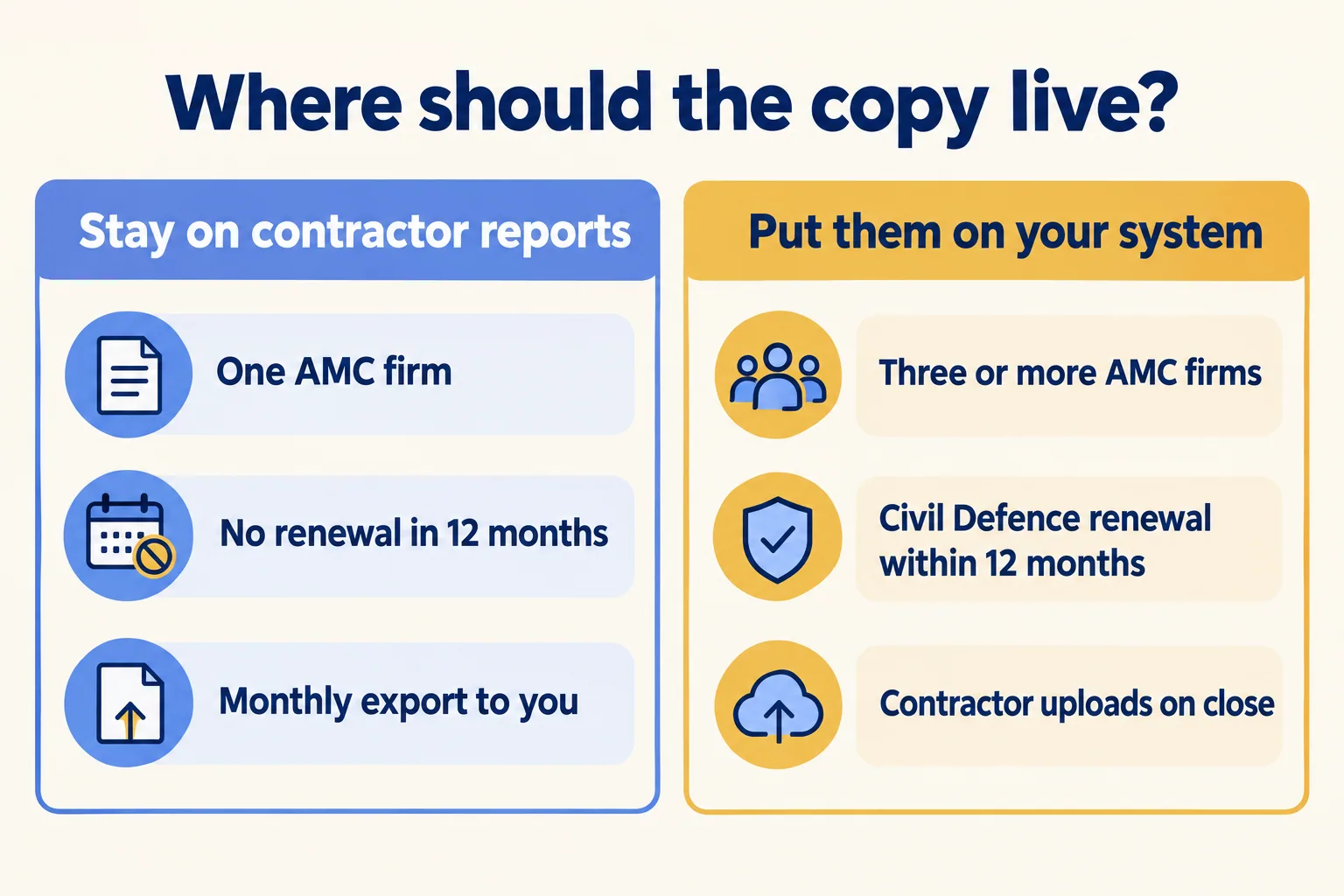
When you have one firm, one renewal date and a habit of asking. Say so plainly: for a single-AMC building, the contractor's own reports plus a monthly export to you are fine. Do not buy software to solve a problem you do not have.
The signal that it stops being enough is your own search time. Pick one lift or one fire panel and ask for its last three visits, who did them and what they found. If that takes an afternoon of phone calls, the record is not yours yet.
What does Maintain do, and what does it leave out?
Mindcat Maintain keeps the copy. A visit is a job on an asset, with the technician, the time and a checklist. A contractor's technician gets their own login today, so closing the job is their step. Planned visits are dated schedules, so the next one shows before it is late. Lift inspection, tank cleaning and fire certificates are kept on the asset as dates and checklists today.
Three limits, stated plainly. Attaching the certificate file, and keeping vendor and contract records, needs the maker's feature licence, which we bill at cost and never call included. Maintain is not connected to Hassantuk or Civil Defence, so alarms still go to your contractor; it holds your copy, not theirs. And no tool makes a building compliant: Maintain keeps the records you can show when someone asks. Our page also says WhatsApp intake is added during setup, not on day one.
The same setup serves facilities management companies and property managers. If you also hand out laptops and phones, that sits in Assets, not here.
What would it cost?
Quote the minimum with the rate, because one seat is not for sale at the per-technician price. On the shared plan it is AED or SAR 149 per technician a month for the first 10, with a monthly minimum of AED or SAR 2,649 for up to 10 technicians. A quick start is a fixed package we set up for AED or SAR 2,500, one time, for up to 10 technicians. Your own copy has a monthly minimum of AED or SAR 5,699. Requesters such as tenants and staff who only raise requests are free. The maker's feature licence, WhatsApp messages and SMS are billed at cost, at the maker's list price of USD 15 (about AED 55) per technician a month. Prices exclude 5 percent UAE VAT and 15 percent Saudi VAT.
What happens in the first working session?
We ask how many AMC firms report to you, which assets each covers and what their reports look like today. We reply with a written setup plan: which contractors get a login, the assets and schedules we load, the go-live date and the monthly price. If you have one firm and no renewal, we say a monthly export is enough, and we do not sell you the system.
If three companies report to you in three formats, get the written setup plan. Tell us how many technicians you run, which buildings they cover and how complaints reach them today.
