

If your chiller contractor's visit report says "checked OK" and nobody can find last summer's readings, this is for you. It is not for a building with one chiller and a contractor that already emails dated reports with readings.
The question usually comes after a trip. The chiller tripped twice in a hot week, the owners ask what the contractor found on the last service, and the answer is a sheet of ticks. Before the chiller maintenance contract renews, we run one test.
Can anyone read out last July's readings?
Ask your supervisor to open last July's chiller visit and read out three numbers: the leaving chilled-water temperature, the condenser approach and the compressor amps. Give them a minute.
Then pull the last three visit reports and count two things on each one:
- Lines that are numbers. A temperature, a pressure, amps, kilograms of refrigerant added.
- Lines that are ticks. "OK", "checked", "satisfactory", a box with a mark in it.
The numbers in the table are a sample to show the shape of the count. Put your own three visits in their place. If the supervisor could not read out the three numbers, the count has already told you most of what you need.
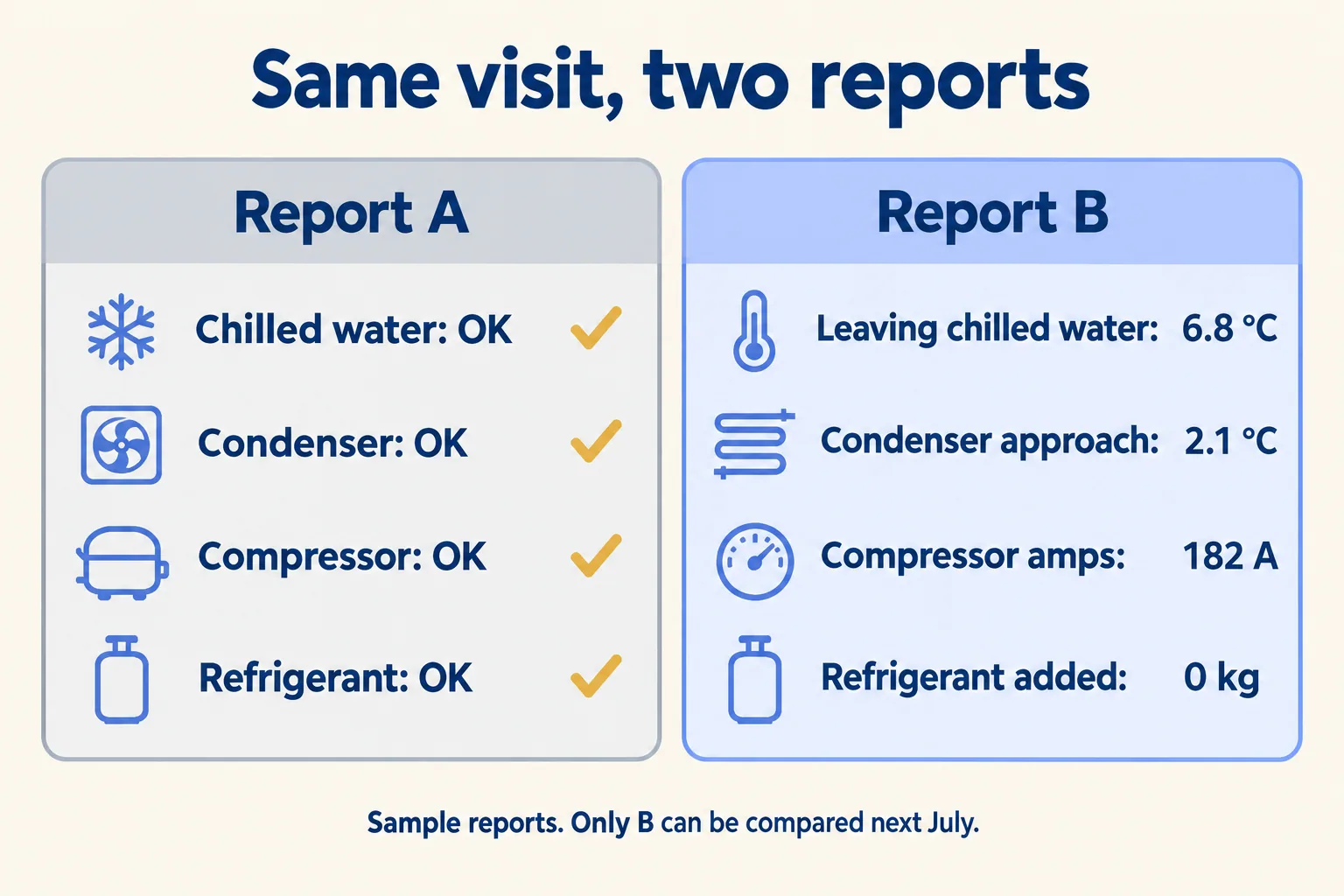
What should a chiller visit report show?
Numbers you can put next to last visit's numbers. A Dubai contractor's chiller checklist for 2026 puts it plainly for the quarterly service: "This is the contractor's visit. Each item should end up as a number on the report, not just a tick."
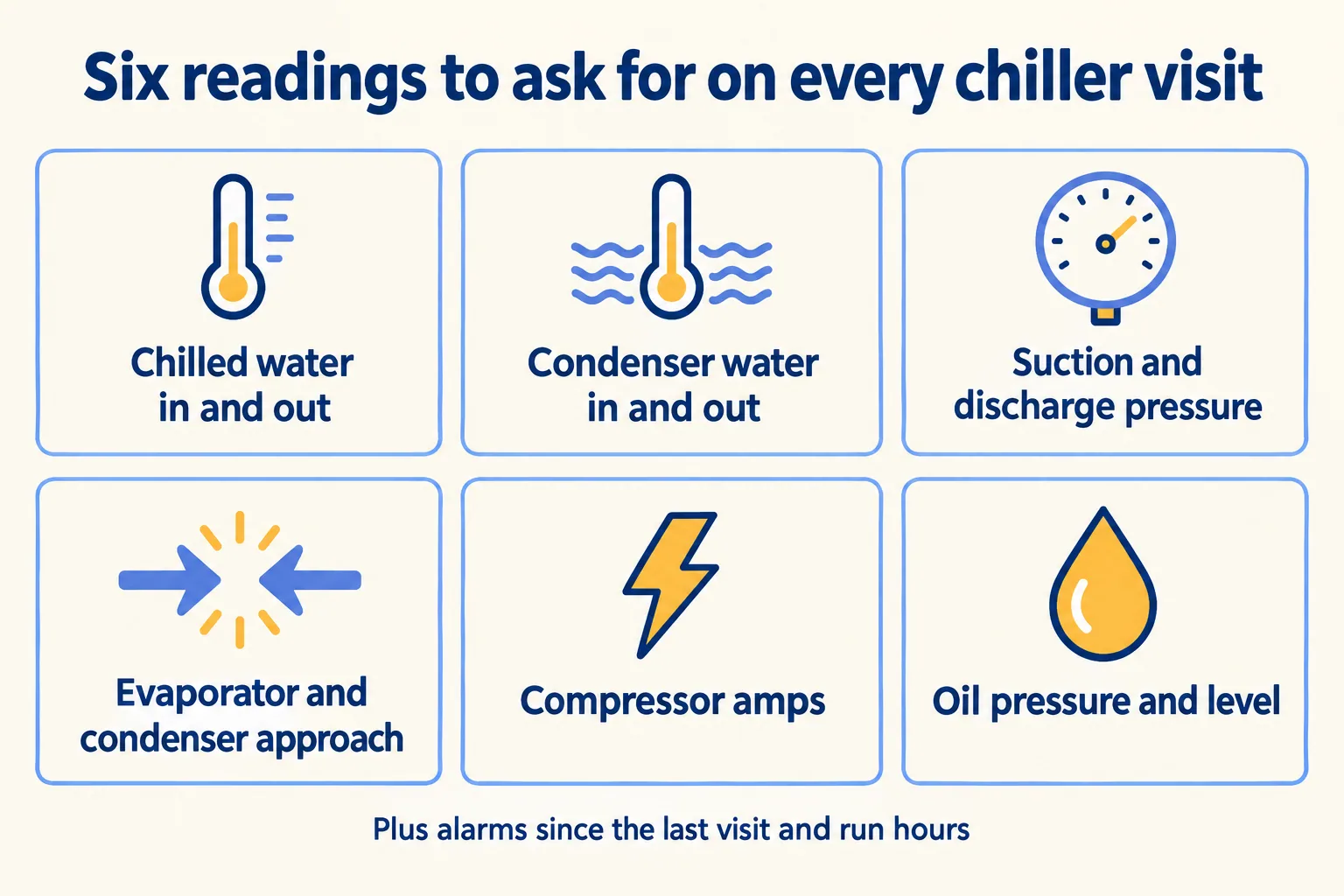
Its daily log, the sheet the site team keeps between visits, lists the readings worth asking the contractor to record as well:
For the quarterly visit the same checklist adds superheat and subcooling for each circuit against the nameplate, a refrigerant leak test, compressor amps and voltage balance, and safety devices trip-tested. Your chiller's own manual sets the intervals. Where the manual and a checklist differ, follow the manual.
Why do ticks fail you next summer?
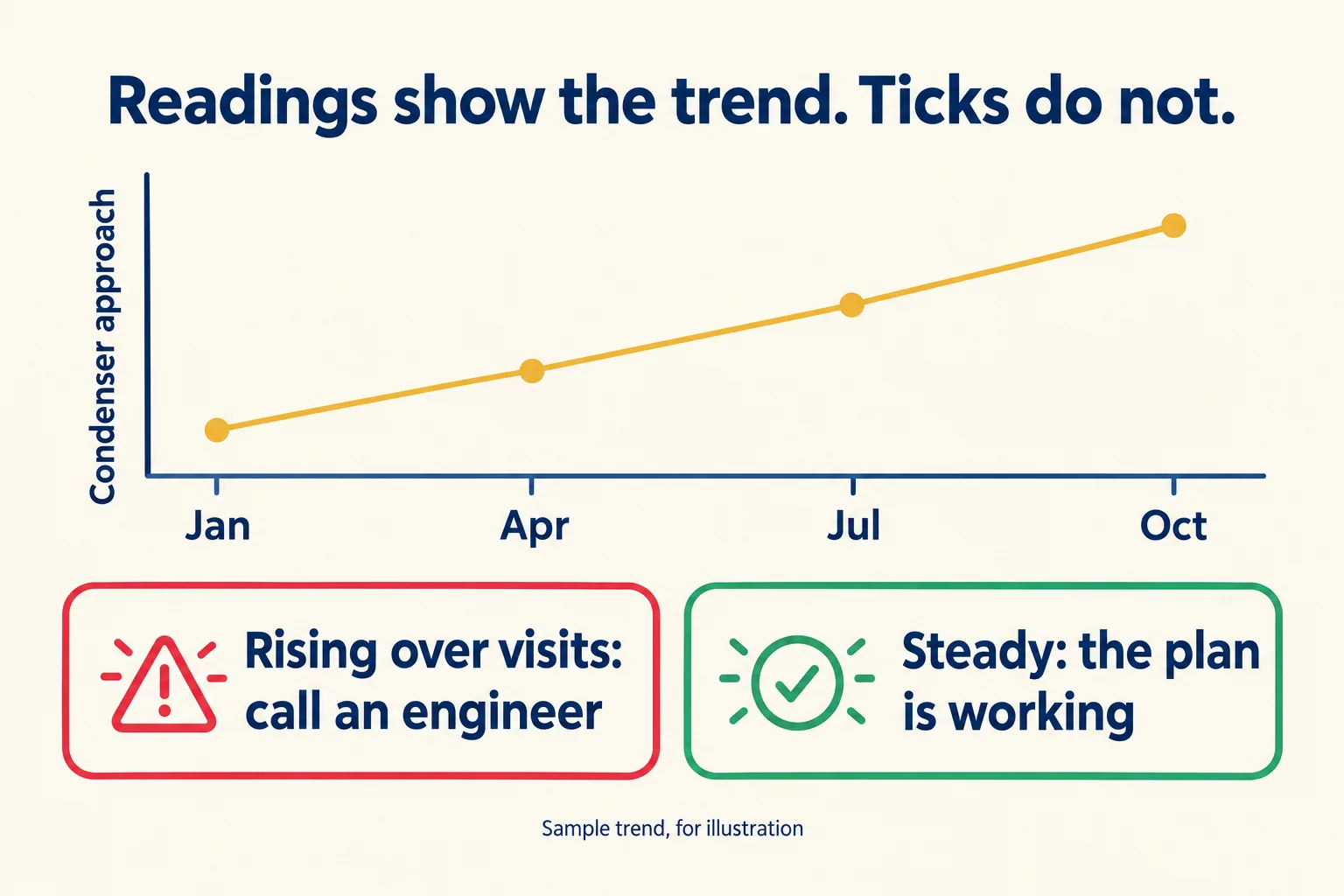
A tick says the technician looked. It cannot say whether the chiller is getting worse.
The same checklist names five log trends that mean call an engineer. The first is a rising condenser approach, which points to fouled or scaled tubes or air in the circuit. It quotes Trane's estimate that a 1°C rise in condenser temperature adds about 2 percent to operating costs. You can only see a rise across visits if each visit wrote the number down.
The US maintenance standard for commercial HVAC, ANSI/ASHRAE/ACCA Standard 180, builds its whole schedule on that comparison. When an unacceptable condition shows up on two successive inspections, the owner investigates the cause, starting with the technician's documentation. After three successive acceptable inspections, the frequency may be reduced, and the reason is documented. It also makes the building owner responsible for the programme, even when a contractor does the work. Standard 180 is not a UAE rule, but its logic holds anywhere: without numbers, you can neither catch a decline nor earn a longer interval.
Contractors say the same about their own trade. A commercial HVAC firm's guide to auditing your vendor warns that reports which are "checklists with everything marked 'okay' and no actual numbers" leave you "no way to verify the work or track trends over time". Another notes that "many facility managers receive generic service reports that say little more than 'system checked'".
What does Dubai already ask you to keep?
On a water-cooled plant, part of the chiller's record is not optional. Dubai Municipality's Technical Guidelines for Legionella Control in Water System (DM-HSD-GU44-LCWS2, version 6, issued 19 August 2025) say:
- Cooling water systems, with their tanks, pumps, pipes and filters, are emptied, cleaned and disinfected at least once every six months, and whenever Legionella is detected.
- A competent person tests the system for total bacteria count at least every month, and inspects the water treatment monthly.
- Daily water treatment readings are kept and checked by the manager.
- Inspection, maintenance and test records are available for inspection by Dubai Municipality staff and submitted every two weeks to its inspection address.
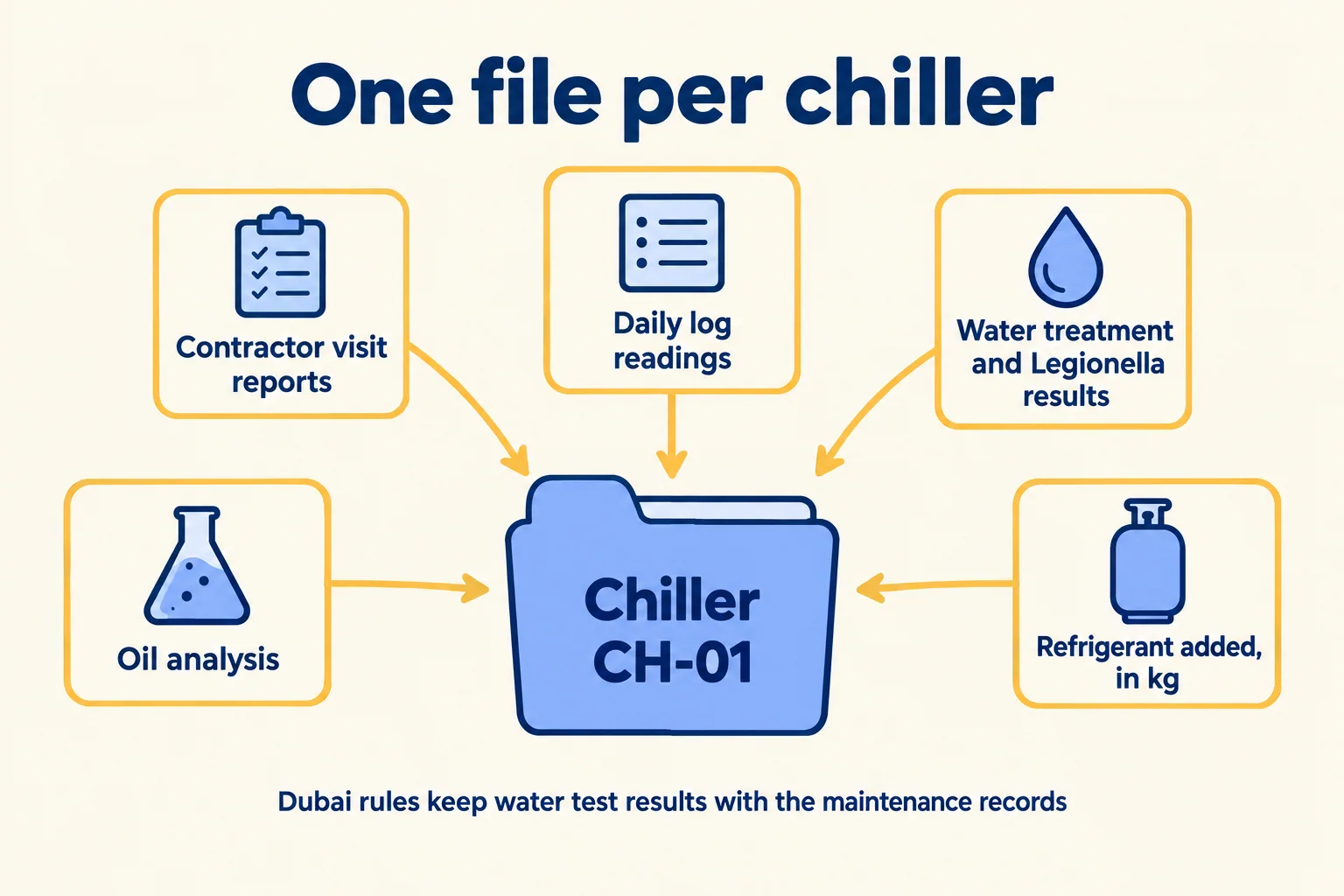
Dubai's green building system, Al Sa'fat (406.01), adds that test results are recorded and kept at site with the records of maintenance and remedial works. Confirm with Dubai Municipality how the guideline applies to your building before you rely on any interval here.
So the water results already have to sit with the maintenance records. The simplest place for the chiller visit reports is the same file.
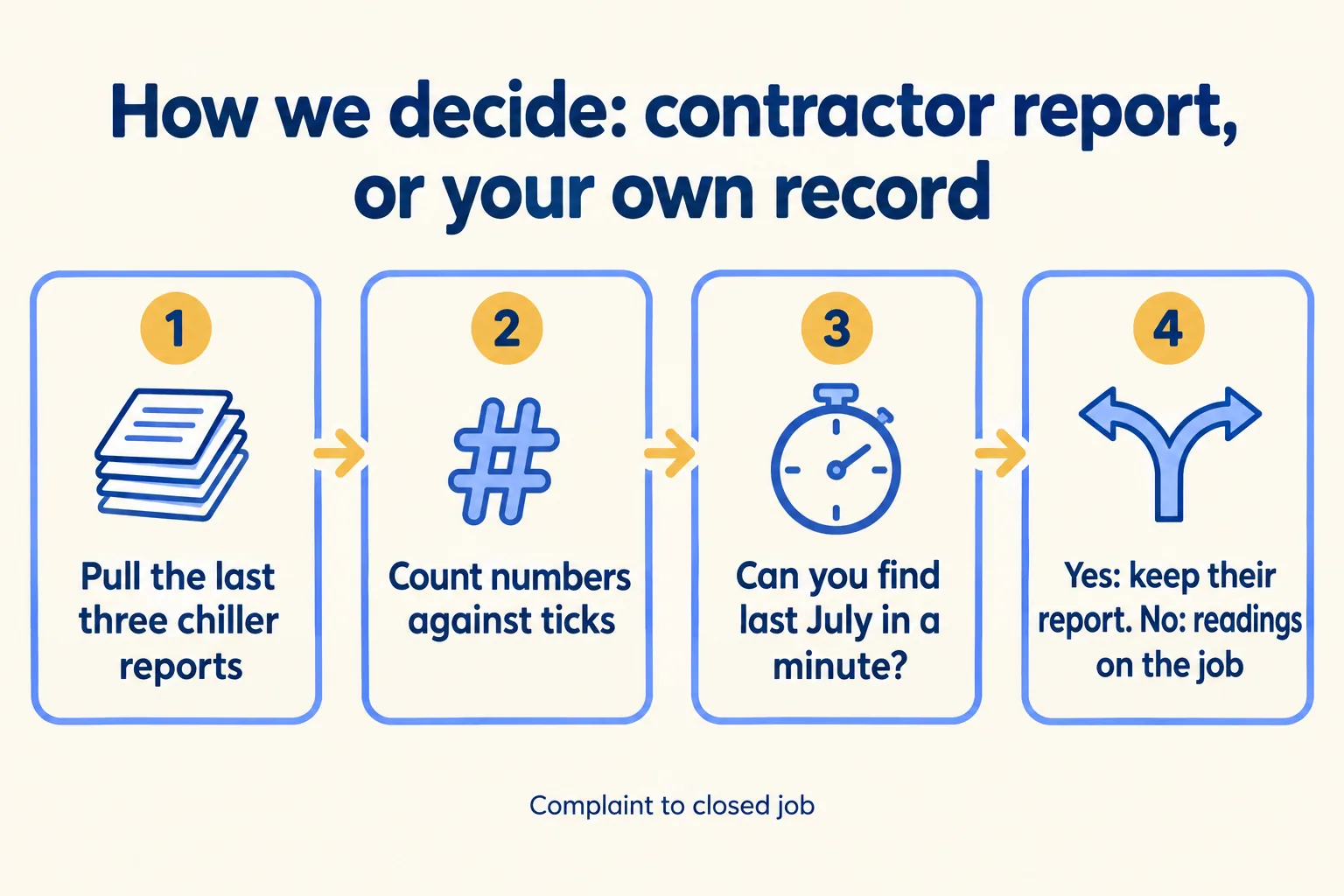
How we decide: their report, or your record
Our rule: pull the last three chiller visit reports and count numbers against ticks. If the reports carry dated readings and your supervisor can find last July's in a minute, keep the contractor's report and file it against the chiller. If they say checked OK, or they sit in someone's inbox, put the readings in the contract and on the chiller's own job record, entered at the plant.
- 01Pull the last three chiller visit reports.
- 02Count the lines that are numbers and the lines that are ticks.
- 03Ask the supervisor to find last July's leaving chilled-water temperature, condenser approach and compressor amps in a minute.
- 04Readings, and found in a minute: keep the contractor's report. Ticks, or lost in an inbox: readings go on the job.
The contract is the cheaper fix, and it comes first. A contractor that is told which readings to record usually records them. If the contractor will not add them before the renewal, have your own technician take the six readings at the next visit and put them on the job. The record on your side matters when you need to compare across visits, across contractors, or after the contract changes hands. A Gulf FM software vendor puts the test well in its guide to proof of work: if the contractor's monthly report cannot be rebuilt from the job records, it is not evidence.
Who holds which record across the fire, lift and chiller contractors is a wider question. Our post on whose system should hold the AMC reports works through it. When the visit dates themselves slip, start with the PPM calendar.

What Mindcat Maintain keeps on the chiller
The readings, on the chiller's job, typed at the plant. In Mindcat Maintain each job carries its own checklist: values such as discharge pressure or leaving water temperature, pass or fail checks, and notes. The technician fills it in on a phone, whoever does the visit: your own team, or the AMC contractor's technicians, who get their own logins. Preventive schedules raise the monthly or quarterly chiller job on its date, and each chiller keeps its jobs, parts and meters. When the same chiller trips next July, the supervisor opens last summer's readings instead of asking who was on shift. A trip reported by a tenant becomes a job on that chiller too, and WhatsApp requests join once we connect your WhatsApp Business account during setup. That is the method we call "Complaint to closed job": every complaint or scheduled visit ends as a closed job with its readings.
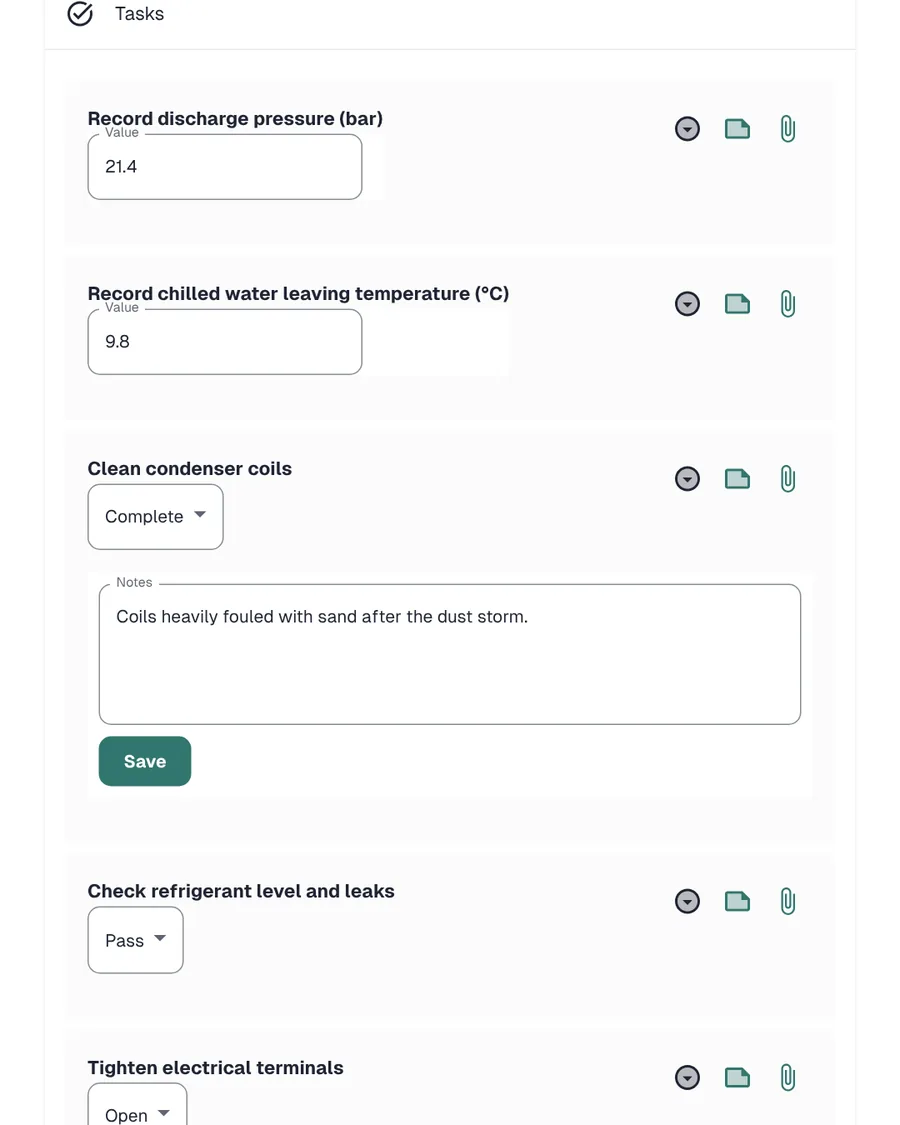
The readings are typed by the technician. Maintain does not read the chiller's controller or the BMS, and it does not set service intervals: those come from the manufacturer's manual and your contract. Attaching the contractor's PDF report, the water test results or photos to a job needs the maker's feature licence, which we bill at cost.
Maintain holds the building's plant, chillers, lifts and pumps, and the jobs technicians do on them. The laptops, phones and licences your staff hold belong in Mindcat Assets. Our facilities management page shows the FM setup with sample data.
Who should not start here?
A building with one chiller and a contractor that already emails dated reports with readings. File the reports against the chiller and spend the money elsewhere. And a building with no maintenance routine yet: Maintain runs the schedules from your AMC calendars, it does not write them.
What does it cost?
From the live Maintain page. The price is per technician a month, graduated: technicians 1 to 10 cost AED/SAR 149 each, 11 to 30 cost AED/SAR 99, 31 to 100 cost AED/SAR 69, and 101 and up cost AED/SAR 49, each band applying only to the technicians inside it. Requesters such as tenants and staff who only raise requests are free.
Every plan has a monthly minimum. The shared plan, up to 10 technicians, has a minimum of AED/SAR 2,649 a month. Your own copy hosted by us in the UAE or Saudi Arabia has a minimum of AED/SAR 5,699. The page's worked example: 30 technicians and supervisors come to 10 × 149 + 20 × 99 = AED 3,470, so the firm pays the AED 5,699 minimum, which covers up to 62 technicians.
The maker's feature licence (photos and files on jobs, the request portal, the PM calendar, vendors and more than 5 users) is billed at cost, at USD 15 per technician a month at its list price. For 30 technicians that is about USD 450 a month. The quick start, which we set up for you on the shared plan up to 10 technicians with our PPM schedule template for chillers, lifts, pumps, tanks and fan coil units, is AED/SAR 2,500, fixed. Larger teams get managed setup to a written plan. Prices exclude 5% UAE VAT and 15% Saudi VAT.
So a building team of up to 10 technicians on the shared plan pays the AED/SAR 2,649 monthly minimum, plus the maker's licence at cost.
Set that against the next chiller trip you cannot explain to the owners. Tell us how many technicians you run, which buildings they cover and how complaints reach them today. We reply with the setup plan and the monthly price per technician, in AED or SAR.
