

If a quote for facility management software lists more modules than your technicians have jobs, this is for you. It is not for FM teams that need floor plans, space booking or lease accounting.
What is on the quote in front of you?
A salesperson has sent a quote. It says "facility management software" at the top, then lists a page of modules: work orders, planned maintenance, assets, a help desk, space management, floor plans, room booking, moves, energy, leases. There is a licence price per user and, somewhere lower down, an implementation fee.
You run an FM company with about 25 technicians. Your people take complaints, fix things, keep the plant serviced and send the client a report. The question is how much of that page they will ever open.
The words at the top of the quote do not answer it. "Facility management software" is a search term, not a product. It can mean three different products, and a quote for the biggest one carries every module of the smallest.
What do CMMS, CAFM and IWMS each cover?
The sellers themselves agree on the split. Here is how three of them define it, read on 11 November 2026.
- CMMS, for maintenance. UrSpayce describes it as "work orders, preventive maintenance schedules, asset registers, spare-parts inventory, and technician labour tracking." Heyfixit's line: "A CMMS is maintenance-deep; CAFM is facilities-wide."
- CAFM, for the building as a workplace. MRI Software lists "work orders, planned preventive maintenance (PPM), asset tracking, floor-plan and space management, and room and desk booking."
- IWMS, for a property portfolio. MRI says it "adds strategic real estate functions like lease administration and accounting, capital project management, and sustainability/ESG reporting."
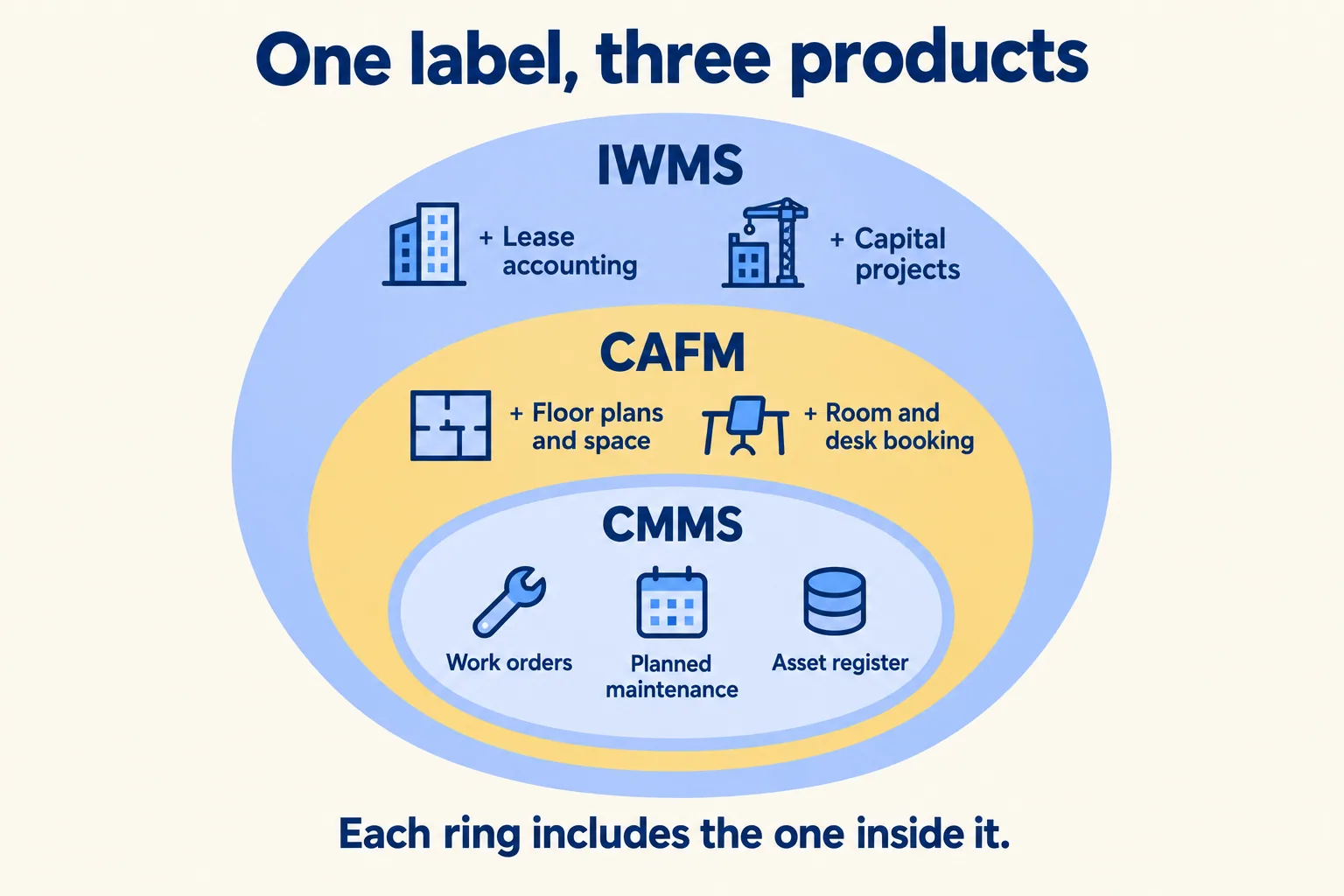
Each ring includes the one inside it. So a CAFM quote carries every CMMS module plus the space ones, and an IWMS quote carries all of that plus leases and capital projects. UrSpayce's advice for a single-site maintenance team is to start with a CMMS, "without the overhead of space or lease modules you will never open."
We covered the contract side of this choice for one tower in our post on CAFM or CMMS for a Dubai tower contract. This post is for the buyer holding a quote.
Which modules does an FM firm use every week?
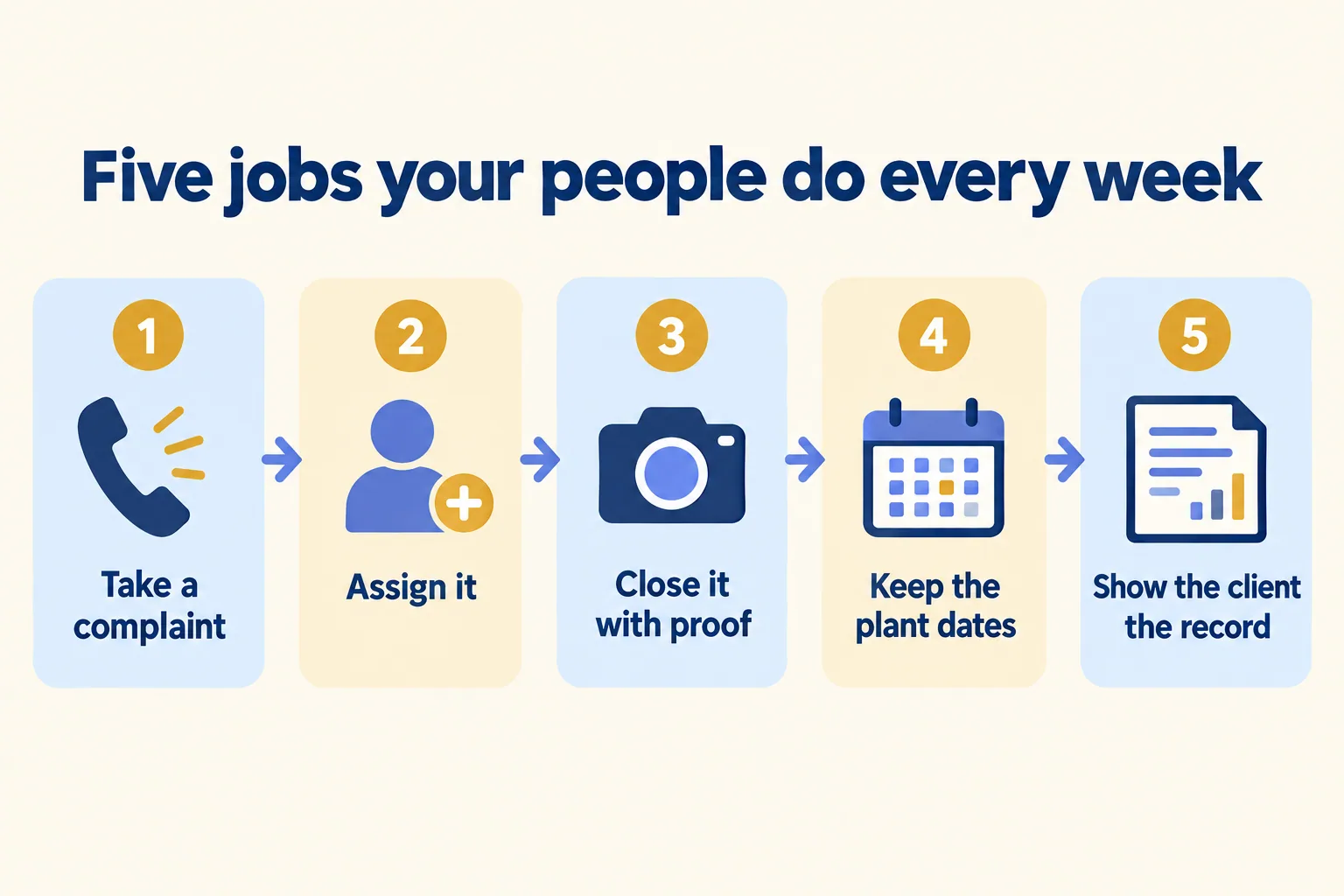
Write down what your people do in a normal week, before the next demo. A typical list for an FM company running residential and commercial buildings has five jobs:
- Take a complaint from a tenant, a resident or the client.
- Assign it to a technician on the right building.
- Close it with proof: a photo, a reading, a time.
- Keep the lift, chiller, pump and tank service dates, and see what is due next week.
- Show the client what was done, for the monthly report or the owners' association.
A UAE maintenance company's guide (HandyUAE, July 2026) lands in the same place: "For most UAE buildings the value is in three modules: work orders, planned maintenance and asset registers. The rest is optional." It names the usual mistake too: "licensing an enterprise platform for a building that needs a work order log and a maintenance schedule."
Those five jobs are the whole of what a work-order and planned-maintenance system has to do. If that is your list, you are shopping for the inner ring.

How do you test a quote line by line?
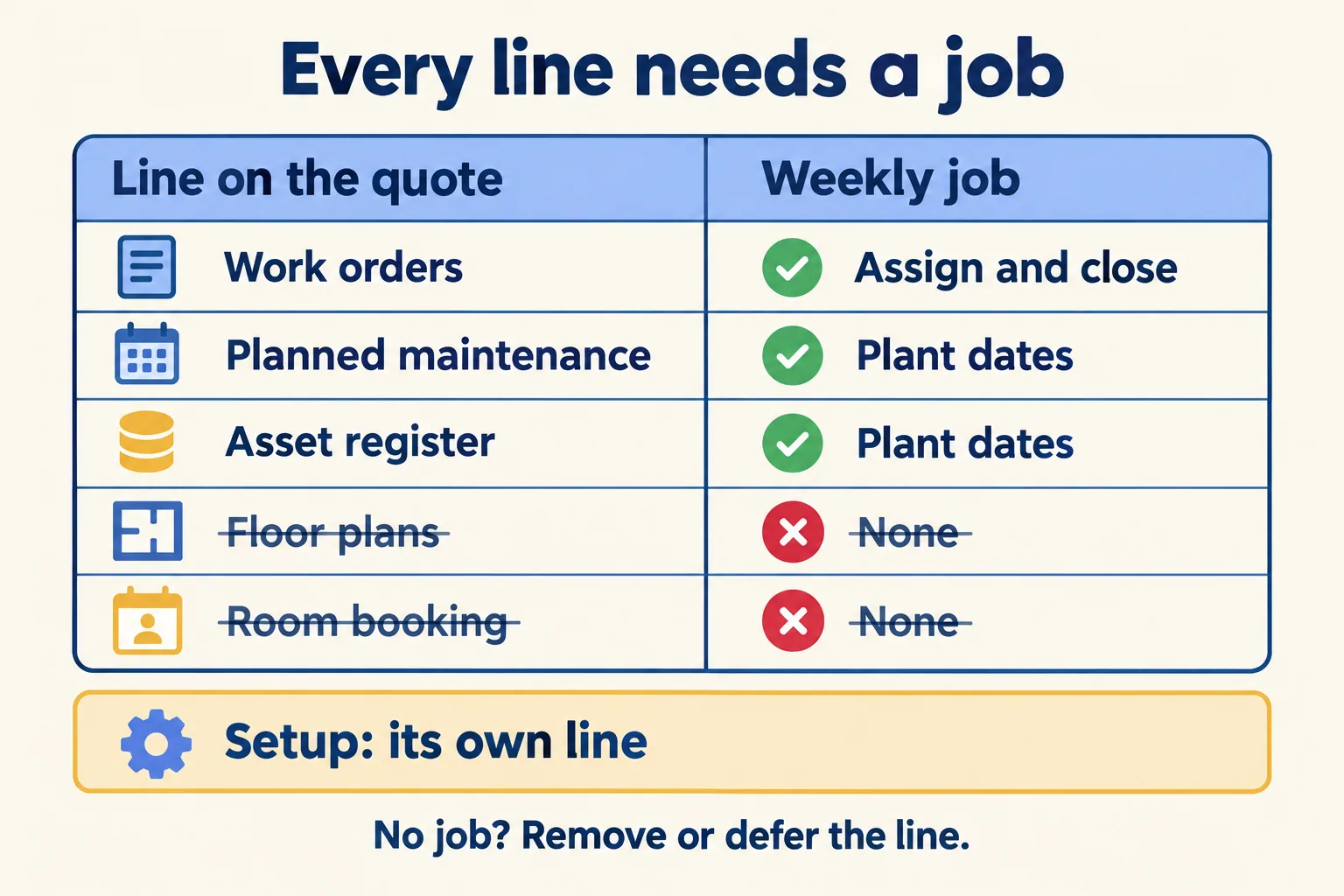
Print the quote. Next to each module, write the weekly job it serves, from your list of five.
- 01Every module line gets a job from your list beside it, or a blank.
- 02A line with a blank is removed or deferred. Ask for the quote again without it.
- 03Ask for setup on its own line: asset register, PPM calendar, logins and training.
- 04Ask who loads your chillers, lifts and AMC calendars, and by which date.
- 05Ask in writing how you get a full copy of your data if you leave.
The setup line matters most. HandyUAE's guide says implementation is "frequently larger than the first year of licences," and calls the licence "the cheap part." Building the asset register and the maintenance calendar is the work that makes the system useful, so it should be priced where you can see it and compare it.
Watch for one more blank: the person who feeds the system. HandyUAE again: "Software does not maintain anything on its own. It is only as good as the data and the team feeding it." If no one on your side owns the asset register, fix that before you buy anything. Our post on building the PPM calendar before the system covers that step.
When should you buy the suite?
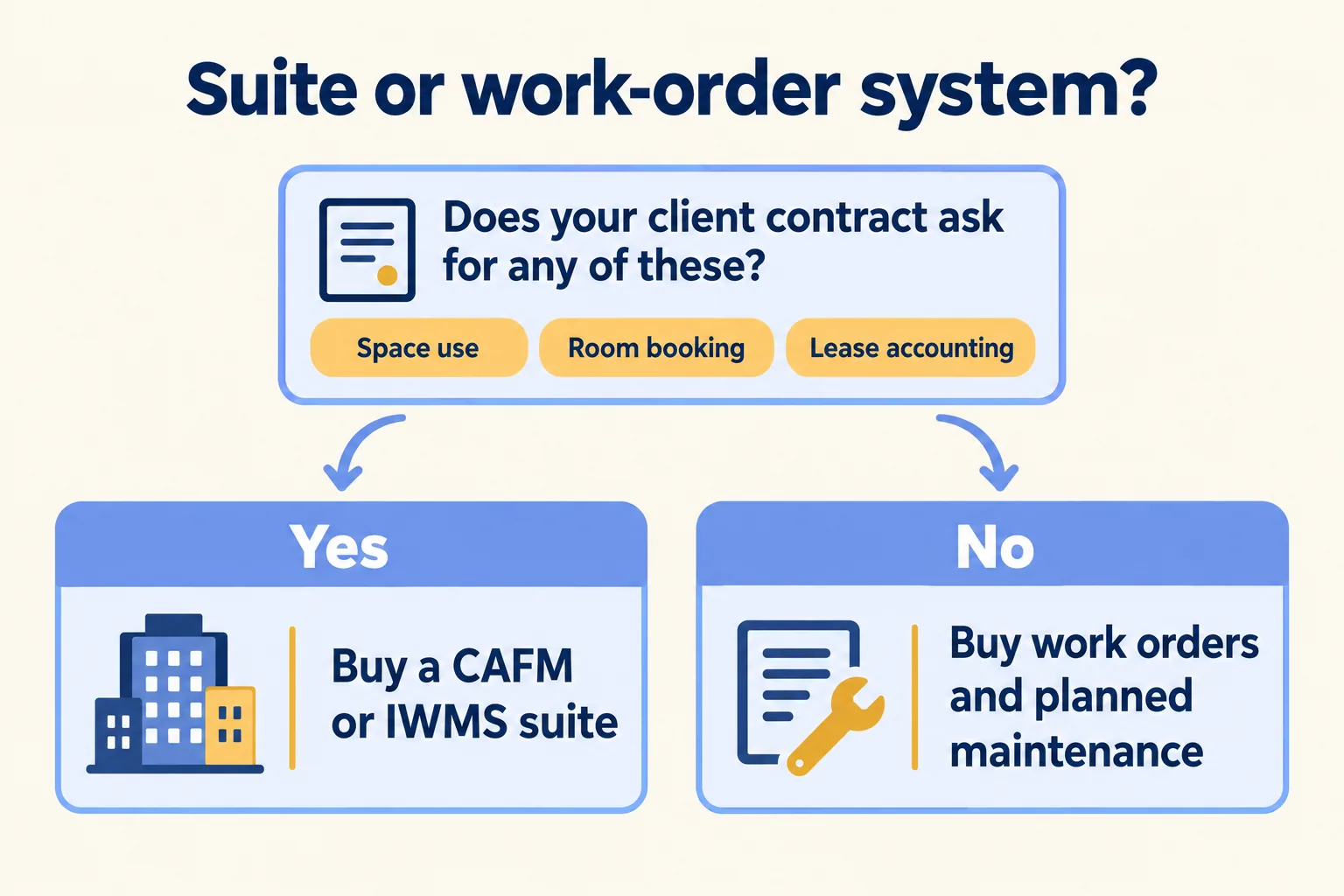
Some FM firms do need the outer rings. Buy a CAFM or IWMS suite when your client contract asks for any of these:
- Space use: occupancy, floor plans, moves for an office client.
- Room and desk booking for the people in the building.
- Lease administration or lease accounting, or capital project tracking across a portfolio.
Then the space and lease lines on the quote have a job behind them, and they are worth paying for. Mindcat Maintain is not one of those suites. It has no floor plans, booking or lease accounting, and we say so before we quote.
What does a work-order system cost for 30 technicians?
Here is the price shape of ours, from the Mindcat Maintain page, so you have one Gulf number to hold a quote against.
For a firm of 25 to 30 technicians, the number that matters is the minimum. Your own copy, hosted by us in the UAE or Saudi Arabia, is AED/SAR 5,699 a month, and that minimum covers up to 62 technicians. Above that, the per-technician price applies, graduated: AED/SAR 149 for technicians 1 to 10, 99 for 11 to 30, 69 for 31 to 100 and 49 above, each band only for the technicians inside it. The page's worked example: 30 technicians and supervisors come to AED 3,470 on the bands, so they pay the AED 5,699 minimum.
Supervisors and admins count as technicians, and so do your AMC subcontractors' technicians if they get logins. Tenants, residents and anyone who only raises requests are free.
Count one more line in. The maker of the software we build on charges a feature licence of USD 15 (about AED 55) per technician a month, and it switches on photos on jobs, the request portal and the PM calendar, so a working FM team needs it. We bill it at cost and never mark it up: for 30 technicians about USD 450, so about USD 2,000 a month in all.
Setup is its own line, as it should be on any quote. Managed setup for 11 to 30 technicians is AED/SAR 11,900: one working session with your FM manager, then your buildings, plant rooms, asset register and PM schedules from your AMC calendars, with training in Arabic and English. Annual prepay takes 15 percent off our part. WhatsApp Business messages and SMS are billed at cost. Prices exclude 5 percent UAE VAT and 15 percent Saudi VAT.
Complaints arriving on WhatsApp are connected during setup, on your own WhatsApp Business account. Until then, tenants raise requests from a free login on their phone. You can take a full copy of the database and files at any time. Who holds laptops, phones and software licences is a different job, for Mindcat Assets.
How do we decide?
Our method is called Complaint to closed job. Before we quote, we ask you for the five weekly jobs and put each line of the quote you already hold beside them. If your contract needs space, booking or lease accounting, we tell you to buy the suite. If the jobs are complaints, work orders, plant dates and the client's record, we set up those and nothing else. More on the buildings we work in is on our facilities management page.
This is not for you if your client contract asks for floor plans, space booking or lease accounting. Tell us how many technicians you run, which buildings they cover and how complaints reach them today. We reply with the setup plan and the monthly price per technician, in AED or SAR.
