
If you have signed something online and a bank, a free zone or a client asked for it again on paper, this is for you. This is not for you if you only sign with people who have already said they will rely on a signing link, or if you are renewing one flat.
Why does a signed document come back for a second signature?
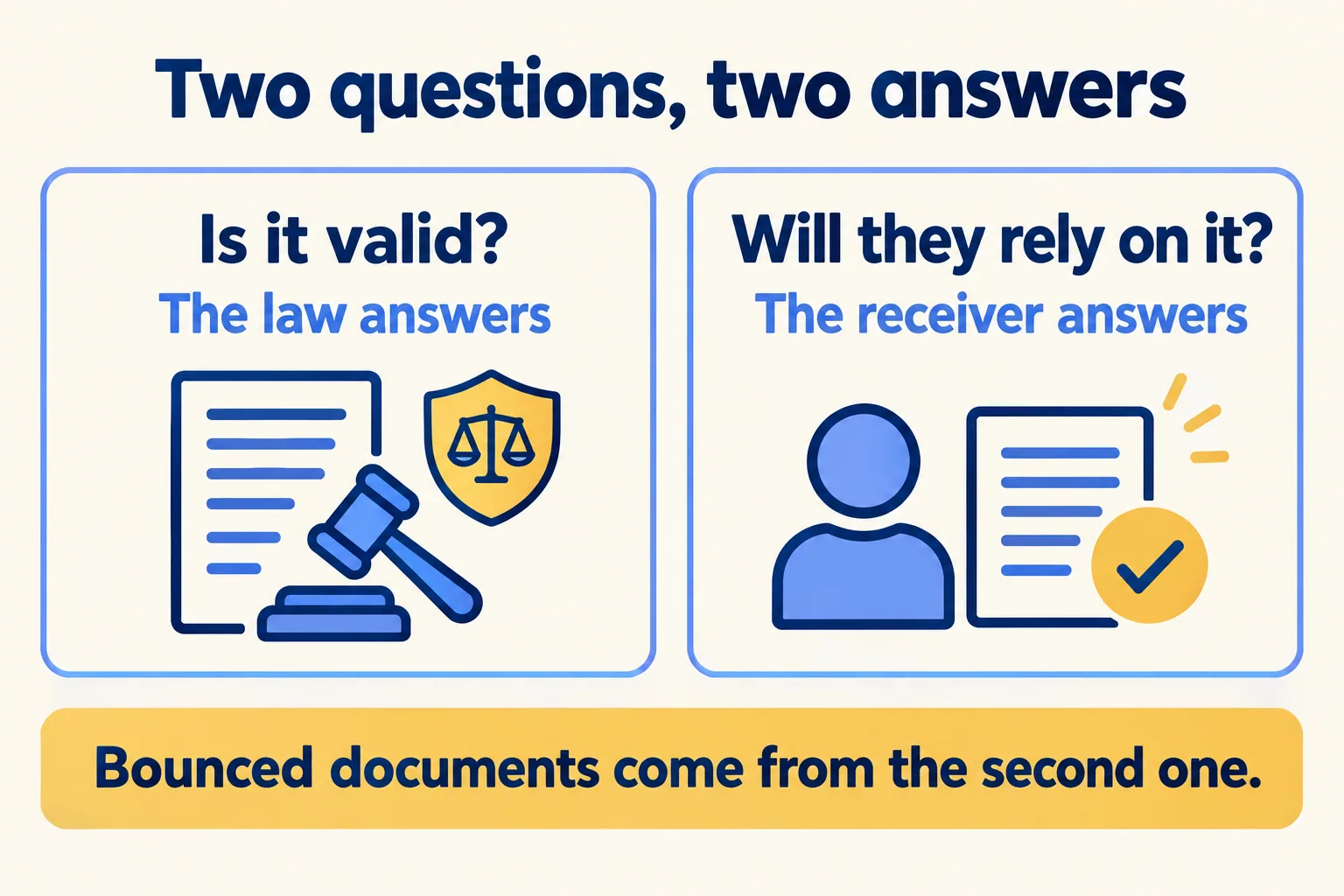
Because two questions got mixed up. The first is whether the signature is valid. The second is whether the person who will rely on the paper will take it in that form. A law answers the first. Only the receiver answers the second.
One law firm's help desk describes the cost: "Many corporate projects in the UAE derail on execution mechanics, not legal intent." Documents, it says, get signed once and then signed again because the wrong format was used. A bounced signature costs you a second round with every signer, and sometimes a courier.
What does the UAE law say about who decides?
Federal Decree-Law No. 46 of 2021 on Electronic Transactions and Trust Services has two lines in Article 28 that belong together. In TDRA's English translation, Article 28(2) says "A Person may use any form of E-Signatures/E-Seals, unless otherwise provided for by the legislation in force." Article 28(1) says "Nothing in this Decree-Law shall require a Person to use or accept an Electronic Dealing."
So you may sign electronically, and the other side does not have to take it. The translation is unofficial and the Arabic text prevails, so read the Arabic or the official legislation portal before you rely on the wording.
What do the practitioners say, on both sides?
Take the cautious view first. ATB Legal's help desk (2 April 2026) writes that banks "often insist on wet-ink signatures, originals sighted, and/or Certified True Copies" and "may reject digitally signed documents even if the licensing authority accepts them". Its rule: use digital signatures only when the specific stakeholder explicitly accepts them for that document type.
One bank's published list shows the paper habit. Emirates Islamic's account-opening list for a limited liability company asks for the account form "signed by the authorised signatories", with the signature on the card "in black pen only". The page does not say what it would do with a form signed by link. So read it as one bank's published process, not as a refusal. It is the reason to ask.
Now the other side. Salloum Law (1 May 2026) argues that an electronically signed document is admissible and carries the same evidentiary weight, that banks' concerns are "largely overstated", and that a platform's audit trail can be a stronger record than a signature in ink. The firm also writes about banks as a group and does not speak for yours.
Both can be true. A document can stand up in court and still be bounced at the counter.
Which documents go by link, and which stay in ink?
Not one list fits every office, and no list we publish replaces a receiver's own answer. The Mindcat Sign page keeps a table of what it does not cover: a property sale or title, and anything a notary or court must see. ATB Legal's help desk says the same of notarised documents, which typically need wet ink and originals. Our posts on a power of attorney and on a rental agreement work through two such cases. This post is the rule behind both.
The rule is short: the person who will rely on the paper sets the format.
What do you send before you sign?
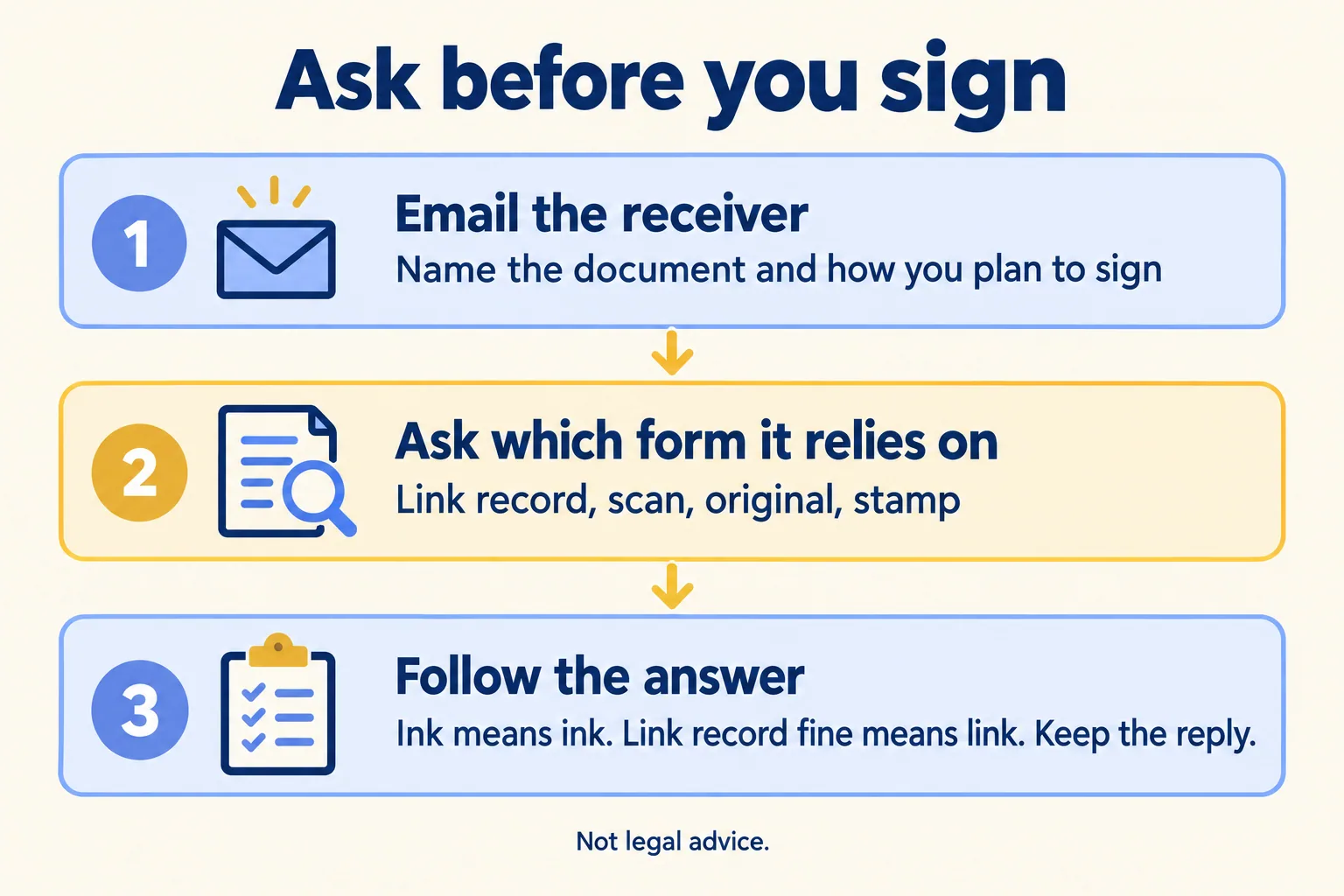
One email to the receiver, per document type, before anyone signs. Then keep the reply with the file.
- 01Name the document and who signs it, and say how you plan to sign: by link, with the audit log and the signed PDF, or by hand.
- 02Ask which form it will rely on for that document: a link record, a scan of ink, an original, a stamp, a certified copy.
- 03If it names ink, a stamp or a certified copy, use that. If it says a link record is fine, use a link and keep the record and the reply together.
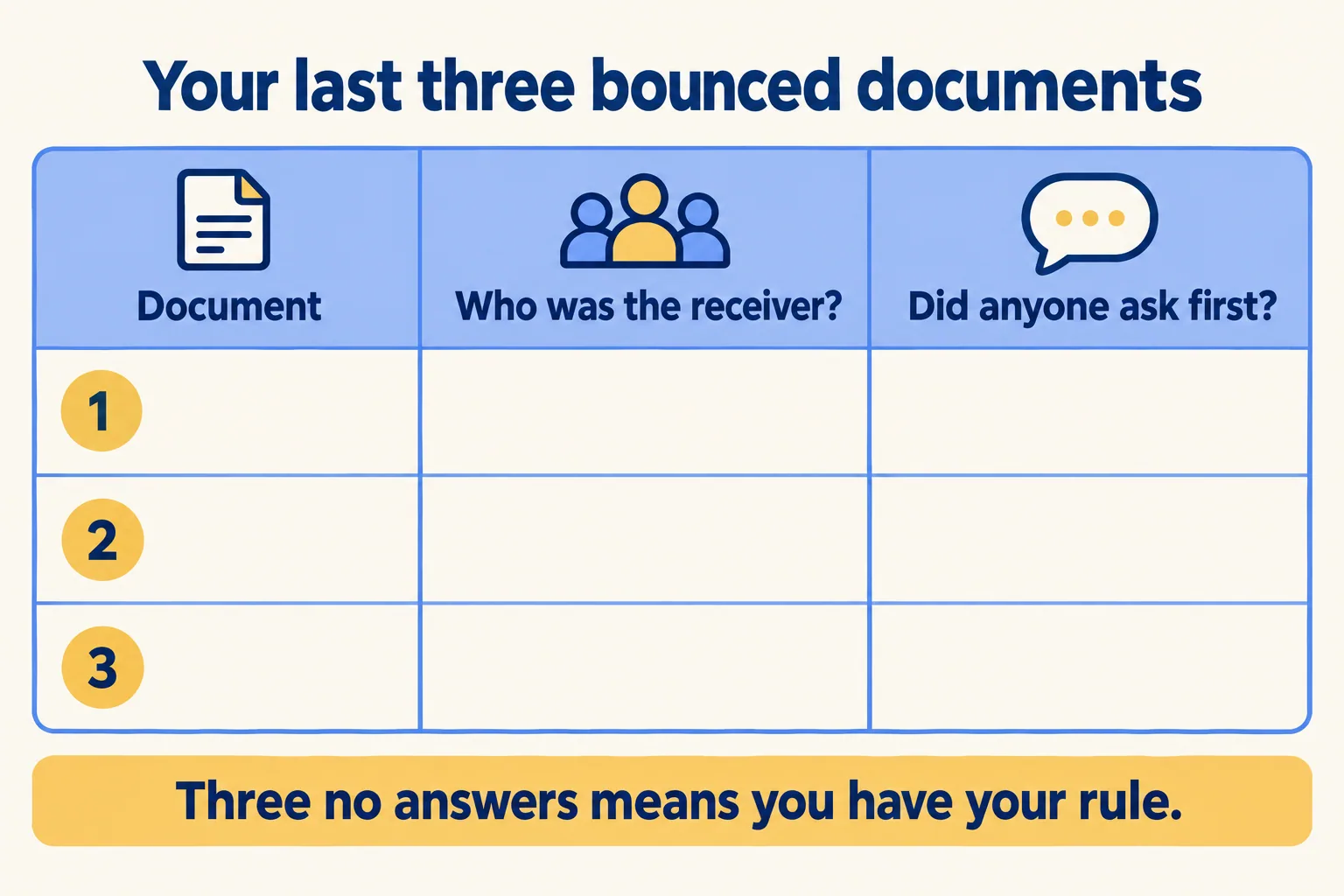
A test you can run today: write down the last three documents that came back with "please sign again". For each, note who the receiver was and whether anyone asked it first. If the answer is no three times, you have your rule.
This is not legal advice. Ask your lawyer about your own documents.
What does a signing link leave in the file?
For the documents the receiver is happy to take by link, you want a record you can hand over. Mindcat Sign sends one link per signer. The signer needs no app and no account. You get an audit log and the signed PDF, stored in the UAE or Saudi Arabia. It is an electronic signature with a record. It is not a UAE PASS or Nafath signature, and it is not a certificate from a licensed trust-service provider. A company certificate from a licensed provider is billed at cost if you want one on the file. The app does not send links on WhatsApp: the sender copies the link and pastes it.
Who signs and who pays: signers are free and unlimited. You pay per sender a month: AED/SAR 69 each for 1 to 5 senders, AED/SAR 49 for 6 to 20, AED/SAR 35 for 21 to 50 and AED/SAR 25 from 51, each band applying only to the senders inside it. The shared plan has a monthly minimum of AED/SAR 349, so a team of three pays the minimum, not 3 times 69. The quick start, up to 20 senders, is a fixed AED/SAR 2,500 that we set up for you. Prices exclude 5 percent UAE VAT and 15 percent Saudi VAT. Automatic reminders, SMS codes, bulk send, single sign-on and your logo on the signing page are paid upstream items we quote at cost, not in the price.
Once signed, the copy and its expiry date have to live somewhere. That is a job for Mindcat Vault, which holds the file and reminds you of the date.
How do we decide?
Our method is called One link per signer. Before we put a document into a signing link, we ask who will rely on it and in what form. If the receiver names ink, we tell you to use ink. If it says a link record is fine, we set up the link and the record together. Tell us what you send for signing and we reply with the setup plan and the monthly price per sender.
