

If your invoices leave your books as PDFs and nobody has told you who connects them to the tax system, this is for you. This is not for you if you sell only to consumers: those sales are treated separately from the first phase.
What is Peppol, and do you connect to it?
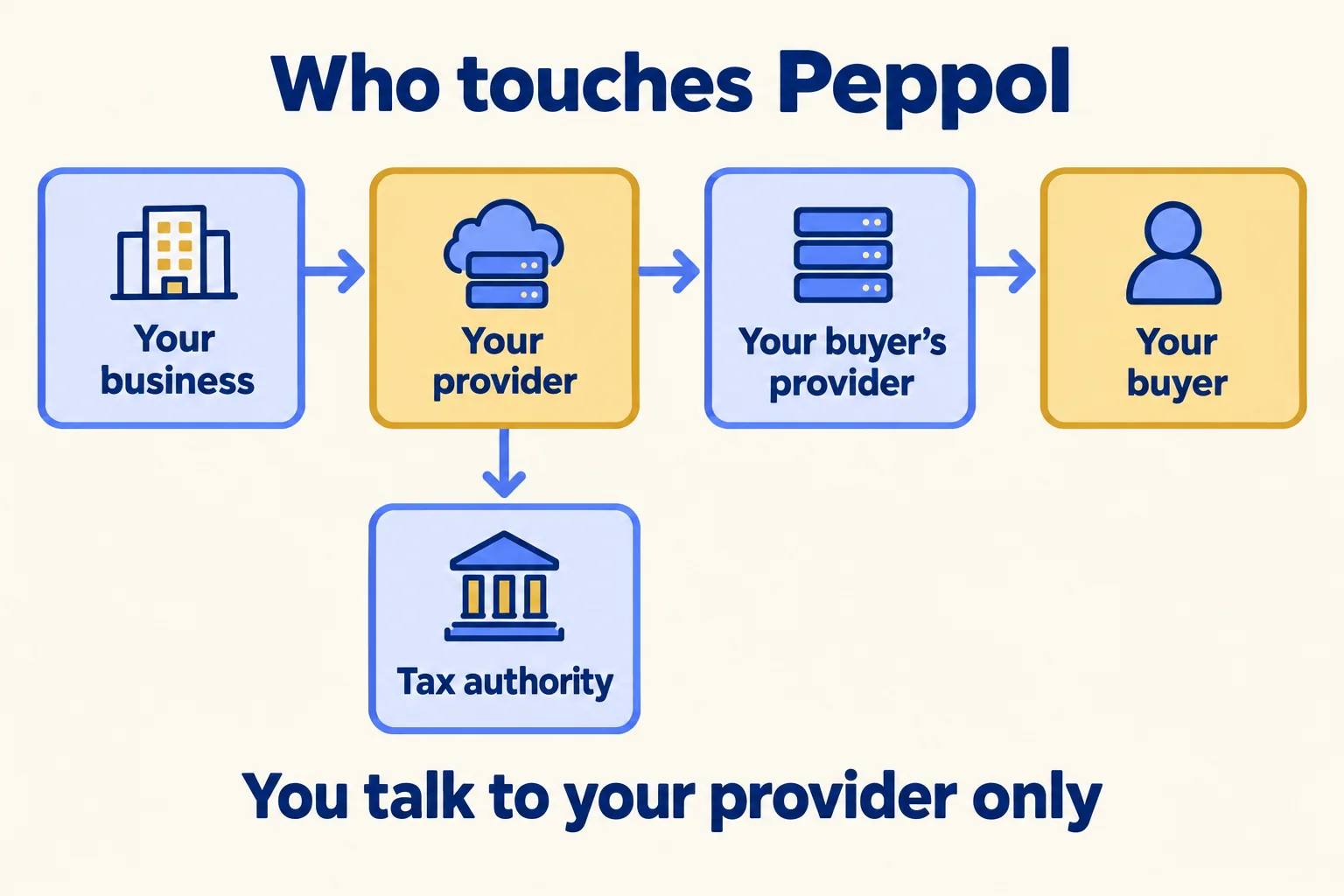
Peppol is the network your invoice travels over. You do not join it. The Federal Tax Authority's e-invoicing page says "the businesses are not required to interact directly with the UAE PEPPOL Authority", and that the Accredited Service Provider liaises with it on their behalf. The page states that businesses in the UAE must engage an Accredited Service Provider to issue and receive e-invoices, and that the provider checks every field against the UAE data dictionary before the invoice is exchanged, then reports the tax data to the Authority.
The Authority calls this a decentralized 5 corner model. Read it as a chain: you, your provider, your buyer's provider, your buyer, and the Authority receiving the tax data. You talk to the first link only.
What are your three jobs?
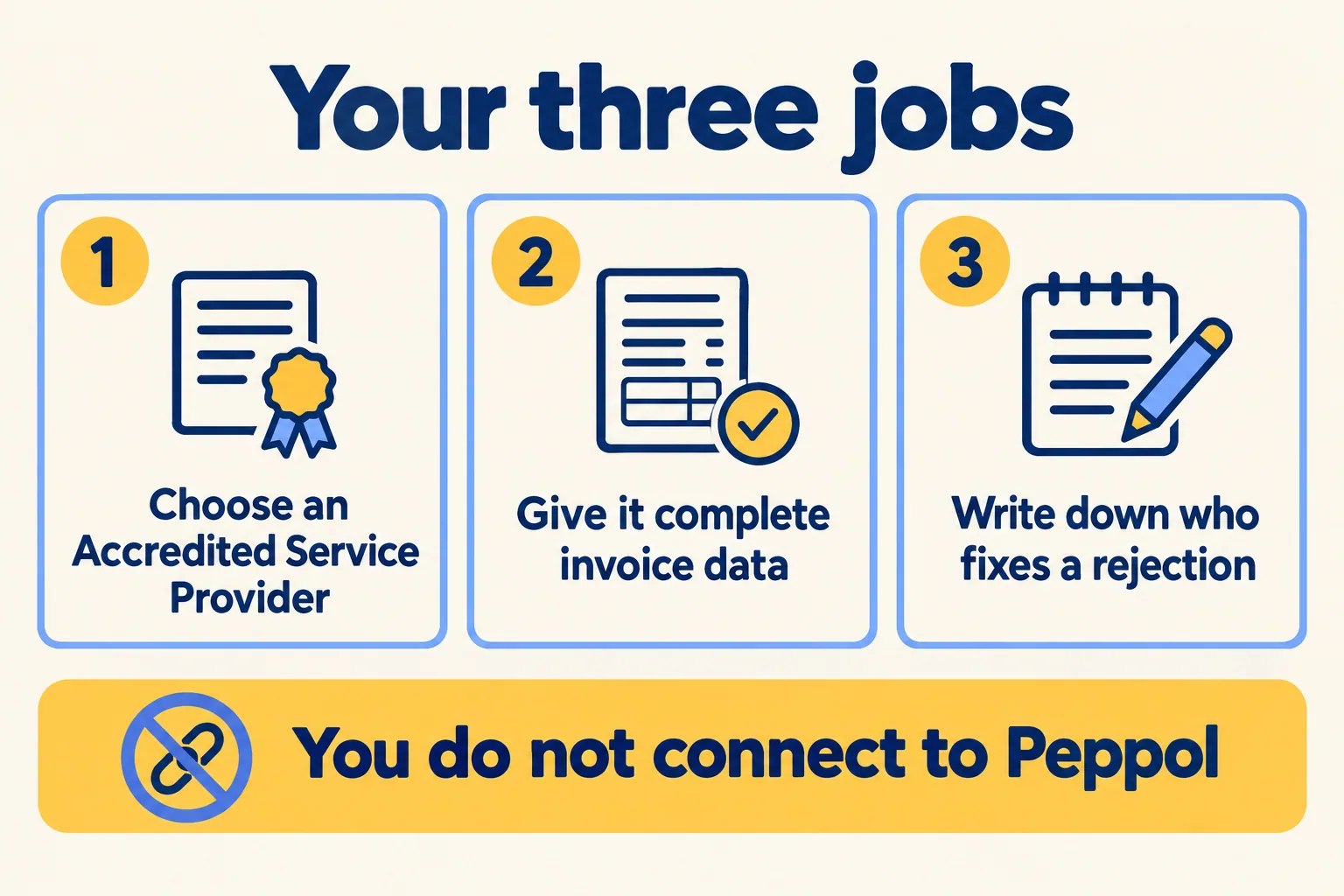
Not connecting does not mean doing nothing. You have three jobs, and none of them is technical.
- 01Choose the provider. It must be accredited. The Ministry of Finance publishes the list, and [a provider checklist](/blog/uae-e-invoicing-provider-checklist) covers what to ask before you sign.
- 02Give it complete invoice data: your own tax registration details, and for every buyer the registration number and address the provider will check.
- 03Write down who fixes a rejected invoice, and how fast. A provider that rejects an invoice for a missing buyer number has done its job. Someone on your side still has to supply the number.
The dates sit on your revenue. Per MEP Middle East (4 November 2026), a business at AED 50 million or more had to appoint a provider by 30 October 2026 and implement by 1 January 2027. Below that, appoint by 31 March 2027 and implement by 1 July 2027. We set the dates out in the rule-change post.
One contract or two?
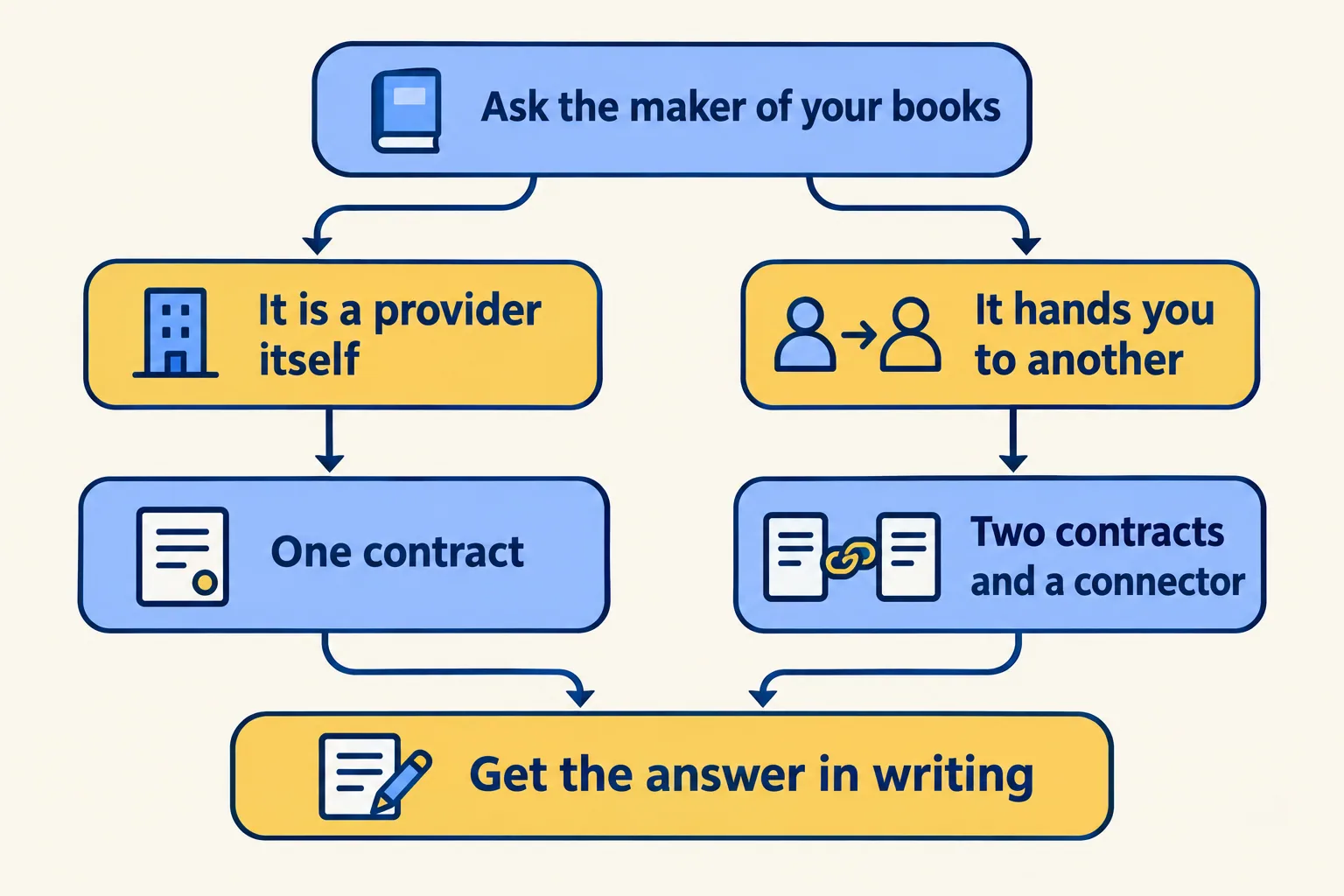
Ask the maker of your accounting program one question: are you an Accredited Service Provider yourselves?
If yes, you sign one contract and the invoice goes out of the books you already use. If no, you buy a provider separately and connect it, which means two contracts and a connector between them. Wafeq, an accounting vendor, puts it on its own page this way: if your accounting software isn't a provider, you need to buy and connect a separate provider product, "its own contract, its own bill, its own support queue". Wafeq states that it is a provider itself.
That is a vendor describing its own market, so check the answer for your program against the Ministry's published list on the day you decide. Ask for the answer in writing.
If you already have a bookkeeper and a program that works, two contracts is a cost, not a reason to switch. Read the earlier checklist before you buy new software only to get a link.
Does appointing a provider hand over the duty?
No. MEP Middle East says appointing a provider "does not transfer the business's statutory obligations to the provider". It advises that the contract allocate responsibility for integration, data retention, technical failures and service levels, and that you confirm the provider is accredited and complete onboarding through EmaraTax.
Retention is yours too. Ministerial Decision 197 of 2026, effective 1 October 2026, removed the requirement to store the data in the UAE, but you still keep invoices, credit notes and related data for the period the Tax Procedures Law requires and produce them to the Authority on request. Ask the provider where the copies sit and how you get them out.
What does Accounts do today?
Mindcat Accounts is not an Accredited Service Provider and is not on the Ministry's list. It holds the invoice data and produces the UAE VAT 201 figures today, and your adviser files the return. The link to the provider you appoint is not built yet. We build it against your provider during setup and quote it after the call. From your date, a PDF is not an e-invoice.
How do we decide?
Our method is called Cleared, then sent. Before we recommend anything, we ask which program you use now, who raises the invoices, and whether your buyers' registration numbers are on file. If your program's maker is itself a provider and your invoices are clean, we tell you to stay where you are.
If Accounts fits, it is AED/SAR 209 per user a month for users 1 to 5 and AED 179 for 6 to 20. The shared plan minimum is AED/SAR 1,045 a month on the quick start, a fixed AED/SAR 2,500 package for one company and up to 5 users we set up for you. When we set it up with you, the minimum is AED/SAR 2,298, which is what 12 users pay. Your provider's fees are on your own contract with it. Prices exclude 5 percent UAE VAT and 15 percent Saudi VAT.
Get the written assessment. The UAE e-invoicing guide lists the dates, and manufacturing and supply chain shows where the fit is strongest.
