

If your invoices reach a bookkeeper by WhatsApp and you see the books once a quarter, this is for you. This is not for you if you are a one-person company with a few invoices a month: a freelance bookkeeper and a spreadsheet are the cheaper fit.
What does a bookkeeper, an accountant and software each do?
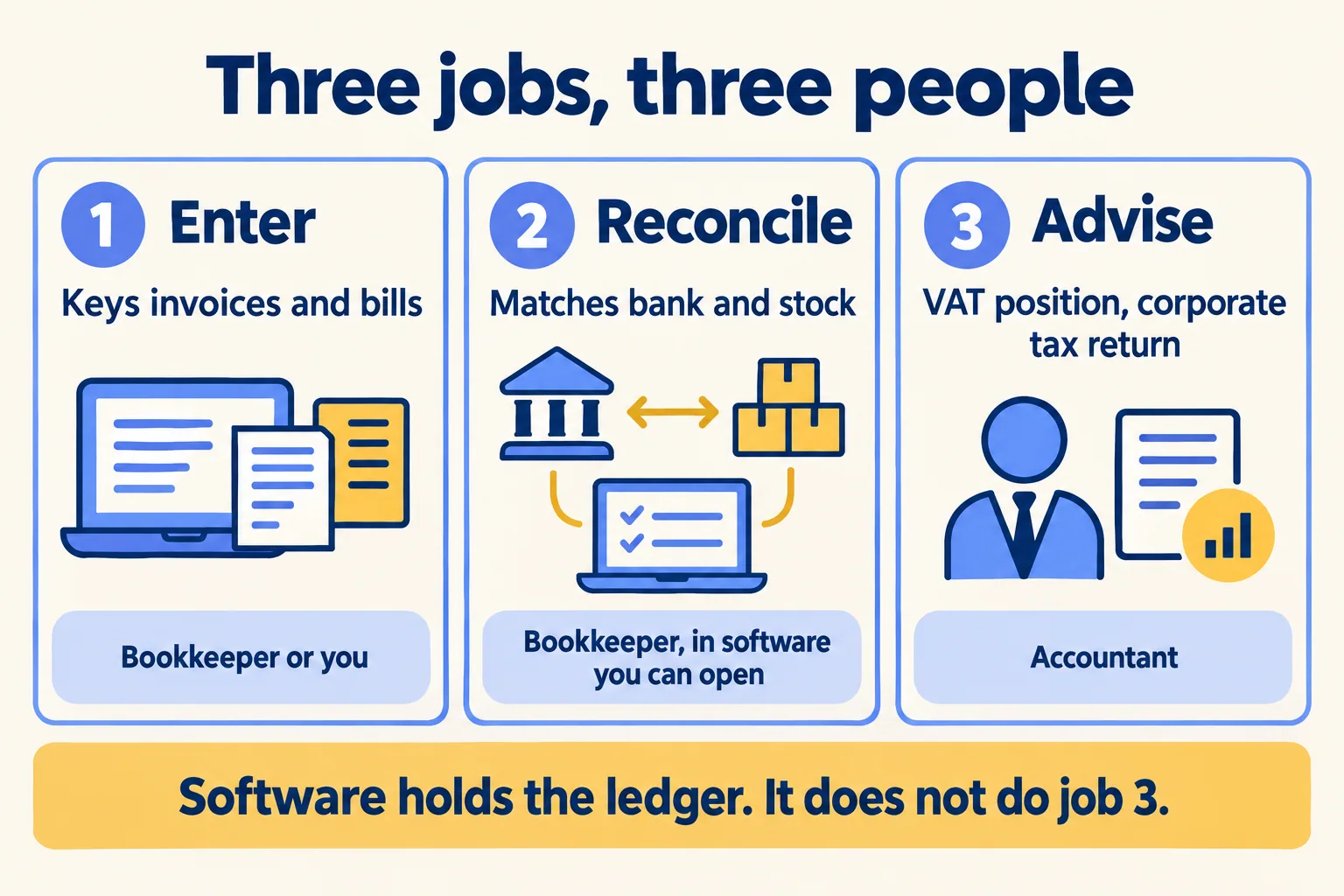
Three jobs get mixed up when you shop for bookkeeping services in Dubai. Someone enters the invoices and bills. Someone reconciles them against the bank and the stock. Someone decides what the numbers mean for your VAT position and your corporate tax return.
Software does the first well and part of the second. It does not do the third. A UAE tax adviser's guide, last reviewed on 2 October 2026, puts it in one line: "The software handles the recording; the accountant handles the judgment." The same guide gives corporate tax adjustments, complex VAT positions and queries from the Federal Tax Authority to the accountant, not the software.
So the real choice is not bookkeeper versus software. It is where the ledger lives. A bookkeeper who keys what you send keeps the books in their own files. You see stock and receivables when a report arrives. Software you own holds the same entries where you can open them on any day.
What do bookkeeping services in Dubai cost?
Every public range comes from someone selling the service, so read each as the seller's number, not a market rate. SSCO Global's page (1 August 2025) lists basic bookkeeping at AED 1,500 to 2,500 a month, a freelance bookkeeper at AED 500 to 1,200 and an in-house accountant at AED 5,000 to 10,000. Finanshels' page (updated 28 October 2026) lists outsourced bookkeeping for a small business at AED 500 to 2,500 a month, and an in-house bookkeeper at AED 4,000 to 12,000 a month before benefits.
Our own line, from the Accounts page today: one company with up to 5 people working in the books is AED 1,045 a month at the shared plan's minimum, plus a fixed AED 2,500 quick start we set up. That is AED 12,540 over a year, before the bookkeeper. Add your bookkeeper's quote to it and you have the real comparison: the bookkeeper's fee stays, in a new role, and the software line is what you add.
What each option costs a month, and where the books live
The table makes one point. The software line is smaller than the person, and the person is still needed to enter and reconcile. What the software line buys is where the file lives.
When is a bookkeeper enough?
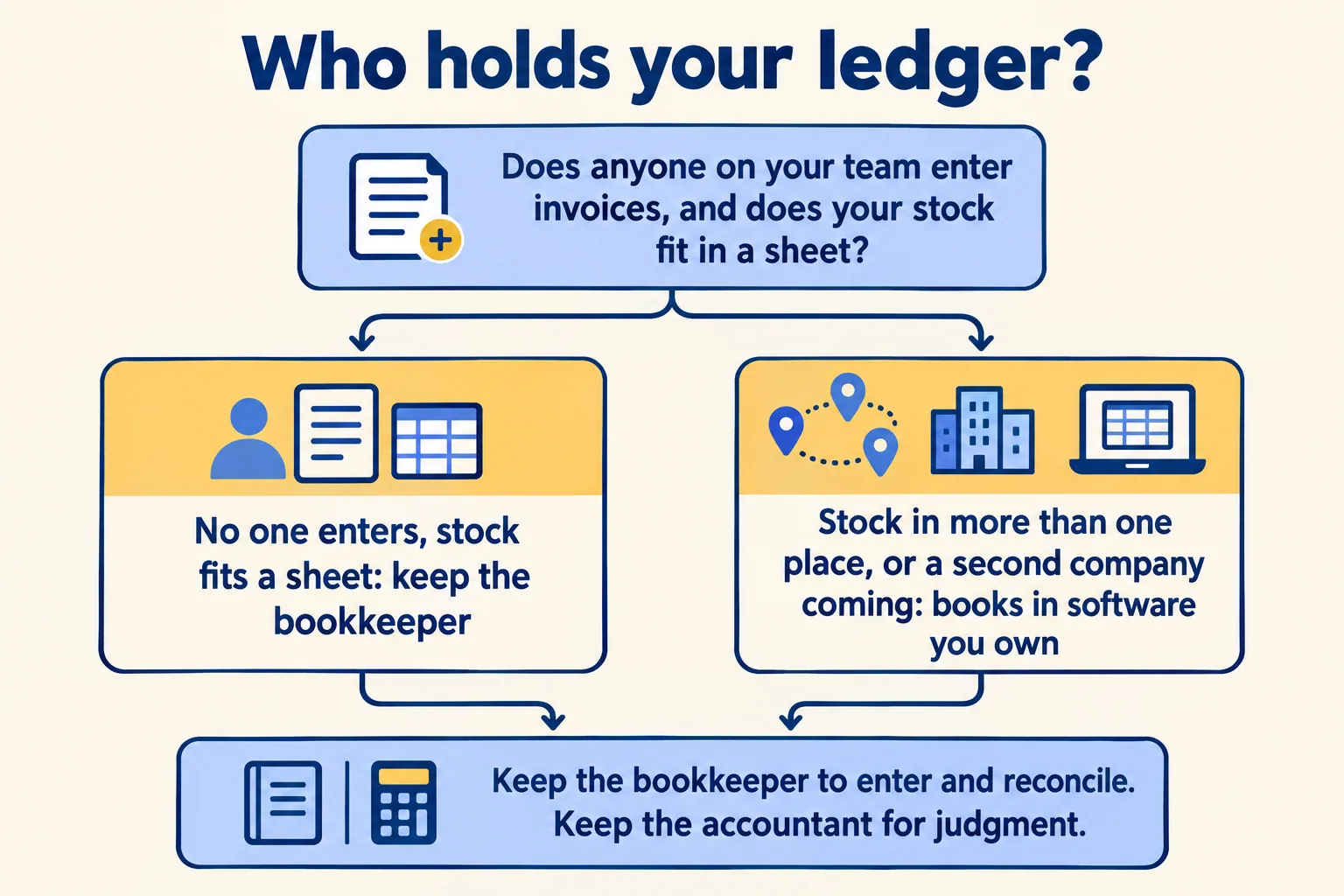
Keep the bookkeeper when two things are true. Nobody on your team enters invoices, and your stock fits in a sheet you can read in a minute. Then the work is typing and matching, a firm does it for a fee you can quote, and your files are a folder of invoices and a monthly report.
The condition is the report. Ask what you will see, and how often. If the answer is "a statement each quarter", you are running the business on three-month-old receivables. For a trader with ten staff, that is the gap: an invoice goes out on the 3rd and the customer's late payment shows up on the 3rd of the next quarter.
When should the books move into software?
Move them when stock moves between places, or when a second company or a Saudi branch is coming. A bookkeeper's files stop being the books at that point, because nobody can see a warehouse count and a receivable on the same screen without asking.
Then keep the bookkeeper, in a new role. They enter and reconcile inside the software, where you can read the same ledger. The accountant stays for the judgment. We say it plainly: Accounts replaces where the books live, not the adviser who files. Your adviser files the VAT 201. Accounts produces the figures for it.

Our accounting software guide sorts the kind of tool you need, from an invoicing app to full books. For the e-invoicing provider dates, read our rule-change post. This post is only about who does the work.
What should you ask any bookkeeper about your files?
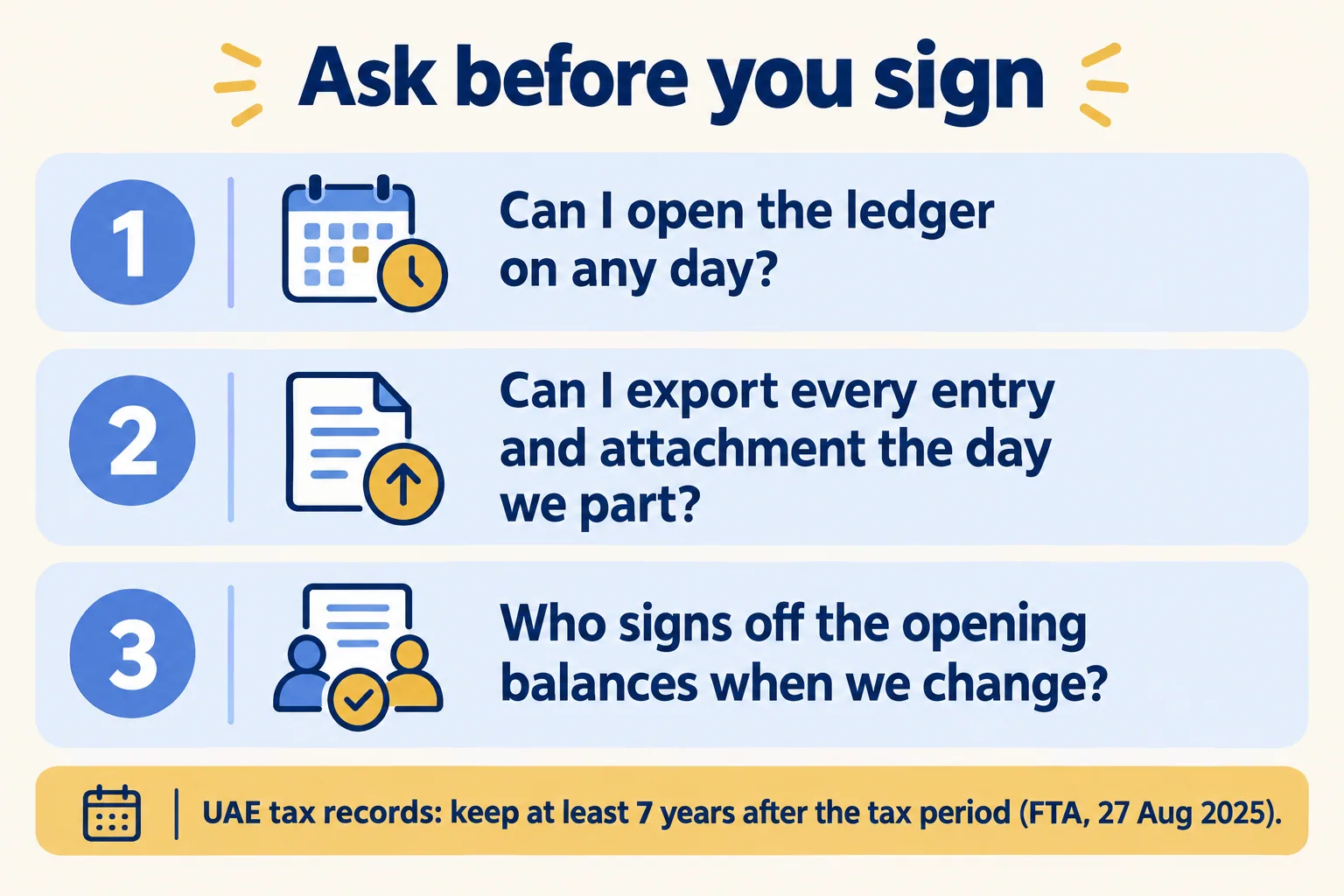
Ask one question before you sign: can I export every entry and attachment on the day we part? The Federal Tax Authority's notice of 27 August 2025 says taxable persons must keep relevant records for at least seven years after the end of the tax period they relate to. Records that sit in a former bookkeeper's system do not help you in year six.
- 01Can I open the ledger myself on any day, or only get a report?
- 02On the day we part, can I export every entry and its attachment, in a format another system reads?
- 03Who enters, who reconciles, and who signs off the opening balances when we change?
A bookkeeper who answers all three in writing is a good fit, in software or out of it. Confirm the retention period for your own records with your adviser.
How do we decide which one you need?
Our method is called Cleared, then sent. Your opening balances come from your trial balance on our template, and your accountant signs them off before go-live. We start from the people who work in the books, the companies and branches, where stock sits and who enters the invoices today. Then we tell you which side you are on, including when the answer is to stay with your bookkeeper.
We do not tell you to stop using a bookkeeper or an accountant. We tell you which of the three jobs software takes over, and which stays with a person. Not legal or tax advice: confirm your own VAT and corporate tax position with your adviser.
What does it cost with us?
Here is what the Accounts page says today. You pay per user a month, and a user is a named login that works in the books. Your customers on the portal and your outside auditor's read-only login are free. Companies, branches, warehouses, items and invoices are unlimited, with no per-invoice fees.
- Users 1 to 5: AED or SAR 209 each. Users 6 to 20: 179 each. Users 21 to 50: 129. Above 50: 99.
- The quick start is a fixed AED/SAR 2,500 for one company and up to 5 users, and we set it up. The monthly minimum is AED/SAR 1,045, so one login does not buy a seat at the per-user rate.
- More than 5 users, or more than one company: we set it up with you. The monthly minimum is AED/SAR 2,298 and the one-time setup is AED/SAR 14,900 for 1 to 20 users.
Your Accredited Service Provider's fees from 2027, SMS and WhatsApp messages and payment gateway fees are billed to you at cost by those vendors. UAE e-invoicing from 2027 runs through an Accredited Service Provider that you appoint; the dates on our page are 1 January 2027 for businesses at AED 50 million or more, and appointment by 31 March 2027 for smaller ones. The invoice data and the VAT 201 figures are ready today. The link to the provider you appoint is not built yet. We build it against that provider during setup and quote it after the call. Prices exclude 5 percent UAE VAT and 15 percent Saudi VAT.
Tell us how many people work in the books, which companies and branches you run and what you use today. We reply with the setup plan and the monthly price. If a bookkeeper and a spreadsheet are enough for you, tell us anyway and we will say so.
