
If you find out about an e-invoicing rule change from a WhatsApp forward, this is for you. It is not for a business with revenue of AED 50 million or more that has not yet appointed a provider: your date is 30 October 2026, and you need a provider's contract, not a blog post.
What did the Ministry change on 19 October?
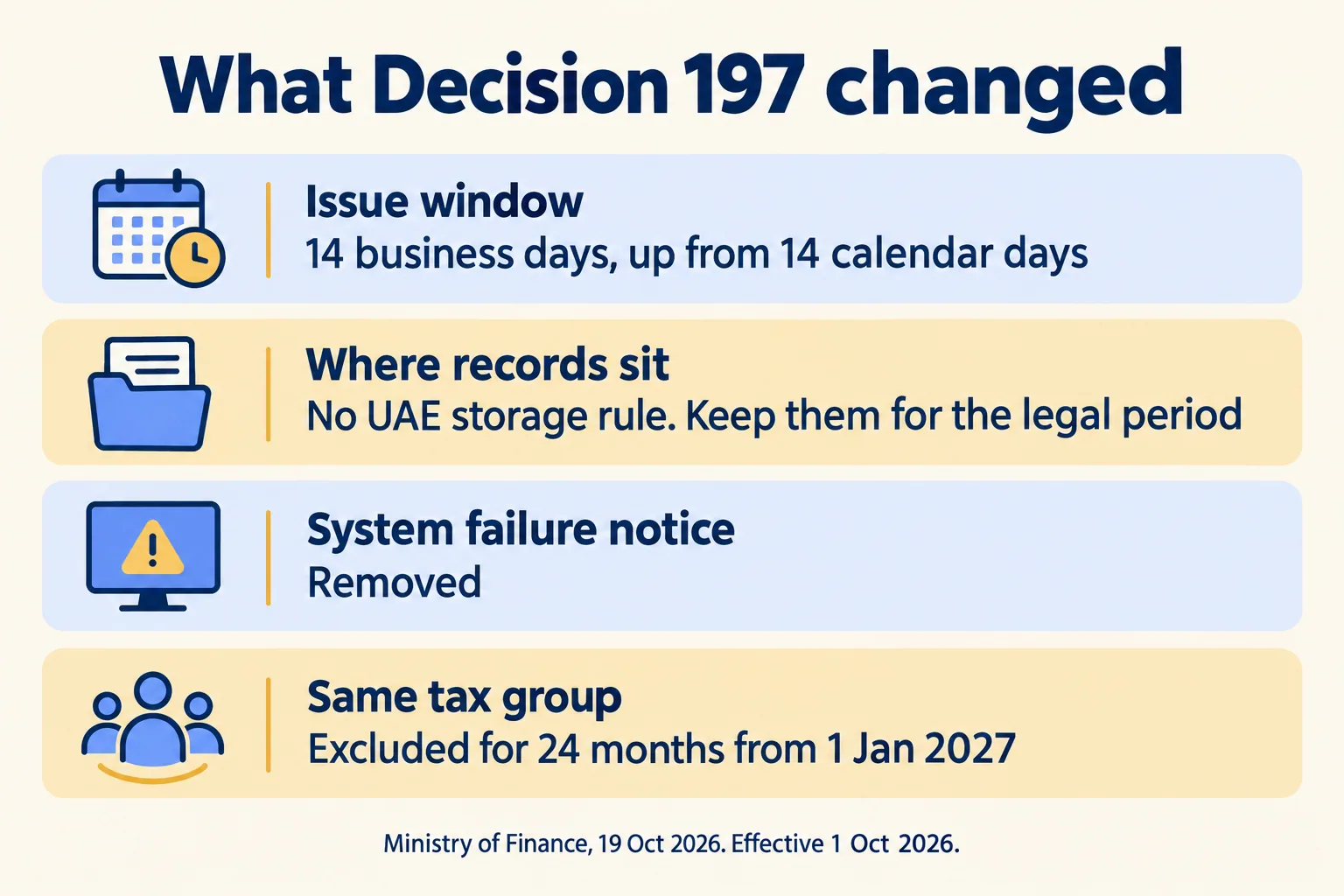
On 19 October 2026 the Ministry of Finance issued Ministerial Decision No. 197 of 2026. It amends the decision that sets up the e-invoicing system (the Ministry's notice calls that one Ministerial Decision No. 243 of 2025). The amendment took effect on 1 October 2026. Four changes matter to a trader.
- Records. You keep every e-invoice, credit note and its data for the period in the Tax Procedures Law and give it to the Federal Tax Authority on request. The old requirement to store it in the UAE is removed.
- System failures. The provisions on "System Failure" are repealed, including the duty to tell the Authority within two business days.
- The clock. A law firm's note (Simmons & Simmons, 22 October) says the time to issue and send an e-invoice or credit note is now 14 business days, up from 14 calendar days. The Ministry's own notice does not mention it, so read the decision text before you write it into a procedure.
- Tax groups. Transactions between members of the same tax group are excluded for 24 months from 1 January 2027.
What it does not change is your dates. A business under AED 50 million appoints an Accredited Service Provider by 31 March 2027 and is live by 1 July 2027. At AED 50 million or more the dates are 30 October 2026 and 1 January 2027.
For the provider questions and the full dates, see the provider checklist. This post is about what the change means for you.
What do you do now, and what waits?
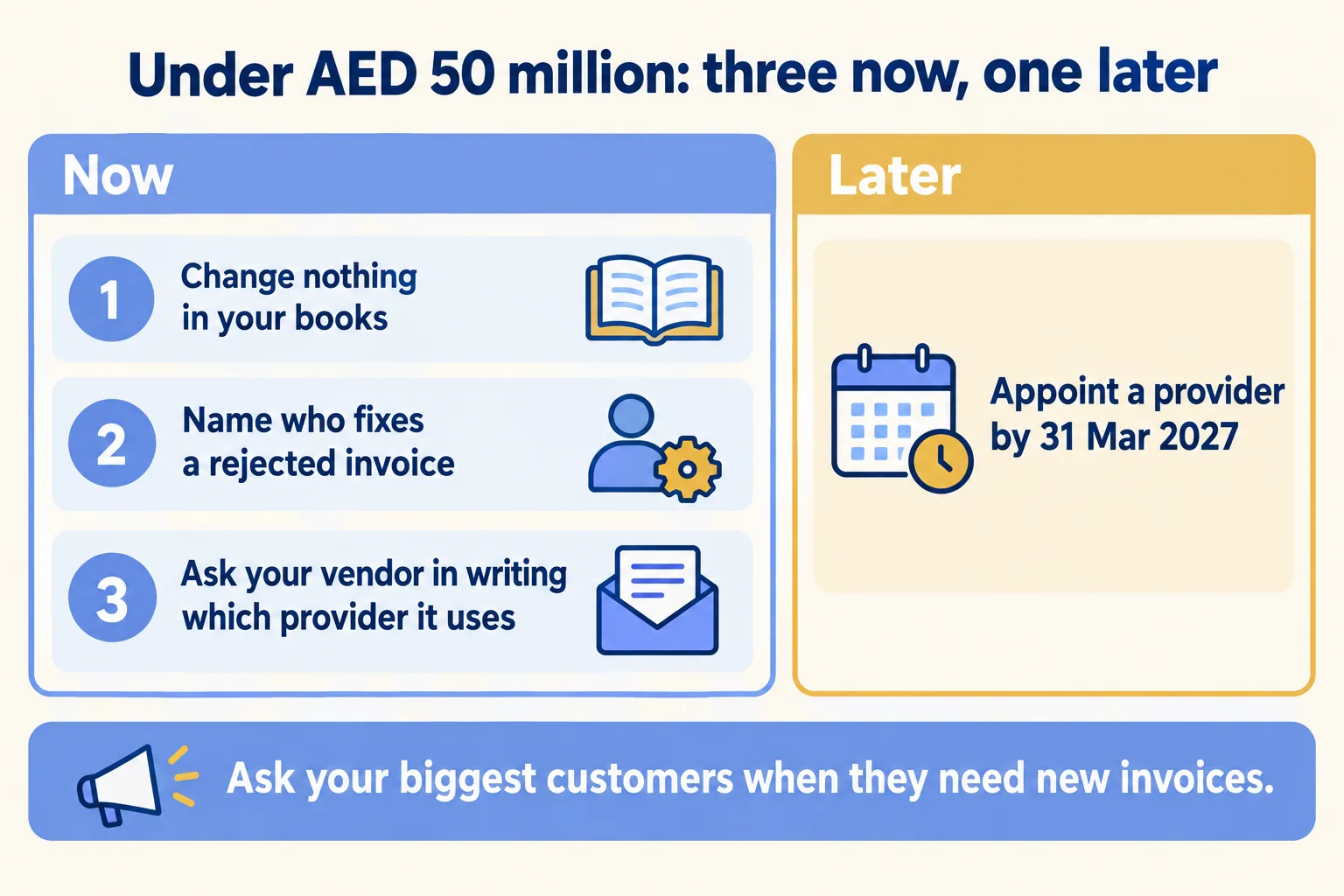
Under AED 50 million, do three things now and one thing later.
Now:
- Change nothing in your books because of Decision 197. Nothing in it moves your date or asks a small trader to switch anything on.
- Name one person for rejected invoices. A rejected invoice has to be fixed and sent again inside the window. Whether that window is 14 business days or 14 calendar days, someone must own the fix. Write their name next to the task, and name a cover for when they are away.
- Ask your software vendor, in writing, which Accredited Service Provider its update goes through. The answer should name a provider and a client that is live on it.
Later: appoint by 31 March 2027, and not before your vendor has shown you a live client. If your current software and its provider will cover you, staying put and waiting is a good answer, and you do not need to buy anything from us. If your vendor cannot name a provider, that is the day to look for a different one.
One provider's page for businesses under AED 50 million says the same about timing: nothing to do today, and those who move during the voluntary window can test with no penalty exposure. That is a vendor's sales page, so use the idea, not the promise. A trial run before your date is cheap. A first run on your date is not.
The storage change deserves one sentence of caution. The rule that records must sit in the UAE is gone, so a hosting location is a choice, not a requirement. Do not pay extra for "UAE-only storage" to satisfy a rule that no longer exists. Keeping the records for the legal period, and being able to hand them over, is the rule that remains.
Why is your accounting update not your provider?
Because they do different jobs. A UAE ERP reseller puts it plainly: the ERP builds the invoice in the PINT AE format, and the provider validates and delivers it. In its words, "the update and the ASP appointment are two separate tasks" (Hitech Inn, 9 June 2026).
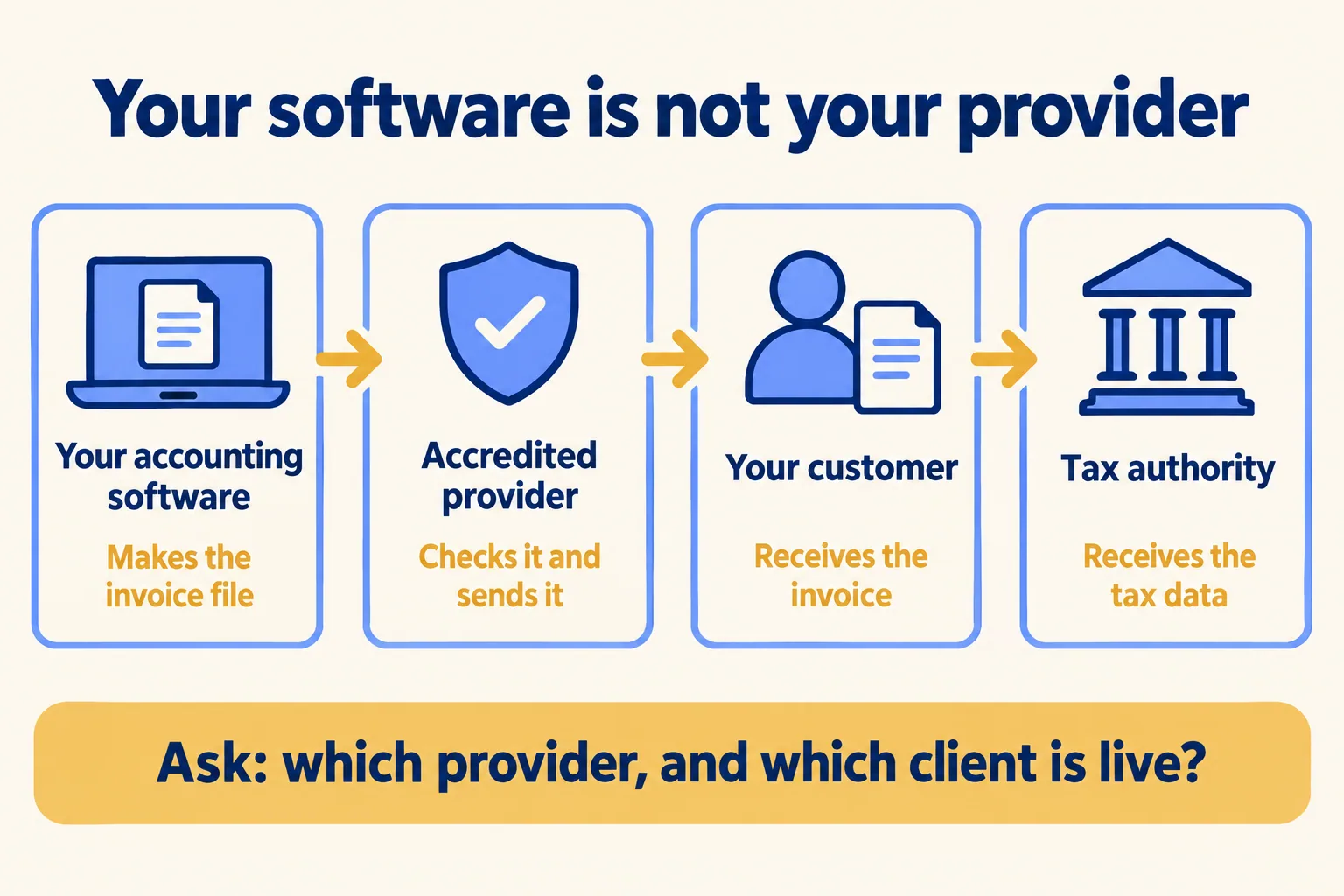
So when your software vendor emails "we are e-invoicing ready", that sentence can mean the file format is done and no provider is attached. The question that settles it is the one above: which provider, and which client is live on it.
Who can pull your date forward?
Your customers can, even though the Ministry does not. A business over AED 50 million has to be live on 1 January 2027, and it will want its suppliers to send invoices it can receive. One accountancy firm (Alburhan Accountancy, 15 October) expects providers to be busy once larger businesses go live, and says smaller businesses that sell to larger customers may be asked to be ready sooner.
So before you settle on 31 March, make a list of your five biggest customers by invoice value and ask each one if it is over AED 50 million, and when it needs invoices from you in the new format. One email each. If two of the five say January, your real date is January.
What does Accounts do today, and what is left out?
Mindcat Accounts is accounting software we host in the UAE or Saudi Arabia. The invoice data and the UAE VAT 201 figures are ready today. See the Accounts page for the Saudi side, and Mindcat for manufacturing and supply chain for the shape of the work.
What it leaves out matters here:
- No UAE e-invoice link yet. The link to the provider you appoint is not built. We build it against your provider during setup and quote it after the call.
- A PDF is not an e-invoice. From your date, invoices must go through your provider. Today our UAE invoices are PDF and print.
- Your provider's fees are separate. They are on your own contract, and they are not in our price.
Check dates and duties with your accountant and the Federal Tax Authority. No software makes you compliant on its own.
What does it cost?
A user is a person who works in the books, not everyone on your payroll, so a 40-person company often has a handful. Accounts is AED 179 a user a month for 6 to 20 users. That rate comes with a minimum: AED 2,298 a month when we set it up with you, which is what our page shows for 12 users. So 12 users pay AED 2,298, not 12 × 179.
A business with one company and up to 5 users starts on a fixed quick start: we set it up for AED 2,500, and the minimum is AED 1,045 a month. Anything larger is managed and scoped in writing. Prices exclude 5 percent UAE VAT and your provider's fees.
What happens on the first call?
We call the method Cleared, then sent: every invoice is checked by the tax system before it reaches your customer. In Saudi Arabia that is how it works today. In the UAE it will be, once your provider link is built during setup. You tell us how many people work in the books, which companies and branches you run and the program you use today. We reply with the setup plan and the monthly price per user, in AED. If your current program already hands a provider clean data, we will say so and tell you to wait. If it cannot, tell us your setup and we start there.
