

Staff training LMS (Mindcat Learn)

UAE

Your HSE induction is read in English and signed by the whole crew. Is the paper enough?

By Shivanath DevinarayananPublished 8 min read
Written forOperations or sales lead at a mid-market UAE business“Leads go cold before anyone replies.”

The short answer

When should a UAE contractor keep the paper HSE induction, and when does a phone lesson in the crew's own language earn its place?

Keep the paper induction for one site, one shared crew language and a supervisor who checks each man understood. Add a phone lesson when crews speak languages the trainer does not, three or more sites need the same induction, or a client wants proof per worker. At Mindcat, we say which fits before we sell.

A signed induction sheet beside a phone showing a quiz question in Hindi, on a site cabin desk

Takeaways

  1. 01A signed induction sheet proves attendance. It does not show a worker understood it in a language he speaks.
  2. 02MOHRE asks employers to educate workers on job risks and post instructions near machines in Arabic and a language workers understand.
  3. 03Dubai Municipality's safety-sign guideline asks for training records, induction included, kept five years for its inspectors.
  4. 04Keep paper for one site, one shared language and a checking supervisor. Add a phone lesson for mixed languages, three sites or per-worker proof.
  5. 05Mindcat Learn opens in the phone's browser, with no app and no offline mode. A camp with no signal stays on paper that hour.

If your HSE induction is read aloud in English to a room where half the crew speaks Hindi, Urdu or Bengali, and everyone signs the sheet, this is for you. This post is not for a team with one site and one shared language, where a supervisor checks that each man understood. For you, keep the paper.

What does a signed induction sheet prove?

It proves who was in the room. An IOSH forum thread from January 2019 (a UK site, so read it as a trade voice, not a Gulf one) opens with the line every HSE officer knows: "its easy to get a signature on a site induction but harder to ensure its completly understood." A reply in the same thread describes sheets signed as "read and understood" by people who did not read English.

The point does not depend on the country. A sheet answers "who attended". When a client's auditor asks "who understood it, and how do you know", the sheet has no answer. The question for a UAE contractor is how much of that gap your client, your emirate's authority and your own risk register ask you to close.

A hard hat on a camp table beside a phone showing a lesson with a green tick and a paper sign-in sheet at dawn
The sheet shows who attended. The phone shows who passed.

What do UAE rules ask of an induction?

Read the wording, then decide. Two sources a UAE contractor can open today:

SourceWhat it saysWhat it does not say
MOHRE, employer guide to occupational health and safetyEmployers educate workers about the risks of their profession, "including fire, machinery, falls, occupational illnesses". They provide "instructions in Arabic and another language the workers understand near machines or areas where operations are performed".It does not set the format of an induction or require a quiz. The language line is about instructions at machines and in the workplace.
Dubai Municipality, technical guideline on safety signs at work (DM-HSD-GU99-SSW2, version 2)In its section on training for safety signs: training is "relevant and understandable", and records of any training, "including induction and tool box talks", are kept "for at least five (5) years" and made available to Dubai Municipality OHS inspectors.The sentence sits in a guideline on safety signs. It is not a general five-year rule for every induction. Ask Dubai Municipality about your activity.

MOHRE also says industrial and construction establishments with at least 100 workers employ a qualified occupational health and safety officer. Under Federal Decree-Law No. 33 of 2021, the ministry checks employers by field visits.

Neither source says a signed sheet is enough, and neither says a phone lesson is required. They ask that the worker is educated, that the instruction is understandable, and that you can show the record. Confirm with the regulator before you rely on any format. That is guidance, not legal advice.
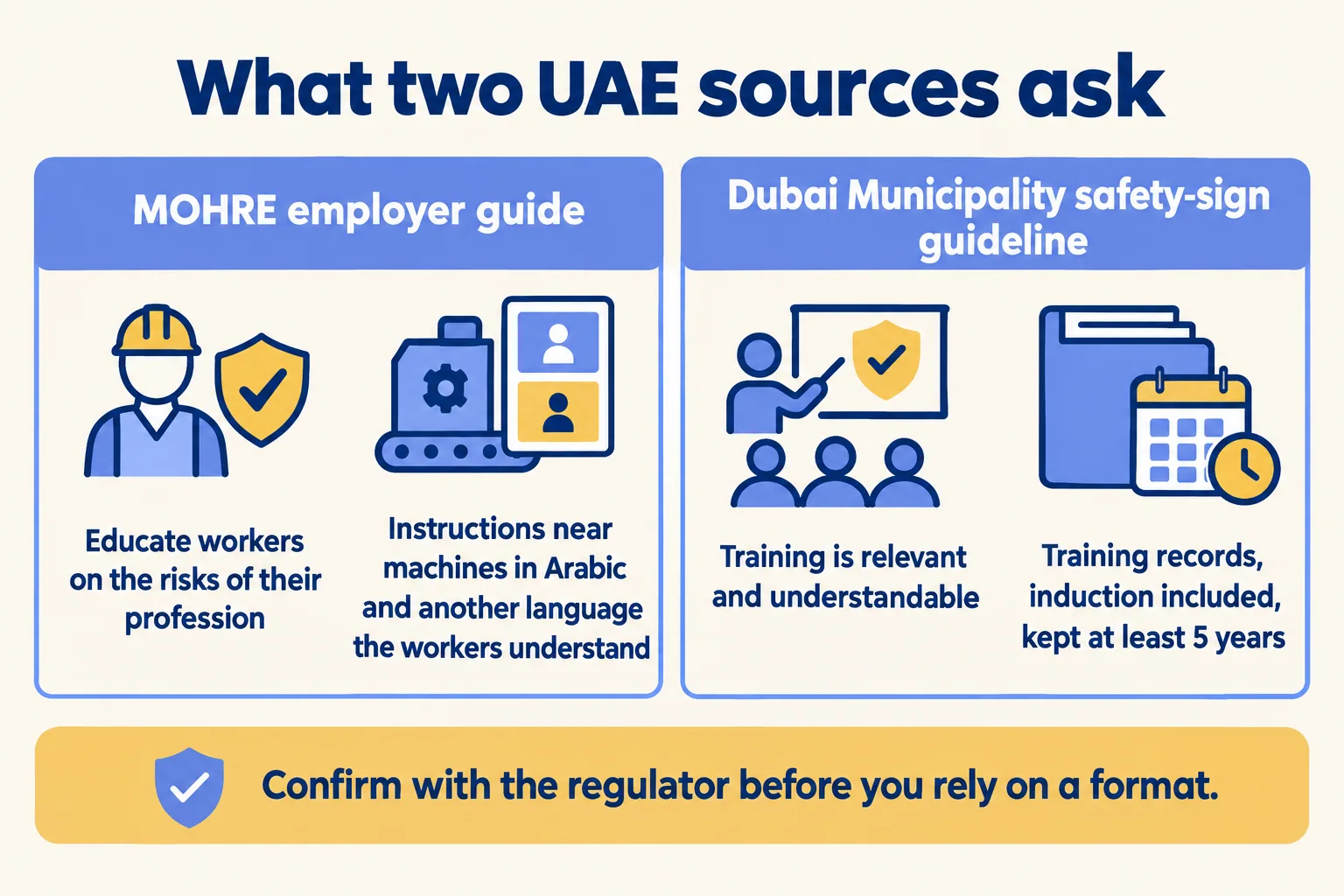
MOHRE: educate workers, instructions in two languages. Dubai Municipality: understandable training, records kept five years
What two UAE sources ask, in short.

When is the paper induction enough?

Our rule has two sides, and the first side is "keep the paper".

Keep the paper induction when all four are true: you run one site, the whole crew and the trainer share one language, a supervisor reads it aloud and checks that each man understood, and your client's auditor asks for no more than the signed sheet. A phone lesson would add cost and no new information.

Add the phone lesson when any one of these is true: the crew speaks two or more languages the trainer does not, you run three or more sites that must give the same induction, or your client asks for proof per worker that the induction was understood.

Your situationUseWhy
One site, one shared language, a supervisor who checks each manKeep the paper sheetThe sheet and the supervisor already do the job.
Two or more crew languages the trainer does not speakA phone lesson per languageEach worker takes the course in his language. A wrong answer shows where it did not land.
Three or more sites with the same inductionA phone lesson with one recordOne tested induction instead of a sheet per site, in one list by worker. If every site has its own language and checking supervisor, paper can still work.
A client asks for proof per workerA phone lesson with a quiz and a certificateThe record shows a pass per worker, not a signature per sheet.
A site with no signal at induction timePaper for that hourThe lesson needs data or Wi-Fi.

The receipt for the second side is the sheet itself. Pick up last month's signed sheet. If a man who understood none of the language could still have signed it, it is not proof of understanding, and the paper side of the rule does not hold for you.
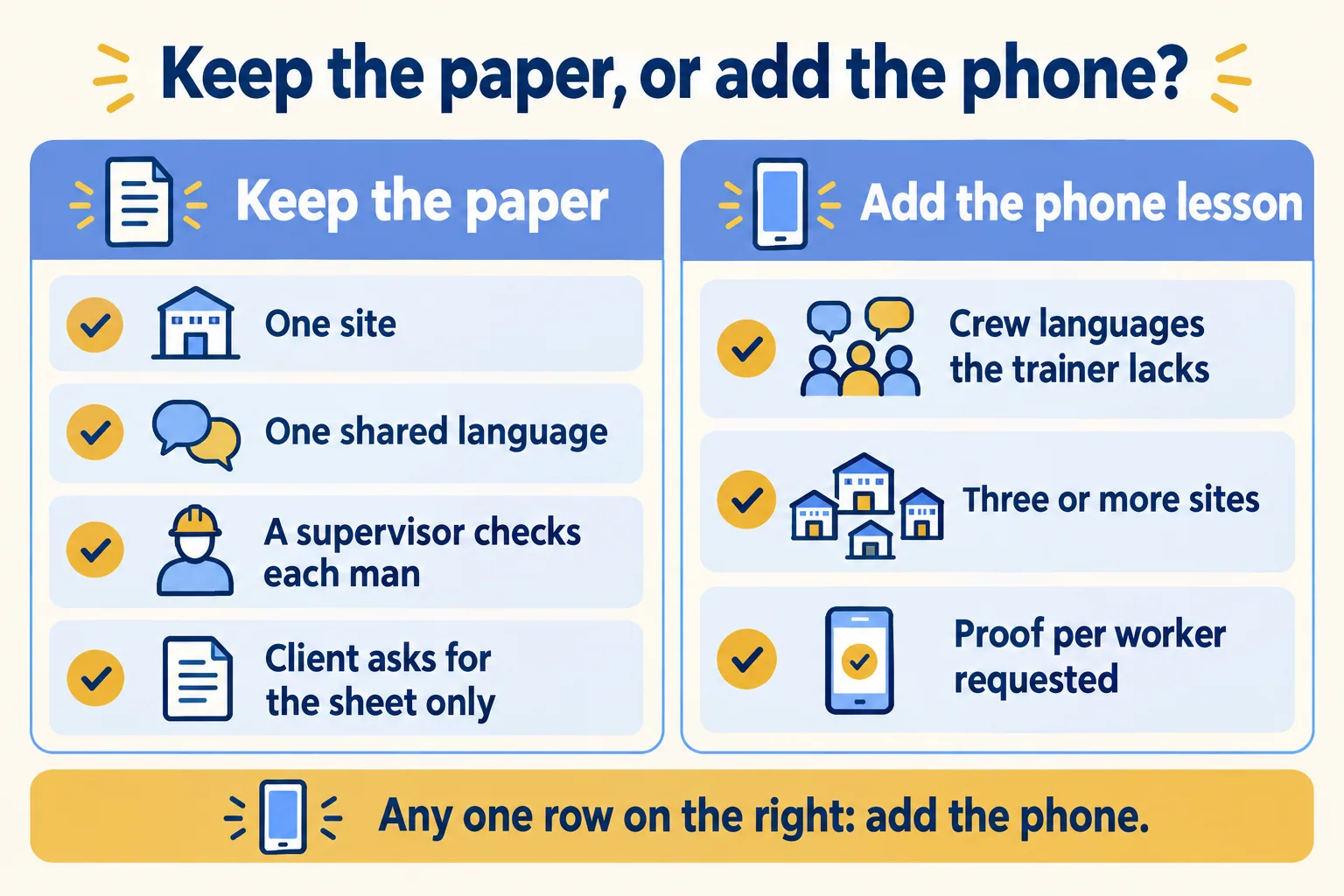
Keep paper for one site, one language, a checking supervisor. Add a phone lesson for mixed languages, three sites, proof
The rule on one page.
For the phone side, a staff-training system for crews on phones gives each worker the induction in his language, with a quiz and a certificate.

What does a client's auditor expect to see?

Clients differ, so ask. A UAE-focused induction checklist from Site Safety UAE (a third-party template, not law) shows what an HSE team may list. It includes "Language proficiency assessed to determine need for translated induction material", "Induction comprehension assessed via verbal or written quiz" and "Interpreter or translated induction materials provided for non-English/Arabic speakers", each with the record to keep.

Use it as a prompt for the conversation with your client's HSE team, not as a rule. If the client's list asks for a language check and a quiz result on file, a signed sheet leaves two rows empty.

What does a phone induction record?
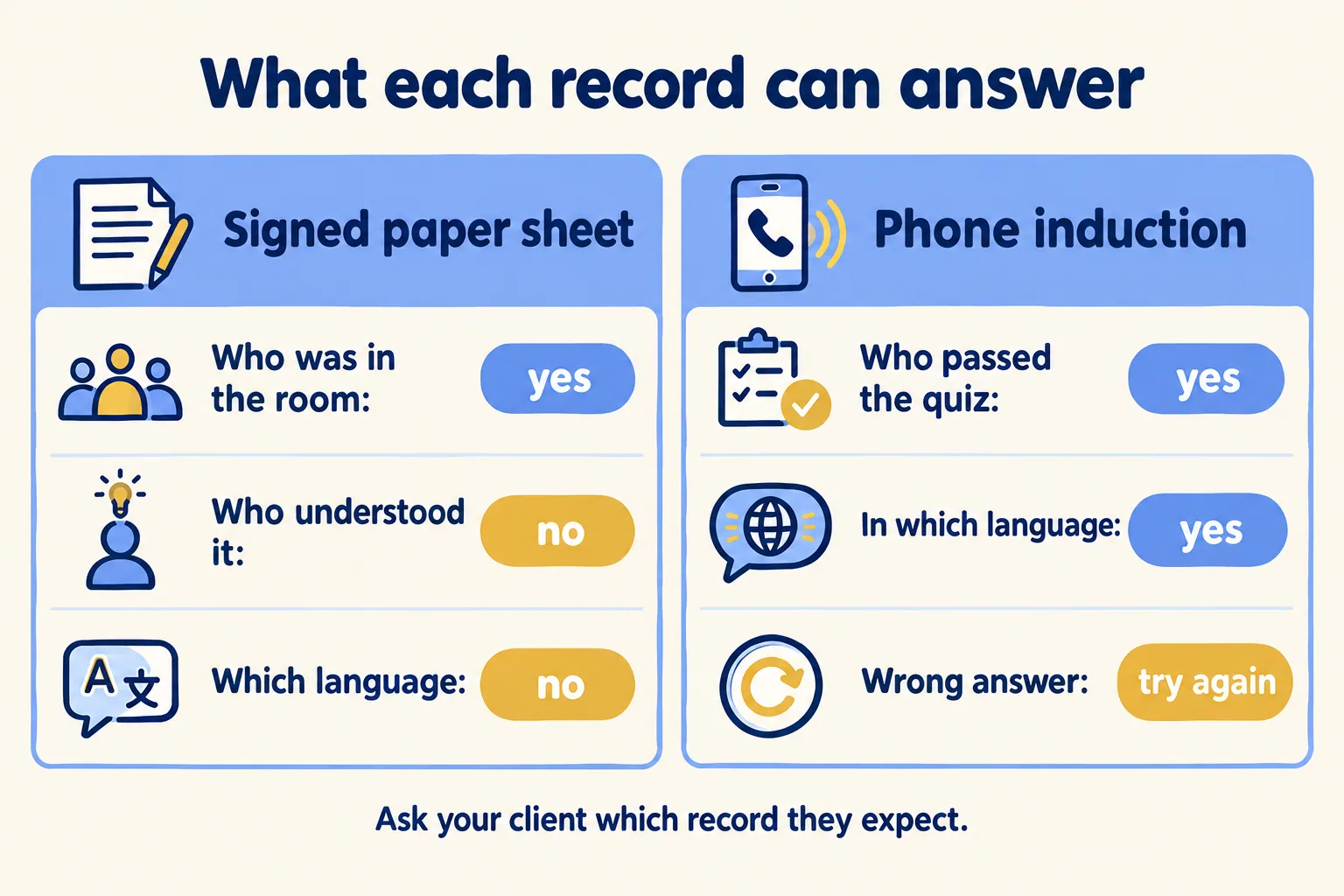
A signed sheet shows who was in the room; a phone induction also shows who passed the quiz and in which language
What each record can answer.

Three things, as our Learn page describes them.

  1. 01A wrong quiz answer means another try, not a signature on a sheet. On our sample induction the check is six questions, four to pass.
  2. 02A completion list shows every worker against every lesson, quiz and certificate, by site. You see who finished and who stopped half way.
  3. 03A certificate carries the worker's name, the course and the date, so a gate supervisor can check who passed.
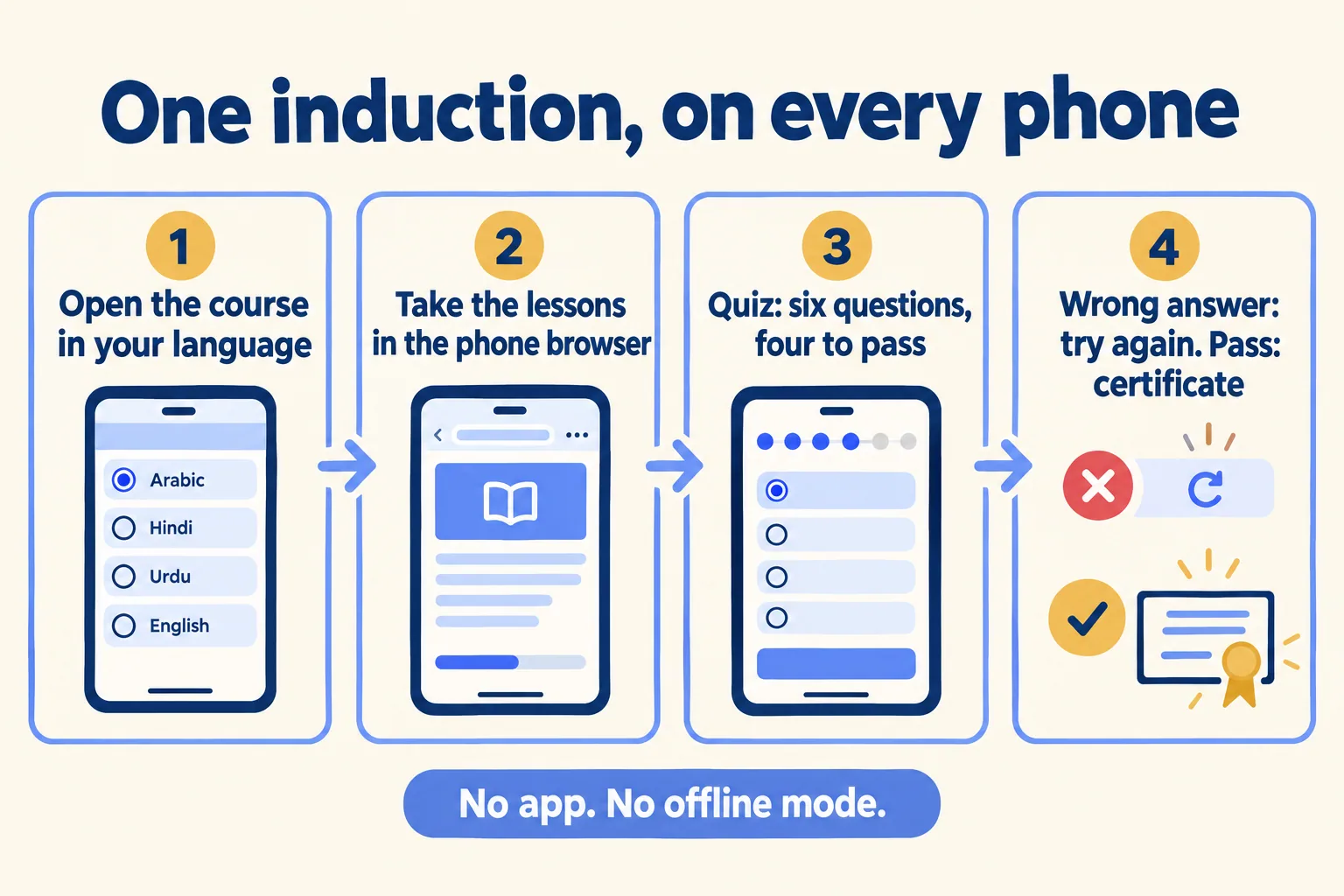
Four steps: open the course in your language, take lessons, quiz of six with four to pass, then retry or certificate
One induction on every phone. No app, no offline mode.

It also has limits, and you should plan around them:

  • The course opens in the phone's browser. There is no app and no offline mode, so a camp with no signal at the induction hour stays on paper for that hour.
  • Arabic reads right to left today. Hindi and Urdu screens are mostly translated, and a few still show English. The course text is whatever you or we write in each language, so translation is not included. Human translation is billed at cost.
  • A quiz shows a worker could answer in the lesson. It does not show he follows the rule on the roof. The supervisor on site still does that job.
  • The course is built from your own material: one, two or four courses depending on the managed band.

The page's screens use sample data, not a client. Your records stay in the country: we set up your copy on our UAE servers, or on your own servers in the UAE or Saudi Arabia.

What would it cost?

Here is what our page says today. You pay per active learner a month, meaning a worker who signs in that month. It is AED or SAR 15 for the first 50, 10 for 51 to 200, 7 for 201 to 1,000 and 5 above that. Trainers and admins are free, and crews who do not sign in that month cost nothing.

The per-learner price comes with a monthly minimum, so no one buys one seat at the per-learner rate. On the shared plan, hosted by us in the UAE, the minimum is AED or SAR 749, which applies below about 50 active learners. The page's own example: 120 workers who sign in cost AED 1,450 a month.

Up to 200 active learners on the shared plan, the quick start is a fixed package we set up for AED or SAR 2,500, one time. It loads your people from our CSV template, grouped by site, and gives you our induction course template with a short quiz. Larger teams are managed under a written plan, from AED or SAR 4,900 for up to 50 learners to 19,900 for 201 to 1,000. Extra work is AED or SAR 450 an hour. Prices exclude 5 percent UAE VAT and 15 percent Saudi VAT.

What happens in the first working session?

We call the method Induction on every phone. For the quick start, you send us your worker list and we send the payment link within 24 hours. For larger teams, we start with one call with your training or HSE lead about your first courses, the languages and the record your clients ask for. Then you get a written plan, a go-live date and the monthly price.

If your crew shares one language and one reader, we will say so and point you back to the sheet. If it does not, tell us who you train and in which languages, and we reply with the plan and the monthly price per active learner. Contractors can start from the facilities contractors page. For the daily talk and the records across sites, see our posts on toolbox talks and the training matrix across sites.

Filed under

Staff training LMS (Mindcat Learn)site induction uaeinduction training for workersmohre occupational health and safetyinduction records
Useful to someone on your team?

FAQ

Questions teams ask next

What is an HSE induction in the UAE?
It is the first briefing a worker gets before he starts on a site: the site, its hazards, PPE, fire and first aid, and how to report a near miss. MOHRE's guidance for employers asks them to educate workers about the risks of their profession, including fire, machinery, falls and occupational illnesses. The exact topics come from your client, your emirate's authority and your own risk assessment.
Is a signed induction sheet enough in the UAE?
For one site, one shared language and a supervisor who checks each man understood, often yes. When the crew speaks languages the trainer does not, the sheet shows who attended, not who understood. Ask your client's HSE team what record they expect, and confirm with the regulator before you rely on a format.
How long must induction records be kept in Dubai?
Dubai Municipality's technical guideline on safety signs at work (DM-HSD-GU99-SSW2, version 2) says records of any training, induction and toolbox talks included, are kept at least five years and made available to its OHS inspectors. That sentence sits in the guideline's section on training for safety signs. Check the current text with Dubai Municipality for your activity.
Does the UAE require safety instructions in the worker's language?
MOHRE's guide for employers says to provide instructions in Arabic and another language the workers understand near machines or areas where operations are performed, and that written fire and risk instructions are in Arabic and any other language the workers understand whenever necessary. It speaks of instructions in the workplace, not of the induction as such.
How much does Mindcat Learn cost?
AED or SAR 15 per active learner a month for the first 50, 10 for 51 to 200, 7 for 201 to 1,000 and 5 above that, with a monthly minimum of AED or SAR 749 on the shared plan. The quick start, up to 200 active learners, is a fixed package we set up for AED or SAR 2,500, one time. Prices exclude VAT.

Sources

  1. 01MOHRE: Occupational Health and Safety System in the UAE (employer guide, PDF)Accessed 28 Oct 2026
  2. 02MOHRE: Occupational Health and Safety (guidance portal)Accessed 28 Oct 2026
  3. 03Dubai Municipality: Technical Guidelines for Safety Signs at Work, DM-HSD-GU99-SSW2, version 2Accessed 28 Oct 2026
  4. 04IOSH forum: Site safety for non English speakers (31 January 2019)Accessed 28 Oct 2026
  5. 05Site Safety UAE: New employee orientation checklist (template)Accessed 28 Oct 2026
  6. 06Mindcat Learn: prices, Gulf fit and limits (live page)Accessed 28 Oct 2026
Shivanath Devinarayanan, founder of Mindcat

Written by

Shivanath Devinarayanan

Founder, Mindcat Consulting · Salesforce MVP Hall of Fame

Builds and runs AI agents in production. Reads every brief that comes in and signs the work that goes out.

About Shivanath

Mindcat Learn · the written assessment

We work in real estate and right now, leads go cold before anyone replies.

Industry
Problem

Brief: Real estate. Leads from portals and WhatsApp. Follow-up has no owner. An agent on a named process. A reviewer on the exceptions. From: /blog/hse-induction-uae-paper-or-phone.