
If your training matrix is a spreadsheet one person updates and a client can ask for it before an audit, this is for you. This post is not for a firm where one person keeps the sheet and it is current the day each course ends. For you, keep the sheet. This is for the day that stops being true.
What does Abu Dhabi say a training matrix holds?
Less than the search results suggest. Search for "training matrix" and you get templates with a dozen columns, written for other countries. Abu Dhabi's own safety framework is shorter, and it is free to read.
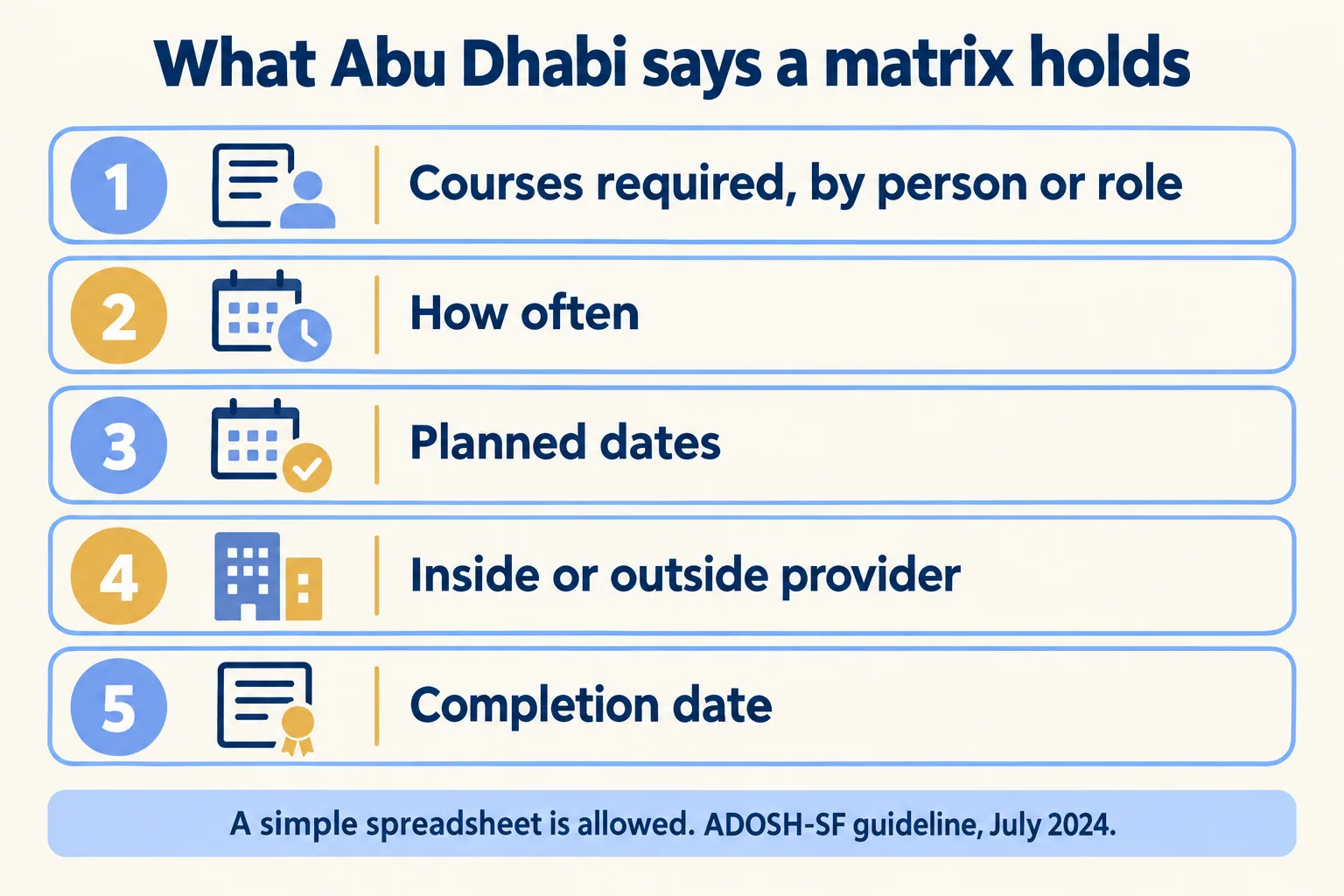
The ADOSH-SF Technical Guideline on training, awareness and competency (version 4.0, 15 July 2024) says a matrix "can have a variety of uses ranging from a simple spread sheet" that shows the requirements for each role, "right through to more complex versions" that track completed training. Regardless of format, it says the matrix should contain:
- 01the training courses required, by individual or role
- 02the frequency of training
- 03the planned dates
- 04whether the training is internal or external
- 05the completion date
It adds that the matrix should hold what needs refreshing and at what timescale. It gives one example: first aid training every three years.
It also asks something no template column covers. The training needs analysis should consider "the languages that are spoken and understood within their workforce", and the guideline says training may need to be delivered in several languages "to ensure that it is fully understood".
This is Abu Dhabi's framework. It is not a federal rule and not a Dubai rule. If your sites sit under different authorities, ask each one which framework applies on its site.
What must each worker's record carry?
The matrix is the plan. The record is the proof, and it asks for more than a tick.
ADOSH-SF Code of Practice 53.1, the construction management plan (version 4.1, 16 February 2026), says employers maintain a record of the required training with six items:
- 01name and ID number
- 02Emirates ID number
- 03subject of the training
- 04training provider
- 05date of the training
- 06who gave the training
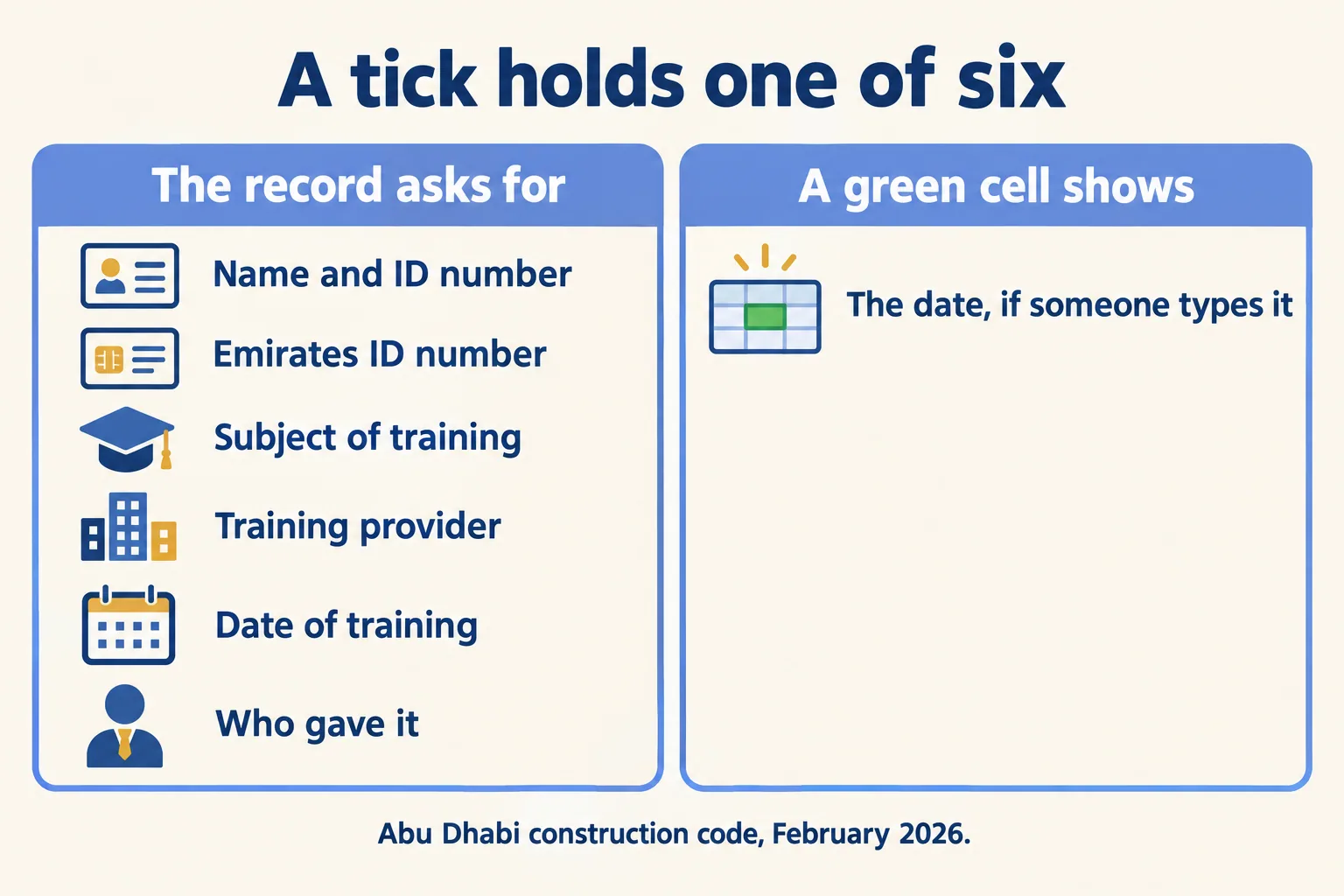
A green cell holds one of the six, the date, if someone types it. Name, subject, provider and trainer sit in other files or in a foreman's memory. A sheet can carry all six if the person who keeps it types them every time. That is the test the rest of this post is about.
One of the six, the Emirates ID number, is personal data. Ask your lawyer how to store it under the UAE PDPL before you copy it into any system, a sheet included.
Where does a shared sheet stop working?
Three places, and none of them is the format.
UK vendors who sell training-matrix software describe the same breaks, so read them as failure modes, not as UAE law. TrainProof, a UK vendor, puts the first one in numbers: version control "becomes a real problem at around 2-3 people editing the same matrix. If only one person ever touches it, you are fine." It puts the second at 20 to 30 training records with different renewal cycles, where manual expiry checking stops being reliable.
FieldClear, another UK vendor, names the third, the one that hits a contractor with several sites: "Emailing 'Site B matrix.xlsx' as a fork of Site A is how CSCS dates diverge by Thursday." CSCS is the UK site card scheme. The mechanism is the same on a Gulf site: a first aid card renewed on one site's file and never copied to the other.
So the sheet breaks when:
- More than one person edits it. Two copies exist by Wednesday and neither is the record.
- Each site has its own file. A worker moves between sites and his dates split.
- A supervisor needs to read it. Someone has to send an extract, so the supervisor sees last week's version.
None of these is a problem for one named person who keeps one file and sends it to nobody. That is why the sheet is the right answer for a lot of firms.
Sheet or system: which test decides?
Ask one question: could a supervisor at your fourth site tell you, in under a minute, which new joiners have not finished the induction?
If yes, you already have what a system would give you. Keep the sheet. If no, because the answer is in a file on someone else's laptop, the sheet has stopped being a record and become a chase.
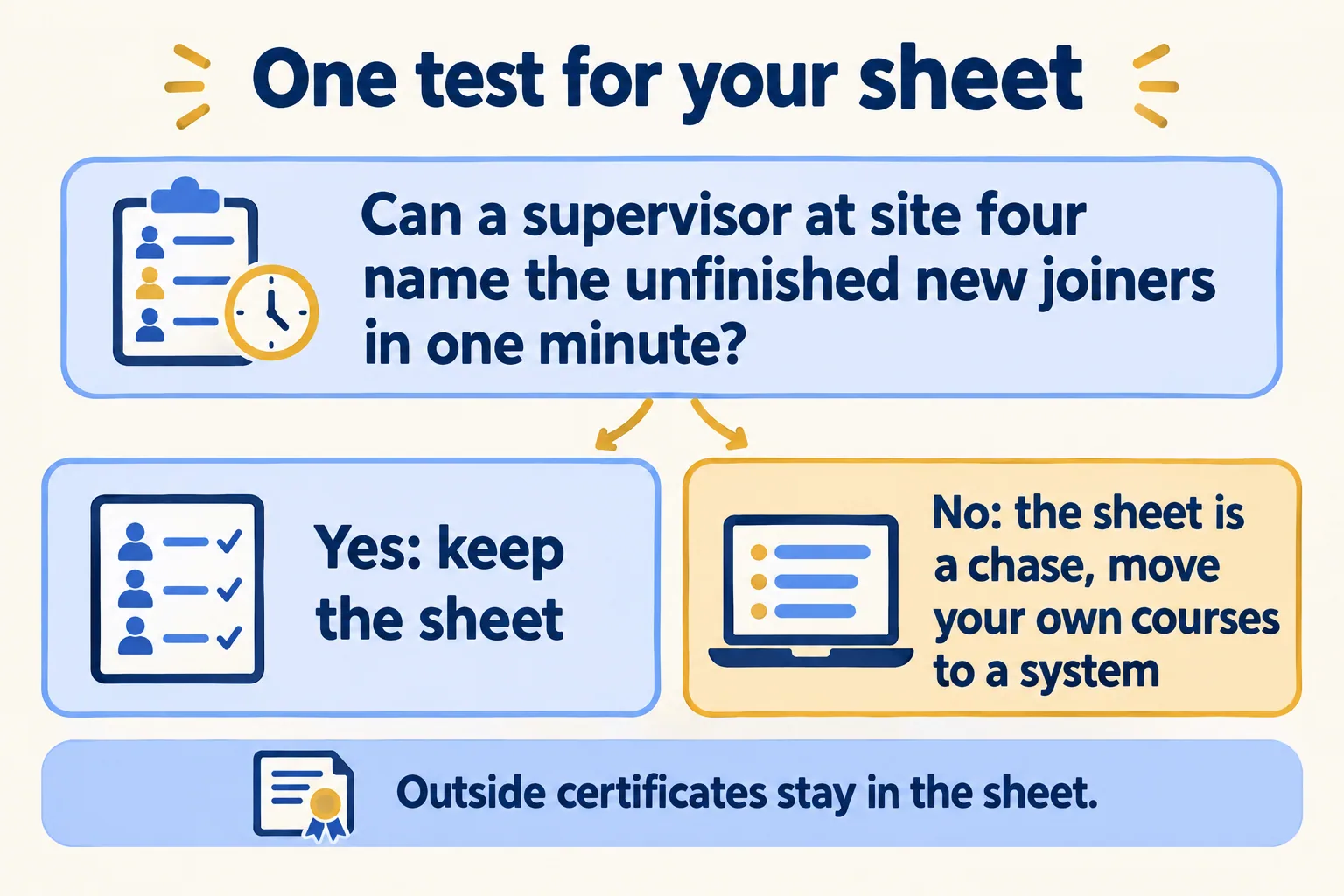
Our rule is the table below: three reasons to move your own courses, and one split for what stays. It is our decision rule, not a study.
If your biggest worry is expiry and renewal across sites, that stays in the sheet today, because Learn does not track it. The split in the last two rows matters. You do not have to choose one tool. Your outside courses stay in the sheet, with its dates and providers. Your own crews' courses, the ones you can put on a phone, go where each site's gaps show without anyone sending a file.
What can a phone system hold, and what stays?
Here is what the live Learn page describes, in the order of the Abu Dhabi list above.
- 01Each worker loads from your spreadsheet with his site, trade and language, and joins his site's group.
- 02A completion matrix lists every worker against every lesson, quiz and certificate in a course. Put each site in its own group and it shows one site at a time: who is done and who stopped at lesson seven.
- 03A report by site lists worker, site, trade, language, progress, passed, completed on and last seen. Filter it to one site, download it as Excel, or have it emailed on a schedule.
- 04The certificate carries the worker's name, the course, the date, the HSE manager's name and a code a client or gate supervisor can check.
Against the five items on Abu Dhabi's list, it covers the completion date, and the language and the quiz result behind it, for the courses taken inside it. The frequency, the planned dates and the refresh timescale stay in your plan, which is your sheet. Learn does not set expiry dates or re-enrol workers by itself. A yearly re-run for a cohort is a setup job or extra work, not a switch.
More limits you should read here:
- The course opens in the phone's browser. There is no app and no offline mode, so the worker needs camp Wi-Fi or mobile data.
- Reminders on WhatsApp are not included. Supervisors see who is behind in the matrix and message those workers inside the site or by email.
- Arabic reads right to left today. Hindi and Urdu screens are mostly translated, and a few still show English. The course text is whatever you or we write in each language, and human translation is billed at cost.
- The six items in Code of Practice 53.1 are the employer's record. A certificate with a code is evidence for the record, and it does not replace what your client or the authority asks for.
- Whether the Emirates ID number is stored at all is a decision for you and your lawyer. It is a custom profile field we would set up with you, not a default.
The page's screens use sample data. Your records stay in the country: we set up your copy in the UAE, or in Jeddah or Riyadh on your own servers.
What would it cost?
Here is what our page says today. You pay per active learner a month, meaning a worker who signs in at least once that month. It is AED or SAR 15 for the first 50, 10 for 51 to 200, 7 for 201 to 1,000 and 5 above that. Trainers, coordinators, supervisors and admins are free. Crews who do not sign in that month cost nothing.
The per-learner price comes with a monthly minimum, so no one can buy one seat at the per-learner rate. On the shared plan the minimum is AED or SAR 749. The page's own example: 120 workers signing in this month cost AED 1,450 a month.
Up to 200 active learners on the shared plan, the quick start is a fixed package we set up for AED or SAR 2,500, one time. It loads your people from our CSV template, grouped by site, and gives you our induction course template with a short quiz, one certificate template and the report by site. The go-live date is counted from the day your CSV arrives. Larger teams are set up with us under a written plan. Storage above 50 GB and outside services you ask us to buy, such as human translation of your courses, are billed at cost. Prices exclude 5 percent UAE VAT and 15 percent Saudi VAT.
What happens in the first working session?
We host Learn in the UAE and Saudi Arabia. We call the method Induction on every phone. For the quick start, you send us your worker list and we send the payment link within 24 hours. For larger teams, we start with one call with your training or HSE lead about your first courses, the languages and the report your clients ask for. Then you get a written plan, the go-live date and the monthly price.
If one person keeps your sheet and it is current, we will say so and point you back to it. If it is not, tell us who you train, at which sites and in which languages, and we reply with the plan and the monthly price per active learner. For the talk-or-lesson question on the same crews, read toolbox talk or phone lesson. Contractors can start from the facilities contractors page.
