
If your toolbox talk is signed every morning and nobody can show a worker understood it, this is for you. This post is not for a crew of ten who share one language and one supervisor who reads the talk aloud. For you, keep the sheet.
What does a signed toolbox talk sheet prove?
It proves who stood there. A safety manager running a dozen sites put it plainly on LinkedIn in July 2026: "A toolbox talk documents attendance. It does not document control." A reader added a second view in the comments: most safety training, inspections and daily pre-task planning "are just signed by employees without reading or understanding the contents."
A newsletter for US construction crews, from September 2026, describes the familiar site version: "We're a month behind on toolbox talks. Everybody come sign these four sheets, and if anyone asks, we did them on the day we said we did." Its author sells an AI talk generator, so take the quote and leave the product. All three voices are US-written. We found no Gulf-site thread, so we do not present them as Gulf voices.
The point holds anywhere. A sheet answers "who was there". When a client's auditor asks "who understood it", the sheet has no answer.
Which topics does a UAE site need to cover?
The search results for "toolbox talk topics" are lists for US, Australian and UK sites. Our rule is shorter: the daily talk covers today's job, and a fixed list covers what every worker must know before he starts.
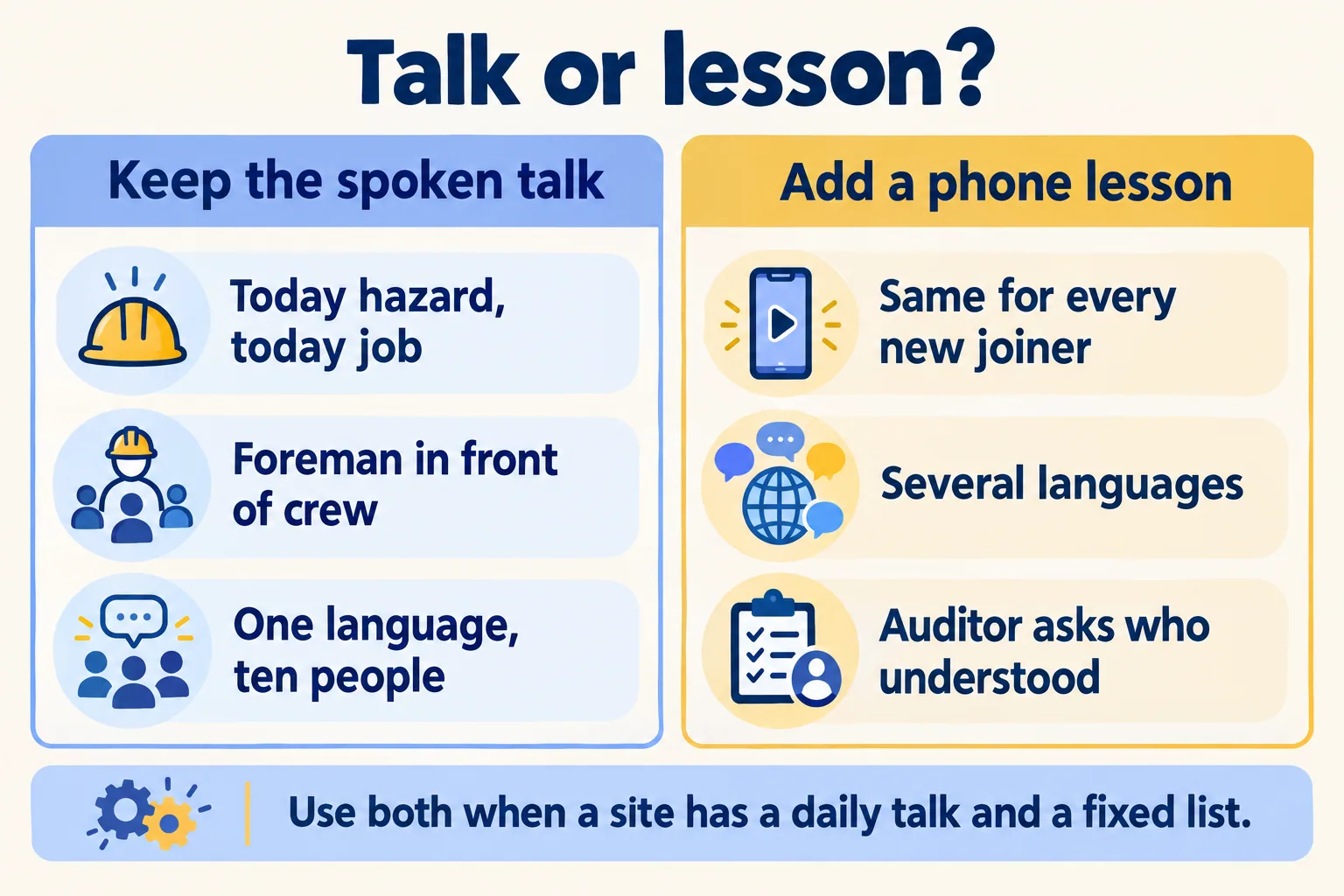
For today's job, use three questions from any good talk: what is the crew doing today, what could hurt them, and what changed since yesterday. That part is spoken and stays spoken.
For the fixed list, start with the UAE midday break. MOHRE says outdoor work stops from 12:30 to 15:00, from 15 June to 15 September every year, and that companies provide shade, cooling, drinking water and first aid. The induction on our Learn page has five short sections: the site, heat and the midday break, PPE, fire and first aid, and near misses. It is a sample course, not a legal list. Check every topic against the official wording on the day you teach it.
Why is language the gap on Gulf sites?
Because the sheet does not carry the language. A crew of Hindi, Urdu and Bengali speakers can hear a talk in English and sign the same line as a man who understood every word.
Saudi Arabia says so in writing. HRSD's page on health and safety says the employer posts the instructions related to work and workers' safety in Arabic and, "when necessary, in any other language that the workers understand." It also says the employer informs the worker, before he starts, of his job hazards. The UAE page we read on the midday break sets duties for the employer but says nothing about the language of the talk. Ask your lawyer which language rules apply to your contract.
None of the pages we read says a quiz is required. A quiz is how you find out whether the language landed.

Keep the talk, or add a phone lesson?
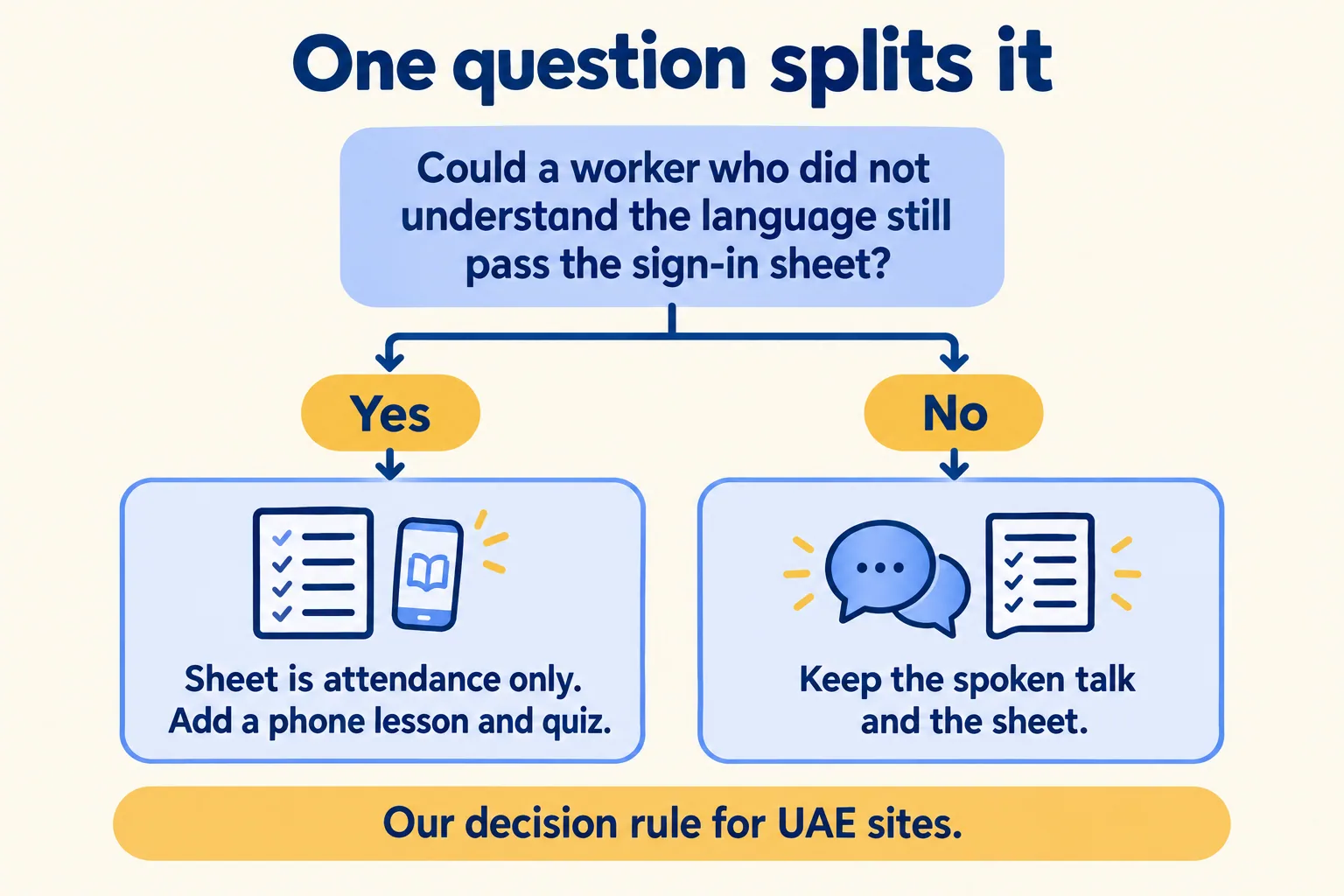
Match the tool to the job. This is our decision rule, not a study.
If you want one question instead of a table, ask this one: could a worker who did not understand the language still pass the sign-in sheet? If yes, the sheet is not proof of understanding.
Be honest about what a quiz proves too. It shows a worker could answer in the lesson. It does not show he follows the rule on the roof. The safety manager's own fix was an owner and a due date on every repeat hazard. A lesson helps with the first half of the problem, whether he knew. Closing hazards is still a site job.
What does a phone lesson record that a sheet cannot?
Three things, as our Learn page describes them.
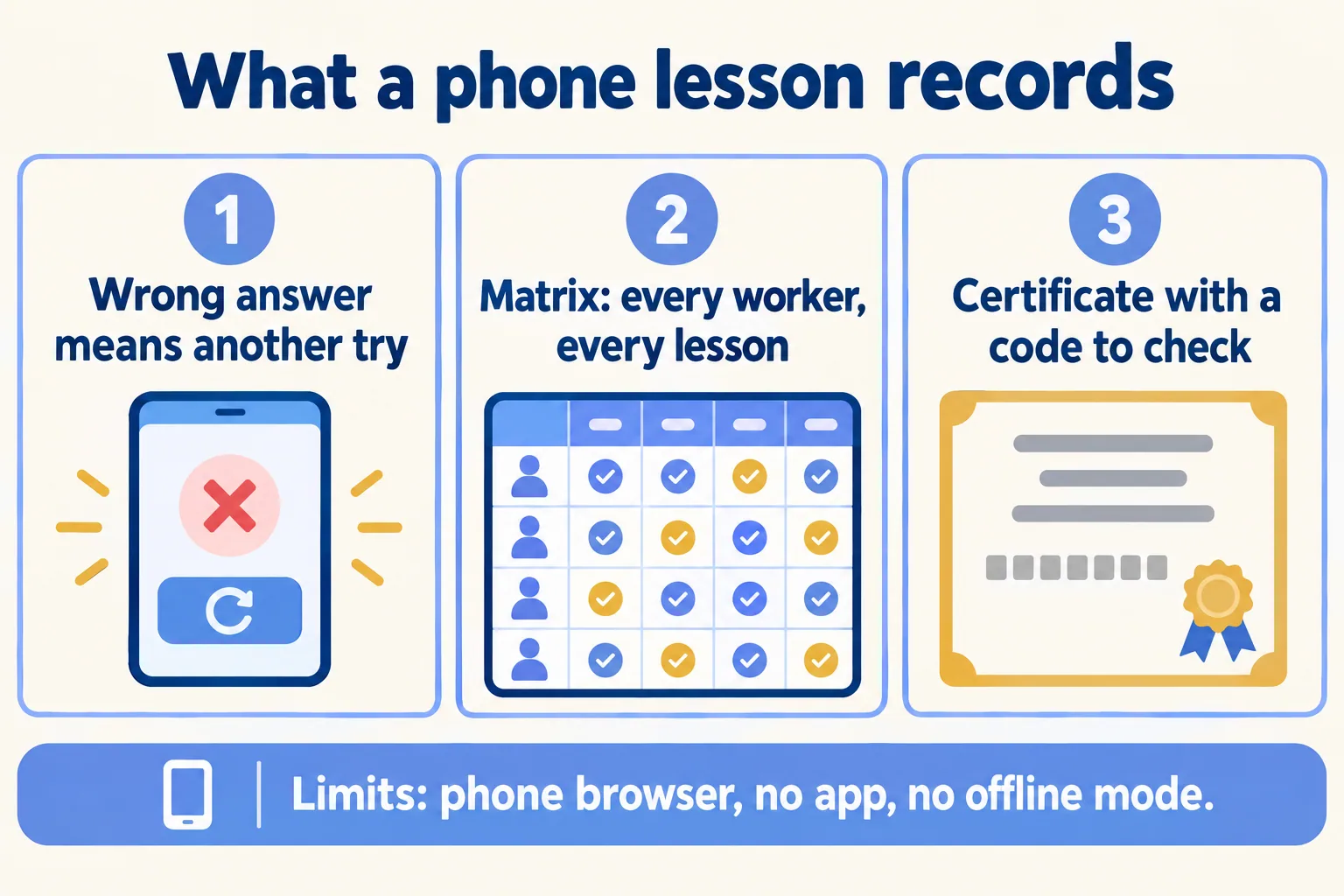
- 01A wrong quiz answer means another try, not a signature on a sheet. On our sample induction the check is six questions, four to pass.
- 02A completion matrix lists every worker against every lesson, quiz and certificate, one site at a time. You see who is done and who stopped at lesson seven.
- 03A certificate carries the worker's name, the course, the date, the HSE manager's name and a code that a client or gate supervisor can check.
It also has limits, and we would rather you read them here:
- The course opens in the phone's browser. There is no app and no offline mode, so the worker needs camp Wi-Fi or mobile data. Our page does not state how much data a lesson uses, so ask us before you size a camp.
- Workers need no email address. Site crews usually sign in with a username we create from your worker list.
- Reminders on WhatsApp are not included, and nothing is sent on WhatsApp. Supervisors see who is behind in the matrix and message those workers inside the site or by email. If your crew lives on WhatsApp, that chase stays manual today.
- Arabic reads right to left today. Hindi and Urdu screens are mostly translated, and a few still show English. Our page names Arabic, Hindi, Urdu and English, not Bengali, so ask us before you plan a Bengali course. The course text is whatever you or we write in each language, and human translation is billed at cost.
- A quiz assumes the worker can read the course language. A course can also carry video, as our sample induction does for heat stress, but ask us what fits a worker who does not read.
- The talk itself stays spoken. Learn does not replace the foreman.
The page's screens use sample data, not a client. Your records stay in the country: we set up your copy in the UAE, or in Jeddah or Riyadh on your own servers.
What would it cost?
Here is what our page says today. You pay per active learner a month, meaning a worker who signs in at least once that month. It is AED or SAR 15 for the first 50, 10 for 51 to 200, 7 for 201 to 1,000 and 5 above that. Trainers, coordinators, supervisors and admins are free, and crews who do not sign in that month cost nothing.
The per-learner price comes with a monthly minimum, so no one can buy one seat at the per-learner rate. On the shared plan the minimum is AED or SAR 749. The page's own example: 120 workers signing in this month cost AED 1,450 a month.
Up to 200 active learners on the shared plan, the quick start is a fixed package we set up for AED or SAR 2,500, one time. It loads your people from our CSV template, grouped by site, and gives you our induction course template with a short quiz. The go-live date is counted from the day your CSV arrives. A worker who signs in even once in a month counts as an active learner for that month. Your team adds its own slides, PDFs and videos. Bigger teams are set up with us under a written plan. Storage above 50 GB and outside services you ask us to buy, such as human translation of your courses, are billed at cost. Prices exclude 5 percent UAE VAT and 15 percent Saudi VAT.
What happens in the first working session?
We host Learn in the UAE and Saudi Arabia. We call the method Induction on every phone. For the quick start, you send us your worker list and we send the payment link within 24 hours. For larger teams, we start with one call with your training or HSE lead about your first courses, the languages and the report your clients ask for. Then you get a written plan, the go-live date and the monthly price. If your crew shares one language and one reader, we will say so and point you back to the sheet. If your crew does not, tell us who you train and in which languages, and we reply with the plan and the monthly price per active learner. Contractors can start from the facilities contractors page.
