
If your lift, fire and chiller service dates live in three people's phones and a spreadsheet, this is for you. The question is which to build first, the service calendar or the maintenance management system, and one hour decides it. This is not for you if you already hold every AMC date and only lose the jobs in WhatsApp; you are past this step.
What does a maintenance management system actually do?
It holds your assets, schedules planned visits, turns a complaint into a work order and records what each technician did. Vendors call it a CMMS or a maintenance management system, and the words mean the same thing.
What it does not do is decide how often anything is serviced. It runs the schedule you give it. If the intervals and last-service dates are wrong or missing when you load it, it shows you wrong or missing dates, neatly, on a phone.

Why do planned visits slip even with a system?
Plant Engineering reported on 23 October 2026 on a September 2026 survey of 686 US maintenance and operations professionals by Limble, a maintenance software company. Its line: "Leaders surveyed estimate that their teams complete just 54% of scheduled preventive maintenance."
That is a US survey, it is leaders' estimates, and the surveyor sells software, so read it as one point only: planned work is the work that slips. Our reading of the cause is simple. A system shows the schedule it was given, so a schedule with gaps shows gaps.
A practitioner on the Asset Management Professionals forum told a new maintenance lead in 2024 to start with "a basic inventory of what is in place and working". Same order: know what you have and when it was last touched, then buy.
What is the one-hour test?
Pick one tower. List every asset class: chillers, lifts, fire pumps, water tanks, fan coil units. For each, write the last service date and the next due date, using only your AMC contracts and the contractors' last reports. Set a timer for an hour.
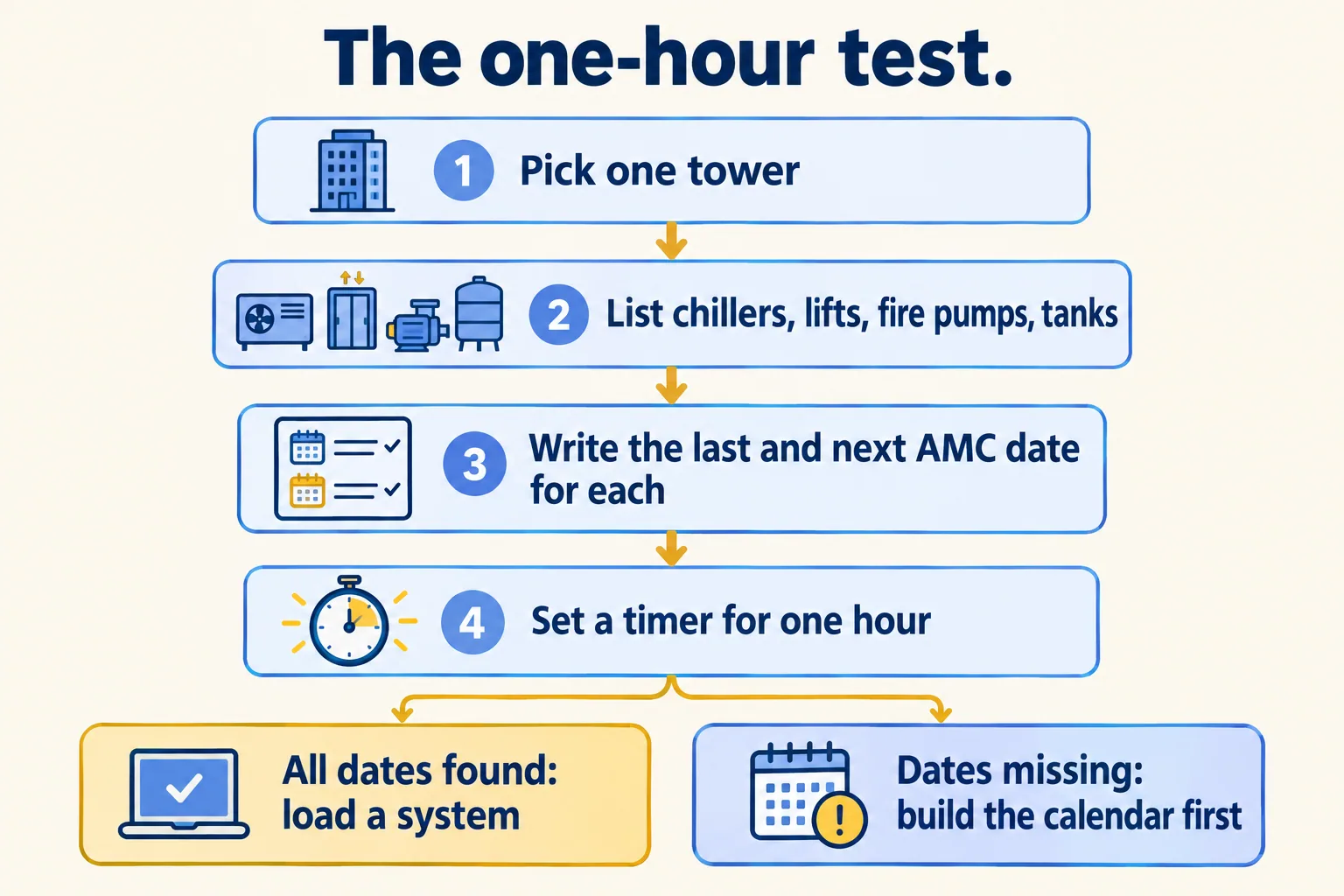
The hour is our test, not a standard. If you cannot finish it with the paperwork you have, the dates are not in one place, and a system loaded today starts out wrong.
Where do the service intervals come from?
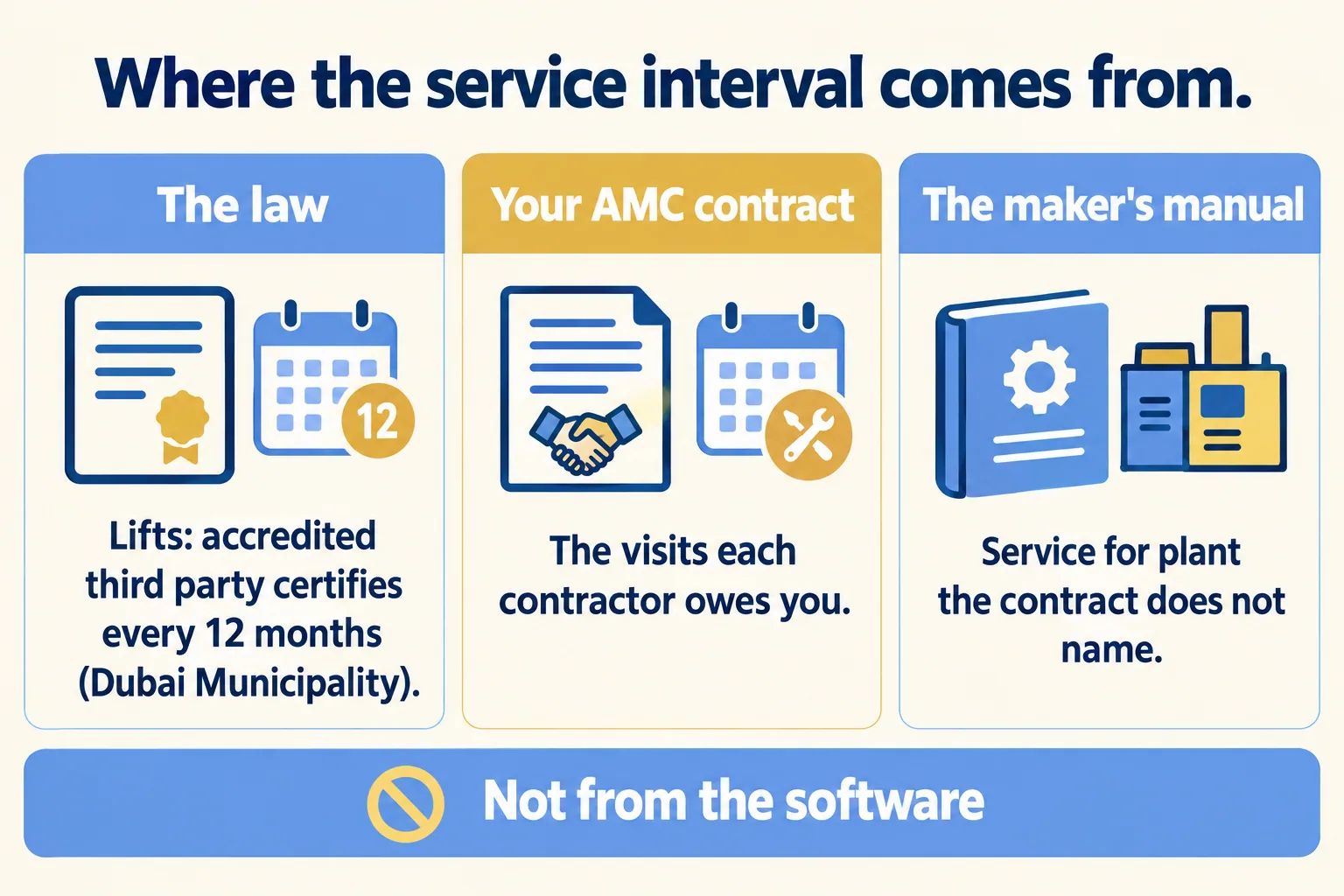
Not from the system. Three places, in this order.
- The law, where it names an interval. For lifts, Dubai Municipality's guideline DM-HSD-GU48-ECLA2 (version 4.0, issued 9 May 2024) says lifts and other lifting equipment "shall be tested and certified by a third party accredited by Emirates International Accreditation Center (EIAC) once every 12 months". It adds that the certificate "shall be kept at the site" and that the repairs the third party identifies "shall be carried out by the owner/occupier immediately". We read it on 27 October 2026. Confirm with Dubai Municipality that it applies to your building type.
- Your AMC contract. It names the visits a contractor owes you for chillers, pumps, fire systems and the rest. This is the calendar's main source. For fire and life safety, the Ministry of Interior's service page for approval of an annual maintenance contract describes the contract as covering "follow up on the site during the contract period 3-4 times a year" and "preparation of a detailed report on the status of installed devices", read on 27 October 2026. Your Civil Defence renewal date and your fire AMC visit dates belong on the same calendar as the chillers and lifts.
- The maker's manual. For plant the contract does not cover, the maker's recommended service is the starting point. Ask your contractor to confirm it in writing.
We quote one public interval here because it is the only one we can source without your contract. We do not give you a chiller interval, and no article should. The right number is in your contract and the maker's manual.
Do implementers start in the same order?
Partly, and the difference matters. Fabrico, a maintenance software company, published a 30-day plan on 22 January 2026. Its first week is a physical audit: walk the line and list the real machines, with the note "(Do not trust your old Excel sheet; it's wrong)". Its rule on data is "Do not upload 10 years of messy Excel history into Fabrico."
That matches what the one-hour test finds. A plan that starts from a spreadsheet nobody trusts starts from the wrong dates.
Where it differs: Fabrico starts with breakdown work and puts preventive checklists live in week four, with the advice "Don't overload the team with PM schedules yet." That is a factory-line plan. In a tower, the planned visits are the part someone else already owes you under an AMC contract, so the dates exist on paper before any technician opens an app. We put the calendar first because the contractors' visit dates are the data you can collect first, and the breakdown jobs follow on the same system.
What does Maintain do with the calendar?
Mindcat Maintain runs the calendar you give it. On the quick start for up to 10 technicians, the package includes our PPM schedule template for chillers, lifts, pumps, tanks and fan coil units, and your asset register comes in from our CSV template. The go-live date is counted from the day your CSV arrives, so the calendar is the first thing you hand over. On a managed setup, we build the PM schedules from your AMC calendars with you in one working session, then set up to a written plan.
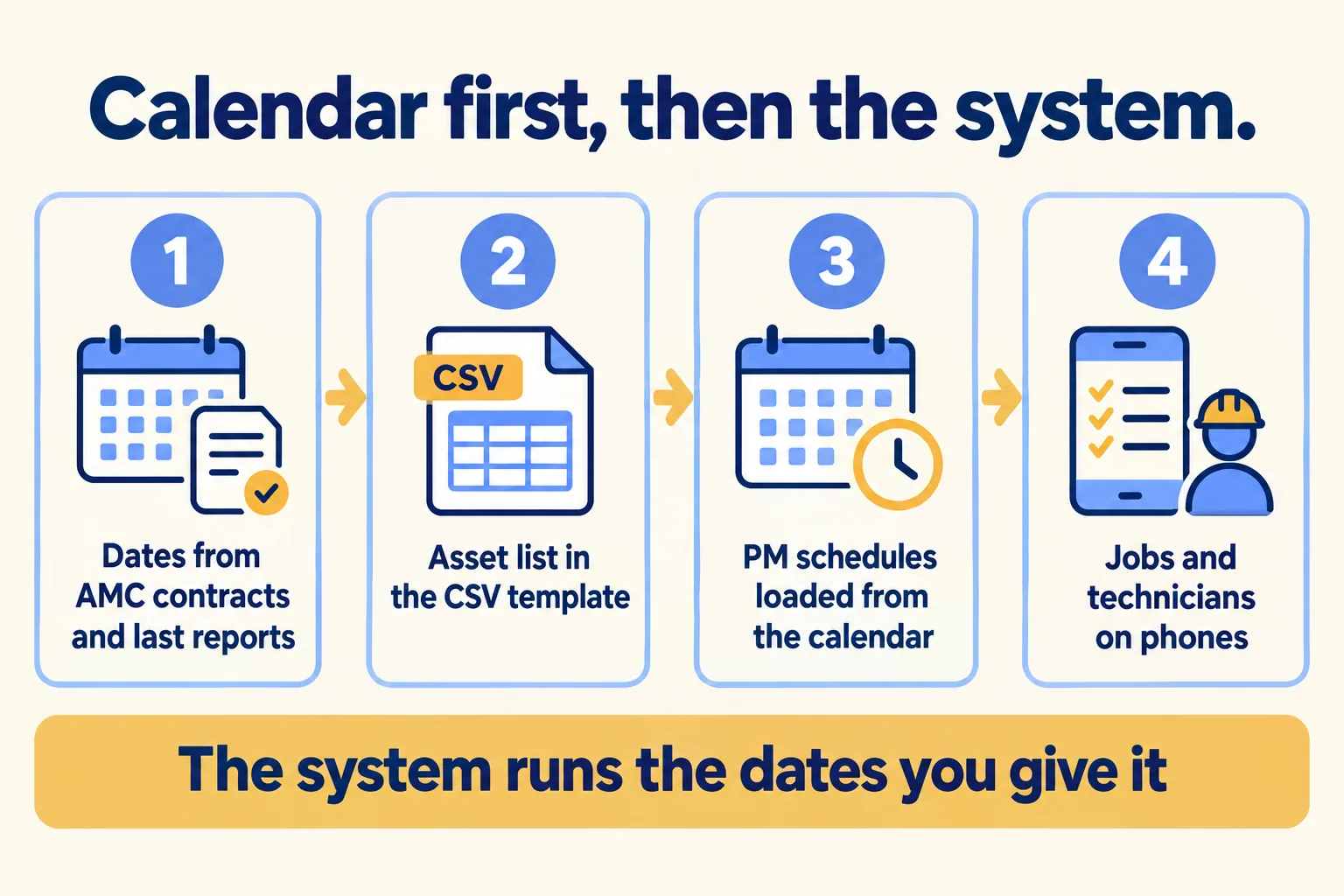
Three limits, stated plainly. Maintain does not decide the intervals; it runs the schedules from your AMC calendars. The PM calendar is one of the features that needs the maker's feature licence, which we bill at cost and never call included. And WhatsApp complaints are added during setup on your own WhatsApp Business account; until then, tenants raise requests from a free login on their phone.
If you also hand out laptops and phones, that sits in Assets, not here. The same setup serves facilities management companies.
What would 25 technicians cost?
The per-technician rate comes with a monthly minimum, because one seat is not for sale at the rate. A technician is anyone with a login who works on or assigns jobs, so supervisors and admins count. Tenants and staff who only raise requests are free.
For 25 technicians the shared plan does not apply, because it stops at 10.
WhatsApp Business messages and SMS are billed at cost too. Annual prepay takes 15 percent off our part. Prices exclude 5 percent UAE VAT and 15 percent Saudi VAT.
If you have 10 technicians or fewer, the quick start is a fixed package of AED or SAR 2,500, one time, that we set up for you.
What happens in the first working session?
We run the one-hour test with you, on one tower. You bring the AMC contracts and the last reports. We list each asset class with its last and next date, and mark the blanks.
You can run the hour on your own first; it needs the AMC contracts and the last reports, nothing from us. Then we reply in writing with which side you are on. If the dates are scattered, we say the calendar comes first and what to collect from each contractor. If you hold them, we give you the setup plan, the go-live date and the monthly price. If one contractor holds everything and reports on time, we say a shared calendar is enough, and we do not sell you the system.
If your service dates live in phones and a spreadsheet, get the written setup plan. Tell us how many technicians you run, which buildings they cover and which contractors service them.
