
If tenant complaints in your towers wait until morning for a reply, and your AMC contractors report in three different formats, this is for you, and so is the question of whether your contract needs a CAFM system or a CMMS. This post is not for you if nobody owns the job after the first complaint (name an owner first), or if your contract is mostly space planning and moves (skip to the last row of the table).
What is the difference between a CAFM system and a CMMS?
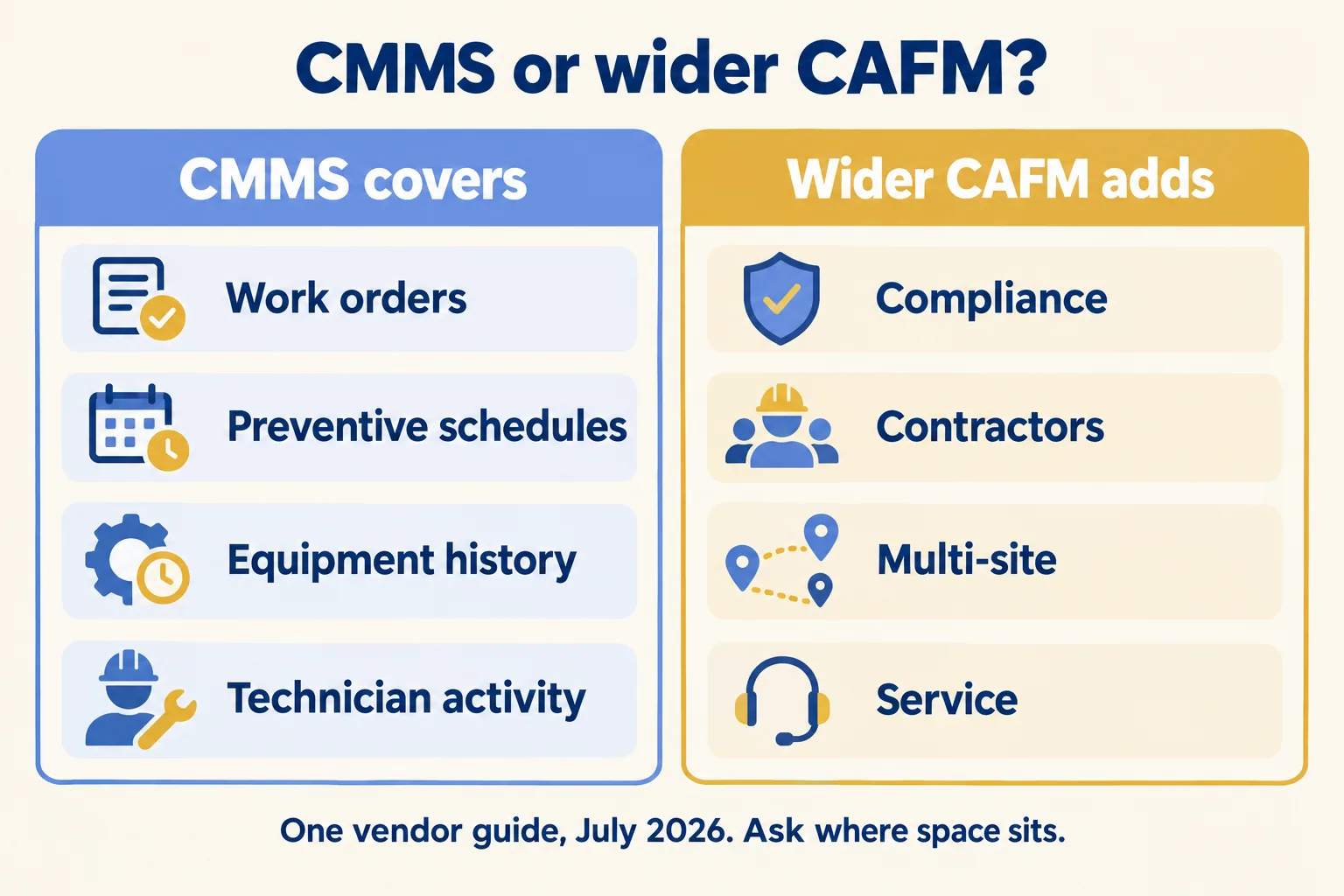
A CMMS runs maintenance. A CAFM system runs more of the facility around it. Expansive, a facilities software vendor, put it this way in July 2026: "A CMMS tends to view the operation through maintenance," and "A CAFM platform treats maintenance as one part of running facilities." Its guide says a CMMS is "well suited to work orders, preventive maintenance, equipment history and technician activity." A CAFM platform "usually adds broader asset, compliance, contractor, service and multi-site management."
Expansive sells software too, so read it as a vendor's definition. The top results for "cafm system" in the UAE are all vendors defining the term by feature breadth. None starts from a Dubai tower contract, which is where the choice is really made.
What does your contract make you prove?
The answer sits in the contract, not in a feature list. Read it for the evidence you owe, then match the evidence to the tool. This is our decision rule, not a study.
The first three rows are jobs and history. The last two decide whether you need something wider. If your answer is the last row, stop reading and buy a space-capable system.
Why does a Dubai owner care about maintenance records now?
Because Dubai put maintenance duties for owners into a new law. Dubai Law No. 3 of 2026 on the quality and safety of buildings was issued on 27 February 2026. We read the text on the Dubai Legislation Portal on 14 October 2026.
As we read it, the owner of a building under 20 years old must perform periodic maintenance and fix defects that put structural safety at risk (Article 9). After 20 years the owner must obtain a Quality and Safety Certificate, and holding one does not remove the duty to keep maintaining the building. The law sets fines from AED 100 up to AED 1,000,000, doubled for a repeat within two years and capped at AED 2,000,000 (Article 16). Owners get a year to comply from the effective date, which the authority can extend (Article 22). The law takes effect 60 days after publication in the Official Gazette (Article 25).
Two limits matter. The text we read does not name maintenance records, and it does not mention lifts. So no tool makes a building meet this law. What a log per asset does is let you answer the question an owner or inspector will ask: what was done, by whom, and when. Ask your lawyer which duties fall on you and when.
A secondary source we read first listed phased deadlines by building age and a lift check. We could not find either in the portal text, so we left them out.
How do you test your own contract in one hour?
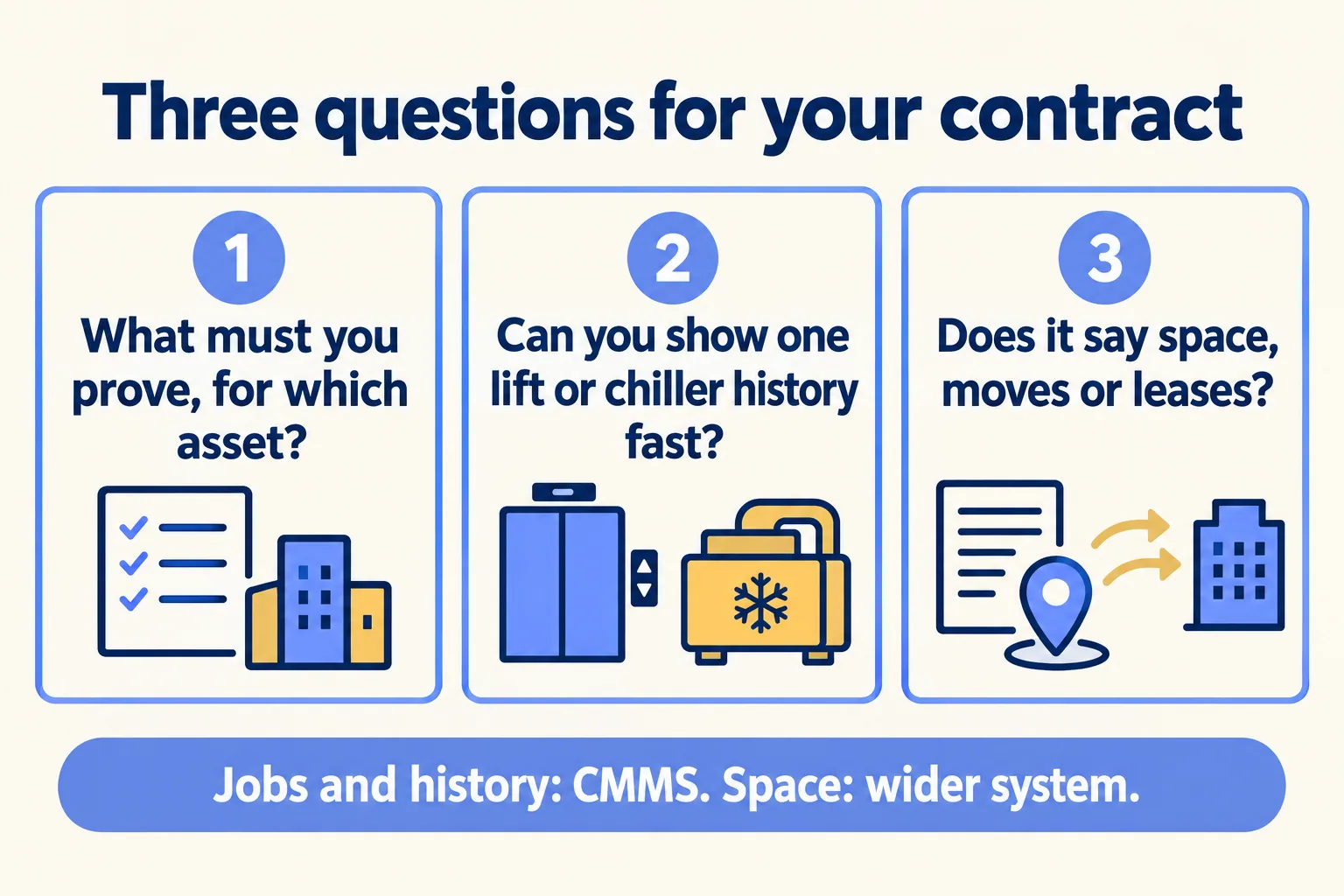
With three questions, answered from the contract and last month's records.
- 01Underline every place the contract says report, certificate, record or log. What must be produced, for which asset, and how fast?
- 02Pick one chiller or lift. How long does it take to show its last three visits, who did them and what they found?
- 03Look for the words space, move, occupancy or lease. If they are there and carry money, you need a wider system than a CMMS.
If question two takes an afternoon, the problem is the record, not the tool. Tenants live that gap. A resident of The Greens told Khaleej Times in June 2024: "One week the ACs works fine, then they collapse the next week," and "the communication with the maintenance team has not been great."
What does Maintain do, and what does it leave out?
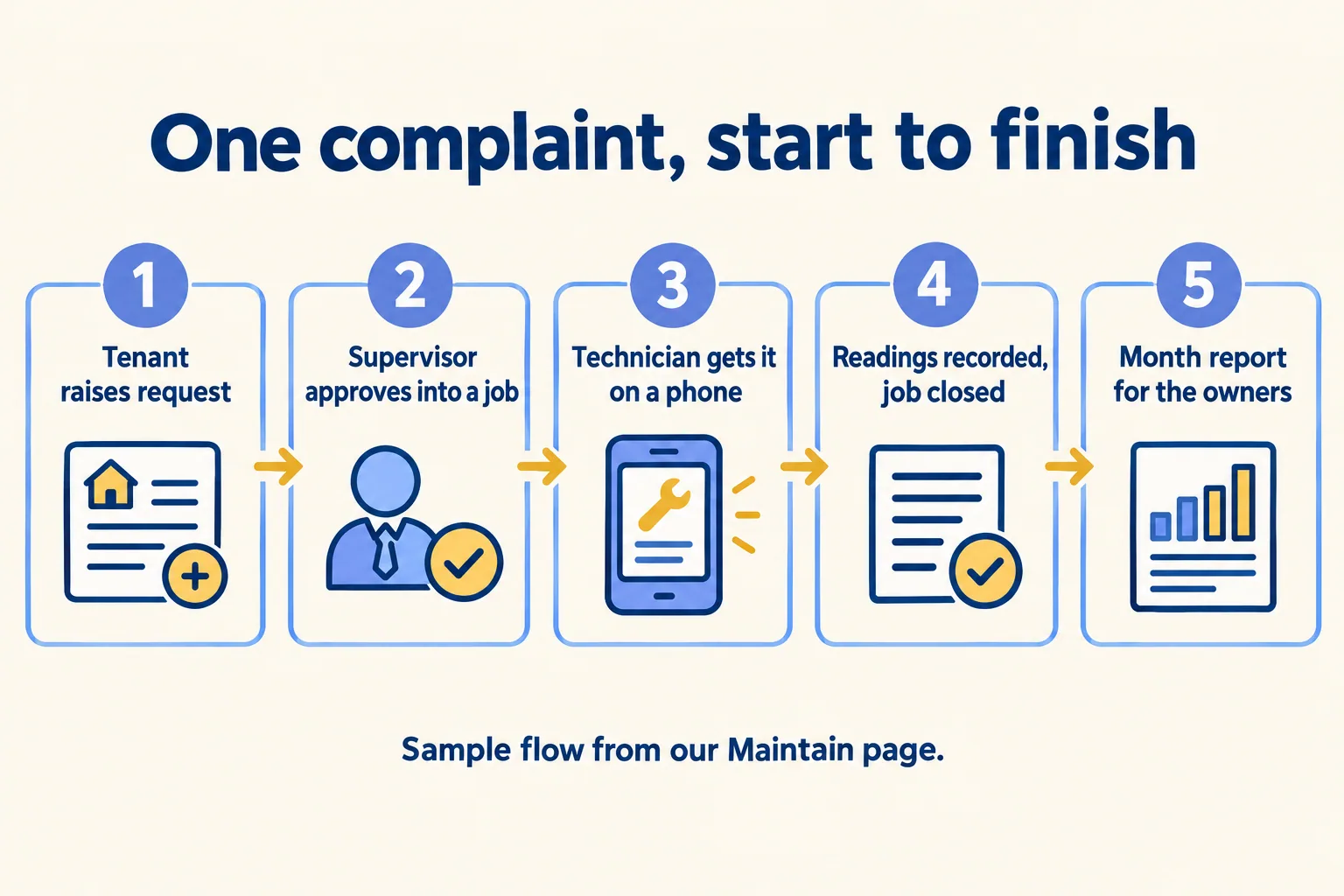
Mindcat Maintain is the CMMS side. Your own copy runs in the UAE, in Jeddah or Riyadh, or in your own cloud, so your tenant data stays in the region. Tenants complain on WhatsApp today, and our page says plainly that WhatsApp intake is added during setup, not on day one. Our page describes one complaint moving like this: a tenant raises a request from a free login on their phone, a supervisor approves it into a work order on the right building and asset, the technician gets it on a phone and records what was found, preventive schedules create the planned jobs, and the manager exports the month's jobs by status and priority for the owners' meeting. The same flow serves facilities management companies and property managers.
What it leaves out matters as much:
- No space management, floor plans, moves or leases.
- Photos and files on jobs, the request portal by QR code, the PM calendar, vendor records, time and cost, and signatures need the maker's feature licence, billed at cost. They are not included in our price. The maker is the company behind the software we build on, and its licence is USD 15 (about AED 55) per technician a month at its list price.
- WhatsApp intake is added during setup on your own WhatsApp Business account. It is not a day-one feature.
- Hijri dates are not supported today. Mollak and service-charge mapping is added during setup, and exports are CSV. Each subcontracted AMC company's technicians get their own logins and sit in their own team, so a lift call goes to the lift contractor. The reports our page describes are jobs by building, status and priority, with CSV export. It does not state per-contractor SLA reports, so ask us before you rely on one.
- Arabic screens work right to left today, and we fix wording that reads translated during setup. A native review is pending.
Those lines come from our own page. The page's screens use sample data, not a client.
What would it cost?
Here is what our page says today. It is AED or SAR 149 per technician a month for the first 10 technicians, then AED or SAR 99 for 11 to 30, 69 for 31 to 100 and 49 above that. A technician is anyone who works on or assigns jobs. Tenants who only raise requests are free.
The per-technician price comes with a monthly minimum, so no one can buy a single seat at the per-seat rate. On the shared plan, for up to 10 technicians, the minimum is AED or SAR 2,649. Your own copy hosted by us in the UAE or Saudi Arabia has a minimum of AED or SAR 5,699, and your own cloud or servers, run by us, AED or SAR 7,949. The page's own example: 30 technicians come to AED 3,470 by the per-technician price, so the AED 5,699 minimum applies.
Up to 10 technicians on the shared plan, the quick start is a fixed package we set up for you, AED or SAR 2,500 one time. Bigger teams are set up with us under a written plan. The maker's feature licence, WhatsApp and SMS are billed at cost. For 30 technicians the licence adds about USD 450 a month, so the page puts the all-in at about USD 2,000 a month for that team. Prices exclude 5 percent UAE VAT and 15 percent Saudi VAT.
What happens in the first working session?
We have been a Salesforce consulting partner since 2010, and we host Maintain in the UAE and Saudi Arabia. The quick start loads your buildings and asset register from our CSV template, with our preventive schedule template for chillers, lifts, pumps, tanks and fan coil units. For larger teams we load them for you: we start with one working session with your FM manager, then set up to a written plan covering your buildings, plant rooms, asset register and schedules built from your AMC calendars. We call the method Complaint to closed job. If your contract is mostly space, we will say so in that session and point you elsewhere. If it is jobs and dated visits, tell us your technician count and we reply with the plan and the monthly price.
