
If callers answer in a language your team does not speak, this is for you. It is not for teams with no recorded calls to count from, and it is not for lenders who want a dialler to call more numbers.
Which language do your callers actually answer in?
Open last month's call log and count. Not the language you called in, the language the person on the other end answered in.
Most teams do not have that number. They have a campaign language and a feeling that "Tamil is hard to staff at night." The count turns the feeling into a pair. Say Hindi to Marathi on weekday evenings, or Malayalam to English at month-end. One pair, one process, one window of the day.
Our rule, so you can argue with it. Pick the first language from your own call log, not from a vendor's language list. Find the language pair that carries the most calls where your cover is thinnest: nights, peaks, a branch with nobody who speaks it. Start with that pair on one process that reads fixed facts, such as a due-date reminder, an appointment confirmation or a status question. Everything else stays with a person until a test on your own recordings says otherwise.
Why does hearing a language not mean answering in it?
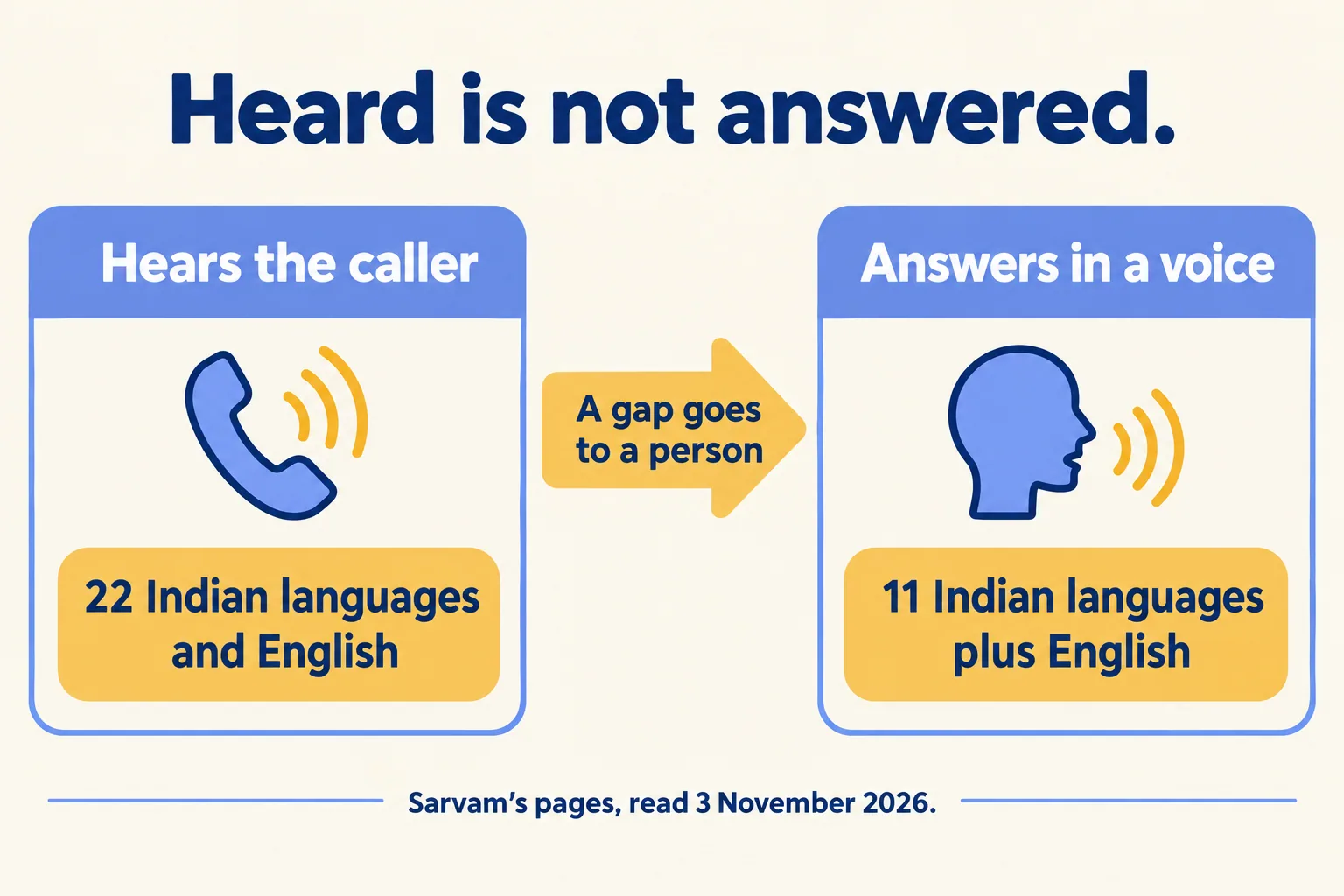
Because they are two different models with two different lists. This is the receipt for the rule, and it comes from Sarvam's own pages, read on 3 November 2026.
Sources: Sarvam, voice agent models and why Voice Agents.
Read the gap. A caller who answers in a language that is in the 22 and not in the 11 can be transcribed, and the agent still has no voice to answer in. Our Sarvam page, checked on 10 October 2026, said ten spoken languages, and Sarvam's page now lists eleven with Assamese. The number on Sarvam's page on the day is the one that counts, so we date ours. Urdu is the example we state on that page: Saaras can transcribe it, Bulbul cannot speak it.
That is a design input, not a fault. A call that is heard but cannot be answered in goes to a person who speaks the language, or the agent hands over with the transcript. Your call log tells you how many calls that is before you build anything.
How do you pick the first language from your call log?
An afternoon, with last month's log. Five steps.
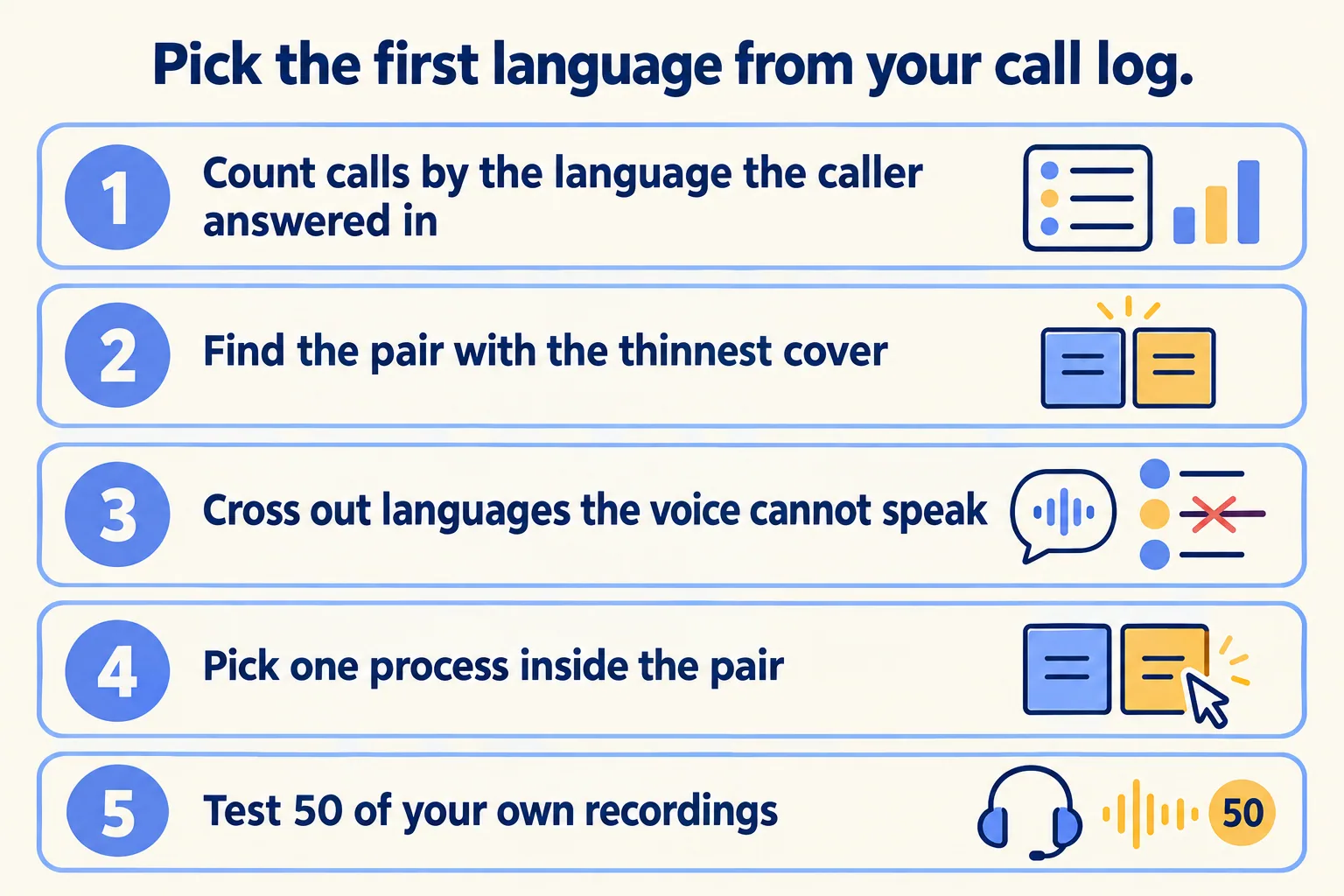
- 01Export a month of calls with the language the caller answered in. If the log has none, tag a sample of 200 by listening.
- 02Count calls per language, then per language pair if your team switches mid-call.
- 03Mark the hours and branches where nobody on the rota speaks that language.
- 04Cross out every language that is not in the voice list for your platform, and write down which of your own languages are out. Those stay with a person.
- 05Take the pair with the most calls left, and one process inside it: a reminder, a confirmation or a status question.
Step four is the one teams skip. A platform's language page is where you cross candidates out, not where you pick. The pair you start with is the biggest gap that survives it.
What does the shadow run on 50 recordings show?
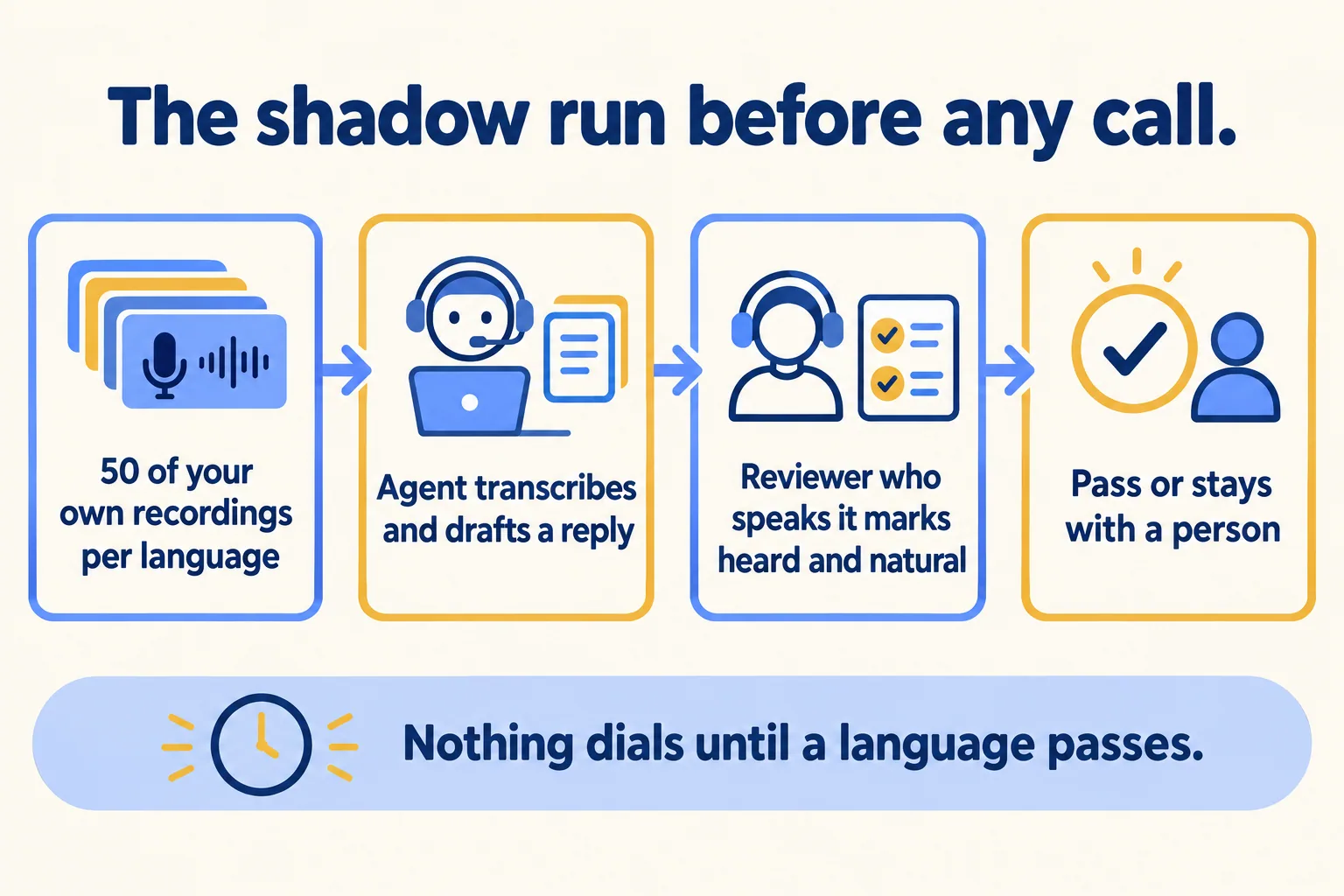
Before the bot dials anyone, it listens. In shadow mode the agent transcribes 50 of your own recorded calls per language and drafts the reply it would have given. A reviewer who speaks the language marks each one on two questions: did it hear what was said, and is the reply how a person would say it. A language passes on the reviewer's mark and nobody else's. The pass mark, for example how many of the 50 must be marked both heard and natural, is written into the spec before the run and signed by your compliance head, not set by us after the fact.
Voice vendors give the same advice. Sicada, a voice vendor, writes on its blog dated 4 July 2026: "pull 50 anonymised recordings from your actual contact centre and run them through any ASR model before committing; vendor benchmarks use clean studio audio; your calls do not." Convo360, another vendor, in a page updated on 19 September 2026, says to test every script with a native speaker before it goes live, "especially for numbers, dates and product names."
Numbers and dates are where a polite reply goes wrong. An amount said in lakh, a due date said as "the fifth", a loan number read out in two languages. The reviewer listens for exactly those.
This is the "shadow" in our method, spec, shadow, gate: the process is written down, the agent runs beside a person without acting, and a human gate sits on anything that writes to your record.
Two more things go in the spec before any language is switched on. First, what lands on the record: our India agents page states that the outcome, the promise-to-pay date, the fields and the recording link are written back to the loan in Salesforce, and a named reviewer checks those writes. Second, who stops it: a named person on that day's rota who can pause the dialler, with a cover when they are out.
What does a voice platform cost, and what is left over?
Sarvam's pricing page, read on 3 November 2026, lists these per-minute rates for its Voice Agents. They are Sarvam's list prices in rupees, they exclude GST, and Sarvam says telephony is billed separately.
Source: Sarvam, Voice Agents pricing. A call is rounded up to a 60-second pulse, so a 45-second call counts as a minute.
Your own cost per call is minutes per call times the rate, plus telephony, plus the minutes a person spends on every call that is handed over. Use your own log for each. An example only: a 90-second call is two billed minutes, so Rs 7.00 on pay as you go before telephony.
Notice what the table does not decide. It does not say which language is covered, which calls a person keeps, or what is written to your record. Those are the first-language question and the call flow. They are why we do not start from a price. On your own number you hold the account with Sarvam or your voice provider, and our build is quoted separately after the call. Mindcat is not affiliated with Sarvam.
Who owns consent and calling hours?
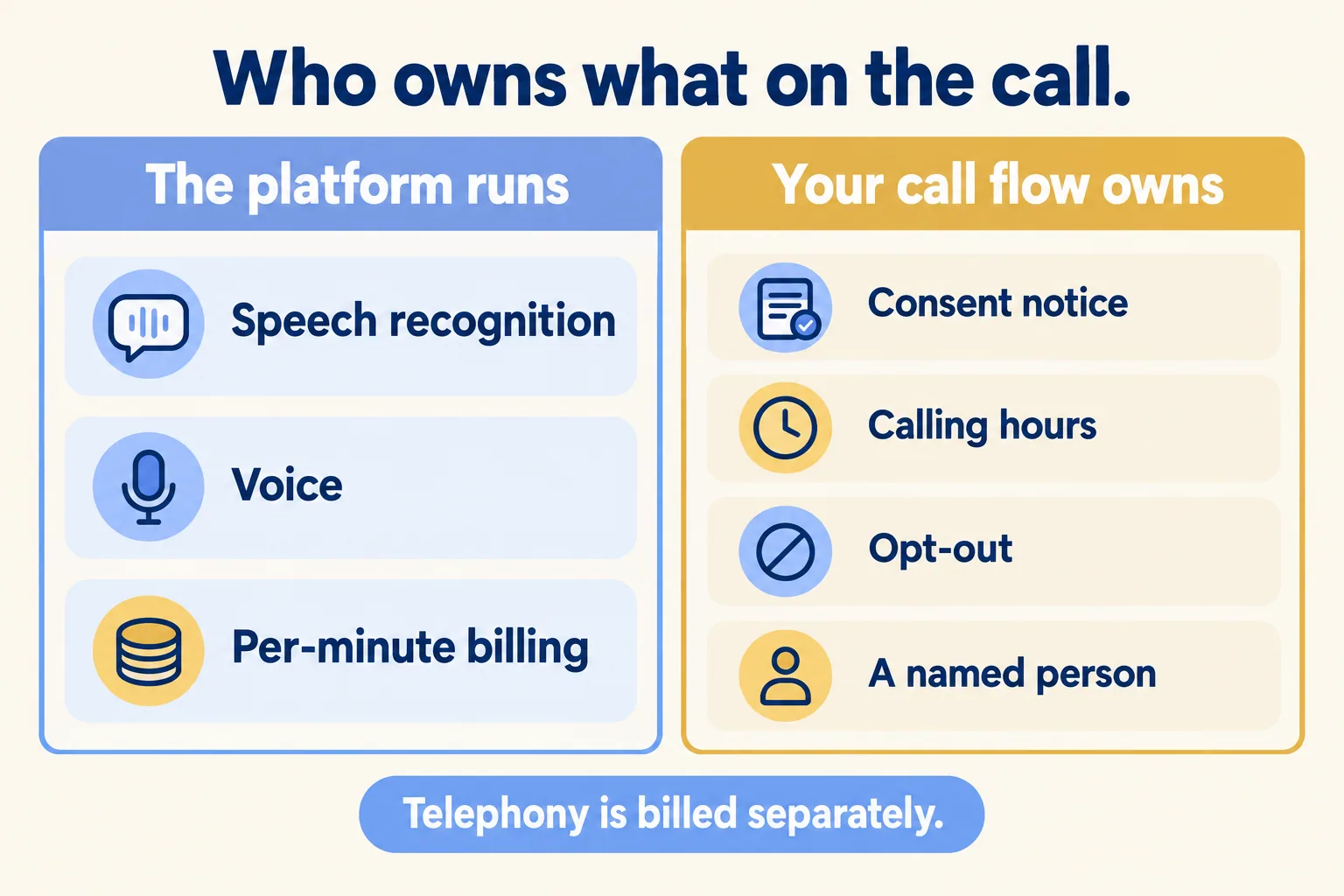
You do, in your call flow. Sarvam's own contact-centre guide lists "Call recording (with consent)" and says that if you are recording for quality checks, "capture consent in the call flow itself." The platform runs the call. The notice, the recording rule and the hours are yours.
So the spec for the first process names them before the first call: the window the dialler may call in, the line the caller hears about recording, how a caller opts out, and who is the named person when they do. For lenders in India, RBI's recovery Directions add paragraphs on the log, the recording and the hours from 1 January 2027, and we read them in which collection calls keep a person. Your compliance team decides how any rule applies to your licence.
When are we the wrong answer?
When you have no recorded calls to count from, or you want a dialler that places more calls. Without the log, the first step is to start recording with consent and count for a month. Our First Agent in Production offer starts with one process in one language pair, a shadow run on your recordings and a reviewer on the exceptions. The first look is free.
If you want the written read, send us the call your team takes in the wrong language and the system it lands in. We reply in writing within 24 hours.
