
If your telecallers speak two of the languages your borrowers speak, and RBI's recovery rules reach you on 1 January 2027, this is for you. It is not for lenders who want a dialler to call more numbers.
What does RBI require of every recovery call?
A log, a recording and a clock. RBI issued Amendment Directions for NBFCs on 6 August 2026, in force from 1 January 2027, about ten weeks away. We read the text on 20 October 2026. These are the paragraphs that touch a call.
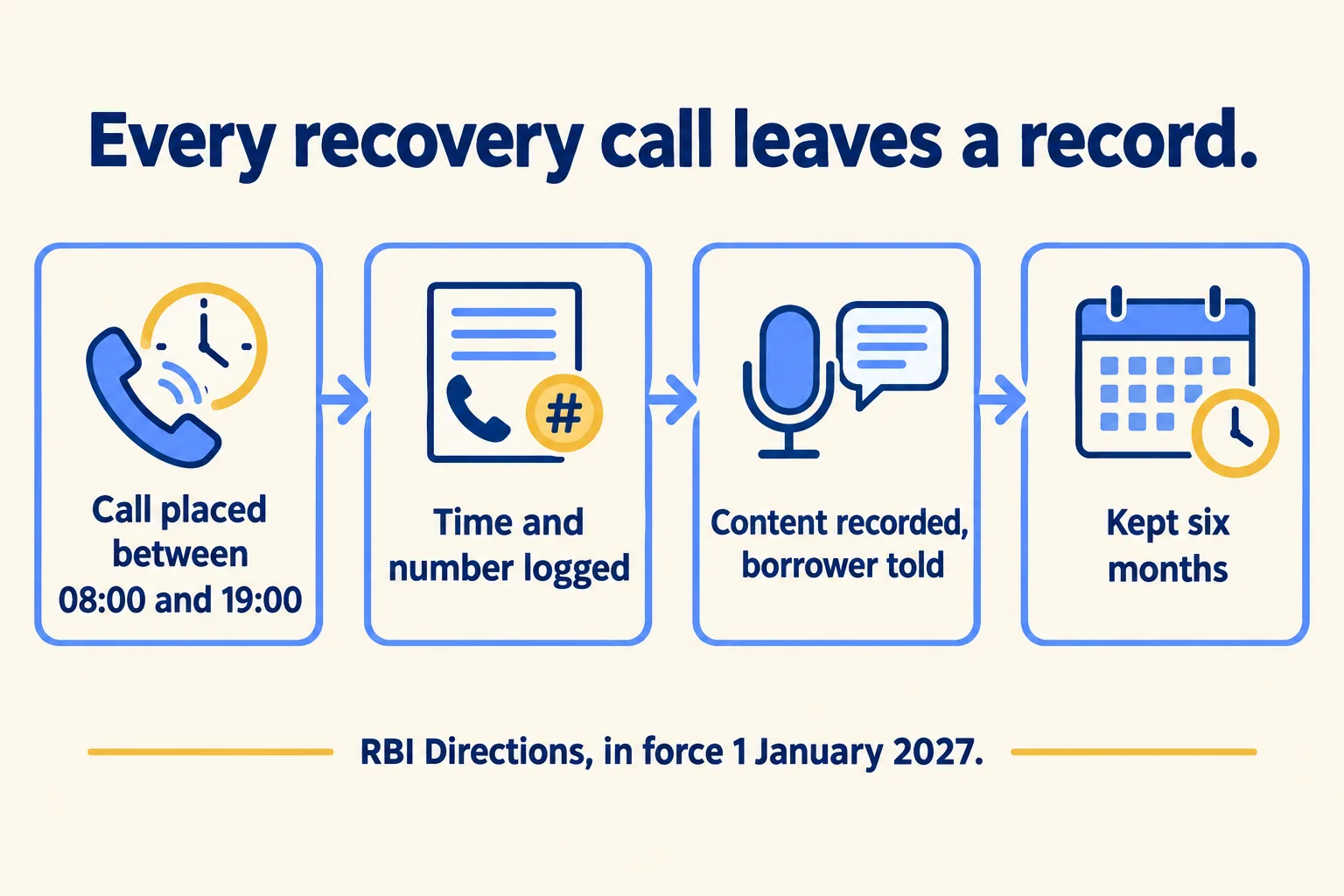
Source: RBI, Amendment Directions of 6 August 2026. Read the paragraphs yourself before you design anything. Your compliance team decides how they apply to your licence.
Do the rules say anything about automated calls?
No. The Directions speak of an NBFC's "employee / recovery agent" and never mention automated or AI calling. We searched the text for it.
That does not make an automated caller outside the rules. Corporate Professionals, writing on 10 August 2026, puts it plainly: the label in the contract does not matter, and "if the work is recovery, the rules apply." A tele-caller, a collection partner or a voice caller all land in paragraph 100P to 100Z the day they dial a borrower. The lender answers for the call.
One industry body does speak to it. FACE, an RBI-recognised self-regulatory organisation for fintech, published debt recovery guidelines on 29 August 2025. They say AI agents must clearly identify themselves and disclose that the message is automated. They also say to monitor AI communication on the human-in-the-loop principle for escalations and critical decisions, and they list "incidents of escalation requiring human intervention for AI-enabled interaction" among the things a lender tracks. These are FACE's guidelines for its sector, not RBI's text. They show where the industry expects the line to sit.
Which calls does a person keep?
Our rule: let an automated caller place only the calls that read fixed facts, and keep every call that needs judgment with a named person. Here is the split we would put in front of a collections head.
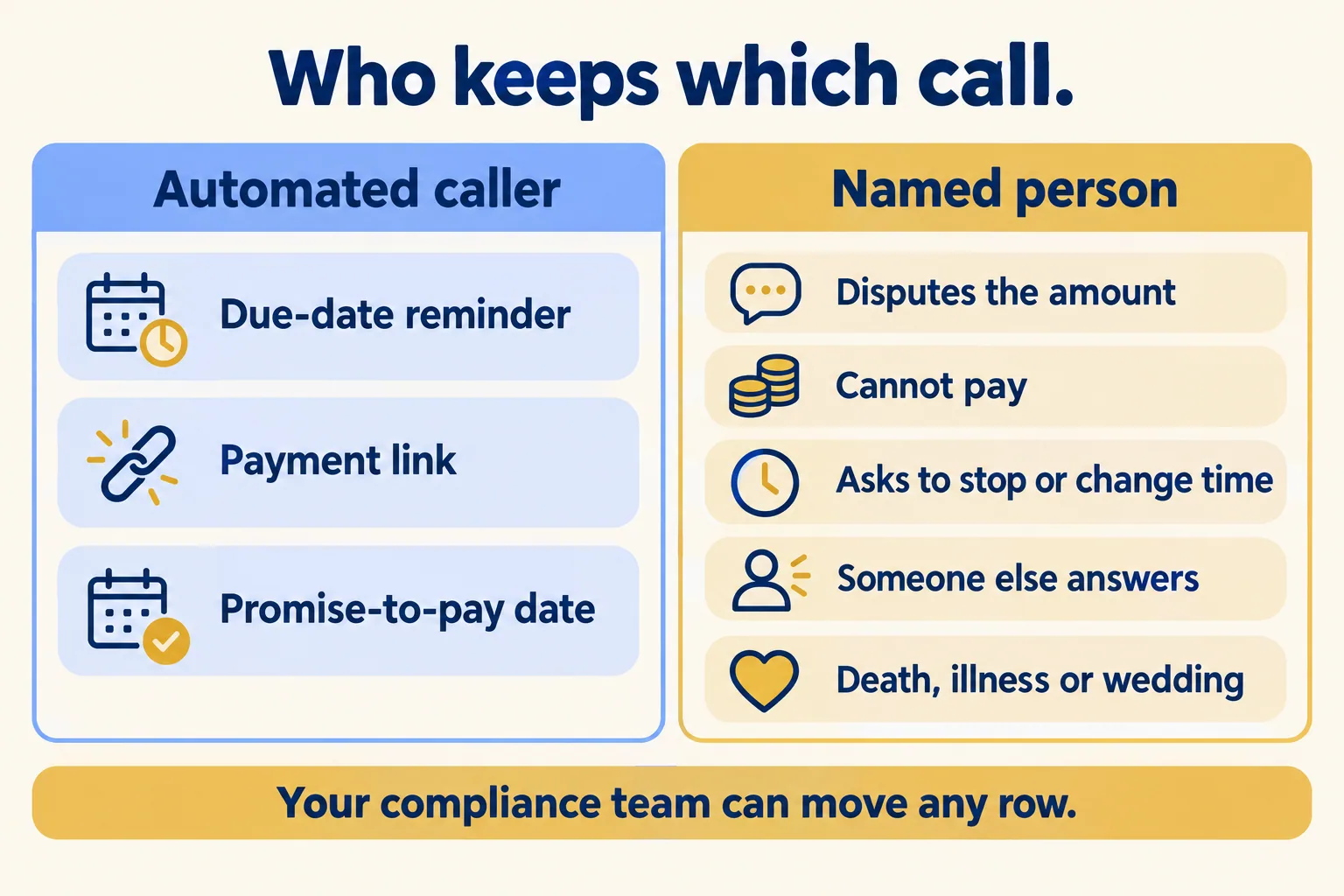
A named person is a collections officer on that day's rota who can settle the case, call back in the borrower's language and pause the dialler. The spec names who, and who covers when they are out. The first two rows are where an agent earns its place. They are the calls telecallers repeat in the borrower's language, and they read the same facts each time. The rest are where one wrong sentence becomes a complaint.
This split is the line we build to, not a reading of the law. Your compliance team decides what applies to your licence and can move any row. A row that moves to a person stays with a person. A row that moves the other way needs the paragraph behind it in writing first.

Why can't you copy a vendor's calling hours?
Because the pages disagree with the text and with each other. We read three on 20 October 2026. One page lists "time-bound calling (9am-9pm)" and an "RBI Guidelines Compliant" badge. Paragraph 100Y(4) says 08:00 to 19:00, so a call at 8 pm is outside the window unless the borrower asked for it. Another, dated 10 July 2026 and so written before the August Directions, says "RBI's minimum is 90 days for collection call recordings." Paragraph 100P says six months.
That is a reason to read the gazette, not a reason to distrust every vendor. A dialler setting copied from a sales page can put your 1 January go-live outside the rule on day one. Copy the paragraph numbers into your design brief, and ask any vendor to point to the paragraph behind each setting.
What should the log hold for each call?
Paragraph 100P requires the first two items below. The rest are ours: a log you can answer a complaint from holds more, and your compliance team decides which of them to keep.
- 01Required by 100P: the time the call started and ended, in the borrower's time zone, and the number dialled.
- 02Required by 100P: the recording or text of the call, the precaution of telling the borrower it is recorded, and six months of keeping, or until a sub judice case is disposed of.
- 03Ours: the outcome as a field, reminded, promise date given, link sent, disputed, hardship, asked to stop, wrong person.
- 04Ours: the promise-to-pay date, if one was given, in the borrower's own words and as a date.
- 05Ours: the name of the person who took over, and when they called back.
- 06Under 100AA: the grievance officer details on every recovery communication, sent after the call as a message the borrower can keep.
Our India agents page already holds the calling window, an attempt cap, the TRAI number series and a person on every hard call in the dialler, not in the script. It says so, and it says your compliance team signs off what applies to your licence. The page also says outcome, promise date, fields and recording link are written back to the loan in Salesforce.
How do you check your own call list in an afternoon?
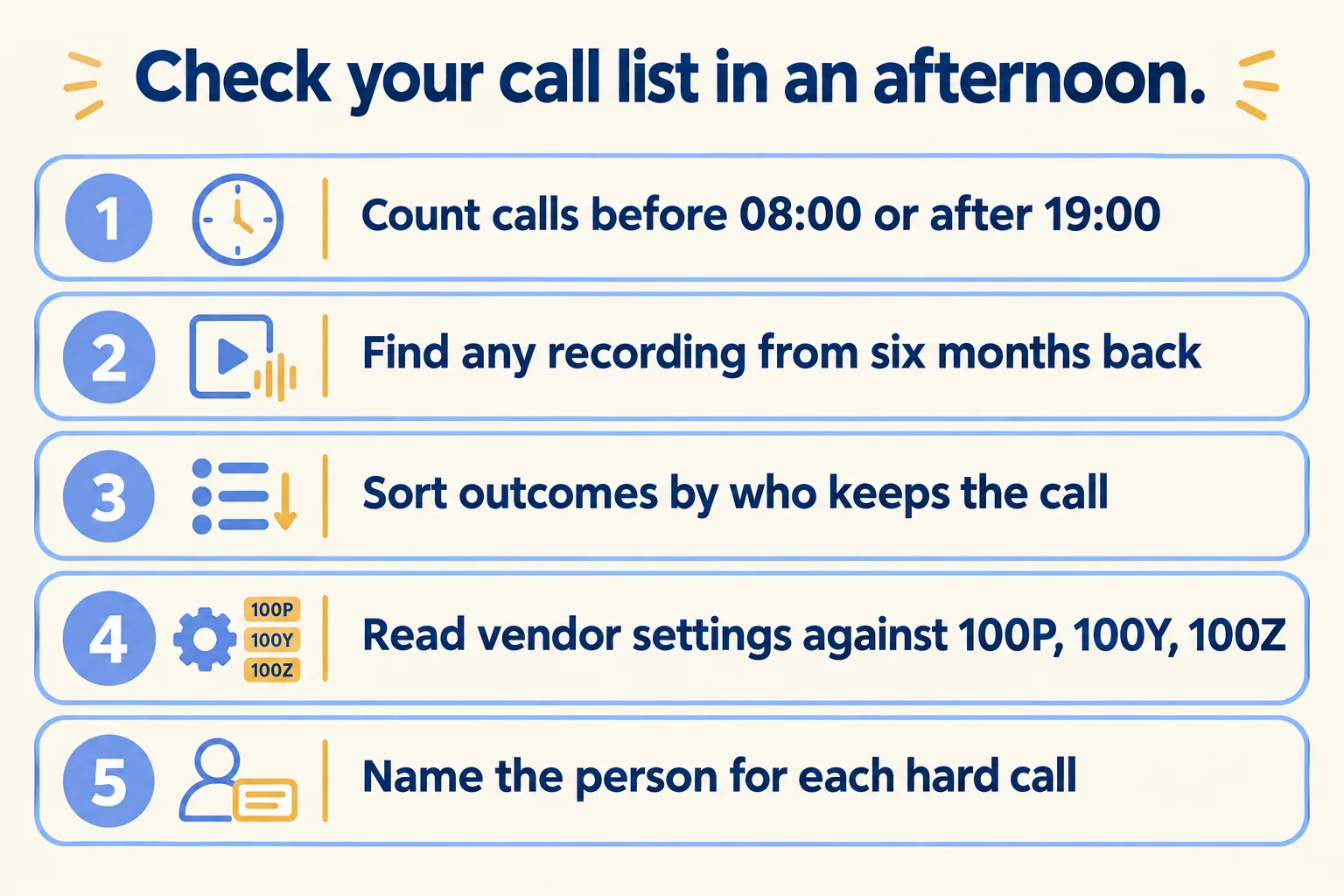
Five steps, none of which need us.
- 01Export last month's recovery calls and count how many started before 08:00 or after 19:00.
- 02Check that you can find the recording and the time for any call, six months back.
- 03Sort the outcomes by who keeps the call, and count the ones where a person took over.
- 04Read your vendor's settings page against paragraphs 100P, 100Y and 100Z, one setting at a time.
- 05Write down who is the named person for each hard call, and what the borrower is told.
If step one finds calls outside the window that the borrower did not ask for, fix that before you add any automation. A caller that dials faster only makes the count bigger.
When are we the wrong answer?
When you want a dialler to reach more numbers, or you have no named person who can take a disputed or hardship call the same day. In both cases the calls are not the problem yet. Our First Agent in Production offer starts with one process in one language pair, with a reviewer on the exceptions, and the Indian use cases list where teams start. Mindcat is not affiliated with Sarvam, and you hold your own Sarvam or voice provider account.
If you want the written read, tell us the call your team makes in the wrong language, and the loan system it lands in. We reply in writing within 24 hours, and the first look is free.
