

If you cannot yet list the ten questions your customers ask on WhatsApp, this is for you. It is not for teams that already answer from a written list, and it is not for teams with nobody who owns the lead after the first reply.
Can you write down the ten questions?
Try it now, without opening the phone. Ten questions, in your customers' words, each with one answer you would stand behind.
If you got to six and started guessing, that is the finding. A chatbot answers from a list. A list you cannot write is a bot that guesses in front of your customers.
A founder on a Reddit thread about WhatsApp workflows for small businesses (mirrored on 26 May 2026) put it this way: do not build the keyword list before you have read a few hundred real incoming messages, because the words customers use are never the ones you assume. Another small-business guide says the same four questions land every day: hours, price, availability, location. Both point at the same first job. Read the chats.
Our rule, so you can argue with it. Build a WhatsApp chatbot only when your team can write the ten most-asked questions from real chats, with one answer each that fits in one message. If the list is not there, read 200 real chats first and keep the bot for later. If the list is there and the answers are fixed, a bot is a small, safe build. If the answer changes per customer, you need more than a bot, and the section after the test explains why.

What does a bot reply cost since 1 October?
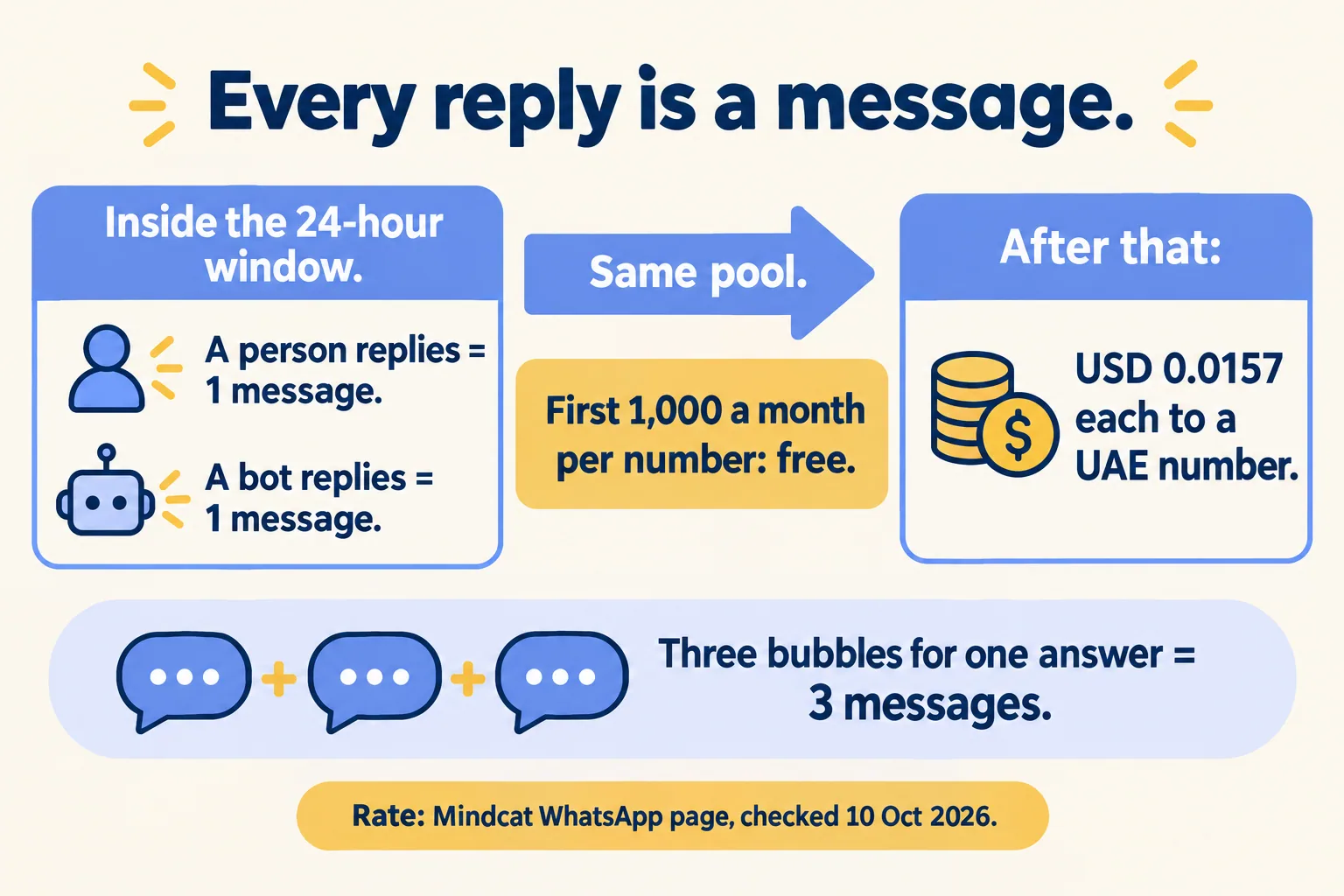
Until 30 September, a free-form reply inside the 24-hour customer window cost nothing on the API. That changed. Meta's pricing page says it "resumed charging, on a per-message basis, for messages that were previously free", including utility messages sent in an open customer service window. Each business phone number gets 1,000 service messages a month free. Unused ones "do not roll over."
The part that matters for a bot: Meta's page says these service messages "can be powered by a 3rd-party AI solution or people." A reply is a reply. A bot's answer and a person's answer draw from the same 1,000. WATI's help centre makes the count concrete: if an agent sends six free-form replies while resolving a delivery question, those are six billable service messages once the free tier is used. The WhatsApp Business app used without the API is not affected.
So the lever is the number of bubbles. One answer split into three bubbles is three messages.
Here is the arithmetic, labelled as an example. Say a team has 500 chats a month. If every answer fits in one message, that is 500 replies, all inside the 1,000 free. If the bot sends four bubbles a chat, that is 2,000 replies. The 1,000 over the free tier cost 1,000 × USD 0.0157 = USD 15.70, at the rate on our WhatsApp page for a UAE number, checked on 10 October 2026.
Notice what this does and does not say. The fee is small. It is not the reason to wait. The reason to wait is the missing list, and the fee is what makes a vague answer countable: you can now put a price on every extra bubble. Meta's own Business Agent is different. It bills per agent message from the first one, about 4 to 5 US cents each by Meta's estimate, and Meta does not offer it to health, finance or government businesses.
How do you run the ten-question test?
This takes an afternoon. You need one week of real chats.
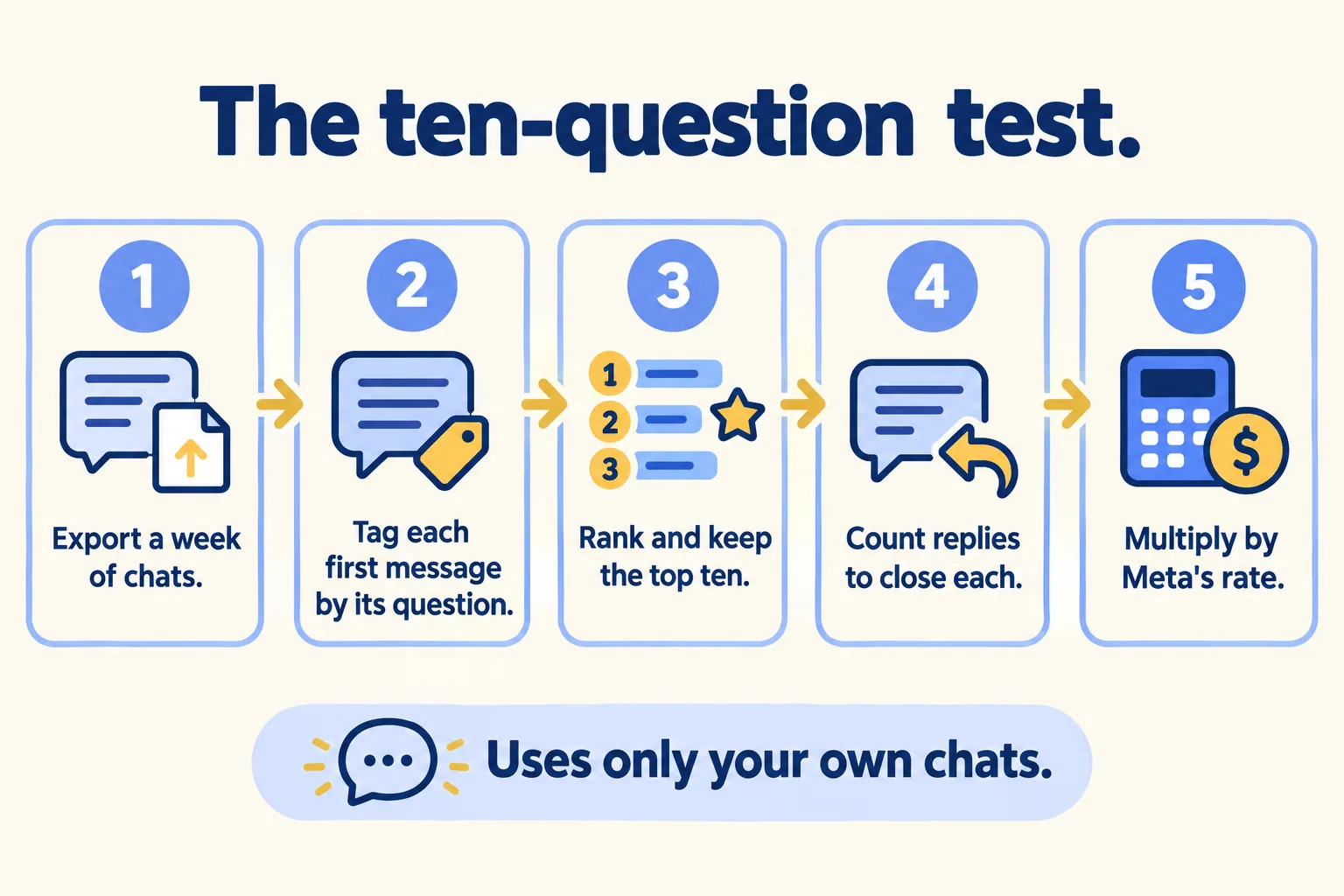
- Export a week of chats. From the app, or from your provider if the number is on the API.
- Tag the first message of each chat by the question it asks. Do not invent categories before you read. Let the questions group themselves.
- Count and rank. The ten most frequent are your list. Write one answer for each that fits in one message.
- Count the replies it took to close each one. Real chats show you which questions took one reply and which took six.
- Multiply. Replies a month, minus the free 1,000, times Meta's rate for your market. The cost calculator does this.
Then read the result against three outcomes.
When is a chatbot safe, and when is it an agent?
Three outcomes, and each one has a different next step.
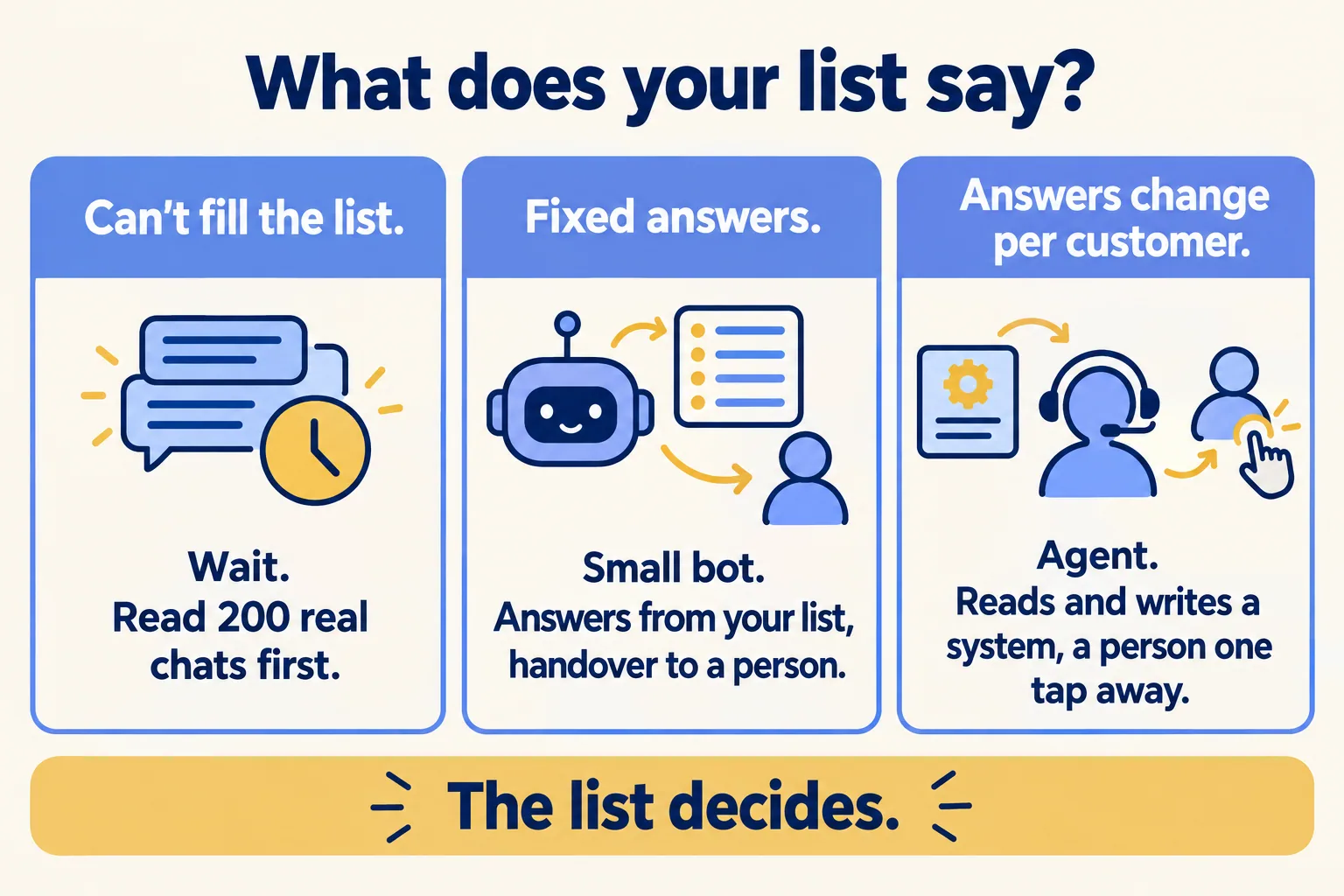
You cannot fill the list. The ten are not clear from the chats, or the top ten cover under half of what people ask. Keep the chatbot for later. Use the list you do have as quick replies for your people, and keep reading chats. This costs you nothing.
The list is full and the answers are fixed. Hours, location, what is included, how to book. The same words are right for every customer. A bot that answers from your list, offers buttons, and hands over to a person is a small build. It is also the safe one, because it only says what you wrote.
The answers change per customer. A price for this unit, a slot that is free today, where this order is. A bot cannot answer from a list. It has to read a system and sometimes write to it, with a person one tap away when it is unsure. That is an agent, and it is a different job with a different price. See WhatsApp agents and, for a comparison with Meta's own agent, the page on Meta Business Agent against a custom agent.
One caution on guides. A provider article written before 1 October may still say free-form replies cost nothing. One we read said exactly that. Check the date of any guide before you use its numbers.
What does each route cost?
Three lines, and they are separate bills.
- Meta's fees, billed at cost on your own Meta account: the first 1,000 replies a month on each number are free, then USD 0.0157 each to a UAE number. Prices exclude 5 percent UAE VAT where Mindcat bills you.
- The build, one-time, quoted in writing from your brief. From AED/SAR 25,000 for answers and a handover to a person (about 1 week), from AED/SAR 75,000 for an agent with integrations (3 to 4 weeks), from AED/SAR 120,000 for an agent that takes actions (5 to 6 weeks). The model calls are extra, at cost. Extra work is AED/SAR 900 an hour.
- People, if you want them on a shared screen: Mindcat Inbox starts from AED/SAR 89 per agent a month, graduated, with a shared plan minimum of 3 agents, AED/SAR 267 a month. In Inbox people answer; there is no automatic reply today.
The build price is one job, one system it writes to and one person it hands over to.
When are we the wrong answer?
When your team already answers from a written list, you do not need this post, and you may not need us. When you only want the free app and one person answers every chat, stay on the app: see phone or desk. When your problem is leads that arrive from ads at night, read WhatsApp ad chats after hours first.
If you cannot write the list and want a second pair of eyes, tell us how many chats you get a week and which number they use. We reply with the written assessment: which route fits, and what Meta would charge for your volume. If the answer is to wait, we say so. For how Meta's fees work in more depth, see what WhatsApp costs a UAE team on Meta's rates.
