

If your receptionist books for four practitioners from four separate scheduling links, this is for you. It is not for one person with one calendar: Calendly's free plan is enough.
Who books the visit: the client or the desk?
Picture a physiotherapy practice in Al Barsha with four therapists. Each has a Calendly link on the website and in their Instagram bio. Most visits still start with a phone call or a WhatsApp message to the front desk, and the receptionist books them by opening each therapist's link in turn, looking for a gap. A walk-in at 11:00 means checking four calendars while the phone rings.
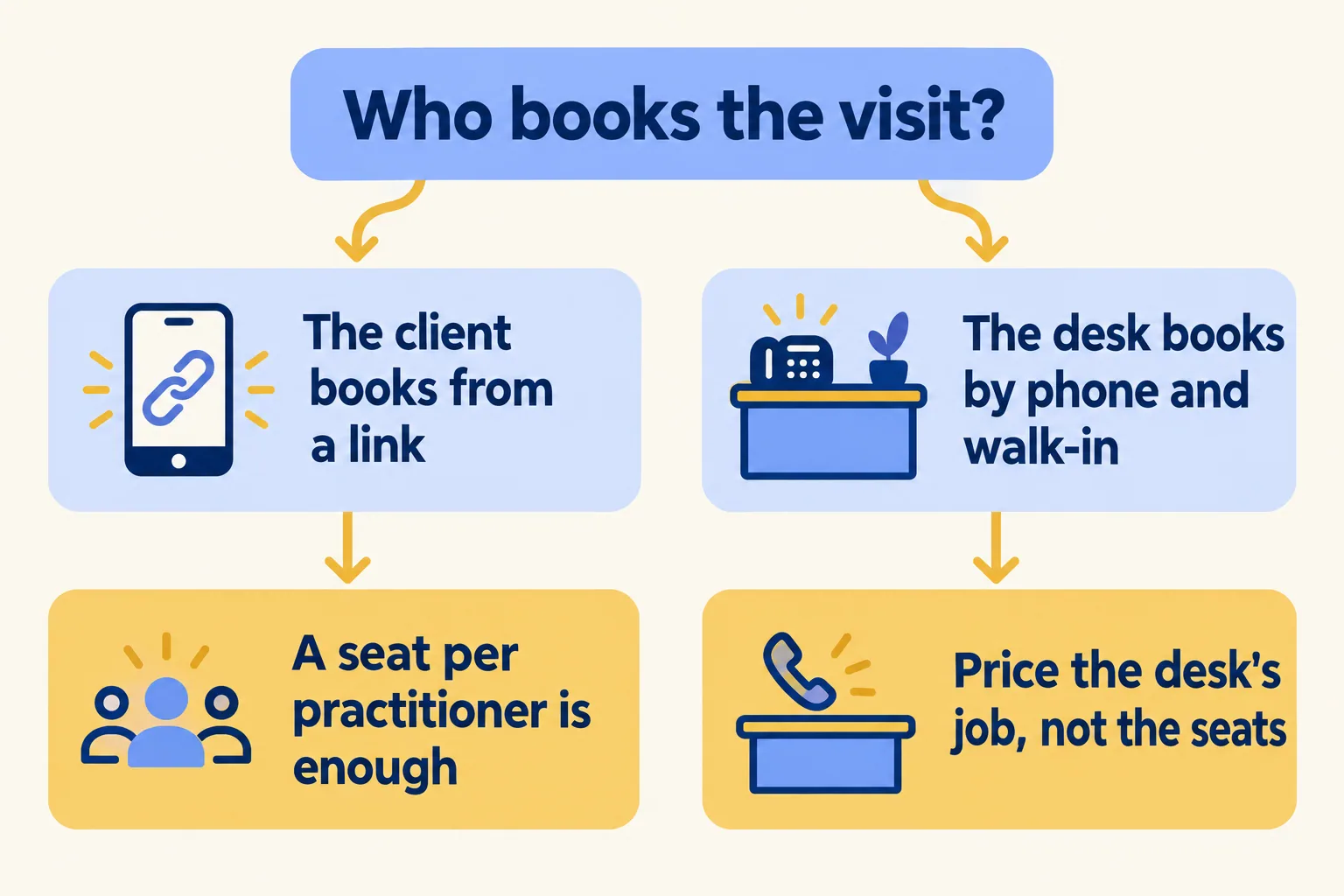
The price question comes second. The first question is who does the booking. If clients book themselves from a link, a scheduling tool priced per seat does the job and costs little. If the desk books most visits for several people, you are paying for the desk's job, and seats are the wrong unit to count.

What does Calendly cost a four-person practice?
These are the prices on Calendly's pricing page on 18 November 2026, billed yearly, in US dollars.
The free plan's limit is variety, not volume: one event type. A practice with a 30-minute assessment and a 60-minute session already needs Standard for each therapist. Four therapists on Standard come to USD 40 a month, or AED 146.90 at the 3.6725 peg.
If you want round-robin, so a client can book "any therapist" and Calendly picks one, that is Teams. Four therapists and the receptionist on Teams come to USD 80 a month (AED 293.80). Calendly's help pages say Teams pricing per seat drops only after 30 seats, so a small practice pays the full rate.
At eight practitioners the sums change. On Standard, eight seats are USD 80 a month (AED 293.80). On Teams with the receptionist, nine seats are USD 144 (AED 528.84). Our booking system for eight is AED 430, with the desk free. Standard stays the cheaper bill; Teams does not.
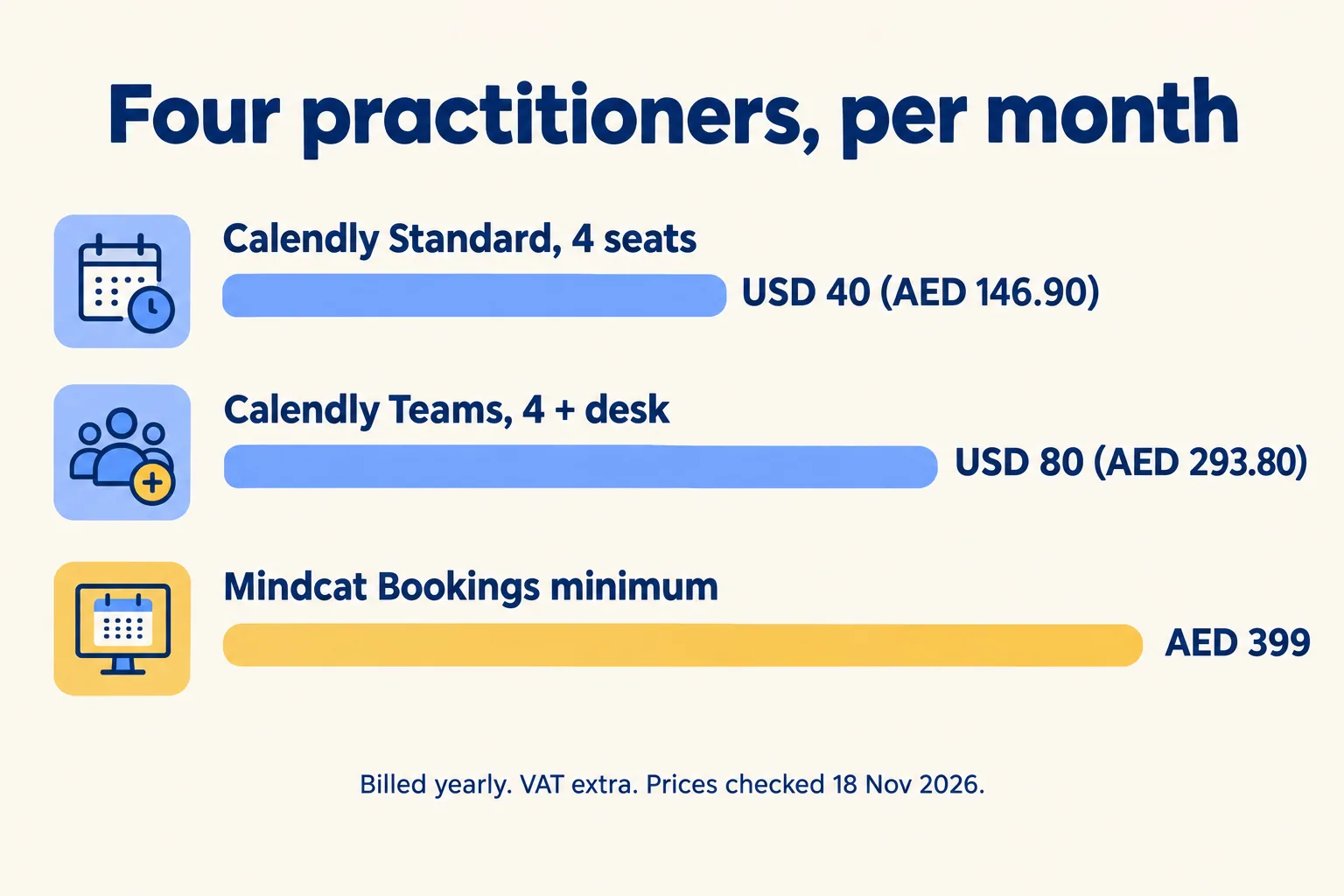
Our own booking system's shared minimum is AED/SAR 399 a month. For four people, Calendly costs less on either plan, and we say that to practices before anything else.
Who needs a seat?
Calendly's pricing page is exact about it: "Seats are required for users to connect calendars and host Calendly meetings - meeting invitees do not require a seat." Clients never pay. Each therapist who has their own diary is a seat.
The desk is the open question. Calendly lets one user book a meeting for another through event type permissions, and its help page on booking in real time says you can "book on behalf of other team members" once those are set. On Teams, the pricing page says seats are required "to connect calendars and create Calendly links to help book meetings". So when we price Teams for a practice, we count the receptionist as a seat. Ask Calendly's sales team to confirm it for your account before you buy.

When is Calendly the right answer?
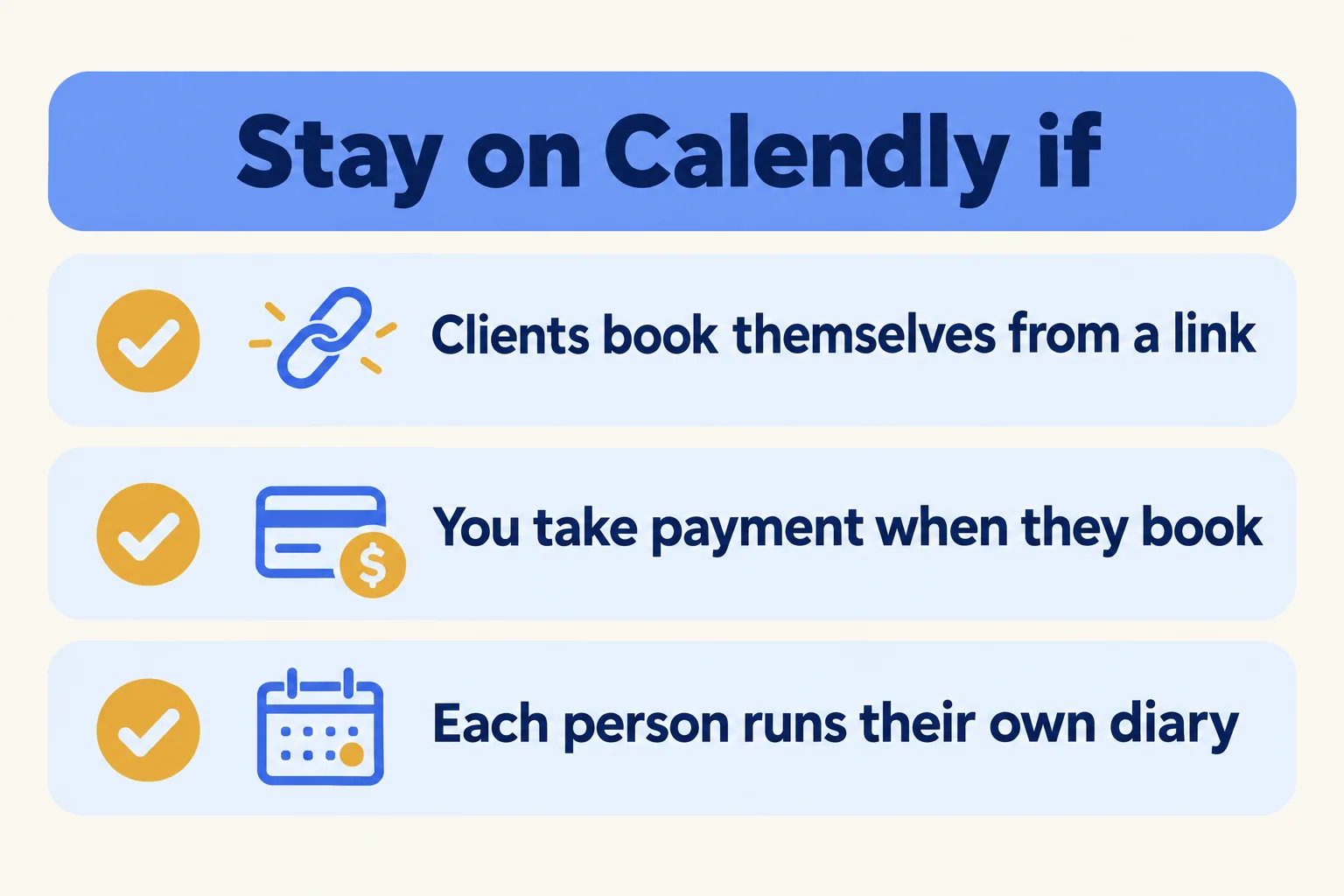
Stay on Calendly when clients book themselves. A coach, a tutor or a consultant who sends a link and lets the client pick a time is exactly what a seat is priced for.
Stay too if you take payment when the client books. Calendly's Standard plan connects Stripe and PayPal, and its page lists deposits and prepaid session packages. Our booking system takes no payments or deposits today, so for a practice that needs a deposit to stop no-shows, that settles it.
Calendly's Standard plan also lists automated reminders. Ours sends a confirmation; the reminder is added during setup.
When is one diary for the desk worth more?
A seat tool is built around each host's link. A front desk works the other way round: it starts from the day and asks who is free. When most bookings come in by phone, WhatsApp or at the counter, the desk needs every practitioner's day on one screen. It moves visits between therapists and keeps the Friday and Ramadan hours right for everyone.
That is a different job, and it is the one to price. Three questions settle it:
- 01Count last week's bookings: how many did clients make from a link, and how many did the desk make?
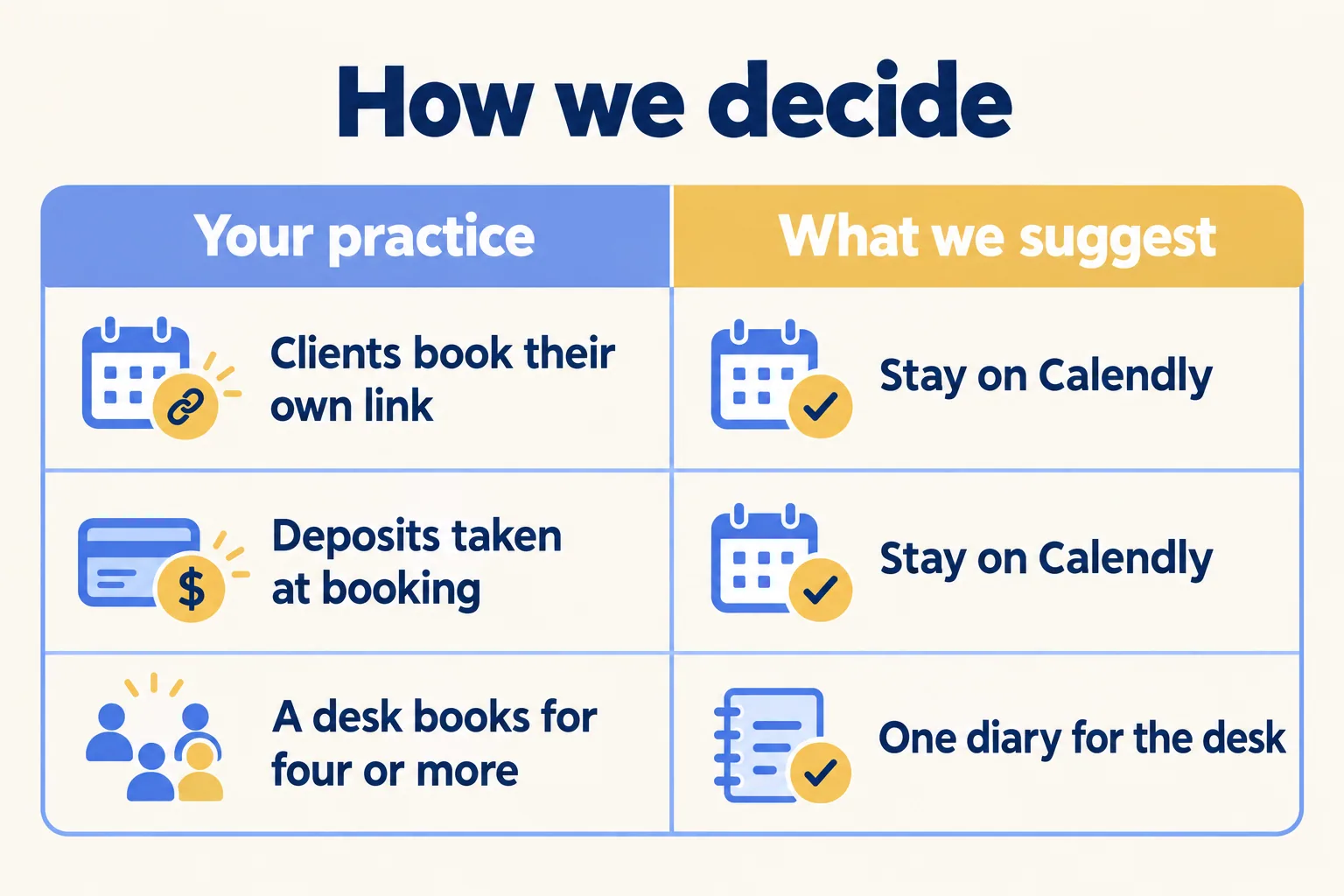
- 02Count the people the desk books for. Four or more is where checking calendars one by one starts to cost time.
- 03Check where the desk keeps the day today. If it is a paper diary or a spreadsheet beside the links, you already run two diaries.
If your bookings mostly arrive on WhatsApp rather than through links, we wrote about that choice in our post on booking pages and WhatsApp for clinics. If your clinic system already has a diary, read our post on whether to add a second one first.
How we decide: seats or one diary
Our method is called Every slot visible. Before we quote, we ask for one week of bookings and who made each one. Then we apply one rule.
What Mindcat Bookings does here, and what it does not
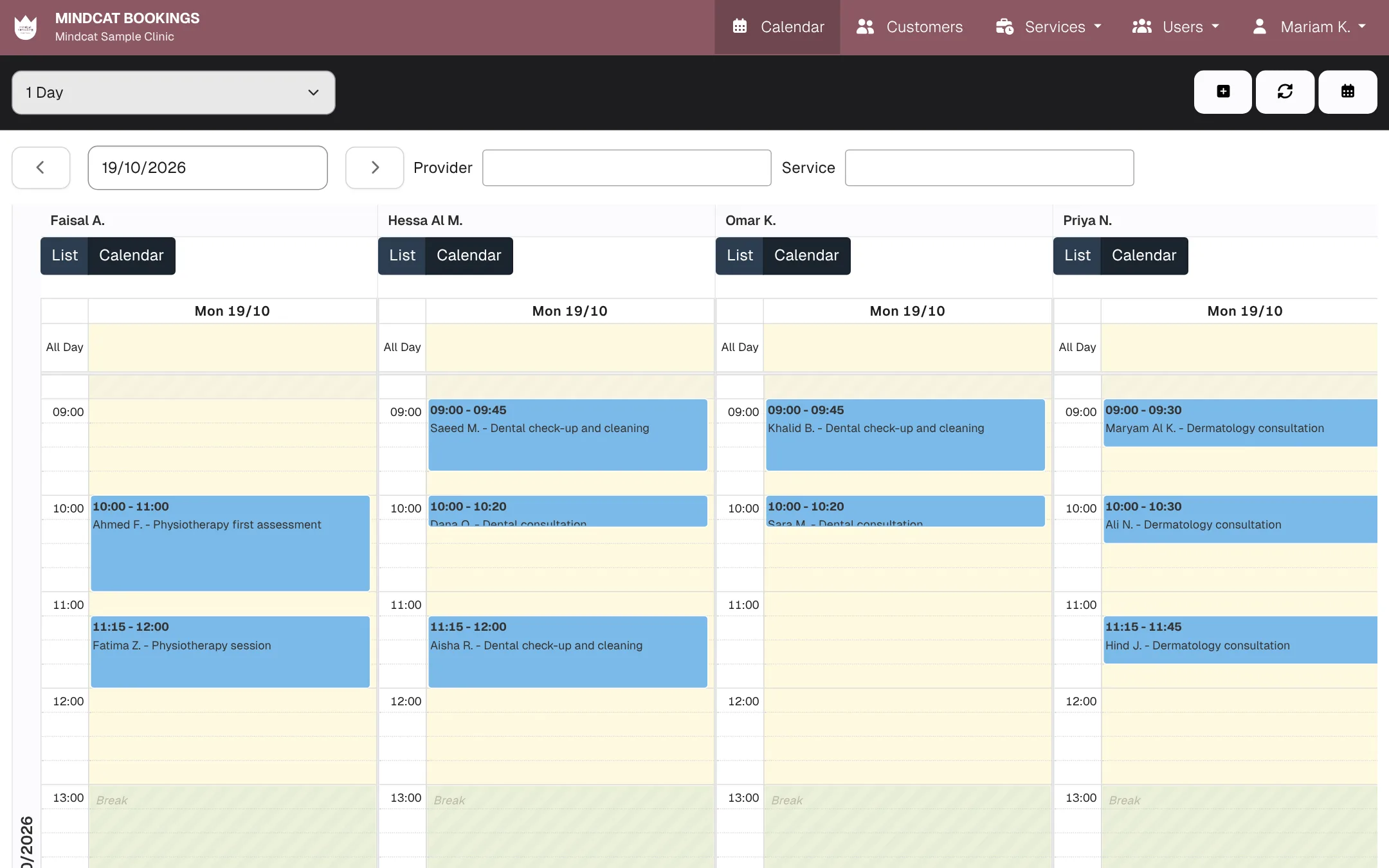
In Mindcat Bookings, the day view shows one column per practitioner, so the desk sees the whole practice's Saturday on one screen. A secretary login can run chosen practitioners' diaries, and a practitioner login shows only that person's bookings. Clients book a free slot on a booking page in Arabic or English, with hours per person, breaks, and different hours on chosen dates for Ramadan. The screen below is from our page, with sample data.
What it does not do:
- It takes no deposits or online payment. Patients pay at the practice.
- The app sends confirmations, not reminders. The quick start adds a reminder email the day before; from 6 calendars, managed setup adds WhatsApp or SMS through your own provider, with message fees billed at cost.
- Dates are Gregorian, and staff sign in with email and password, not UAE PASS or Nafath.
- Google Calendar sync is part of managed setup from 6 calendars.
Patient records and visit notes are a clinic system's job; Mindcat Clinic keeps those. Bookings keeps the diary.
What does it cost?
From the Bookings pricing, per staff calendar a month on the shared plan, AED and SAR the same: 59 for calendars 1 to 5, 45 for 6 to 15, 35 for 16 to 40 and 25 from 41. A staff calendar is a person or a resource clients book, such as a bay. Receptionists and managers who run the diary are free. The shared minimum is AED/SAR 399 a month, so a four-person practice pays 399, not 4 × 59. The page's example: 8 practitioners pay 5 × 59 + 3 × 45 = AED 430 a month. There are no per-booking fees.
Up to 15 calendars, the quick start is a fixed AED/SAR 2,500: we set up your copy, the booking page in Arabic and English, each person's hours from our CSV template, and the reminder email. Above 15, setup is managed. Prices exclude 5 percent UAE VAT and 15 percent Saudi VAT.
In the first year, a four-person practice pays 2,500 + 12 × 399 = AED 7,288 with us, before VAT. On Calendly Standard it pays 12 × USD 40 = USD 480 (AED 1,762.80), and sets it up itself. If the desk's time is not the problem, that difference is the answer.
This is not for you if clients book themselves from a link, or if you need a deposit at booking; stay on Calendly. If your desk books for four or more people and keeps the day in a paper diary beside the links, more on the practices we work with is on our clinics page. Tell us how many people take bookings and how clients book today. We reply with the setup plan and the monthly price per staff calendar, in AED or SAR.
