
If a customer disputes a delivery and you cannot say within a minute which signed note shows the count, this is for you. This is not for you if you run one van for regular customers and have had no dispute in a quarter: keep the book and count the cash each night.
Why does the note, not the invoice, start the argument?
Because the two documents are written by different people at different times. The driver fills the note at the gate. The office writes the invoice later, from the order. When the count on one differs from the other, the argument starts at payment time.
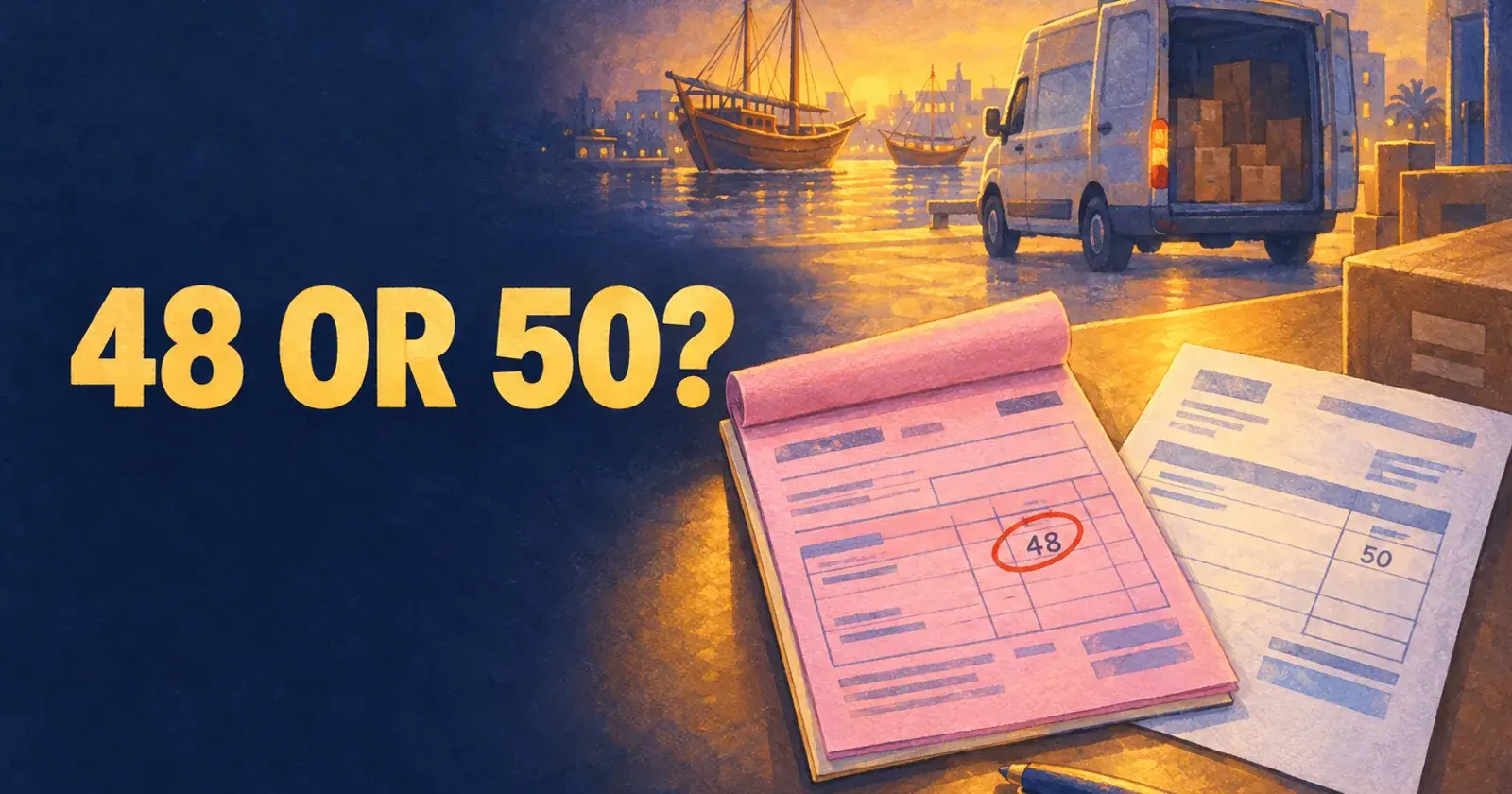
Pyalm, an invoicing vendor, describes the drift in a post of 1 August 2026: if the note says 48 units and the invoice says 50, someone will notice, "usually at payment time." The customer pays for 48, your invoice says 50, and now two numbers and one signature are being argued over.
Download a template and the page will give you a clean grid for the note. It will not tell you what must be written in it, or who keeps the signed copy.
What has to be written on the note?
The receiver's own count. A signature on its own says little. Kayrouz & Associates, a Dubai law firm, wrote on 7 April 2026 that "a signed delivery note without annotation is treated as acceptance of the quantity and visible condition of the goods." Its list of evidence for a later claim includes delivery notes annotated with the actual quantity received. The firm names signing without inspection as the single most common error.
That article is written for buyers, but the note is the same piece of paper on the seller's side. If the receiver counted 48 and wrote 48, you have a number to match against the invoice. If the receiver only signed, you have a signature that can later be read as acceptance of whatever the note says. Ask your lawyer how this applies to your contracts. The firm's article is guidance, not a ruling.
So the driver's job at the gate has two parts: get the count written by the person receiving, and get the signature beside it. A short delivery written as "short by 2" at the gate costs a minute. The same short delivery found at payment time costs a week.
When is a carbon-copy book enough?
When three things hold:
- 01The receiver writes the count they actually got, and a signature as well.
- 02The note number is written on the invoice, so the two documents point at each other.
- 03Someone can find the signed copy for any customer within a working day.
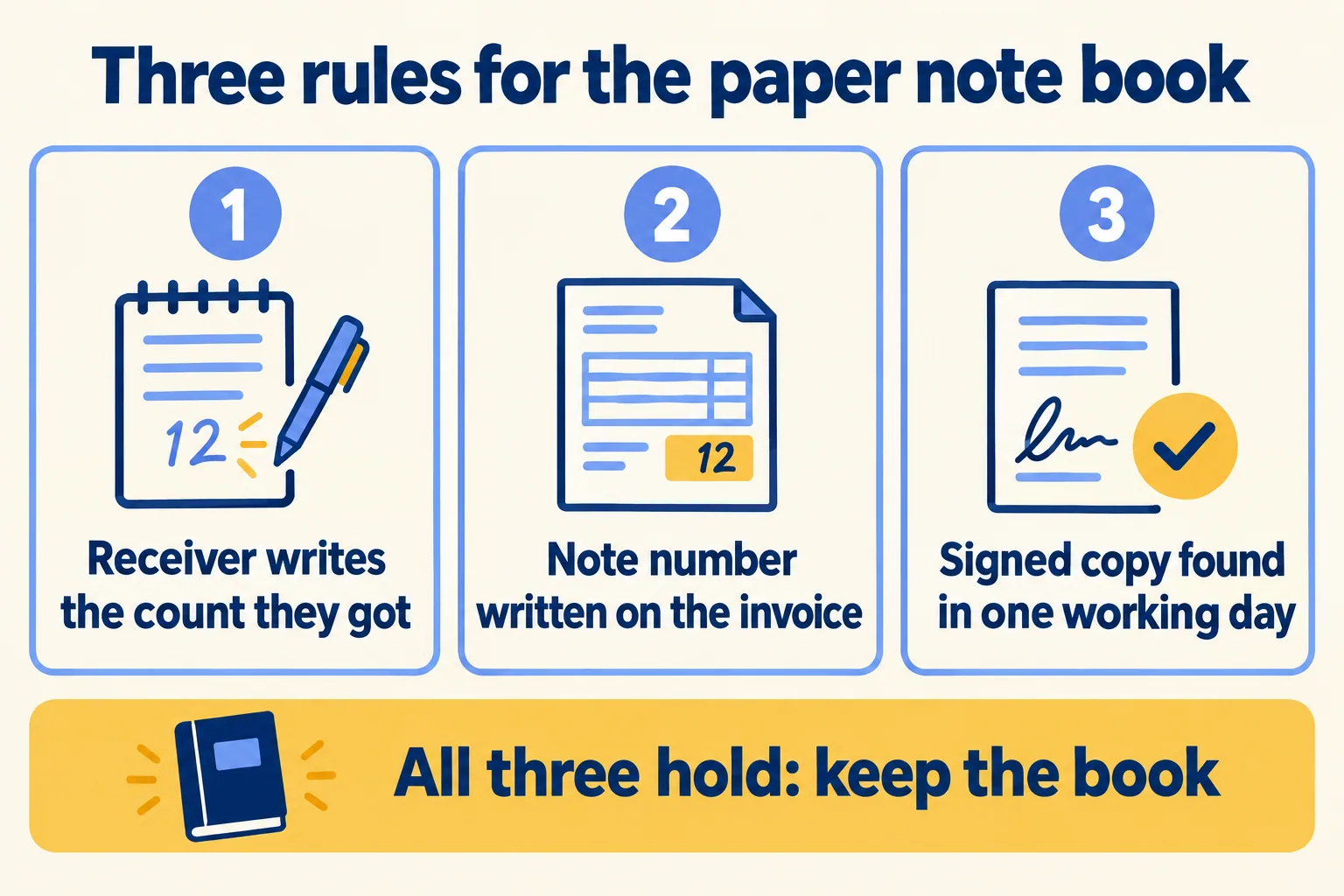
A book that passes all three is a good tool. It costs almost nothing, drivers already know it, and customers accept it. If your customers are a few regulars who know the driver by name, and nobody has disputed a delivery in a quarter, stop here and change nothing.
How do you test your book today?
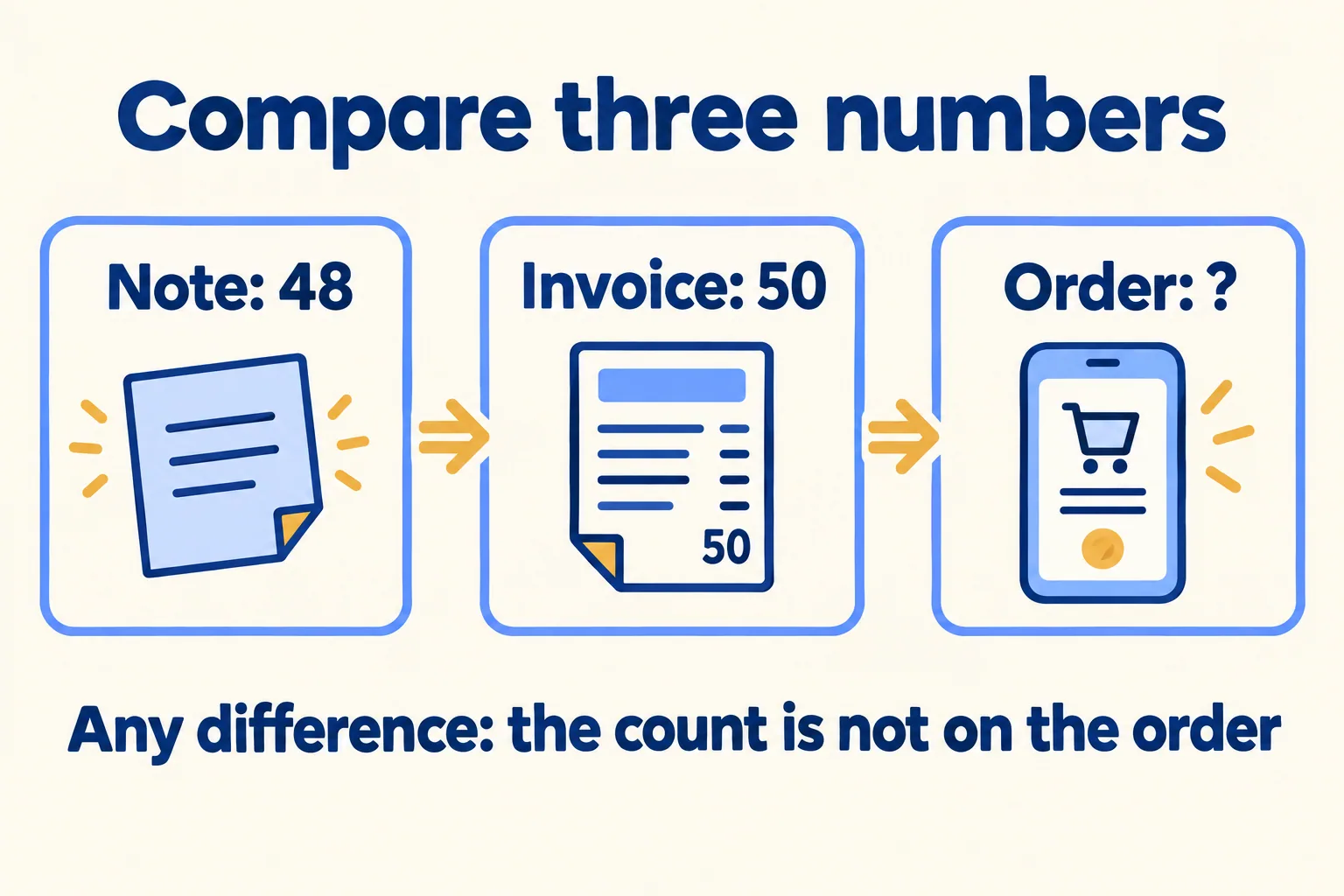
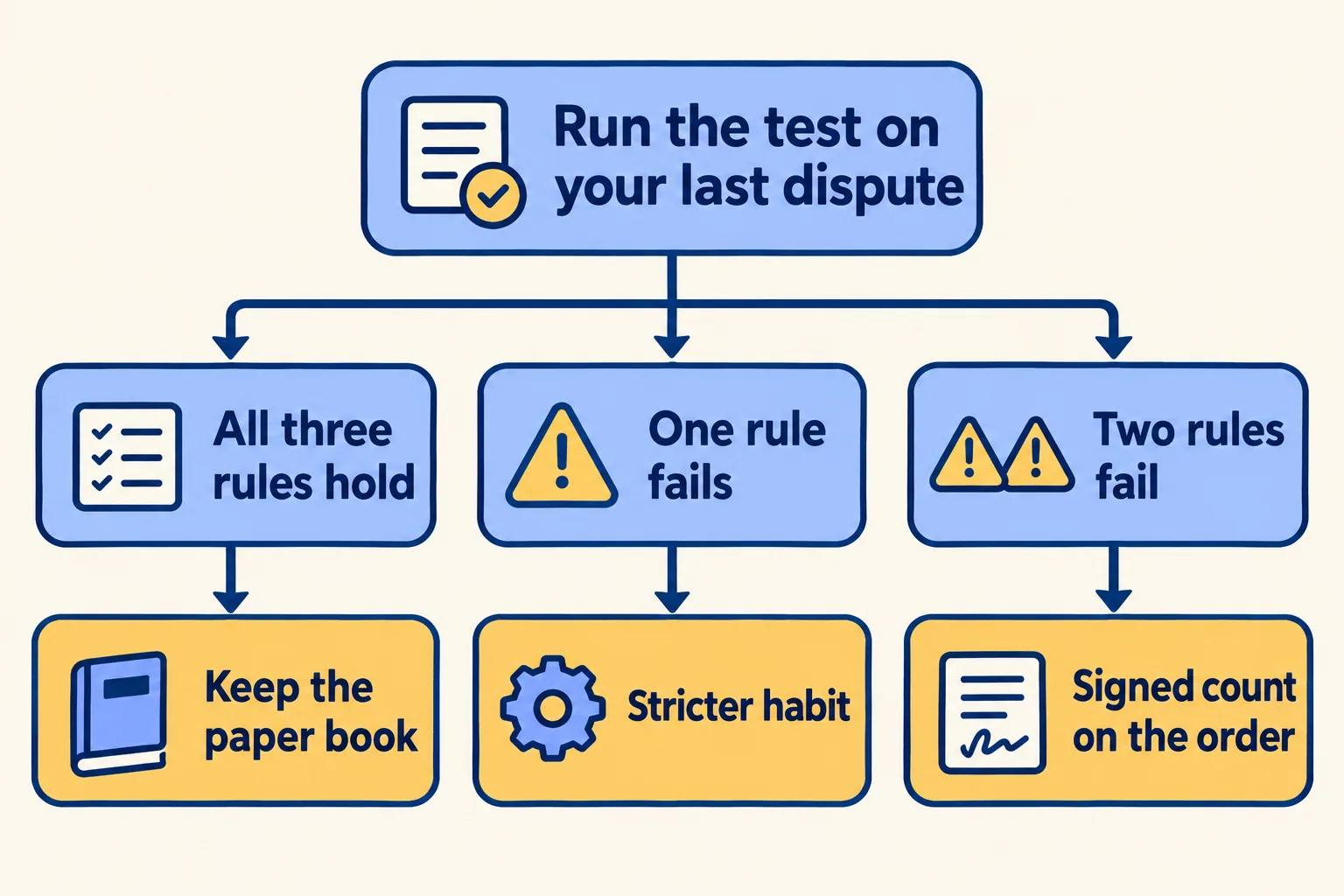
Take the last delivery a customer disputed. Run three checks, and write down the answers.
- 01Time how long it takes to find the signed copy. More than a working day fails rule three.
- 02Put three numbers side by side: the quantity on the note, on the invoice and on the order. Any difference means rule two is not working.
- 03Read the note. Is the receiver's own count written on it, or only a signature? A signature alone fails rule one.
One failed rule is a book problem, and a stricter habit may fix it: a count line the driver must fill, a number written on every invoice, one shelf per customer. Two failed rules, or the same failure on the next disputed delivery, means the paper has stopped keeping up with your volume. That is the point where the signed count belongs on the order itself, taken at the gate and kept with the order.
At Mindcat Dispatch, the driver app asks for the photo or signature before an order can be closed when the order needs proof, and each order keeps its route, driver, van, customer and every status change with the time. Run the test above on your own last dispute to see how long that search takes today.
What does a delivery note not do?
It is not a tax invoice. The UAE Federal Tax Authority's tax invoice guide says a tax invoice must be issued within 14 calendar days of a taxable supply and is the document used to recover VAT. That is why a delivery note template has no price or VAT block. Ask your accountant which document fixes the date of supply for your business; we do not give tax or legal advice.
It also does not settle a dispute by itself. It is evidence, and its weight depends on what is written on it. Dispatch does not raise tax invoices or compute VAT either: the invoice is raised in Mindcat Accounts or in your own books, and Dispatch holds the order, the proof and each driver's cash.
How do we decide?
Our method is called WhatsApp to dispatch board. Before we recommend any app, we ask how many drivers you run, how orders reach them today and what your last ten disputes were. If the answer is that you have a few regular customers and no disputes, we say stay on the paper book.
For ten drivers, Mindcat Dispatch is AED/SAR 119 per driver a month for drivers 1 to 10, so AED 1,190 a month, with a shared plan minimum of 3 drivers (AED/SAR 357), plus one-time setup of AED/SAR 7,500 for up to 10 drivers. WhatsApp and SMS messages, maps and card fees are billed at cost. Prices exclude 5 percent UAE VAT and 15 percent Saudi VAT. Dispatch is built on Fleetbase, licensed under AGPL-3.0.
Read how a distributor picks a proof of delivery by the dispute it has, how a water distributor weighs coupon books against an app, and why a GPS tracker and a dispatch board answer different questions. The couriers and delivery page covers the wider fit.
