
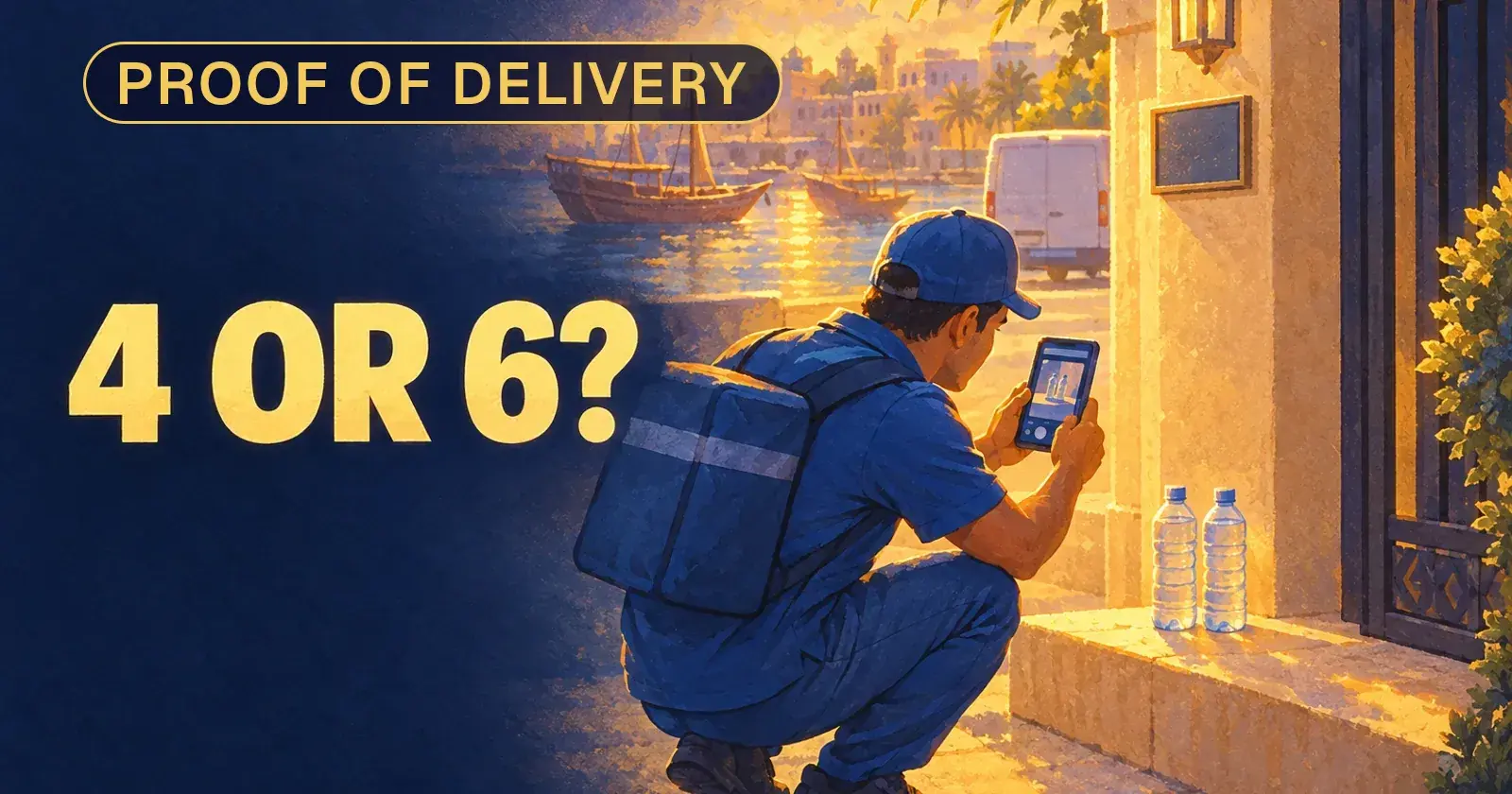
If a short-delivery complaint ends with your driver's word against the customer's, this is for you. This is not for you if nobody owns a complaint after the driver has answered it: name that person first, because no proof helps without one.
What can count as proof of delivery?
Three things, in practice: a photo taken at the door or gate, a signature from the person who received the goods, and a code the customer gives the driver. Each settles a different argument, and each costs the driver a different amount of time.
Customers keep their own proof too. One customer's review of a US water delivery company, dated 7 November 2025, says the driver was supposed to deliver six bottles and delivered four. In the customer's words, the driver "initially had the 6 being delivered until I said that I had photos and video proving otherwise." That is one consumer review from another country, not a Gulf figure. It shows the shape of the argument: a distributor with no record can lose to a customer with a doorbell camera.
Which proof settles which dispute?
Pick the proof by the dispute you actually have. List your last ten complaints and tag each one: quantity ("four, not six"), payment or coupon, no-show, or damage. The biggest tag chooses the proof.
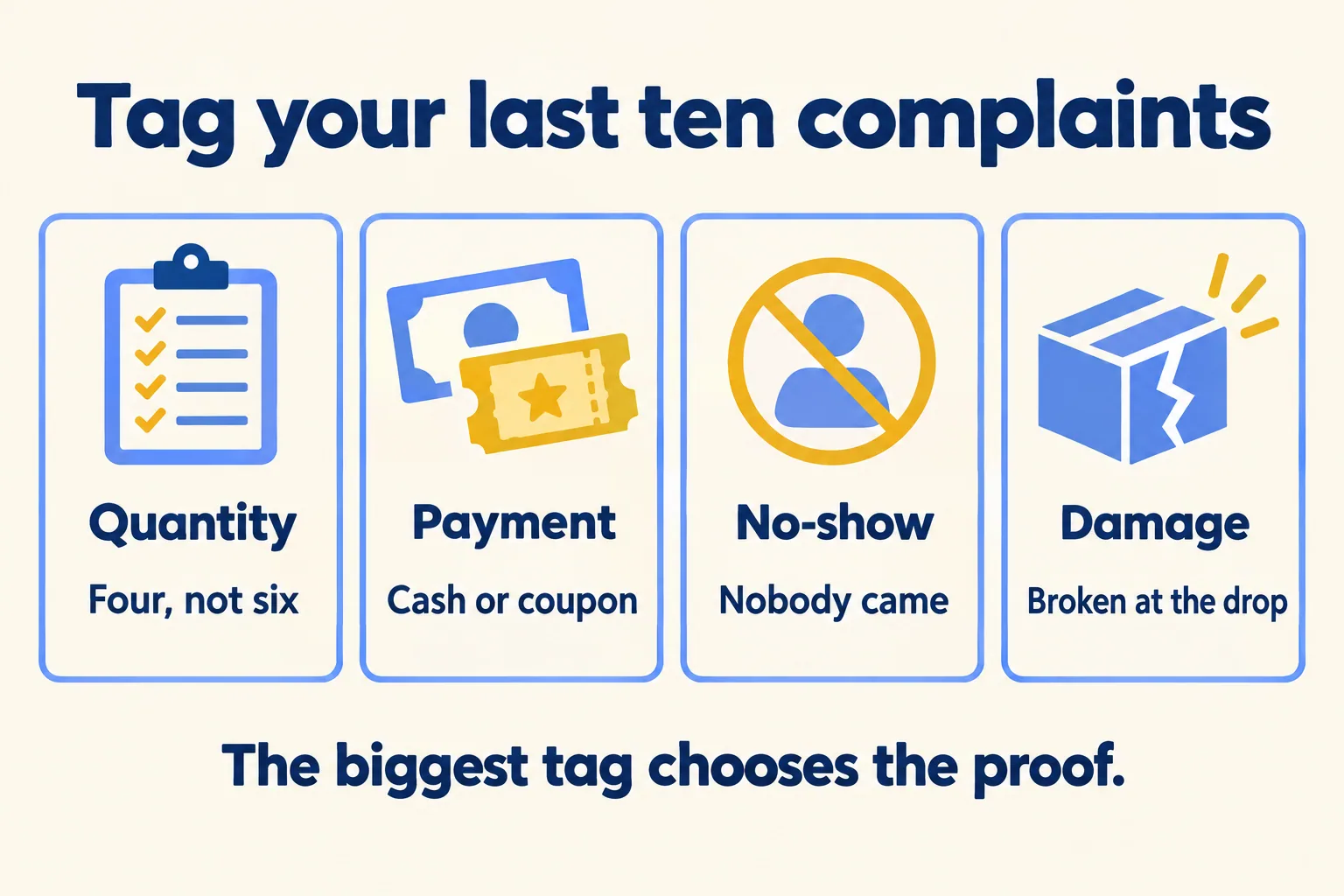
Dispute, proof and what it costs the driver
A signature proves the customer received the goods. It does not prove the cash reached your office. In one Dubai court case, our Dispatch page notes, a driver kept AED 114,966 of customer payments for two years before anyone matched the books (Khaleej Times, July 2024). A signature would not have caught that. Cash counted per driver from the day's orders would.
What does a photo have to show?
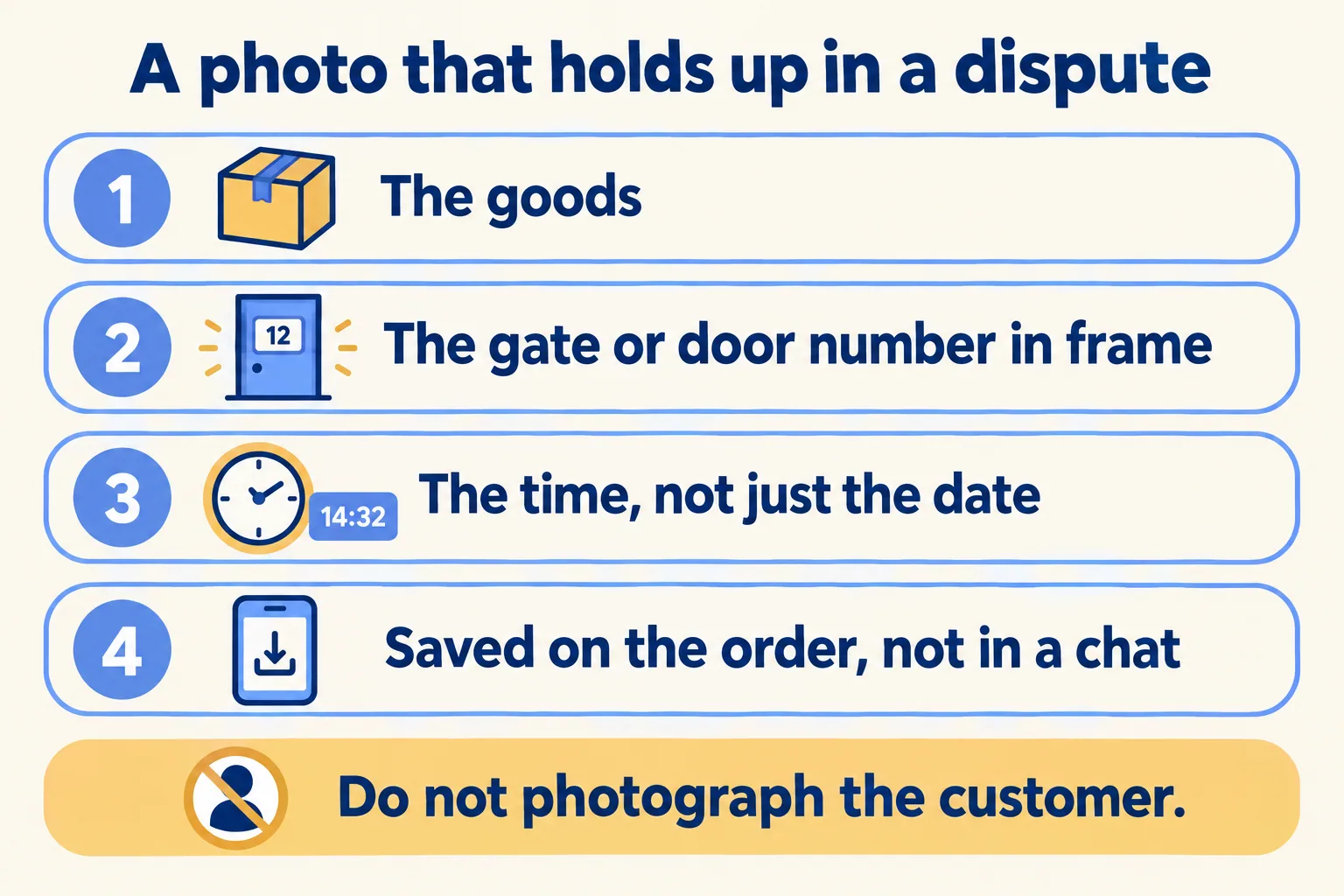
A photo is only proof if someone can use it three weeks later. Routerra, a delivery software vendor, lists what a record should hold in its guide of 20 August 2026: a photo showing the goods, the place and something that identifies the address, a timestamp rather than a date, a link to the specific order, and a record of who saved it and when. The same guide says photos kept in a driver's camera roll or a WhatsApp thread are hard to find when the dispute arrives.
A courier network's driver guidance says the same from the other side. Jitsu lists as unacceptable a photo of the box label only and a photo with no location or address. For a water distributor, translate that: a photo of six bottles on a doorstep with no gate or villa number is weaker than it looks. Tell drivers to include the number, and not to photograph the customer.
How do you pick in one afternoon?
- 01Pull the last ten complaints and tag each as quantity, payment, no-show or damage.
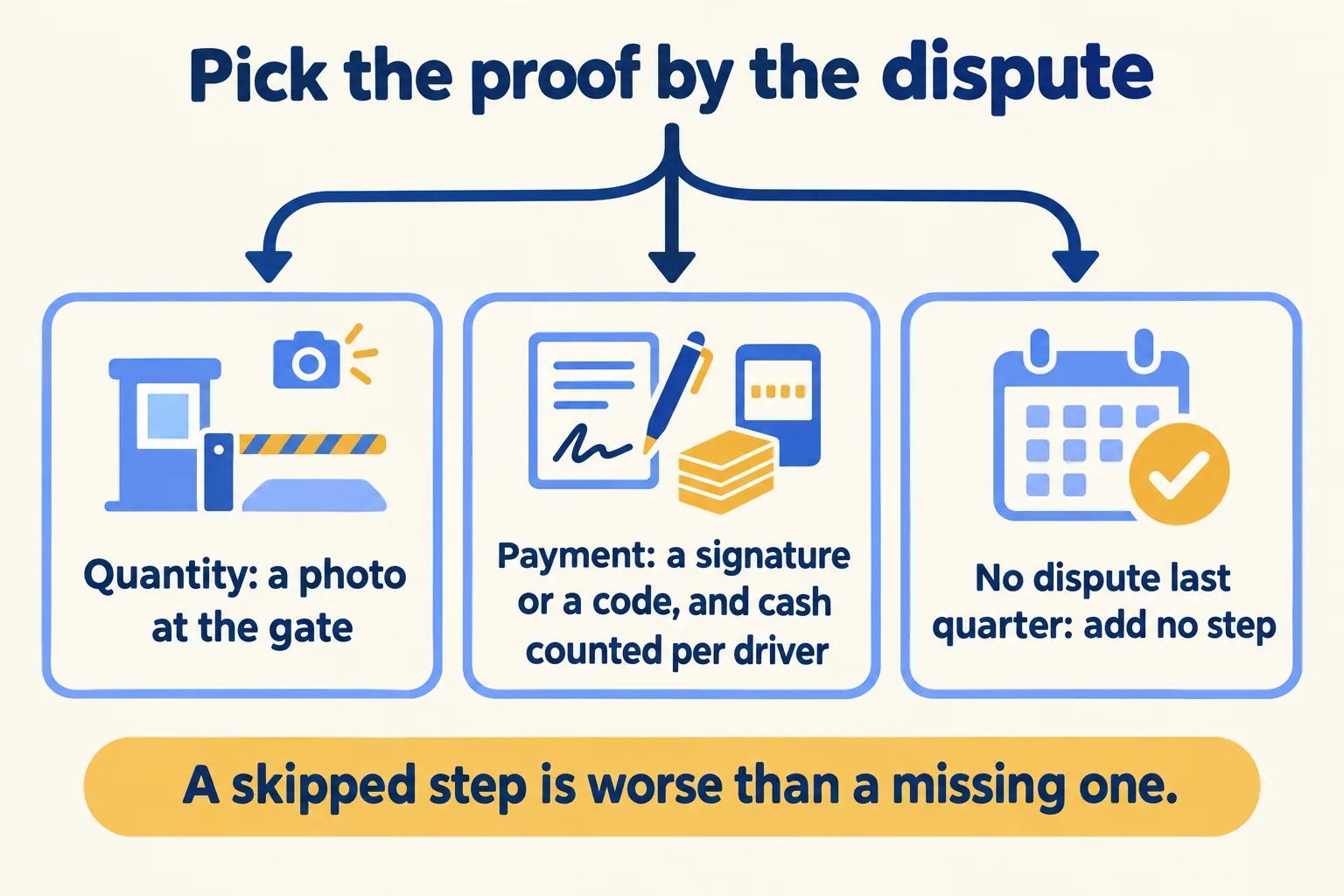
- 02Take the biggest tag and pick the one proof from the table that settles it.
- 03Run it for two weeks on one route, and tag the complaints again.
Coupons and cylinders follow the same rule. A coupon dispute is a payment dispute: record the coupon on the order and photograph it, so the book at the depot and the order agree. For gas, the photo should show the cylinder at the gate with the number in frame, and our Dispatch page ties each cylinder to a licensed van and driver. Orders that arrive on WhatsApp become a record the moment someone enters them on the board, and the driver's proof attaches to that same order, not to the chat.
If a tag is mixed, say a quantity dispute that is also about cash, start with the photo and add the nightly cash count. Do not add the signature and the code and the photo on day one. A driver with six steps at every gate skips steps, and a skipped step is worse than a missing one because it looks like a record.
At Mindcat Dispatch, the driver app asks for the photo or signature before an order can be closed, and the customer portal shows the proof. The one-time code needs an SMS provider, billed at cost. What it does not do is keep an empty-bottle or deposit ledger. If your disputes are about returned bottles and deposits, that sits outside it today.
When is no proof the right answer?
When you have had no dispute in a quarter. Then an extra step costs the driver time every day to solve a problem you do not have. Count the cash per driver each night and stop there.
The same goes for a route with a handful of regulars who know each other by name. Proof earns its place when the customer and the driver do not know each other, or when the order passes through a third person, such as a building guard or a villa's staff.
How do we decide?
Our method is called WhatsApp to dispatch board. Before we recommend any app, we ask how many drivers you run, how orders reach them today, and what your last ten complaints were. If the answer is that you have no disputes, we say stay on what you have.
For ten drivers, Mindcat Dispatch is AED/SAR 119 per driver a month for drivers 1 to 10, so AED 1,190 a month (twelve drivers: AED/SAR 59 each for the 11th and 12th, so AED 1,308), with a shared plan minimum of 3 drivers (AED/SAR 357), plus one-time setup of AED/SAR 7,500 for up to 10 drivers. WhatsApp and SMS messages, maps and card fees are billed at cost. Prices exclude 5 percent UAE VAT and 15 percent Saudi VAT. Dispatch is built on Fleetbase, licensed under AGPL-3.0.
See how a water distributor chooses between coupon books and an app, and how a distributor weighs its own riders against a courier. The couriers and delivery page covers the wider fit.
