

If you run your own delivery drivers, can see your vans on a map and still cannot say why the cash on delivery count is short, this is for you. A GPS tracker answers where the van is. Whether you need one depends on what you lose. This is not for you if your loss is fuel, speeding or a van used after hours. Then a tracker is the right buy, and you can stop here.
What does a GPS tracker tell you, and what does it miss?
It tells you about the vehicle. One UAE vendor, IOTee, lists what its trackers do on its own page: a position every 10 seconds, geofences, speed and idling alerts, driver safety scores, fuel sensors, remote engine immobilisation and more than 60 report templates. Its page says tracking starts at AED 500 per vehicle per year, with renewals of AED 400 to 600 and discounts from 10 vehicles. We read that on 13 October 2026. Prices change, so ask for the current figure in writing.
Cash collected per driver is not on that list, and neither is the order. That is not a fault. A tracker is built for the vehicle, and these are good answers to a vehicle problem. Fahim, a Saudi accounting vendor, describes the owner's version of this: the driver left with sixteen orders, returned with thirteen, and the cash is short by 120 riyals. The van could be on a map all day and that gap would still be there. The map shows where he was. It does not show what he handed over at the gate.
Which loss decides what you buy?
The one you can put a number on from last week. Match your loss to the job, and buy for that job.
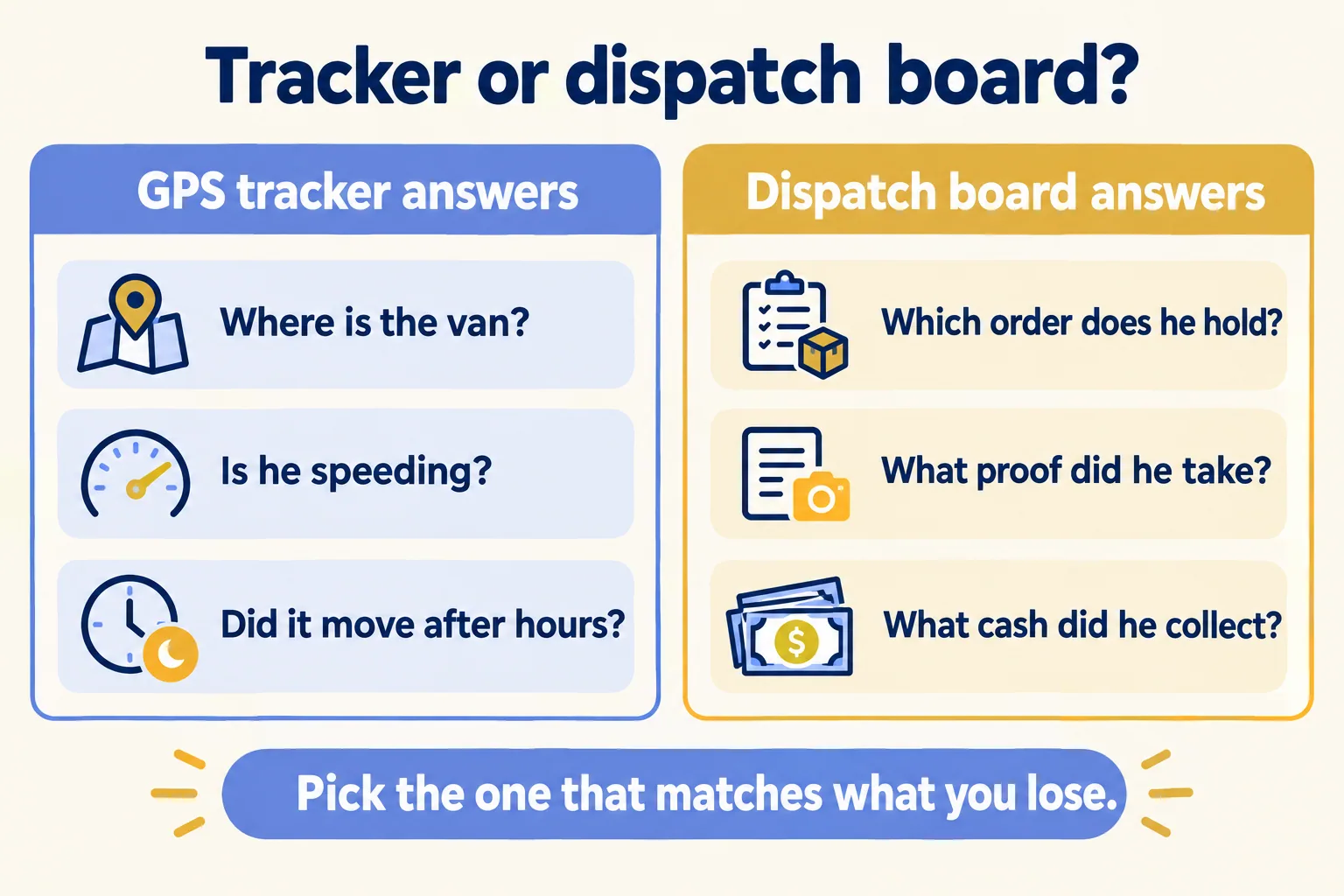
The honest test is a question, not a feature list. Ask which loss you could explain from last week's records. If you can explain the fuel but not the cash, you do not have a tracking problem.
How do you test your own fleet in one afternoon?
With three questions, answered from your own papers. They are our rule of thumb, not a study.
- 01Pick last week. How many orders went out, and for how many do you hold proof of who received them?
- 02Ask for one driver's cash total for yesterday. How long does it take to get it, and is it ready before he is back?
- 03Name the last shortage you could not explain. Was it a cash gap, a missing order, or fuel?
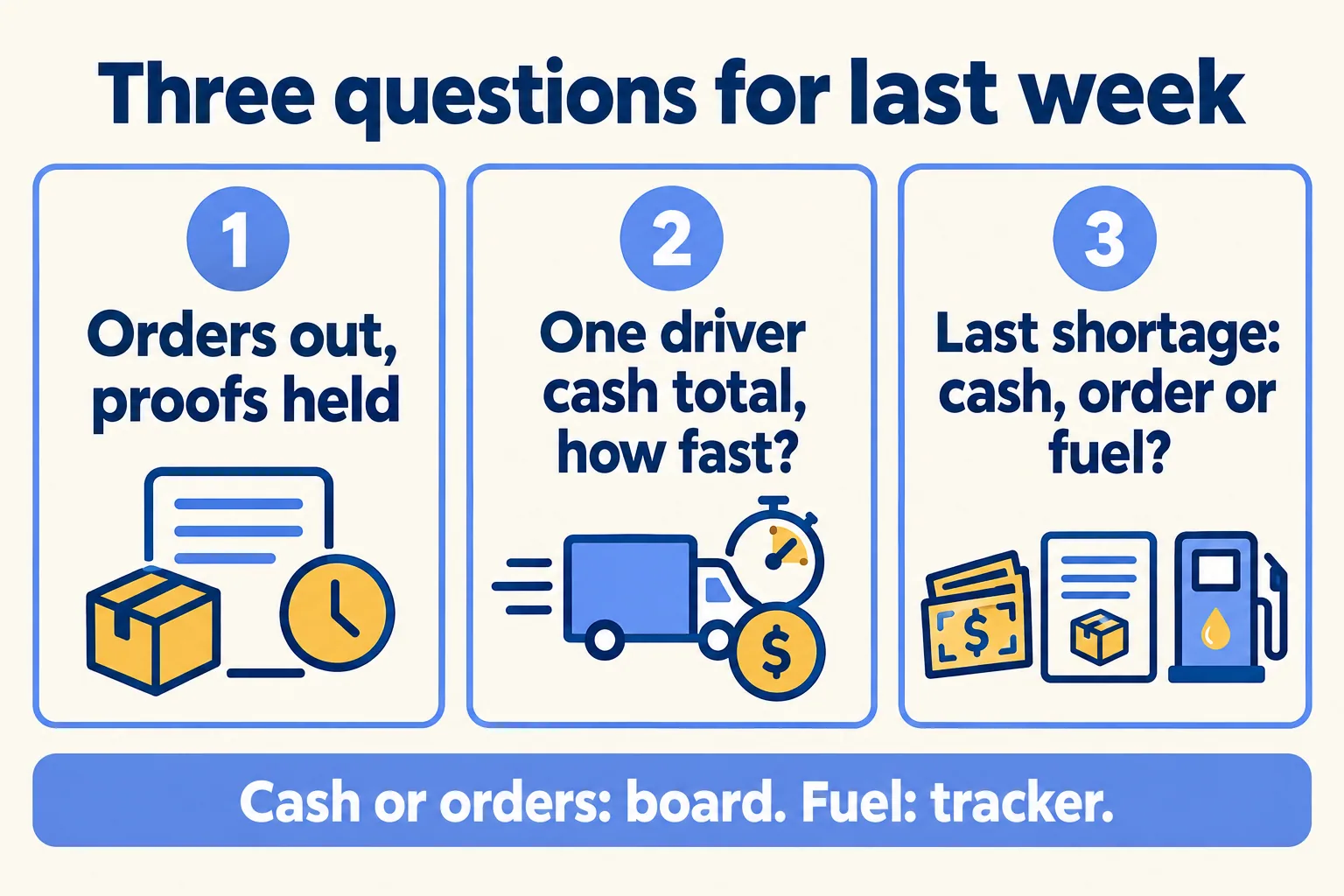
Cash and orders in the answers point to a dispatch board. Fuel points to a tracker. A shortage you cannot name points to neither yet: start by writing down what each driver took out and what came back.
When do you need neither?
With three to five drivers and no cash problem, you may not. Fahim, a Saudi accounting vendor, wrote on 6 September 2026 that a delivery business "does not need a tracking app, it needs proof for every handover and an open account per driver." It suggests one short, fixed WhatsApp message per event: assigned, on the way, delivered with the cash amount, failed with a reason, returned, and shift close. Fahim sells software too, so read it as a method and not as a result.
The six messages, written out: "Order 1042 to Saad", "1042 on the way", "1042 delivered cash 185", "1042 no answer after two tries", "1042 returned two items", "Saad shift handover".
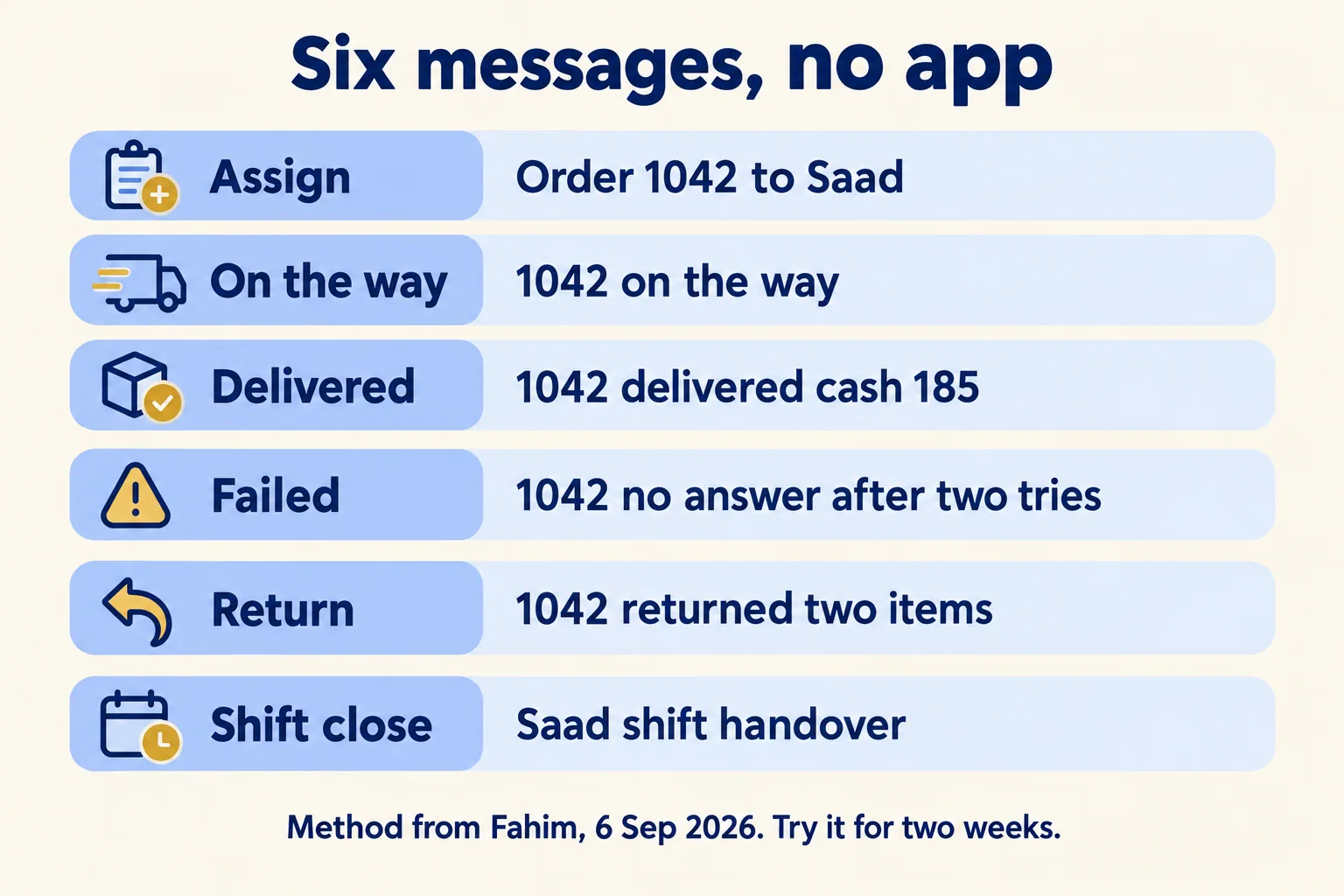
You can try that for two weeks at no software cost. Charge each cash order to the driver, credit what he hands in, and close the shift every day. If the shortfall disappears, you were short of discipline and not of software. If it stays, the cost is now a number you can compare with a dispatch board.
What changes for your dispatcher and drivers?
On our page, the dispatcher keeps WhatsApp and phone orders on one board instead of two phones and a notebook. The driver gets the day's stops on a phone app, with navigation, and the app asks for a photo, signature or code before an order can be closed when proof is required. The driver records the cash on the order. Finance reads each driver's total from the day's orders. The same board serves couriers and delivery firms and retail and e-commerce shops with their own riders. The customer gets a tracking link, which we send by SMS or WhatsApp once your own account is connected during setup. That connection is part of setup, not something that works on day one.
Our page describes the water and gas version, for water and cylinder distributors, as a before and after. Before: coupon disputes at the villa gate and a cash bag counted at 10 pm. After: the 06:00 route is planned by district, the driver logs bottles, cash or coupons with a photo at each gate, and each cylinder is tied to a licensed van and driver. That is the page's own illustration, not a client result.
Two things our page does not say, so ask before you rely on them: how the board works with a tracker you already own, and what the driver app does with no signal. Ask us both in writing.
What would a dispatch board cost you?
Here is what our page says today for Mindcat Dispatch. It is AED or SAR 119 per driver a month for the first 10 drivers on the shared plan, which we host in the UAE. The plan has a minimum of 3 drivers, so AED 357 a month. Dispatchers, admins and finance users are free. Five drivers come to AED 595 a month and ten to AED 1,190, by that arithmetic. Setup is a one-time AED or SAR 7,500 up to 10 drivers, and it is done with us. Above 10 drivers the page drops the price to AED or SAR 59 per driver for drivers 11 to 50, with setup at AED or SAR 14,900 for 11 to 50. There is no self-serve start.
WhatsApp and SMS messages, Google Maps and payment gateway fees are billed at cost, outside the driver price. Prices exclude 5 percent UAE VAT and 15 percent Saudi VAT. Compare that with the size of your shortage, not with a tracker: they do different jobs.
What happens in the first morning?
We have been a Salesforce consulting partner since 2010 and we host Dispatch in the UAE. We spend one morning with your dispatcher. We map how orders, drivers and cash move today, in Arabic or English. After that you get a written plan, the go-live date and the monthly price. We call it WhatsApp to dispatch board. If your answer from the three questions is fuel, we would rather tell you to buy a tracker. If it is cash or orders, tell us your fleet size and we reply with the plan and the price.
