

If your holiday home operator has told you it is stopping, and your bookings, permit and guest list sit in its accounts, this is for you. This is not for you if your licensed operator is staying open: keep the operator and skip to the cost section.
What happened, and which date applies to you?
A Dubai operator, Silkhaus, is closing its holiday-home business. Two dates are in the news, and they are different. FWDstart reported on 27 October 2026 that owners had received notices ending their management agreements on 11 November, and that the operator's own site would not take bookings beyond that day. Skift reported on 30 October that the company said on LinkedIn it will stop operating at the end of November 2026.
Read your own notice for your date. FWDstart could not verify the identity of the owners who posted about the notices, and Skift wrote that guests with existing bookings and owners on the platform are left without clear answers. We name the company only as the dated news. The rule below applies to any operator, closing or not.
Which three records must sit in your hands?
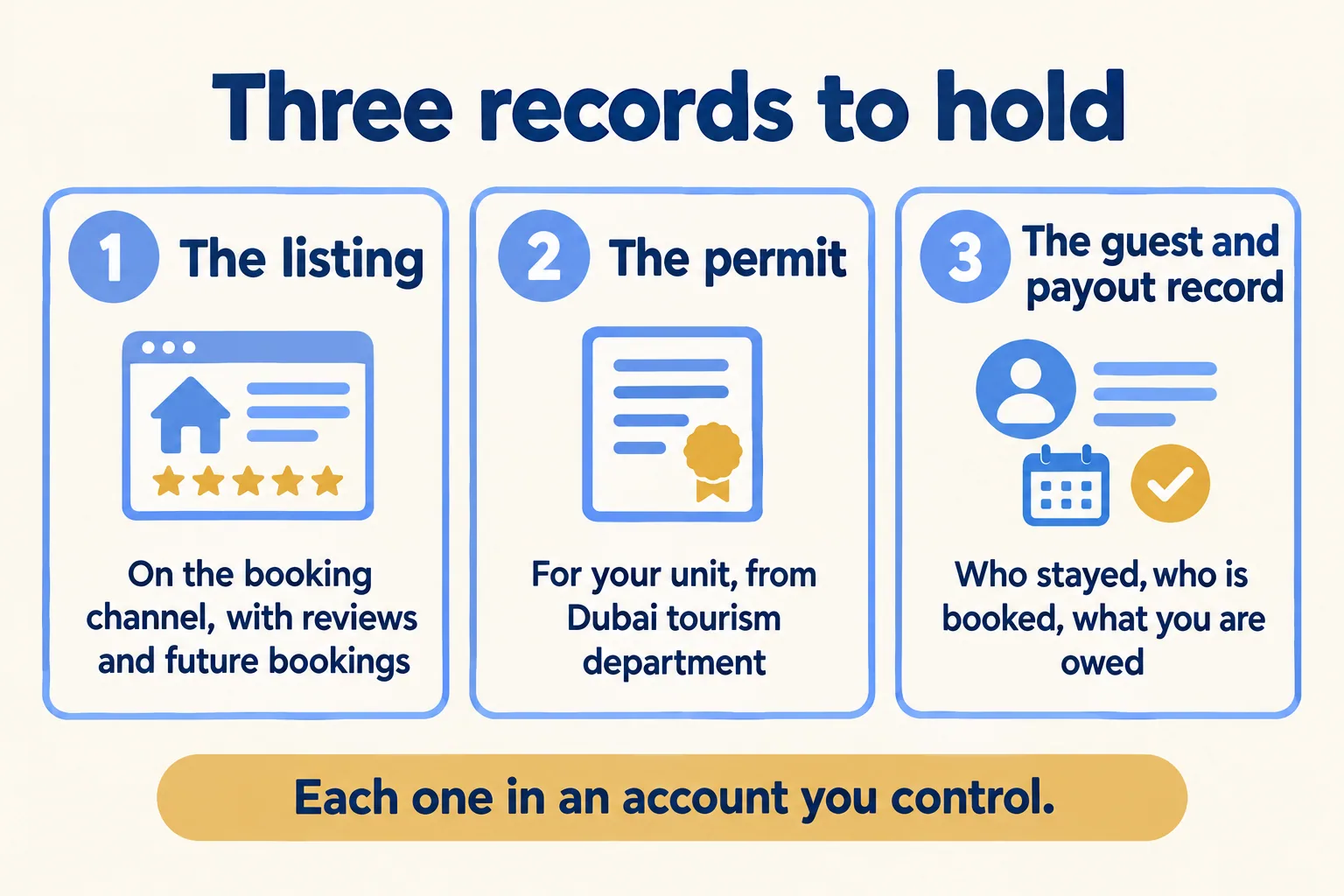
Here "operator" means the company that lists and runs your unit, and a "co-host" is an operator added to a listing that stays on your own account. Whoever runs your unit, three records should sit in accounts you control.
- The listing on the booking channel, with its reviews and its future bookings.
- The permit for your unit, which Dubai's tourism department issues.
- The guest and payout record: who stayed, who is booked, and what you are owed.
The permit is a government document about your unit, not about the operator. Dubai's Administrative Resolution No. 1 of 2020 defines a permit as "a document issued by the DTCM stating that the DTCM approves that a furnished real property unit be designated as a Holiday Home". It defines the operator's licence as a separate document. An application asks for the passport or Emirates ID "of the owner or tenant" and proof that the applicant has the right to dispose of the unit. DTCM is the name the 2020 text uses for the body now called the Department of Economy and Tourism.
One Dubai operator's guide (updated 23 October 2026) adds that a permit managed through your operator was linked to your contract with them. That is an operator's view, not the resolution's text, so ask the department about your own unit.
How do you check each one this week?
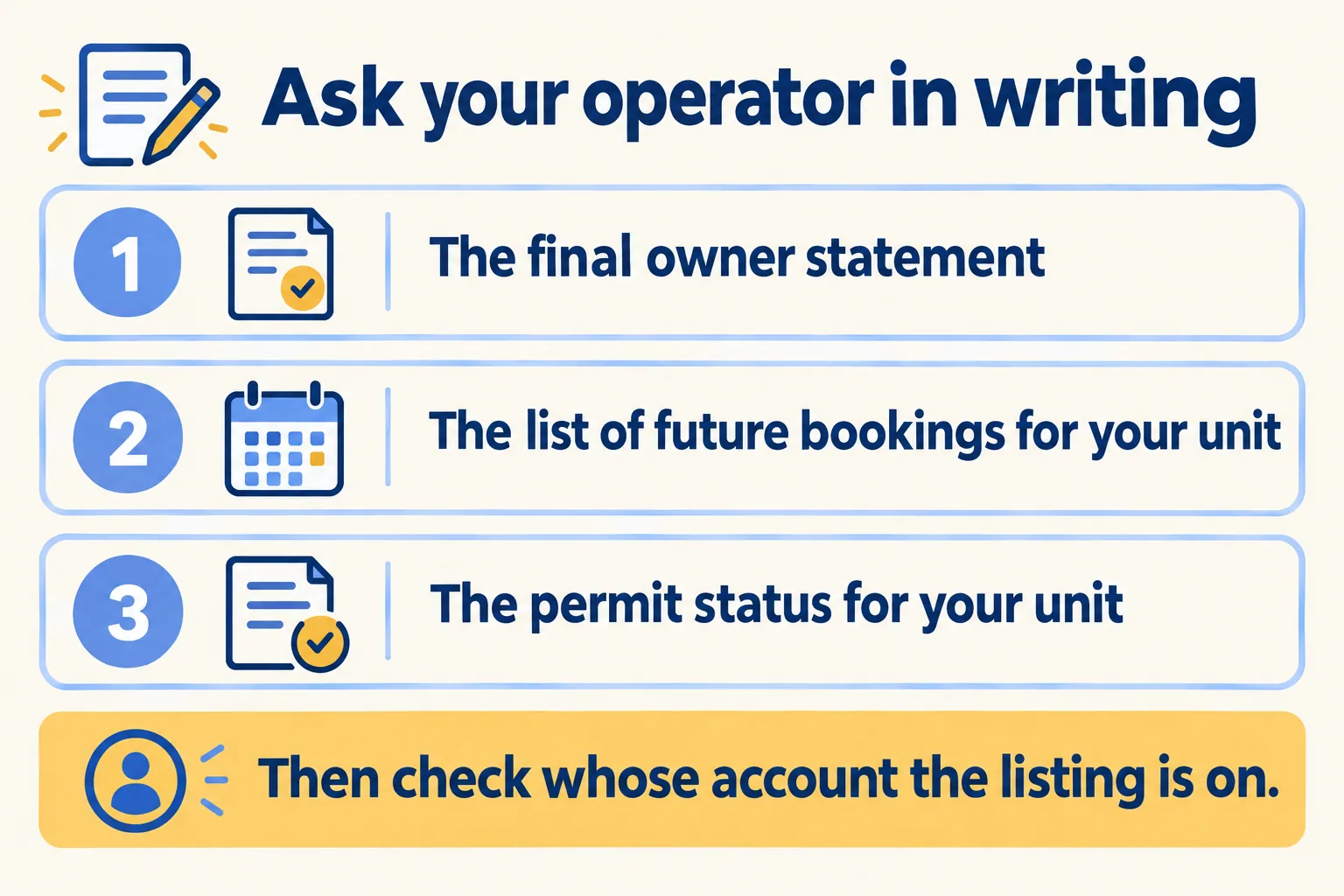
Ask your operator for three things in writing: the final owner statement (revenue, expenses and what is owed to you to the last day), the list of confirmed future bookings for your unit, and the status of your unit's permit. A competing manager's page lists the same three, plus the furniture position if the operator furnished the unit. That page sells management, so read it as a checklist, not as advice to move.
Then ask one question of every listing: whose account is it on? The Dubai operator's guide says bookings made on the operator's Airbnb or Booking.com account belong to that account, and are usually cancelled by the platform when the operator stops trading. If the listing sits on your own account with the operator as co-host, you keep the listing, its reviews and its bookings. That is one operator's account of how channels behave, so confirm it on the channel's help page for your listing.
- 01Ask in writing for the final owner statement, the future bookings list and the permit status.
- 02Open the channel and check whose account the listing is on; if it is the operator's, ask for a guest list you can export.
- 03Ask the tourism department and a UAE lawyer about your unit's permit and your contract before you sign with anyone new.
Also ask what happens to guests already booked and to your deposit and any cash owed, and where guest chats and arrival instructions live. This is not legal advice. Your contract, your permit and your deposit are between you, the operator and the department.
What does it cost to run 2 to 5 units yourself?
Run the sums before you buy any tool. Our own line, from the Stays page today: AED/SAR 20 per bookable unit a month for units 1 to 20, with a shared monthly minimum of AED/SAR 490 that covers up to 27 units. Five units at 20 would be AED 100, but the minimum applies. So five units pay AED 490 a month, AED 5,880 a year, plus one-time setup of AED/SAR 3,900 for up to 20 units. The arithmetic is ours.
A manager's published share is a different line. Homevy's page states a flat 20 percent with no onboarding fee and monthly payouts. That is one competitor's claim, and it is not a quote for your unit.
Two ways to pay, for 2 to 5 units
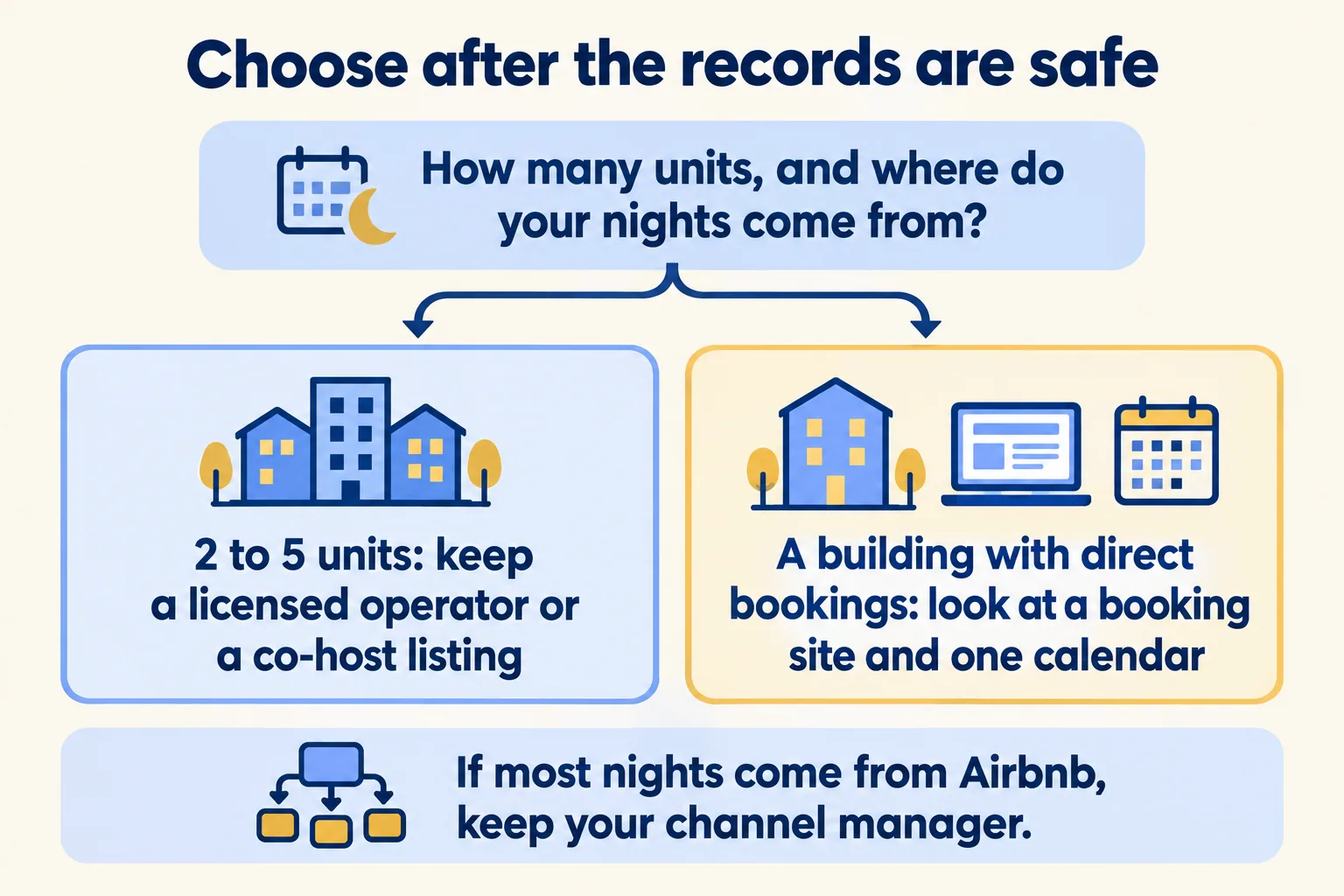
For 2 to 5 units, the software line is larger than the units justify. The minimum stops binding only at 25 units (25 times 20 is 500). So we say "not yet": keep a licensed operator, or a co-host listing, and put your effort into the three records.
When does a booking site of your own pay?
When direct bookings and one calendar save you more than the monthly minimum. That usually means furnished units in a building or a spread of units you run yourself, and a guest base that books on your own site as well as through channels.
Be clear about what Stays does not do. It does not sync with Airbnb or Booking.com today, so if most of your nights come from them, you keep your channel manager. It does not register guests in the Dubai holiday home system, and your desk keeps doing that as before. The Tourism Dirham is its own line per bedroom per night, set during setup.
Hotel apartment buildings are the closer fit for a booking site; see our hotel apartments page. A separate job, checking an advertising permit before a brochure goes out, is in our Trakheesi check post.
How do we decide?
Our method is called Every unit, every night. We ask how many units you run, where the nights come from today, and whose accounts hold the listing, the permit and the guest record. Then we tell you which side of the line you are on, including when the answer is to keep your operator or your channel manager.
Prices exclude 5 percent UAE VAT and 15 percent Saudi VAT, and card gateway fees go to your own gateway. See what Mindcat Stays covers, and what it does not, on its page.
