

If calls after 7 pm go to voicemail and come back as complaints, this is for you. It is not for businesses whose calls are mostly disputes, and it is not for teams with no phone log to count.
Why do three Dubai call centre quotes look nothing alike?
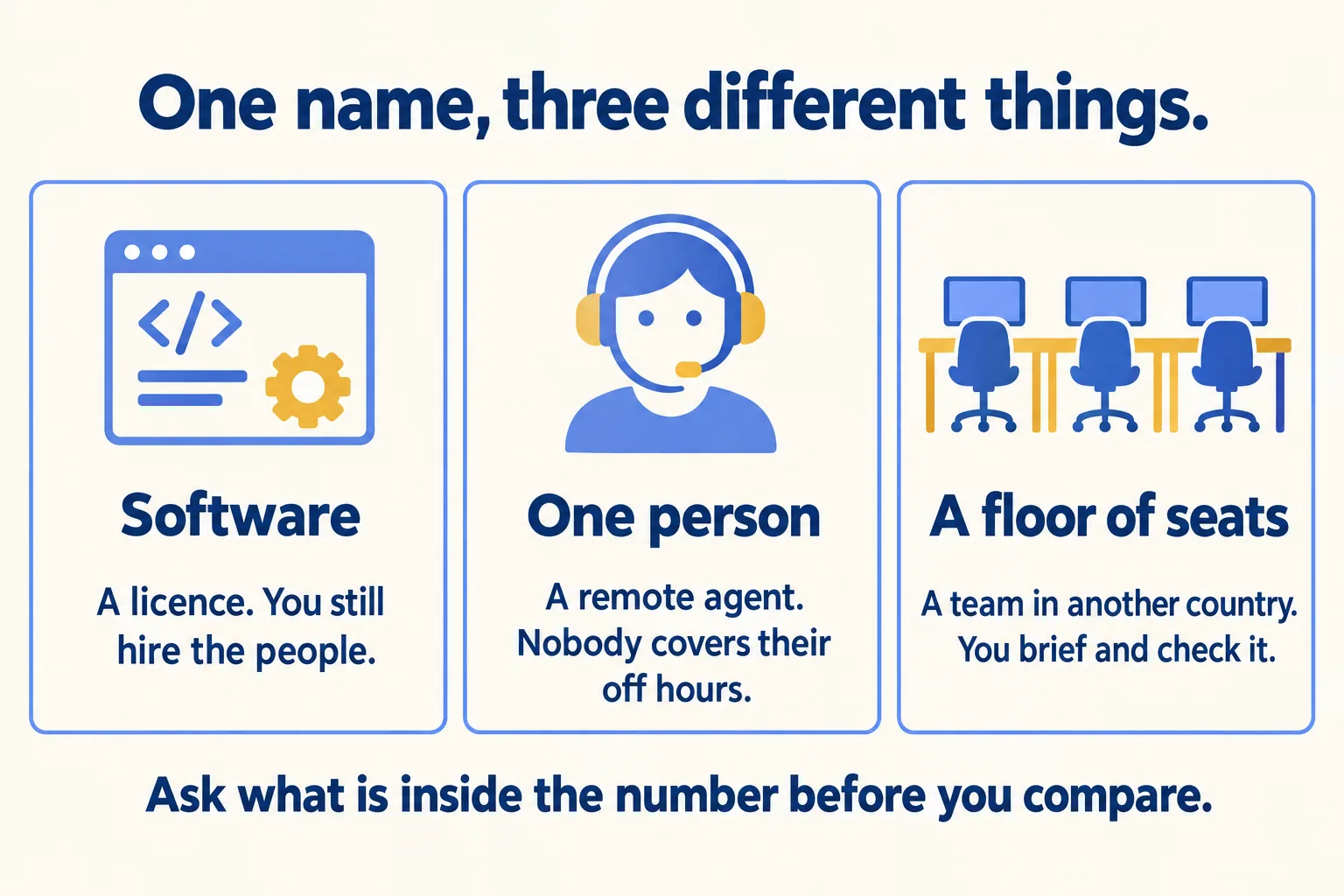
Because "call centre" in Dubai names three different things, and a buyer who compares the prices is comparing a tool, a person and a floor.
Search for the term and the first page is job listings, directories and provider pages. None asks the question that comes first: does this business need a centre at all? Here is what three providers state on their own pages, read on 10 November 2026.
Source: the three provider pages, read 10 November 2026: TechBee, Gram Pacific, ScaleDesk Gulf. These are the providers' list prices, not ours, and they change.
Our rule: do not compare quotes until you know which of the three your missed calls need. That takes a week of your own call log, not a vendor demo.
What does a week of your call log say?
It tells you whether you have one problem or several. Take seven days of missed and abandoned calls from your phone system, mobile bill or voicemail inbox and mark each one three ways.
- 01Hour. Which calls arrive after 7 pm, at lunch, on Fridays, on weekends? A cluster at fixed hours is a rota or a night-cover problem.
- 02Language. Arabic, English or another language, and which Arabic. Mark Gulf Arabic separately from other dialects.
- 03Outcome. What did the caller want? Book a slot, ask where an order is, ask a price, complain, chase a payment? Group them in plain words.
If you cannot say what callers wanted, listen to ten voicemails and write one line each. Most teams find that two or three reasons cover most of the calls. A team that finds twenty reasons has a different problem from a team that finds two.
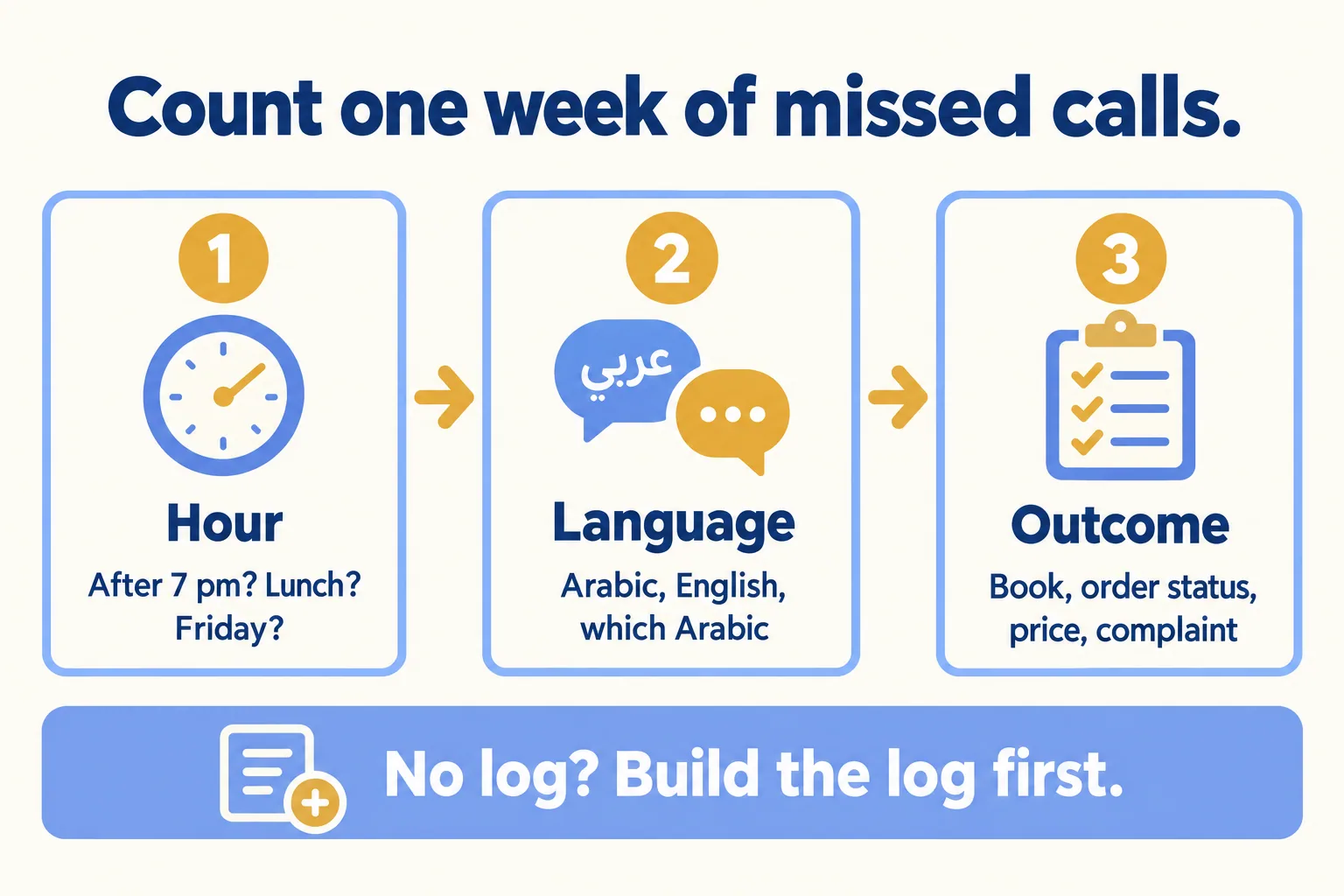
If there is no log at all, start there. A phone line that records nothing cannot be improved by any of the three options, and no provider can size the cover without it.

Which fix does the count point to?
The count points to one of three fixes. This is our decision rule, so you can argue with it.
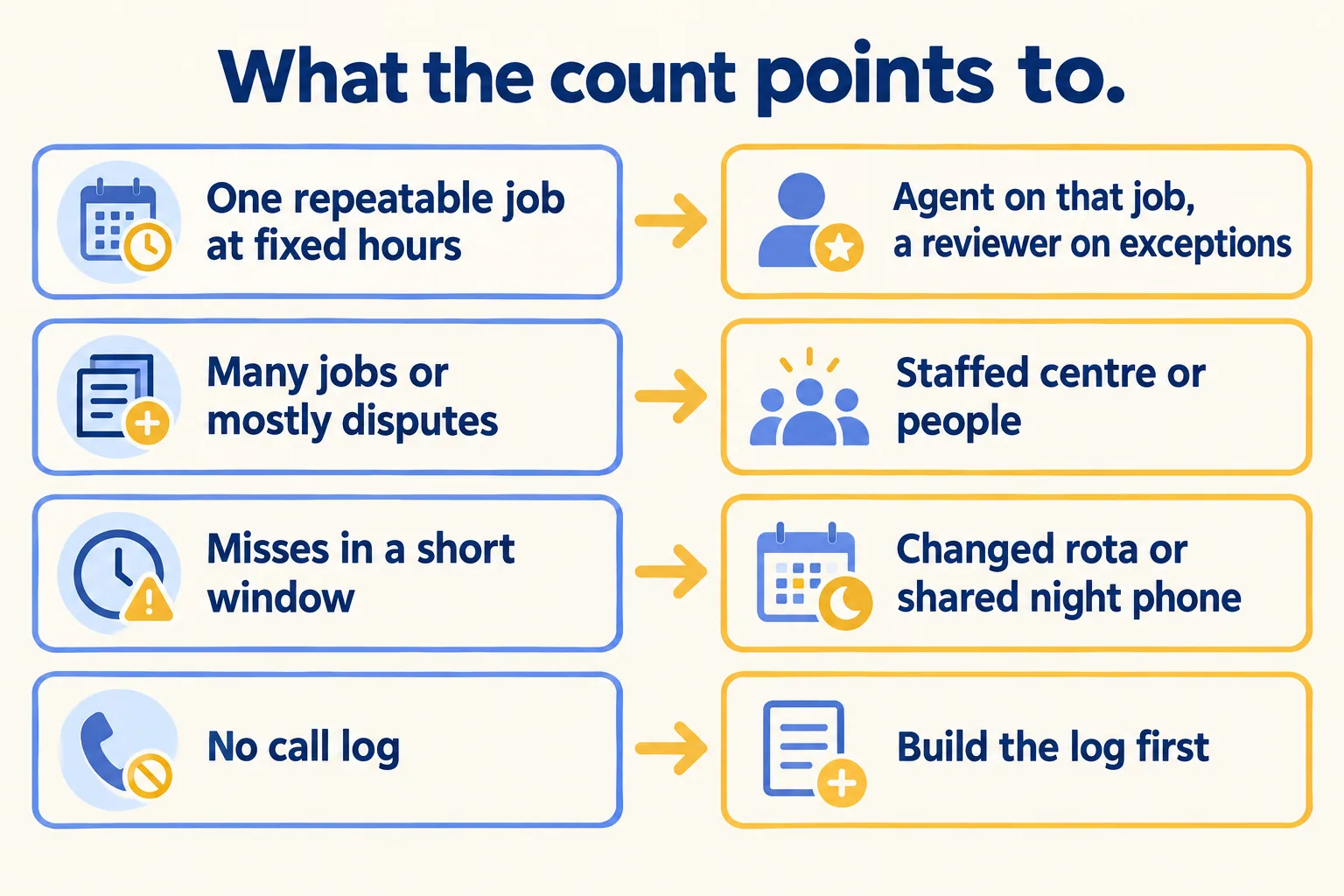
What the call count points to
By agent we mean software that answers the call, does the next step in your system (books the slot, reads the order status, writes the note) and passes the odd call to a named person. A repeatable job has a fixed set of questions, one correct answer for each, and a record to write at the end. A booking, a delivery status and an opening-hours question qualify. A caller asking why they were charged twice does not, because the right answer depends on one customer.
Here is one step, before and after, as an example and not a client case. Before: a caller rings at 8 pm to move a viewing or ask where an order is, reaches voicemail, and the team calls back next morning to a customer who has already booked elsewhere. After: the call is answered, the slot is moved or the status read out, the record is updated, and the team sees a one-line summary at 8 am. Anything else goes to a person with the summary attached.
The agent never replaces the person who handles the calls that need judgment. It takes the repeatable job and hands the rest over with a summary. If the log shows mostly disputes, the agent has little to take, and people are the answer.
Mixing these up is what makes call centre quotes disappointing. A business with one repeatable job buys a floor of seats and pays for twenty reasons it does not have. A business with twenty reasons buys software and finds nobody to answer.
How is an agent tested before it answers a call?
Against your own recorded calls, with a reviewer who speaks the language, before it says a word to a customer. At Mindcat, we call it Spec, shadow, gate.
The spec is week one: the job on one page: the inputs, what the agent writes, its limit, who approves, and what it may never do. The shadow run comes next. The agent runs beside the person and writes nothing, and a reviewer marks its answers against what the person did on a sample of your recorded calls (we start with 50). Only then does it go live, with writes behind a human approval. The gate loosens only where the shadow run earned it.
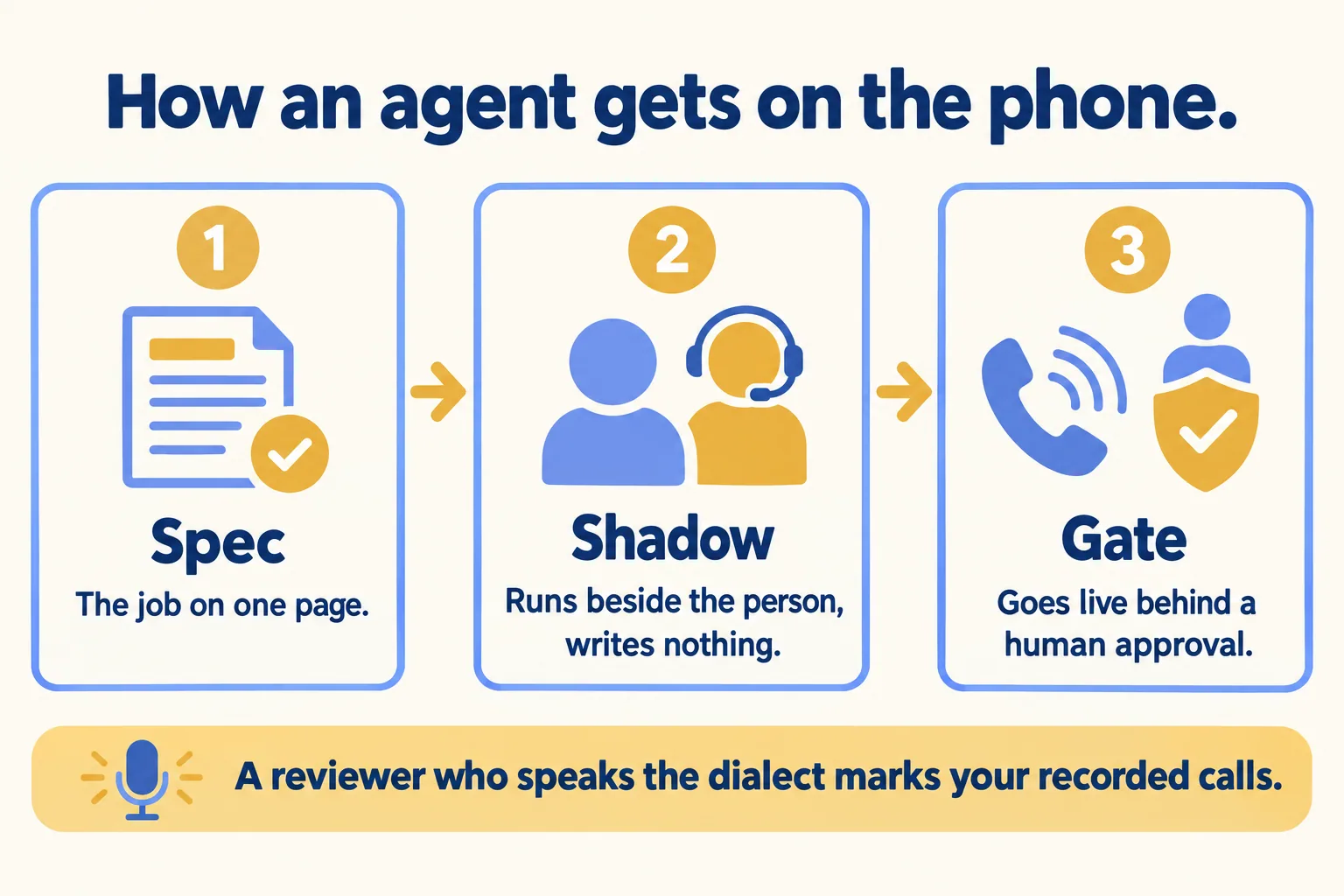
Dialect is the check that matters most in this market. ScaleDesk Gulf's own page says Egyptian Arabic is "the most widely understood dialect" in the region and that, where Gulf dialect is a must, it sources Gulf-dialect speakers "at a higher rate". Dialect is a cost and a risk for a human centre too. So test every option, whether a person or an agent, on your own recorded Gulf calls, and let a reviewer who speaks the dialect do the marking.
If your customers mostly write on WhatsApp rather than ring, the same count applies to messages, and the fix is a different offer: see automate WhatsApp in this order and our WhatsApp page.
The rules differ by direction. This post covers inbound calls. For calls your team places, the telemarketing rules apply first, and our post on outbound calls and the registry sets them out.
What does it cost to find out?
The count costs you a week of a log you already have. The assessment from us is free: a short read of your setup and a written note on which of the three fixes the calls point to.
If you go ahead with an agent, the first build week is a fixed AED/SAR 14,900 (about USD 4,050), credited in full when you sign the build within 60 days. It ends with a written scope and a date. Telephony and model use are billed at cost. We do not set that price against a person's salary or a centre's seat rate. The comparison that matters is what the missed calls cost you in lost bookings and repeat chasing, and you have that number after the count.
When are we the wrong answer?
When your calls are mostly disputes or sensitive cases, a person should answer them, and we will say so. When the misses sit in a two-hour window, a changed rota or a shared night phone costs less than anything above. When the work is a software factory with a named delivery date, we are the wrong partner. And when there is no log and no one who owns the phone line, start with those.
If the count shows one job at fixed hours, name the job and send us a week of the log. We write back with which of the three fixes it points to, and what a first build week would cover.
