
If the same twelve messages arrive every day and a person types each answer, this is for you. It is not for teams that already answer in minutes, day and night, and it is not for teams with nobody who owns the lead after the first reply.
Why does the order matter?
Because the four things people call "WhatsApp automation" carry four different risks, and most teams start with the riskiest.
A greeting cannot say anything wrong. A fixed answer says only what you wrote. A booking changes a record in your system. An outbound message reaches people who did not just write to you. If you start at the bottom of that list, your first mistake is the expensive one.
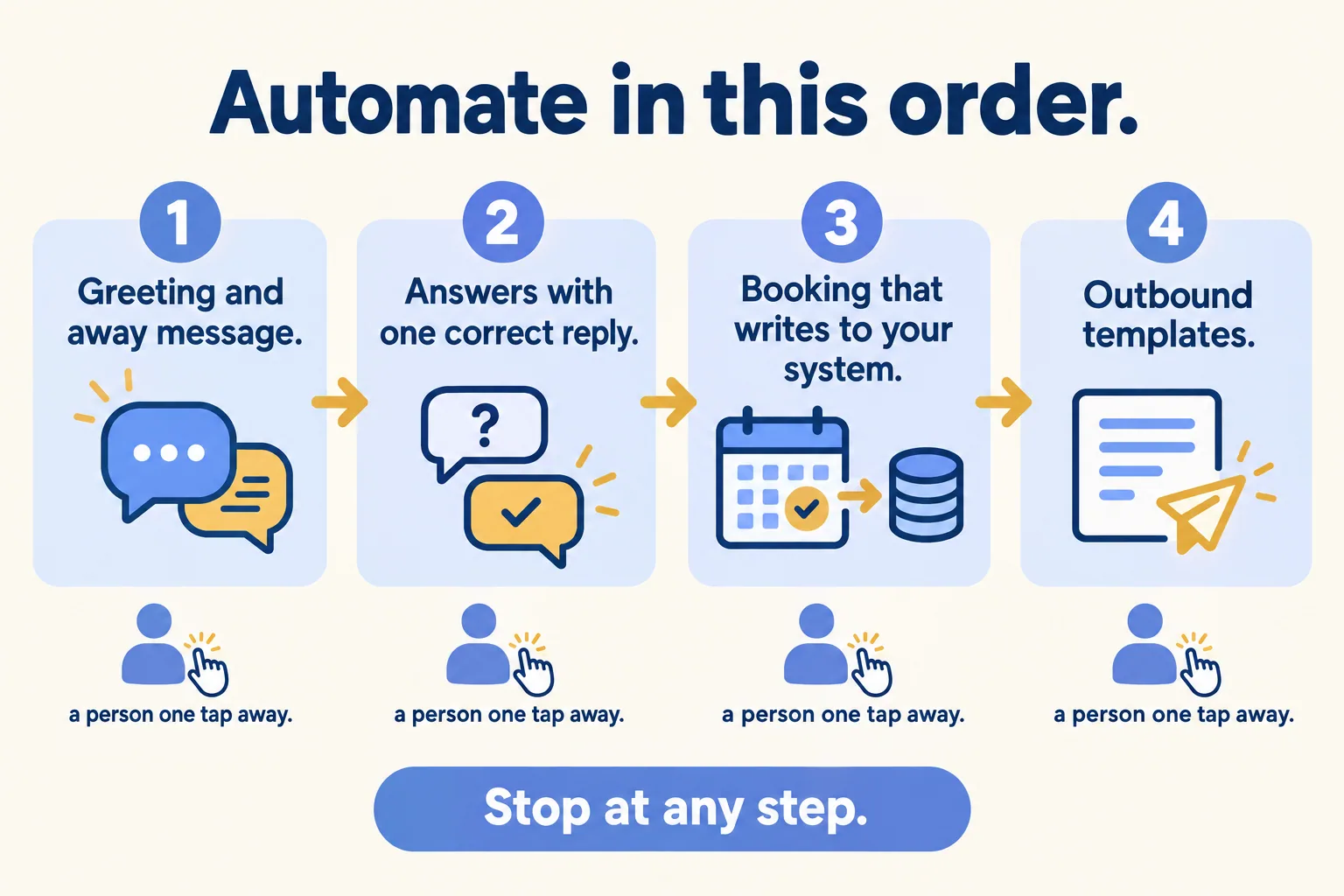
Our rule, so you can argue with it. Automate in this order: the greeting and away message, then the answers that have one correct reply, then the booking that writes to a system, and only then outbound templates. Every step keeps a person one tap away. You can stop at any step, and a team that stops at step two has already removed most of the typing.
What is the order?
Step 1: the greeting and the away message. The first reply goes out the moment someone writes, and it says when a person will answer. You wrote every word, so there is nothing to check. Meta's page for the WhatsApp Business app describes it as greeting people "the moment they start a conversation" and responding "even when you're away."
Step 2: the answers with one correct reply. Hours, location, what is included, how to book. Write each so it fits in one message. This is the list from our earlier post on the ten questions. If you cannot write the list yet, read 200 real chats first.
Step 3: the booking that writes to a system. A slot, a viewing, a delivery time. This step reads your calendar or CRM and writes the result back, so it needs a named owner and a person one tap away when the system and the customer disagree. This is where a chatbot becomes an agent, and where the build and the price change.
Step 4: outbound templates. Reminders and follow-ups sent to people who did not just write. Last, because it reaches customers on your initiative and Meta bills it by category and market.
Which step is free, and which is not?
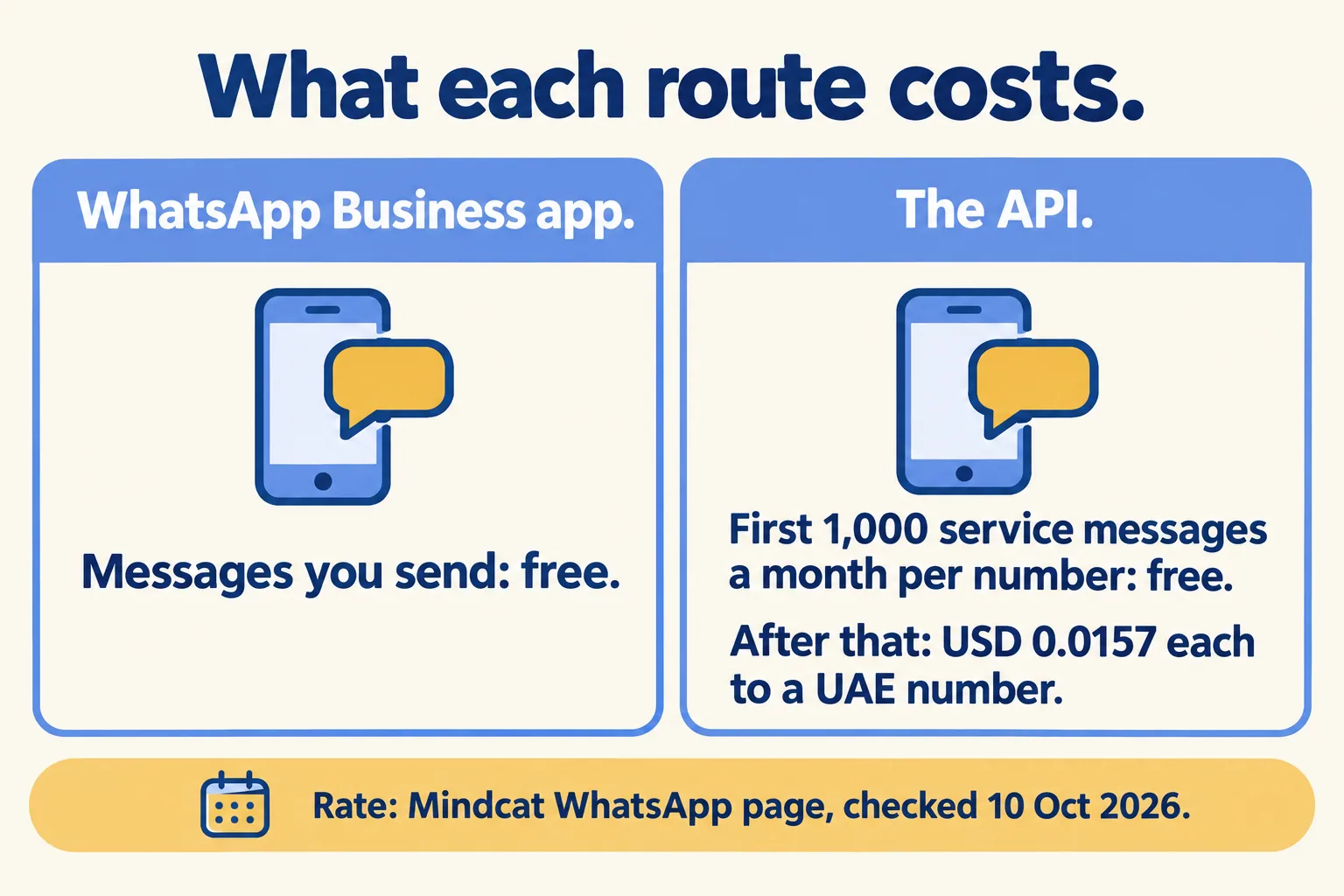
Steps 1 and 2 can run free if the number stays on the WhatsApp Business app. Meta's pricing page says messages sent from the app "will continue to be free." The catch is who answers: the app lives on one phone, and a shared desk or a system needs the API. See phone or desk for that choice.
On the API, Meta's pricing page says each business phone number has "one free tier of 1,000 delivered service messages per month" from 1 October 2026. A reply inside the 24-hour window is a service message, whether a person or a program wrote it. After the free tier our WhatsApp page shows USD 0.0157 a reply to a UAE number (checked 10 October 2026). Utility and authentication messages follow Meta's published rates by market, and Meta's Business Agent is a separate charge of USD 2.00 per million tokens, which Meta puts at about 4 to 5 cents a message.
One thing to plan for. Meta's developer page on onboarding Business app users lists quick replies, labels, and greeting and away messages as "not supported" on the Cloud API. They keep working in the app. If you move to the API, you build step 1 again in the system that answers. Do it on purpose, in that order.
What stays with a person?
Anything where the right answer depends on judgement about one customer: a refund, a complaint, a medical or legal question, a price you have not quoted before. The agent hands these over with the chat attached, and a person replies from the same number.
Meta also draws lines of its own. Its Business Agent is not offered to health, finance or government businesses, as our WhatsApp page states. If you are in one of those, a custom build with a handover is the route, and the page on Meta's agent against a custom one sets out the difference.
What does the first job cost?
We do one job at a time. We name the job, the number and the system, run it on your real messages with a person one tap away, and quote it in writing. At Mindcat, we call it Answer, book and write it down.
From our WhatsApp page: from AED/SAR 25,000 for answers and a handover to a person (about 1 week), from AED/SAR 75,000 when it connects to a system (3 to 4 weeks), from AED/SAR 120,000 when it also takes actions and follows up (5 to 6 weeks). Meta's fees and model calls are extra, billed at cost. Use the WhatsApp cost calculator to put your own volume against Meta's rates.
When are we the wrong answer?
When one person answers every chat and the typing is not the problem, stay on the free app. When your team already replies in minutes at all hours, there is little to automate. When nobody owns a lead after the first reply, fix that before any step above.
If the twelve messages are real and the order above fits, send us the number, the system and the twelve questions. We reply with the written assessment: which step to build first, and what Meta would charge for your volume.
