

If your agent writes code, or your customers upload scripts, and something has to run them away from production, this is for you. Vercel Sandbox gives each task its own throwaway microVM. Whether that is cheap depends less on the CPU price than on how long you leave the box open. It is not for an agent that only reads and writes records: with no code to run, you need no sandbox.
What are you paying for when an agent runs code?
Five meters, of which two matter for most agents. Vercel describes the product as "an on-demand, isolated Linux microVM", each one a Firecracker microVM with its own kernel. On Pro and Enterprise these are the rates on 16 October 2026, at the default iad1 region:
Rates for CPU, memory, transfer and drives vary by region, so price the region you will use, not iad1. Memory is billed in one-minute minimum increments, so even a ten-second check pays for a minute of memory. Creations and snapshot storage cost the same everywhere. All Pro usage first draws on the plan's $20 monthly credit.
This post is about the bill. What a sandbox stops, and what it leaves to policy, is in our post on agent sandbox policy.
Why is memory most of the bill?
Because CPU stops counting while your code waits, and memory does not. Vercel's docs say time spent waiting on I/O, "network requests, database queries, or AI model calls", does not count toward Active CPU. Memory is the RAM you provisioned, 2 GB per vCPU, multiplied by the time the sandbox runs, in one-minute minimum increments.
Vercel's own example shows the effect. An "AI code validation" task of 5 minutes on 2 vCPUs and 4 GB, at 10 percent CPU use, costs $0.0021 in CPU and $0.0071 in memory: $0.0092 in total. Memory is about three quarters of it, at that 10 percent CPU use. The split moves with your workload: our arithmetic on the same box kept 60 percent busy gives about $0.0128 in CPU against the same $0.0071 in memory. Measure your own task before you pick which knob to turn.
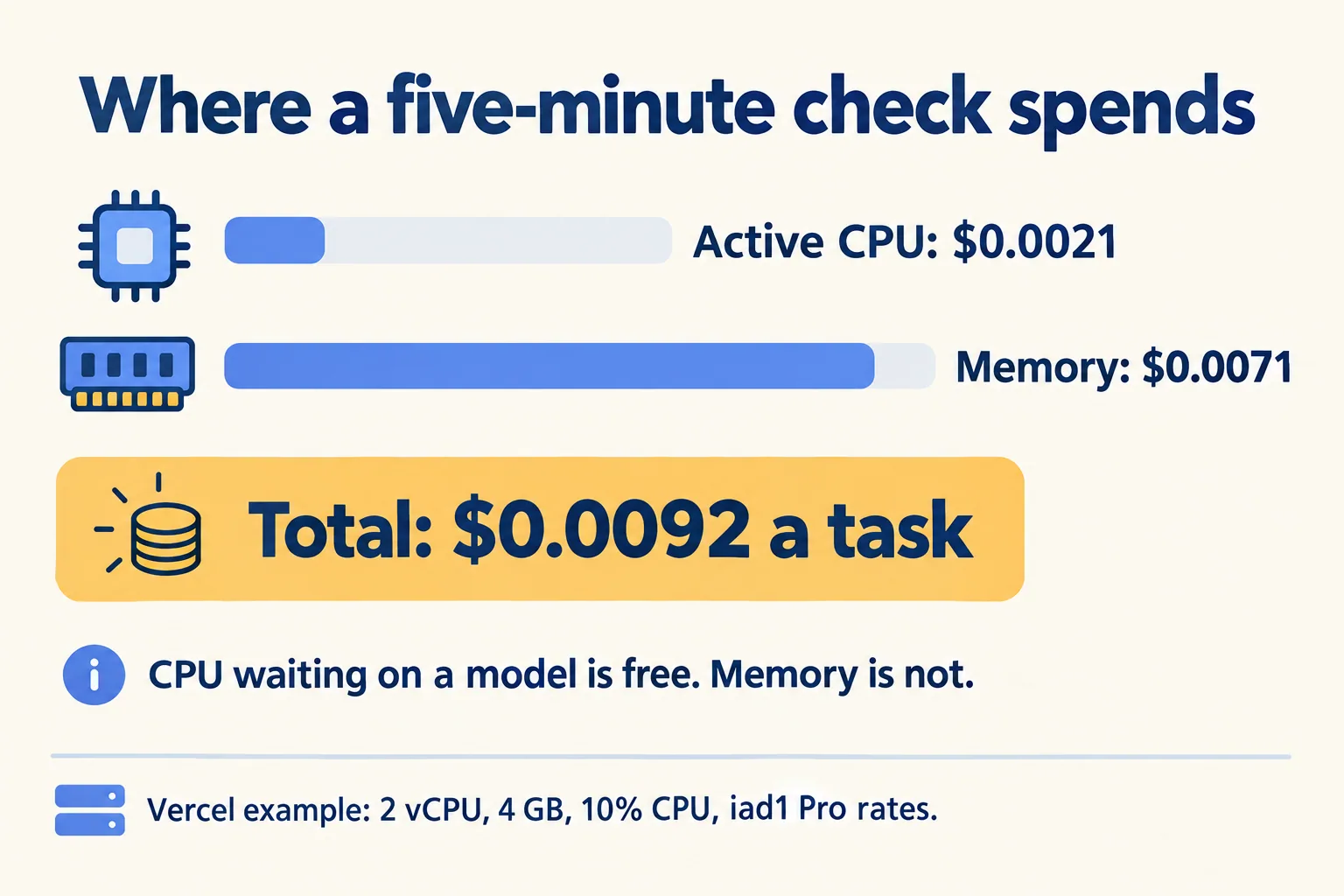
The product page claims "up to 95% lower cost for workloads with bursty or I/O-bound patterns". That saving is on CPU. For an agent that thinks for a minute between commands, the lever you control is the clock. Our stop rules: provision the smallest box that runs the task, set a timeout per task shorter than the default, stop the box on the task's own done signal, and kill it when it sits idle. A hung agent then costs minutes, not the five-minute default per call or a 24-hour session.
What does a month of checks cost?
About $28 a month at agency scale, before the Pro plan's credit. Here is our arithmetic on Vercel's example, for a sample digital agency where an agent drafts landing pages and every draft is built and tested before anyone looks at it. It is a sample volume, not a client's bill.
- 013,000 drafts a month, each checked in one sandbox for 5 minutes on 2 vCPUs and 4 GB (our assumption).
- 023,000 × $0.0092 is $27.60 in CPU and memory, at iad1 Pro rates.
- 033,000 creations at $0.60 per million add less than one cent.
- 04The Pro plan's $20 monthly usage credit is drawn on first.
- 05Model tokens for writing the drafts, and outbound traffic on a preview port, are separate lines.
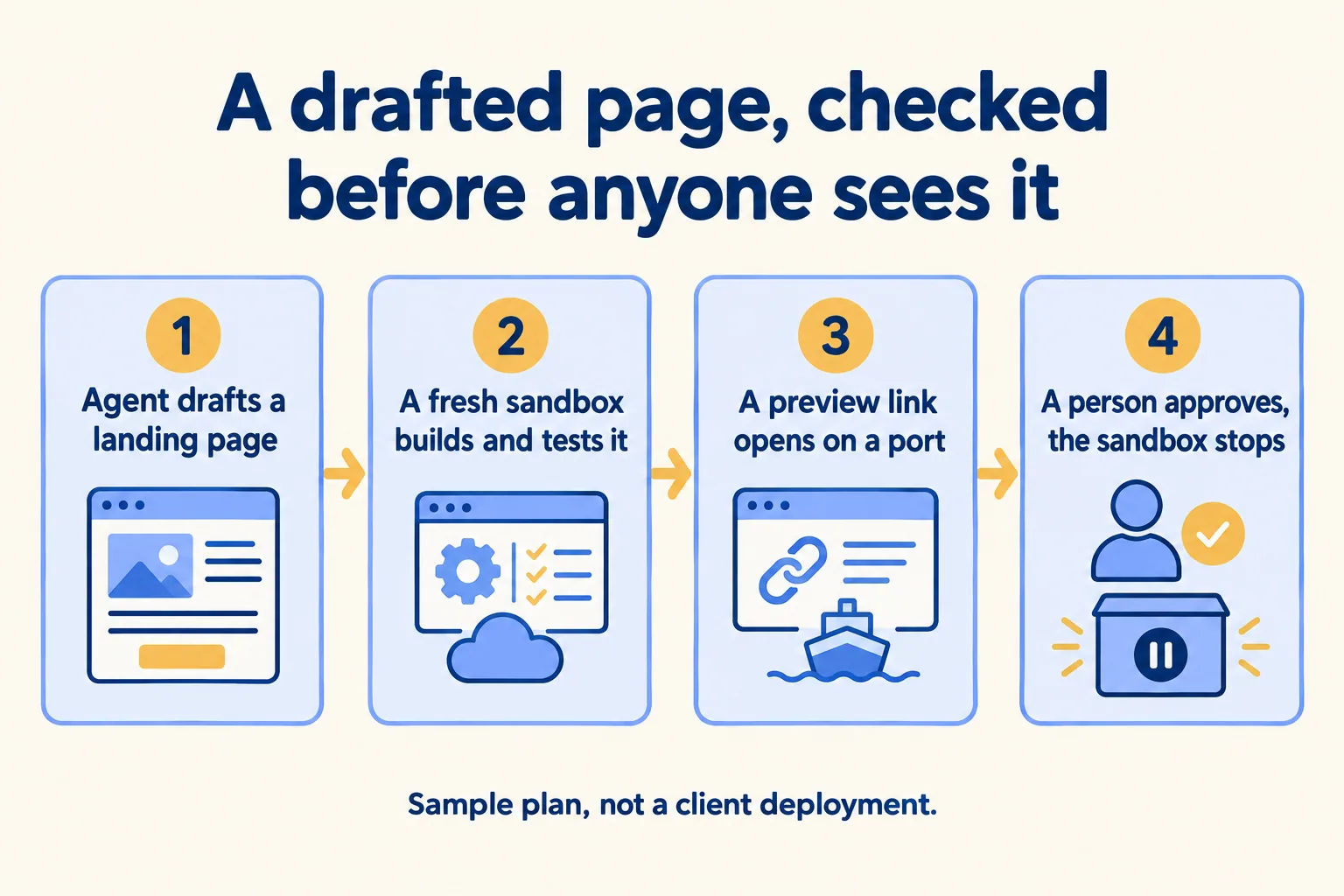
Pro costs $20 a month with one deploying seat, and that fee comes with $20 of usage credit, so most of this sample's sandbox use sits inside the plan. The model tokens for writing each draft can easily be the larger line, so we price both per task in shadow mode before go-live, from your own drafts, not from Vercel's example. Count cost per passed draft, not per run: a failed check costs the same as a passed one. We price the sandbox, the model and the retries together, as one cost per task.
The number that moves this is time open, not volume. The same 3,000 checks left open for 30 minutes each, on Vercel's "build and test" shape of 4 vCPUs and 8 GB, is $0.1104 a task in its example, or about $331 a month. For the agency side of this work, see Mindcat for digital agencies.
Which limits decide the design?
Session length, concurrency and box size, and each one differs by plan.
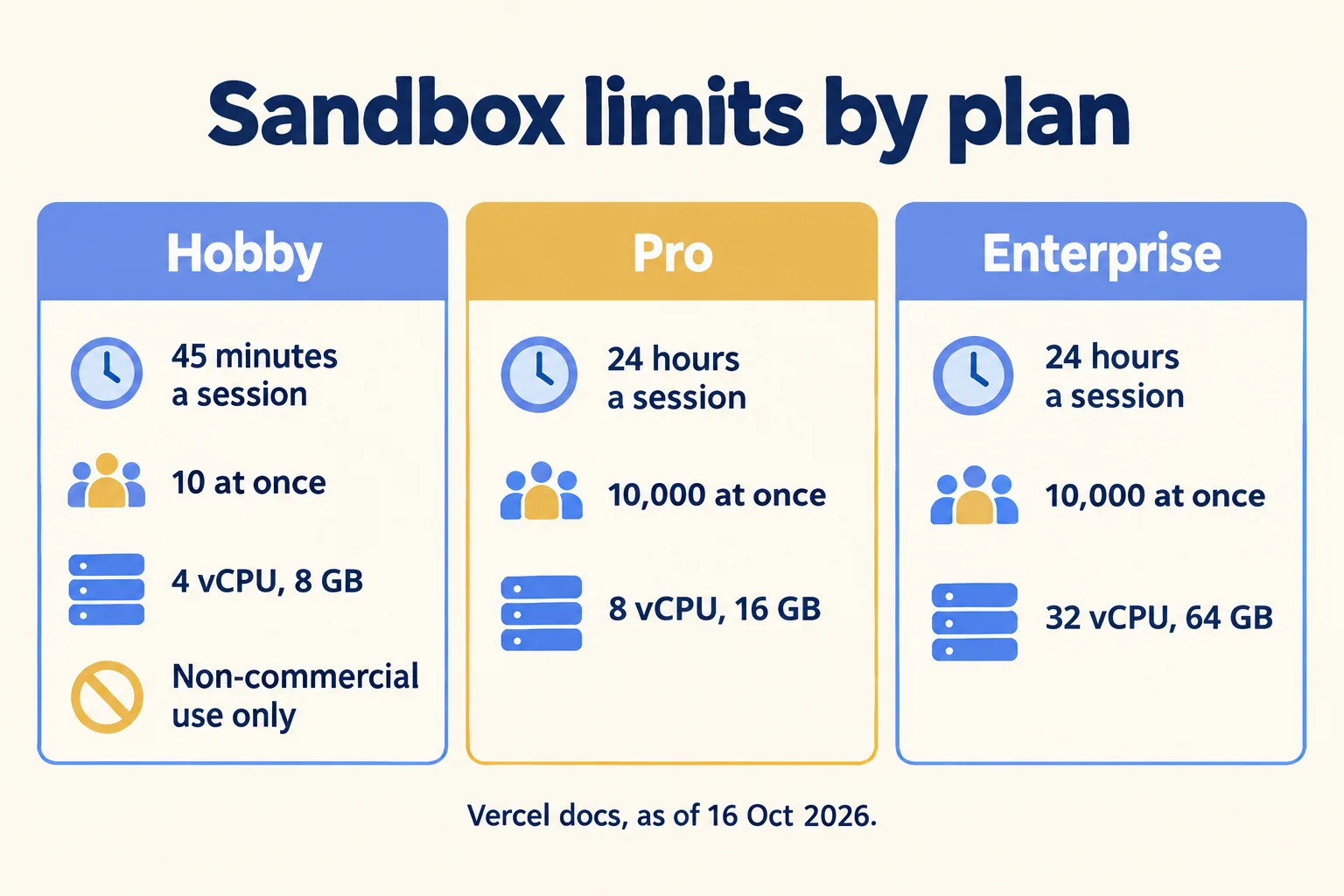
Two of these catch teams out. Hobby is for non-commercial, personal use only, so a client pilot on Hobby is on the wrong plan before any limit applies. And 24 hours is a ceiling per session, not "unlimited": a job that runs longer needs a snapshot or a persistent sandbox that stops and resumes, which Vercel says resets the clock.
Where does the code run?
In one of Vercel's 19 regions, and none of them is in the UAE or Saudi Arabia. Mumbai (bom1) is the nearest; the default is iad1 in Washington, D.C. You can set the region per sandbox or as a project default on any plan, and failover regions on Pro and Enterprise.
Pick the region before you save anything. Snapshots and drives are stored in the region they were created in. An India team can keep code, files and snapshots in Mumbai. A Gulf team whose code reads customer records cannot keep them in-country on this product today, so we confirm the data path per project, in writing, before you sign.
When does a sandbox per task pay off?
When the code is untrusted and the work comes in bursts. That covers code an agent wrote, scripts a customer uploaded, and builds of a draft nobody has read yet. Each task gets a fresh box with its own kernel and network policy, and the box is gone when the task is. Vercel's page also says credentials are "injected on egress" and "never enter the sandbox", which is the property you want when the code is someone else's.
Build or buy is a real choice here. Our reading, not a benchmark:
It is the wrong tool in three cases:
- The code is yours and reviewed. Run it where you already run code. A microVM per call is overhead.
- The box would sit open all day. Memory bills by the hour while it runs. A steady worker belongs on compute you size once.
- The data must stay in the Gulf. No region there today.
How do we start?
We call the method Spec, shadow, gate. We write down what the agent may run, which hosts the sandbox may reach and when each box stops, run it beside your team with nothing written to production, then put a person on the step that ships. The written assessment is free. The first build week is a fixed AED/SAR 14,900, credited in full if you sign the build within 60 days, and our Run plans are on one page. See how we build on Vercel for the rest.
We are not a Vercel partner; we use the product's own names, and mindcat.ai itself runs on Netlify. If your agent never runs code it wrote or code a customer sent, you do not need a sandbox yet: keep the agent to reads and approved writes, and come back when it starts writing scripts.
