
If your app breaks at night and the first hour of every fix is someone reading logs, this is for you. The question is not whether an agent can read the logs. It is what each read costs and who says yes to the fix. It saves the morning's reading, not the night: nothing is fixed until a person approves. If someone already watches alerts overnight, you need this less.
What breaks when nobody is on call?
The fix is usually small. Finding it is not. A function starts timing out after an evening deploy, errors climb at 1 a.m., and the first person to look is the developer who arrives at nine.
Most of that first hour is reading: deployment logs, the last commit, the metric that moved. That is the part Vercel Agent is built to do, and the part you can price.
What does the agent do, and what does it not do?
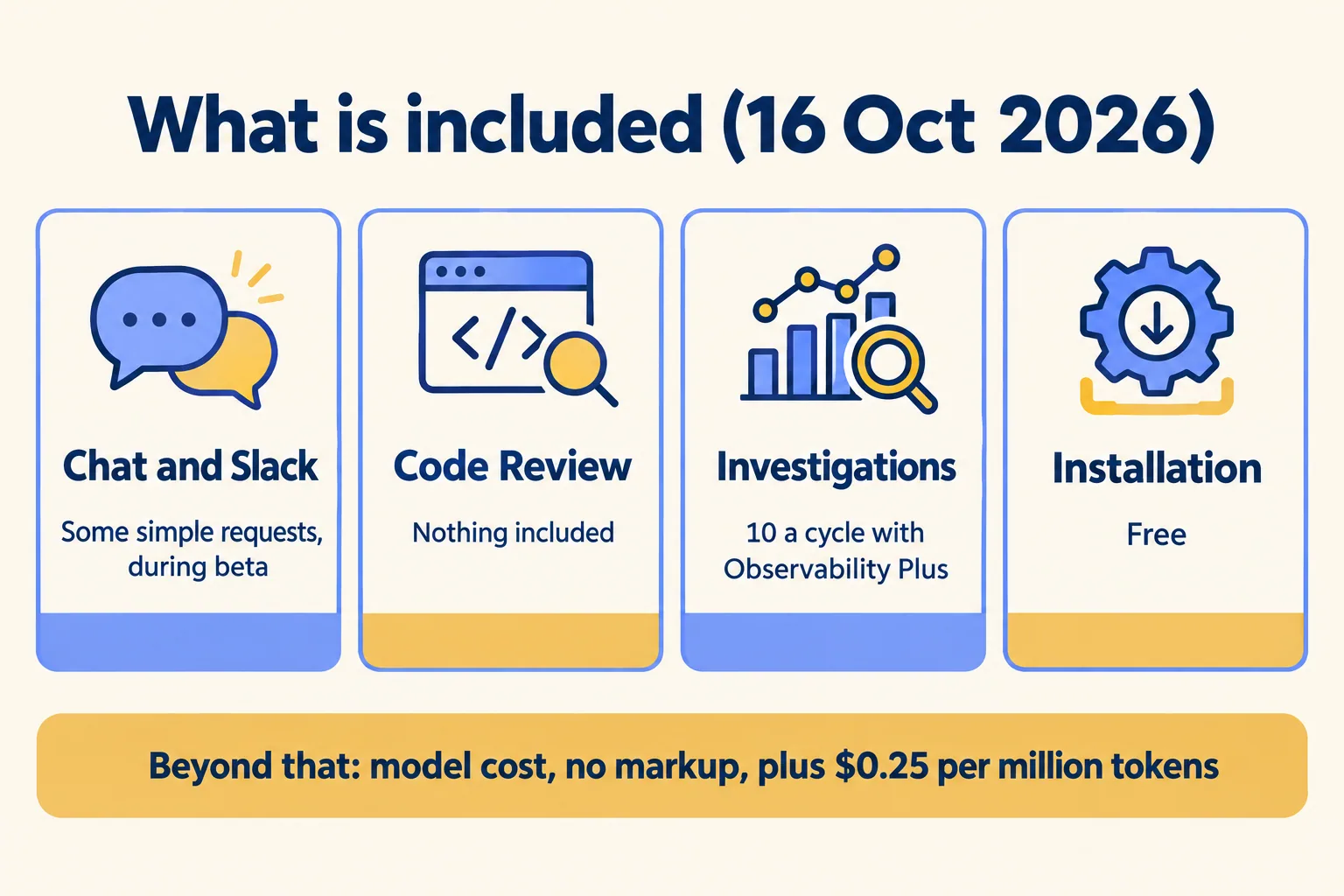
It reads your Vercel project and proposes, and a person approves. Vercel's docs list chat in the dashboard and in Slack, code review on pull requests, investigations of alerts, and installation of Vercel products such as Web Analytics. It runs in public beta on Pro and Enterprise plans only.
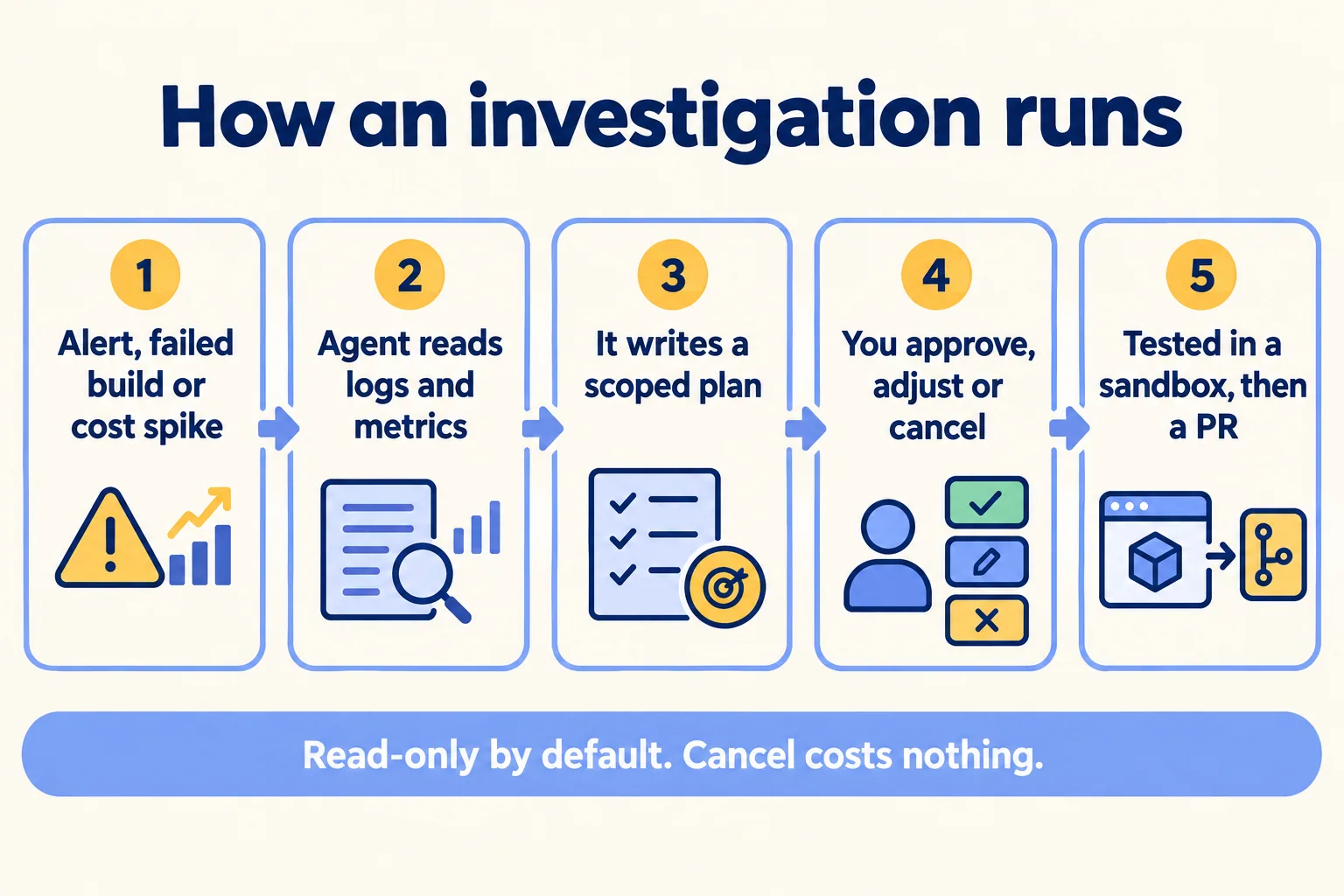
Three lines from Vercel's own pages set the limits:
- Read-only by default. "When a task requires write access, it presents a scoped plan and waits for your approval."
- Tested before you see it (code review only). On pull requests, Code Review generates patches, runs them in Vercel Sandbox against your real builds, tests and linters, and only validated suggestions reach the pull request.
- Attributed. The June changelog says the agent runs under its own identity, bounded by the requesting user's permissions, and elevated actions are attributed to the agent, the requester and the approver.
For a security questionnaire, note what it reads: logs and metrics, which can hold customer data. Vercel's Agent page says it never trains on customer code if your data sharing setting is off, or on Enterprise. The pages we read do not say which model provider processes the logs, or how long anything is kept. Ask Vercel in writing before you switch on investigations for a project whose logs carry personal data, and keep that project out of the list until you have the answer.
What it does not do: deploy a fix on its own, or work on a Hobby team. That approval step is the whole design, and we would keep it. We wrote about why a person should own each write in human approval for AI agents.
What does an investigation cost?
You pay for tokens, not seats. Vercel charges the model provider's token price with no markup, plus a Vercel Token Rate of USD 0.25 per million tokens, on input, output and cached tokens alike (as of 16 October 2026).
Vercel Agent is billed on usage, and the cost "varies based on how much log and metric data Vercel Agent analyzes". So price it as a formula, then measure your own:
As arithmetic only, not a Vercel figure: a run that reads 2 million tokens adds USD 0.50 in Vercel's rate, plus the model provider's charge for the same tokens. A noisy month is the risk, because automatic runs are reads, and reads need no approval.
A sample month, with the assumptions shown and our arithmetic: Pro at USD 20; 5 million Observability Plus events at USD 1.20 per million, USD 6; 15 Medium and High alerts, so 5 runs past the included 10; at 2 million tokens a run, USD 2.50 in Vercel's rate. That is USD 28.50 (about AED 105), plus the provider's charge for 10 million tokens, which we cannot price because Vercel's pages do not name the model. Your first month's usage page replaces every one of these guesses.
Three settings keep the bill bounded. Under Projects to Investigate you choose all projects or specific ones, so a noisy staging project never runs up a bill. Selecting Cancel on a proposed plan does not run or charge for that work. And every new Vercel team has a default on-demand budget of USD 200 a cycle, which you can change, with an optional pause at a hard limit.
What does a 2 a.m. failure look like for a courier app?
Here is the shape for a courier company whose dispatch board runs on Vercel. It is an illustrative example, not a client.
At 01:40, after an evening deploy, errors on the board's API climb and a High anomaly alert fires. Vercel's docs say the agent investigates Medium and High anomaly alerts automatically once investigations are switched on. It queries the logs and metrics around the alert and writes a summary: the errors began with the last deployment, and one function is timing out. Nothing changes, because nobody has approved anything.
At 07:30 the lead developer reads that summary in the dashboard instead of a raw log. She asks the agent for a fix in chat. It presents a scoped plan, she approves it, and a pull request opens. The cost was one investigation, inside the ten a cycle that come with Observability Plus.
Notice what did not happen. The board was still failing overnight. The agent saved the first hour of the morning, not the night. If the night matters, that is an on-call question, and no agent answers it. See how dispatch work runs for couriers and delivery.
When does it pay off, and when does it not?
It pays off when failures come at hours nobody covers and the first hour of each fix is reading. It also pays off on pull requests, where Code Review only posts suggestions that passed your own builds and tests. It does not when your team already reads every alert within minutes, or when your code is not on Vercel at all.
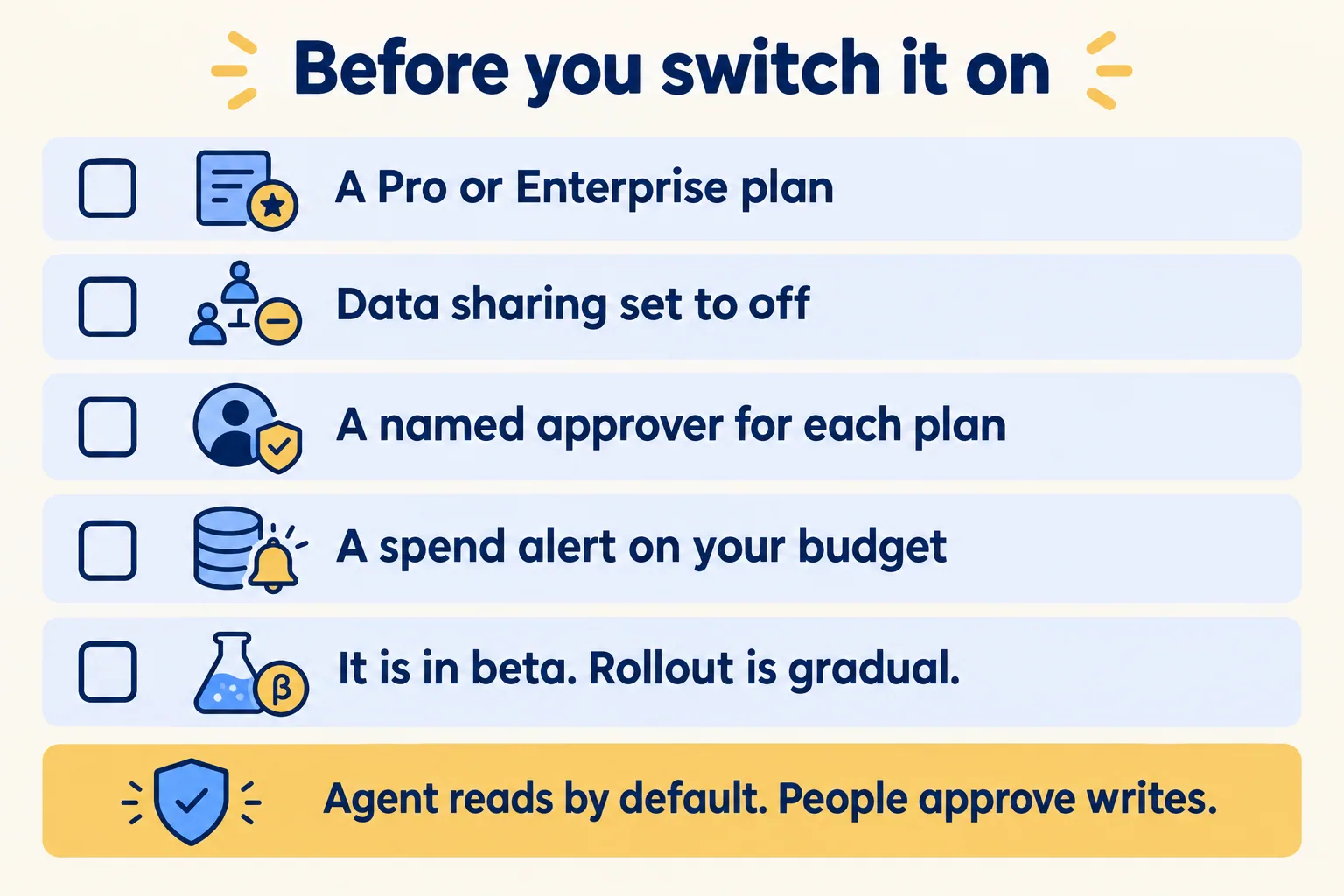
How good are its diagnoses? Vercel publishes no accuracy figure, and neither can we for your logs. The shadow weeks below are how you get your own number. Before you switch it on, settle five things in writing:
- 01A Pro or Enterprise plan. Rollout is gradual, so check your team has it.
- 02Data sharing set to off, if you are on Pro and do not want your code used for training.
- 03One named approver for plans, per project, and a backup for leave.
- 04A spend alert on the team budget, so token costs show up before the invoice.
- 05A note that it is in beta. Features and included usage can change.
Data residency is a separate question. Vercel lists 19 compute regions and none is in the UAE or Saudi Arabia (Mumbai is nearest). If logs must stay in a country, settle that before any agent reads them.
This is not for a team without a production workload on Vercel yet. Start with the app, then add the agent once you know which failures cost you sleep.
We call our way of doing this "Spec, shadow, gate". Spec: the projects it may investigate and who may approve. Shadow: for the first weeks, an engineer writes down their own root cause for each alert before reading the agent's, and we count how often they match. Gate: only once that count is good enough for you does one named person start approving its plans. We are not a Vercel partner and are not affiliated with Vercel; we use its product names and pick it per job. See the rest of what we build on Vercel. The assessment is free and the first build week is a fixed AED/SAR 14,900, credited in full if you sign the build within 60 days. A Run plan then keeps it watched.
