

Two engineers in a Riyadh office at night read a chat thread and charts while tracing a failed release.

Vercel · Tools · Beta

The site breaks at night. The one person who reads the logs is asleep.

A build fails after an update, or checkout errors climb during a sale. Today someone scrolls logs until they find it. Vercel Agent reads your deployments, logs and metrics, names the likely cause, and tests a fix in a sandbox. It changes nothing until a person approves. It is in public beta on Pro and Enterprise, rolling out gradually.

Salesforce consulting partner since 2010 · MVP Hall of Fame · 200+ agents in production · UAE, India and US desks

The problem

Where the hours go when something breaks.

What Vercel Agent is

Vercel Agent, in plain words.

Facts from Vercel’s own pages, checked on 16 October 2026. The sources are at the end of this page.

What it is
An agent in the Vercel dashboard, in Slack and in GitHub pull requests. It chats, reviews code, runs investigations and makes approved changes.
Status
Public beta on Pro and Enterprise only. Vercel says rollout is gradual, with an early-access form for teams that do not have it yet.
What it may do
Read-only by default. For any write, it shows a scoped plan and waits for approval. It runs under its own identity, bounded by the asking user’s permissions.
Code Review
It writes patches, runs them in Vercel Sandbox against your real builds, tests and linters, and shows only the suggestions that pass.
Price, as of 16 October 2026
Model usage at the provider’s rate with no markup, plus $0.25 per million tokens. Code Review has no included usage. Ten investigations a cycle come with Observability Plus.
Your code and training
Vercel says it never trains on customer code when the team’s data sharing is off, or on Enterprise.

How it works

From an alert to a fix someone approved.

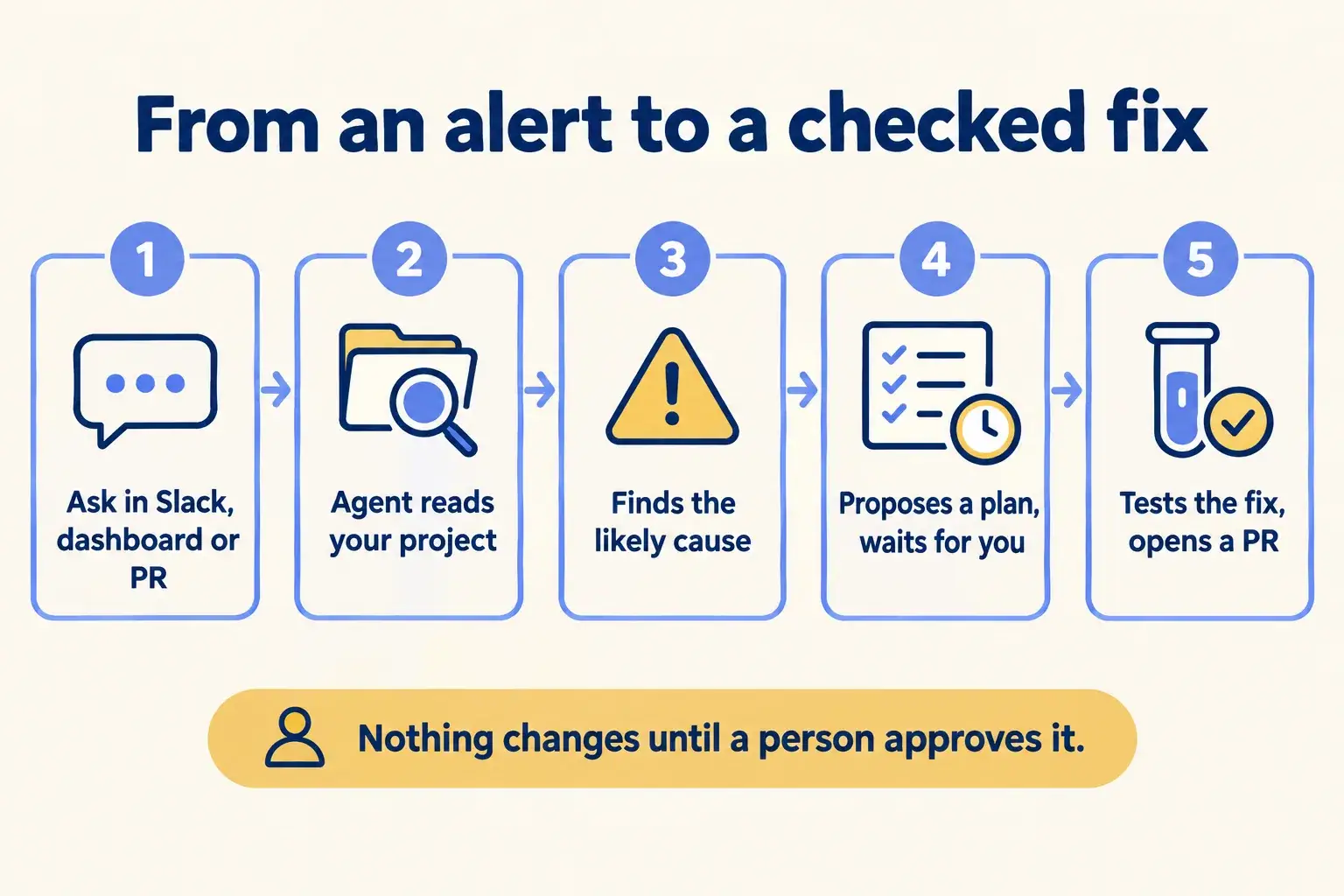
Five steps. The agent does the reading and the testing. A person on your team makes every decision that changes something.

Five steps: ask in Slack, the dashboard or a PR, the agent reads the project, finds the cause, proposes a plan, tests the fix.

Infographic

The same steps are written out below.

Step by step

What happens at each step.

  1. Ask

    Ask in the dashboard, Slack or a PR

    Select Agent in the dashboard, mention @Vercel in Slack, or comment @vercel on a GitHub pull request.

  2. Read

    It reads your project

    Deployments, logs, metrics, configuration, usage and the connected repository.

  3. Investigate

    It names the likely cause

    It queries logs and metrics and sums up what most likely went wrong.

  4. Plan

    It proposes a plan and waits

    Any change comes as a scoped plan. You approve, adjust or cancel. A cancelled plan is not charged.

  5. Prove

    It tests the fix, then opens a PR

    The code runs in Vercel Sandbox first, then lands as a pull request or the approved change.

How it fits together

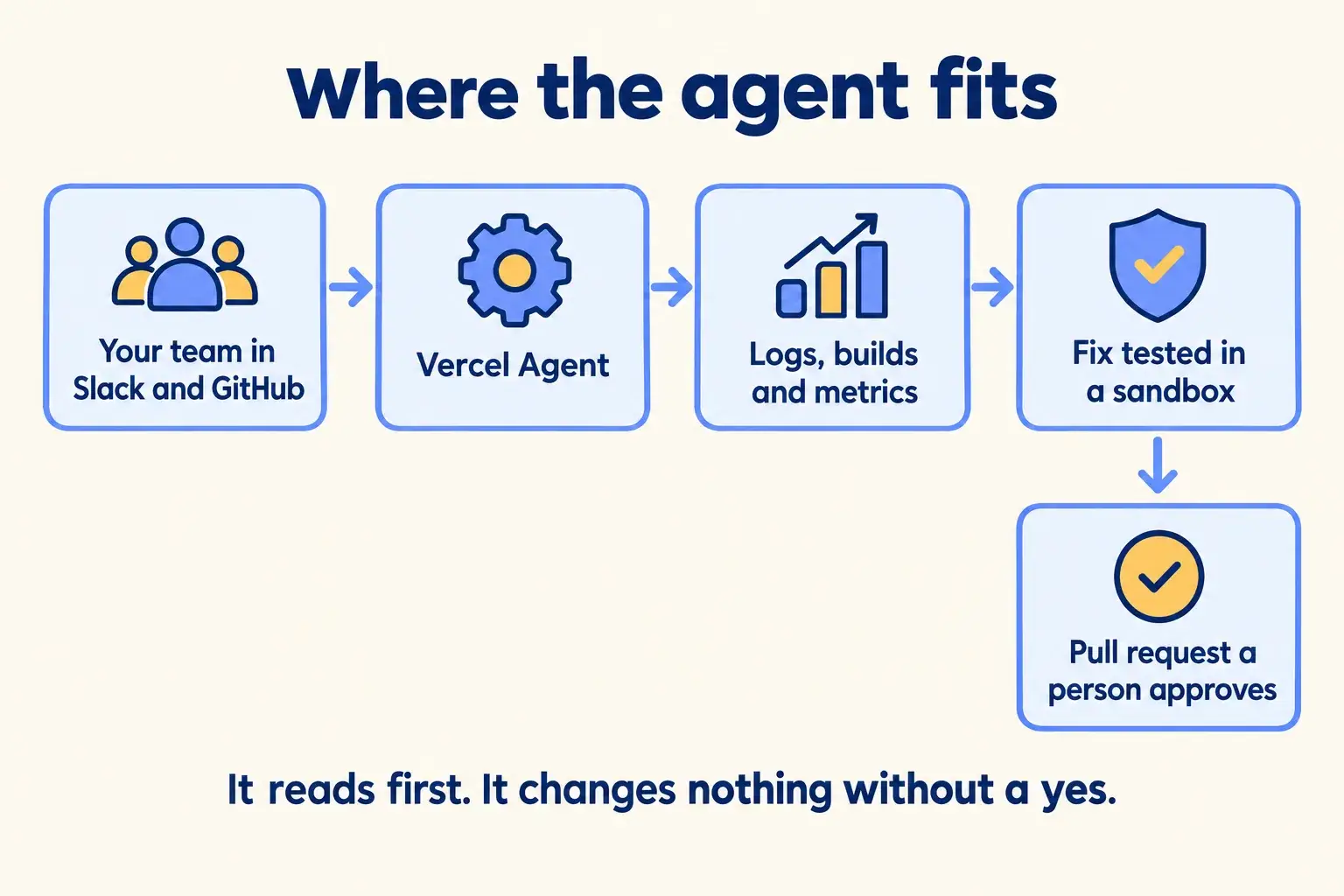
Where the agent sits between your team and your logs.

Your team asks in Slack or GitHub. The agent reads builds, logs and metrics on Vercel, tests its fix in a sandbox, and hands back a pull request that a person approves and ships through a preview.

Your team in Slack and GitHub asks the agent, which reads logs and builds, tests a fix in a sandbox and opens a PR for approval.

Infographic

Where it sits next to the systems you run today.

Use cases · worked examples

One worked example in each industry.

How Vercel Agent fits into the work of the industries we serve, one step at a time.

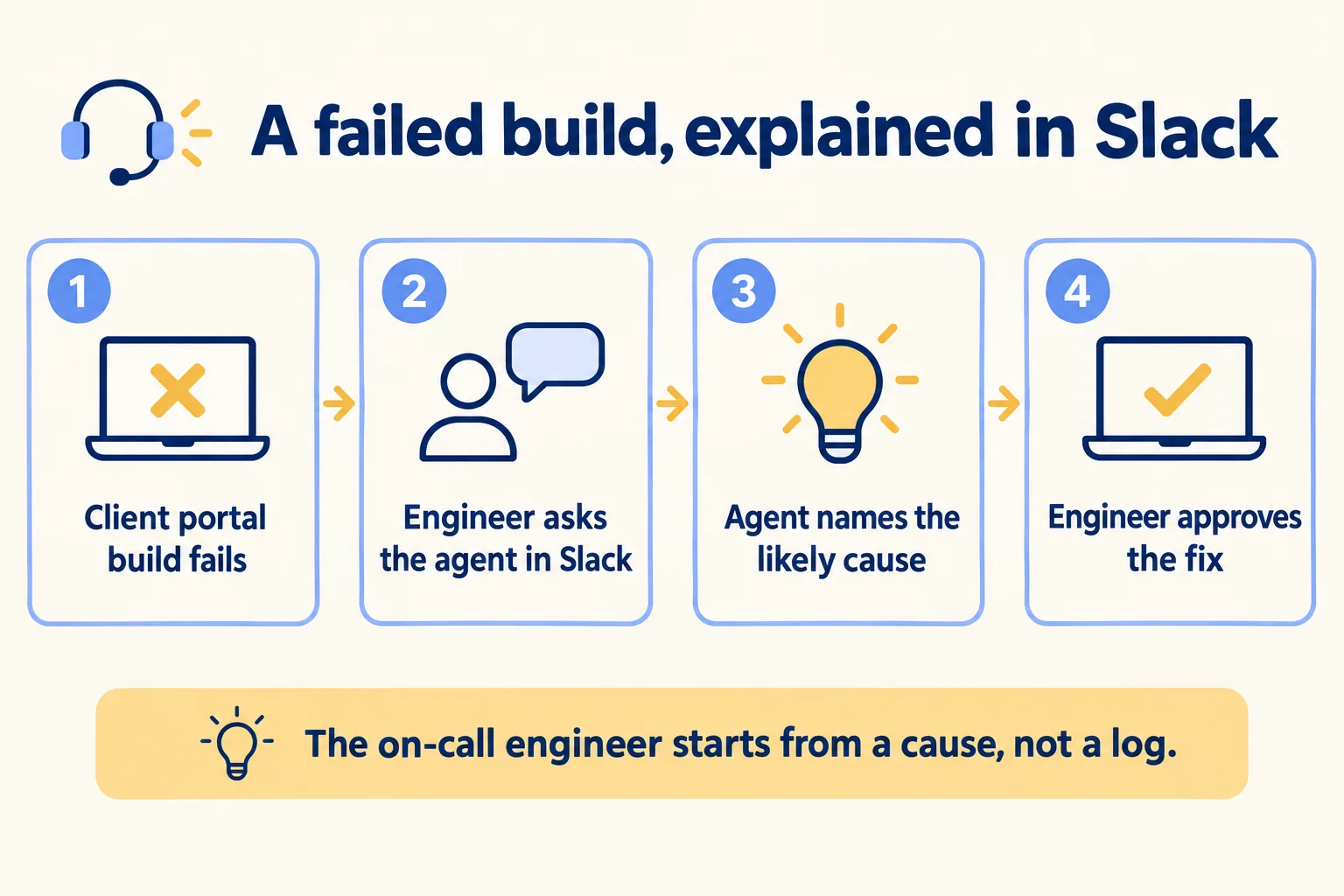
  1. A failed client portal build is explained in Slack, the agent names the cause, and the engineer approves the tested fix.

    Example 1 · IT service desk, Bengaluru · Infographic

    On-call engineer at a Bengaluru managed IT service provider

    Today: A client portal build fails at 10 p.m. after a package update. I am on call for six clients and I do not know this codebase well.

    After: The engineer asks the agent in Slack. It reads the build logs, names the error, and tests a fix in a sandbox. The engineer approves it.

    Worked example, step by step

    1. 22:10Vercel. The client portal’s production build fails after a dependency update.
    2. 22:12On-call engineer. Mentions @Vercel in the team’s Slack channel: why did the last build fail?
    3. 22:14Vercel Agent. Reads the build logs and points to a type error from the updated package.
    4. 22:20On-call engineer. Comments @vercel fix the type errors on the pull request.
    5. 22:31Vercel Agent. Tests a patch in a Sandbox with the real build and linters, then posts it on the PR.
    6. 22:40Team lead. Reviews and merges. The service desk ticket closes with the PR link and the cause.

    The night ends with a reviewed fix and a written cause the client can read.

    IT service desks
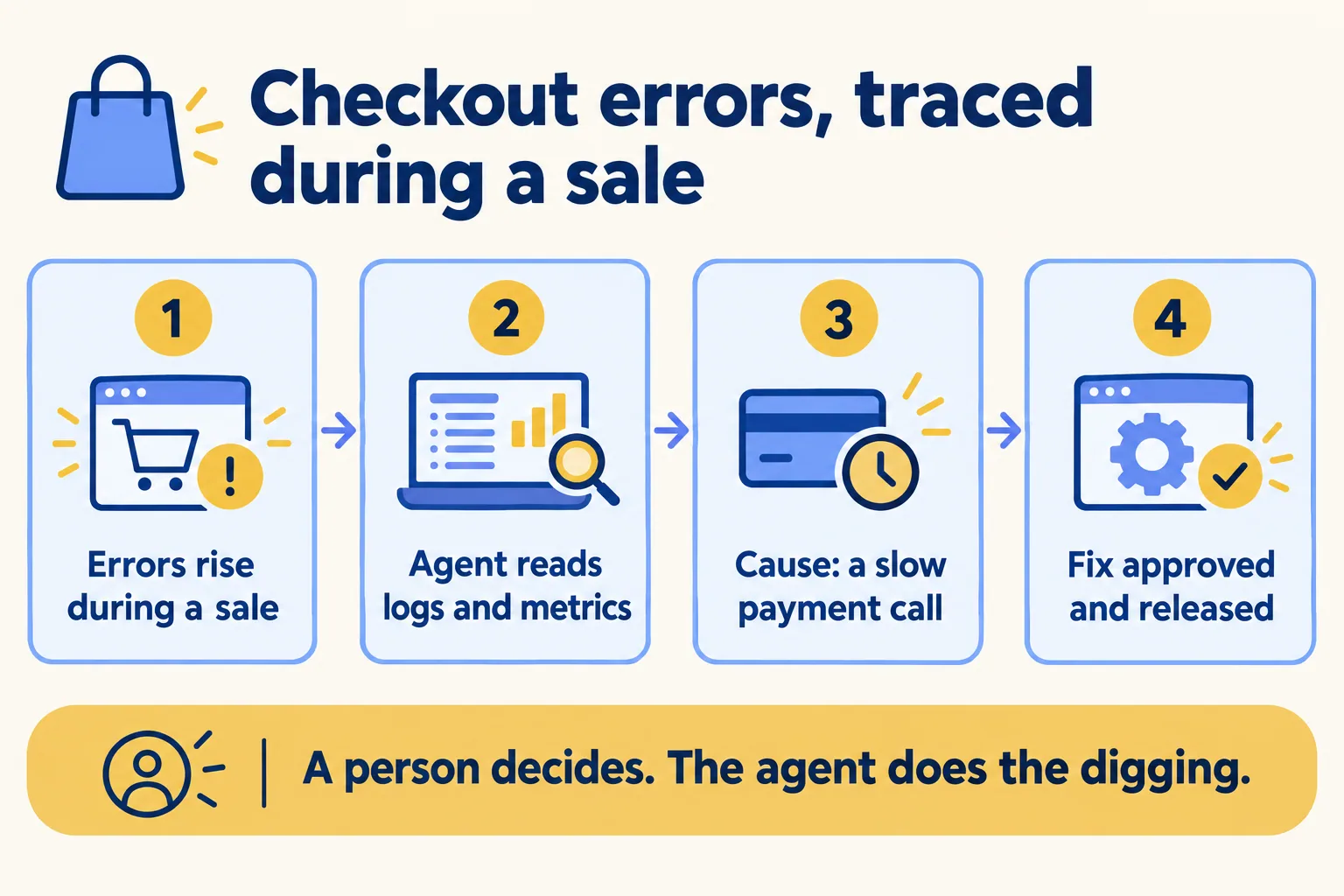
  2. Checkout errors during a sale are traced to a slow payment call, and a fix is approved and released.

    Example 2 · Online retail, Riyadh · Infographic

    E-commerce lead at a Riyadh fashion retailer

    Today: The weekend sale opens and checkout errors start. Our agency says they will look in the morning.

    After: The lead starts an investigation from the dashboard. The agent traces the errors to a slow payment call and proposes a fix. The developer approves it, and it ships through a preview.

    Worked example, step by step

    1. 20:00Store. The weekend sale opens and traffic climbs.
    2. 20:25Vercel. An error alert fires on the checkout route.
    3. 20:26E-commerce lead. Opens Agent in the dashboard and starts an investigation.
    4. 20:30Vercel Agent. Sums up the logs and metrics: timeouts on the call to the payment provider.
    5. 20:40Developer. Asks for a plan. The agent proposes a shorter timeout with a retry, and waits.
    6. 20:55Developer. Approves. The agent tests it in a Sandbox and opens a PR, which goes out through a preview.

    The fix ships the same evening, with a record of who asked, who approved and what changed.

    Retail and e-commerce
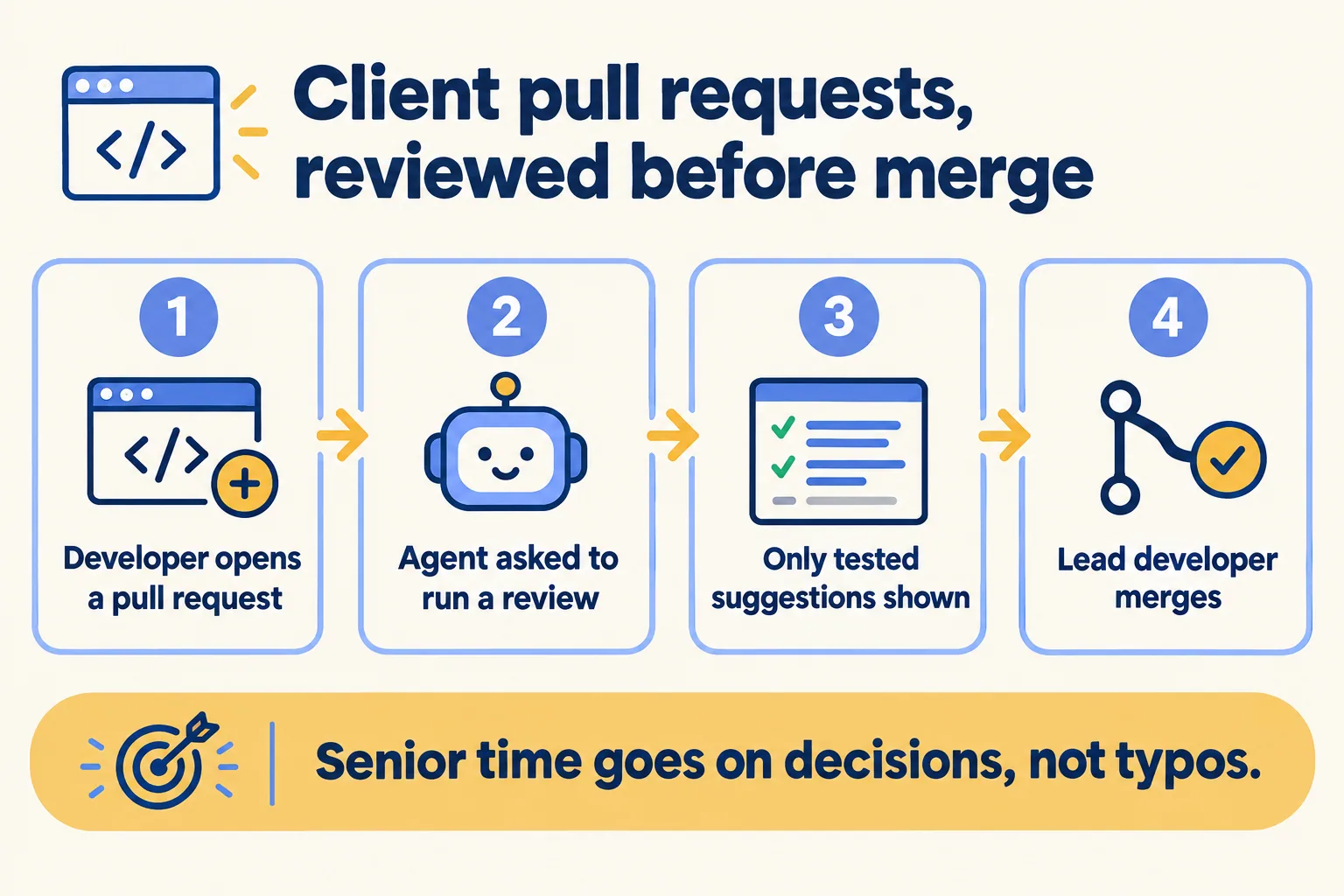
  3. A developer opens a PR, asks the agent to review it, sees only tested suggestions, and the lead developer merges.

    Example 3 · Digital agency, Mumbai · Infographic

    Lead developer at a Mumbai digital agency with many client sites

    Today: I review every pull request myself. Half my comments are typos and type errors, and the real questions wait.

    After: Developers ask the agent for a review first. It tests its suggestions against the real build, so the lead developer sees a cleaner PR.

    Worked example, step by step

    1. 10:00Developer. Opens a pull request on a client’s site.
    2. 10:01Developer. Comments @vercel run a review.
    3. 10:15Vercel Agent. Runs its patches against the build, tests and linters in a Sandbox. Only the ones that pass appear on the PR.
    4. 10:30Developer. Accepts two suggestions and rejects one.
    5. 11:00Lead developer. Reviews the PR with its preview link and merges.

    The lead developer spends review time on decisions, and each review’s token cost shows on the agency’s bill.

    Digital agencies
Examples of the work, not client stories. Times in each example show the order of events, not a measured result.

Is it for you

When Vercel Agent fits, and when it doesn’t.

Good fit

Not for you yet

You are on Pro or Enterprise and have access
You are on Hobby
Your code is on GitHub and deploys on Vercel
You want fixes deployed with no human approval
Errors or failed builds cost you hours to trace
You need a GA product with a support commitment
Someone on your side can approve its plans
You need a fixed monthly price, not per-token billing

What Mindcat does

We build it, then we run it.

The assessment is free: a short read of the org and a written note. If you go ahead, the first build week is a fixed AED/SAR 14,900 (about USD 4,050), credited in full when you sign the build within 60 days. After go-live, we keep it patched, watched and changing every month.

FAQ

What teams ask about Vercel Agent.

Can it change our site on its own?
No. Vercel Agent is read-only by default. For anything that writes, it shows a scoped plan and waits for approval, and any action that needs extra rights records the agent, the person who asked and the person who approved.
Do we have it already?
Maybe not. It is in public beta on Pro and Enterprise, and Vercel says rollout is gradual. Teams without it can ask for early access.
What does it cost?
As of 16 October 2026: model usage at the provider’s rate with no markup, plus a Vercel rate of $0.25 per million tokens. A limited number of simple chat requests are included during the beta, Code Review has no included usage, and Observability Plus includes ten investigations a cycle. There is no seat licence.
Does it train on our code?
Vercel says it never trains on customer code when the team’s data sharing setting is off, or on Enterprise. We check that setting before it is switched on.
Which frameworks does it know?
Vercel says it is tuned for Next.js, React, Nuxt and Svelte, and not limited to those.

Sources

Where these facts come from.

Start here

Tell us what you want built, and where it runs today.

One or two lines is enough. You hear back within 24 hours from the person who signs the work.

Salesforce consulting partner since 2010 · MVP Hall of Fame · 200+ agents in production · UAE, India and US desks