

If you own the company's web apps and operations wants to turn the shared spreadsheet three people overwrite each morning into an app with an AI builder, this is for you. The build is the quick part. You sign off what goes into the prompt, who reads the code, what it costs a month and what you tell the next security questionnaire. If nobody is asking for an app, leave the sheet alone.
Why does the spreadsheet stop working?
Because a sheet holds rows, not a process. Two supervisors edit the same cell, a formula breaks on Friday, and the housekeeper on the third floor reads a status that changed an hour ago. The fix people reach for is a WhatsApp group next to the sheet, and now the truth lives in two places.
The job usually has one clear shape: a list of things, a status for each, who changed it and who signed it off. That shape is exactly what an app builder is good at. Before you start, check the sheet against three questions:
- 01Does it have one job, such as unit status, and not five?
- 02Do a handful of people update it, and could you name each one?
- 03Can you test it with sample rows instead of real customer data?
Three yeses, and it is a candidate. If you already pay for Microsoft 365 and the job is only a shared list, try the tools you have first; build only the step they cannot do.
What does an app builder actually do with your sheet?
It writes the app's code from what you describe or upload, shows it running, and publishes it. v0's FAQ says you can prompt in any language, or upload screenshots, a Figma design or a zip, or import a GitHub repository. It writes in Next.js, React, TypeScript, Tailwind CSS and shadcn/ui, a common stack, so another developer or agency can take the code over later.
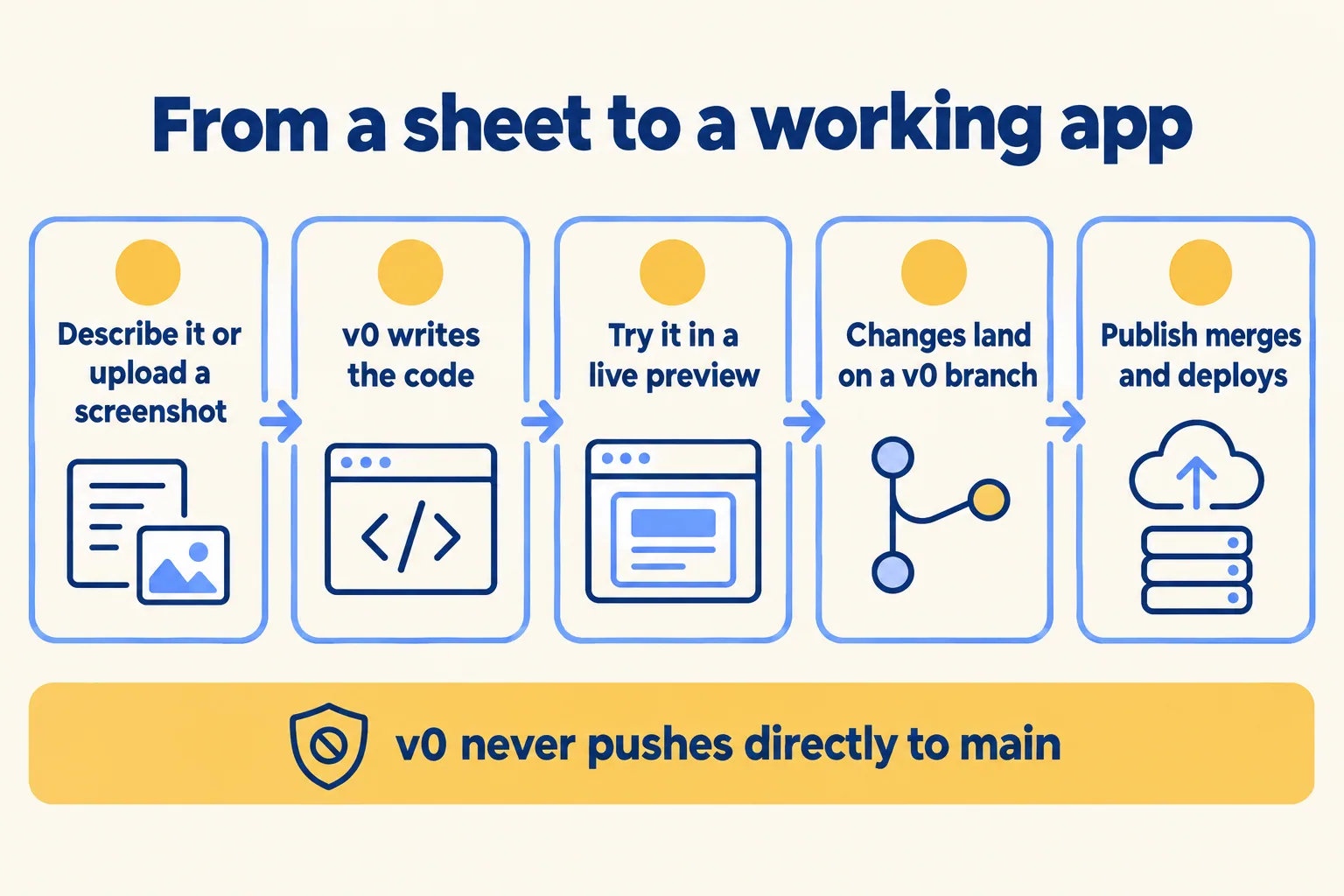
Two details matter for whoever owns the app. Previews run in Vercel Sandbox, which the FAQ calls "a lightweight virtual machine", so the form that saves a status really saves it while you test. And with a GitHub-connected project, v0 never pushes directly to main. Changes land on a v0/... branch, and Publish merges a pull request and starts the production deployment, with your required GitHub checks and reviews still applying. That is the hook for a human review, if someone sets it.
What should never go into the prompt?
Real guest or customer data, unless your plan opts out of training. v0's FAQ says it "may use user-generated prompts and/or content as inputs to models and learning systems from third-party providers to improve our products". Content of Enterprise customers, or of a customer that has opted out of training, is not used. v0's pricing table shows data opt-out on Business and Enterprise only, not on Free or Plus.
So the practical rule: build with sample rows. Replace guest names and phone numbers with "Guest A" and "050 000 0000" before you upload the sheet or paste it into a prompt. The app does not need real data to be built. It needs real data only once it is live, in a database you chose.
Where that database runs is the second question. Vercel lists 19 compute regions and none is in the UAE or Saudi Arabia (Mumbai is nearest). The published app's code runs in one of those regions, so any personal data it reads is processed outside the UAE. If guest records must not leave the country, keep personal data out of the app entirely (unit numbers and statuses only), and keep guest records in the system that already holds them. Settle that in writing before the build, not after.
What does it cost as of 16 October 2026?
Per person who builds, not per person who uses the app. v0's pricing docs list:
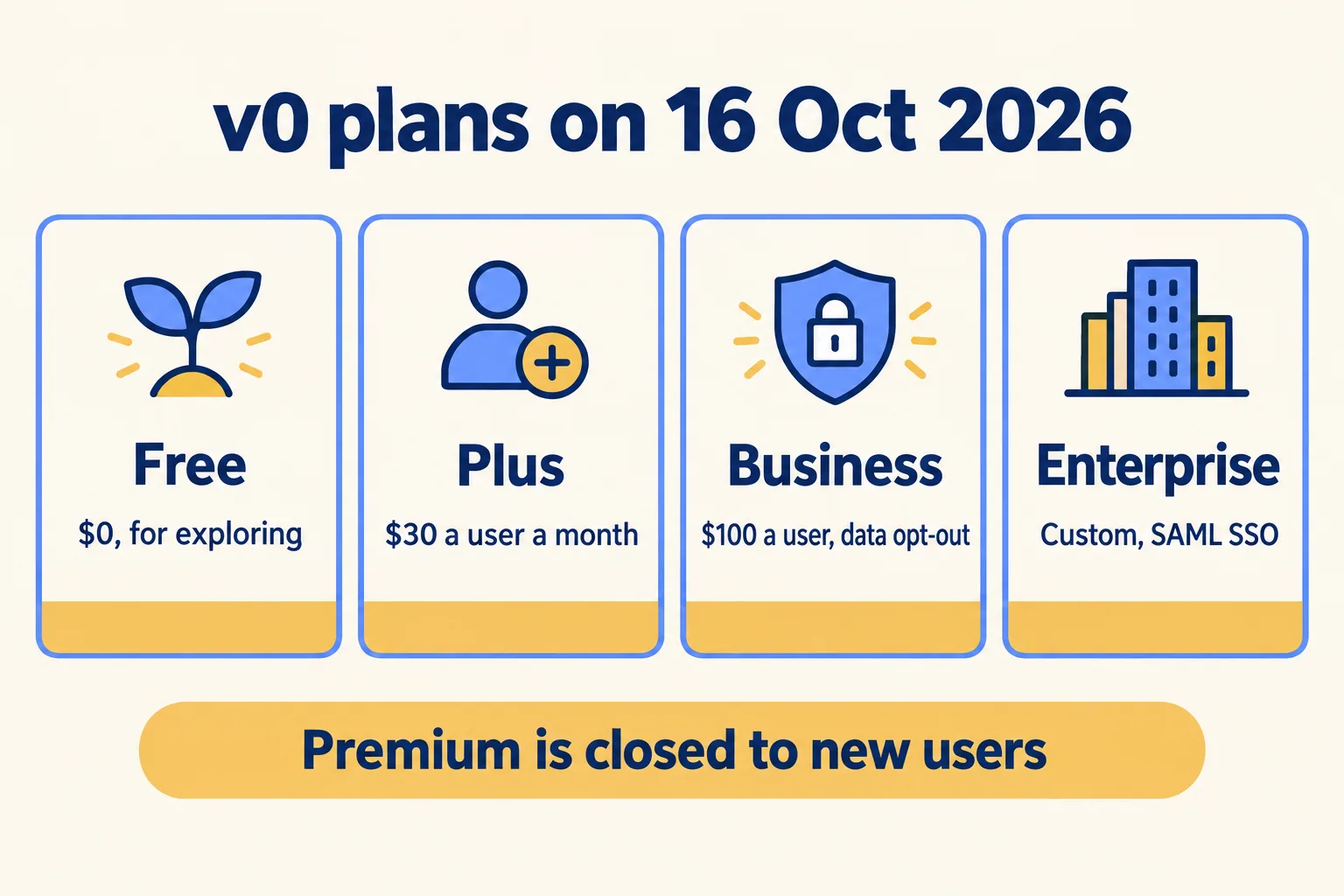
Most operations teams need one builder seat, not one per user: the people who use the published app do not need a v0 plan. Choose Business only if the person building must work with real records; otherwise build on Plus with sample rows. The published app runs on your Vercel account, which bills separately, and for business use that means Vercel's Pro plan, because Hobby is restricted to non-commercial, personal use. Premium, at USD 20 a month, is closed to new users.
A sample month, with the assumptions shown: one builder on Plus at USD 30 and the app on Vercel Pro at USD 20, which includes USD 20 of usage credit, comes to USD 50 (about AED 184) while usage stays inside the credit and the builder stays inside the plan's credits. When v0 credits run out, generation pauses. Any database you connect bills on its own.
What does a housekeeping board for serviced units look like?
Here is the shape for a hotel apartment building in Dubai whose housekeeping runs off a shared sheet. It is an illustrative example, not a client.
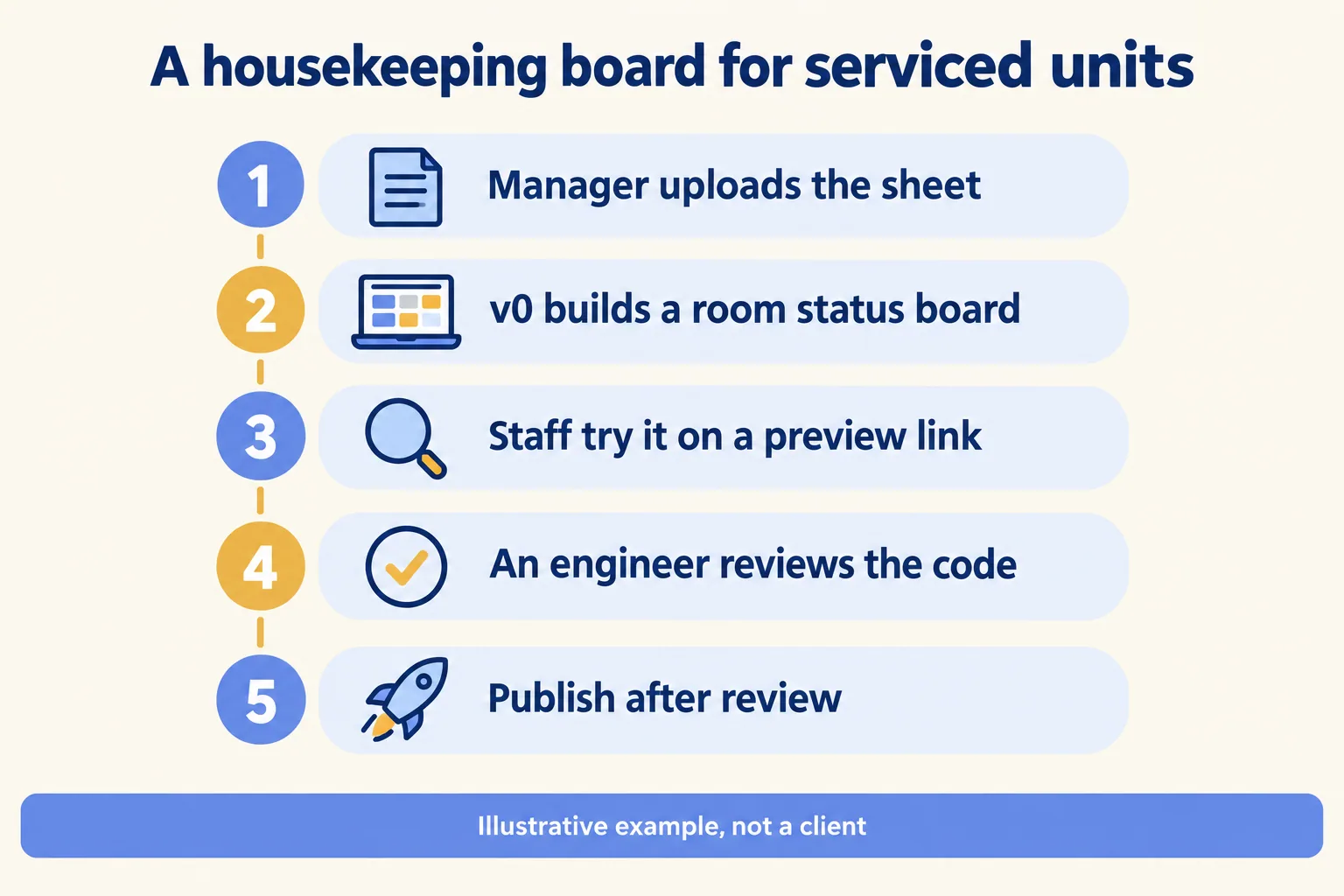
- 01The operations manager copies the sheet, replaces guest names with sample rows, and uploads it with one line: a board of units with a status each, and who changed it.
- 02v0 builds a room status board. She tries it in the preview, in English and then in Arabic.
- 03Two supervisors use the preview link for a morning, on their phones, alongside the old sheet.
- 04An engineer reads the pull request: who can change a status, who can mark a unit ready, where the data is stored, what happens when two people tap at once.
- 05The board is published after that review. The sheet becomes read-only, and the WhatsApp group stops carrying statuses: a unit is ready when the board says so.
The engineer's read in step 4 is the step that tends to be skipped. A board that works in a preview can still let anyone with the link change any unit. It is a small change in the code if someone reads it, and a bad week if nobody does.
Then write down who owns it. The operations manager owns what the board does; one named engineer owns the code, the account and the change history. When either person leaves, the app has a second name on it, or it becomes the next spreadsheet nobody understands.
What do you tell the security questionnaire?
v0's FAQ says it "is included in the scope of Vercel's SOC 2 report". That covers v0 and Vercel, not the app it wrote for you. Split each answer:
When should you build, and when should you buy?
Build when the job is specific to how your building runs and no product does it. Buy when the job is already a product. If what the sheet tracks is bookings and nights per unit, Mindcat Stays already does that, hosted in the UAE or KSA, and you would build only the housekeeping piece around it. See how we approach hotel apartments.
This is not for a team happy on its current tools. If the sheet works and nobody chases anyone, leave it; we do not move you for the sake of it.
Our method is "Preview every change": every edit lands on its own preview link and a named person approves it before staff see it. We are not a Vercel partner and are not affiliated with Vercel; v0 is its product, and we use it when the job fits. When you want us to review or finish an app you started in v0, the assessment is free and the first build week is a fixed AED/SAR 14,900, credited in full if you sign the build within 60 days. A Run plan makes us the second name on the app after go-live. You hear back within 24 hours from the person who signs the work. See what else we build on Vercel.
