
If you were shown a van-sales app and your drivers mostly deliver what the office already sold, on all your routes or only some, this is for you. It is not for a distributor whose drivers sell from van stock and print the invoice at the shop: that is a van-sales app, and it is not us.
What does van sales mean?
The driver is the shop. FieldSales, a vendor that sells van-sales software in the UAE, defines van sales as "a distribution model where the rep carries stock in their vehicle and sells, delivers, invoices and collects payment in the same visit", instead of "taking an order today and delivering tomorrow".
The other model is pre-sales. A rep or the office takes the order first, the warehouse picks it, and a van delivers it later. In the same vendor's words, pre-sales "only captures an order for later warehouse delivery".
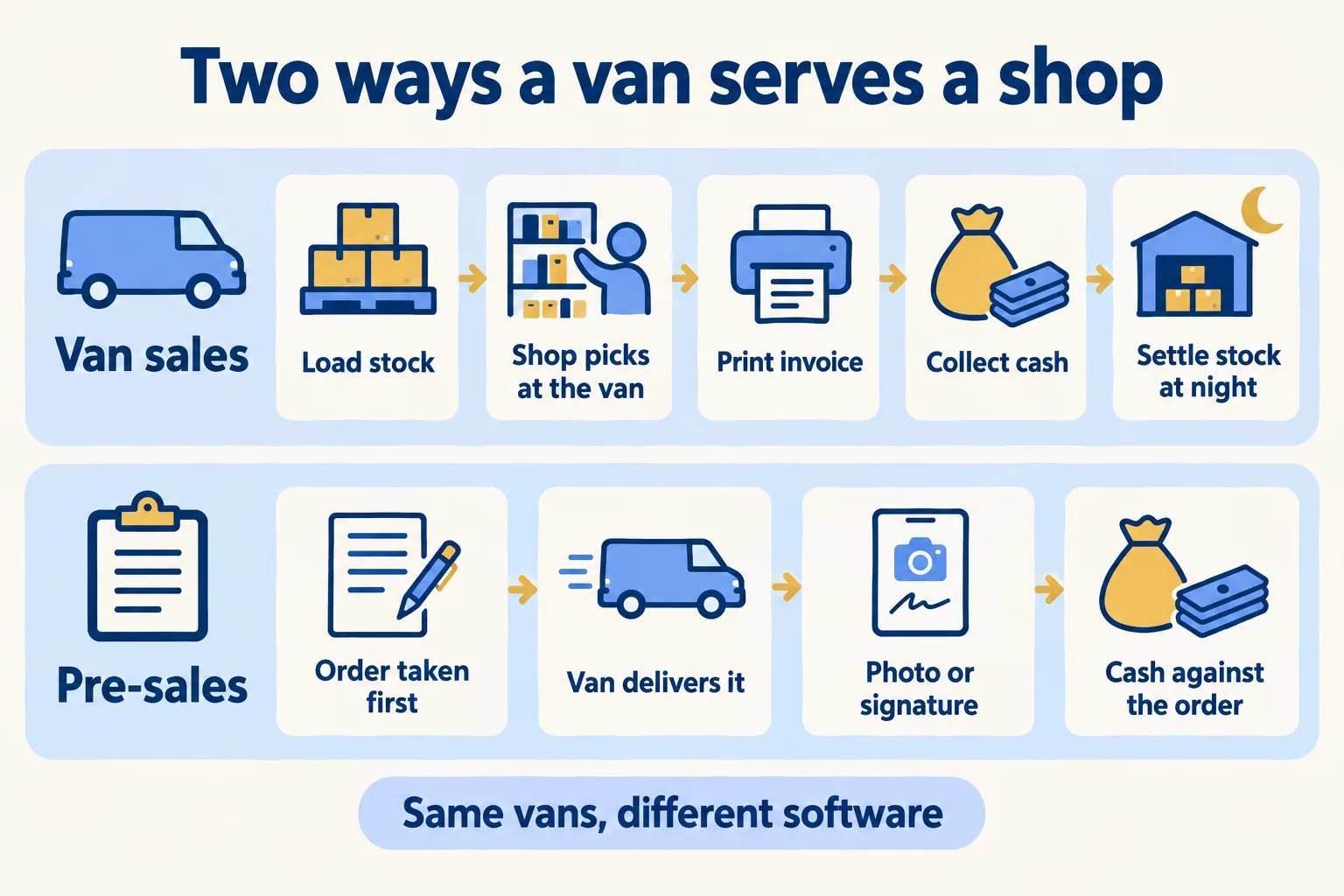
Both models use vans, drivers and cash, so both get sold "van sales software". They need different things. A van-sales driver needs to know what is on the van and print a tax invoice at the counter. A delivery driver needs to know which booked order is next, and to prove it arrived.
What did your drivers do at each stop yesterday?
Our test, so you can run it before the next demo:
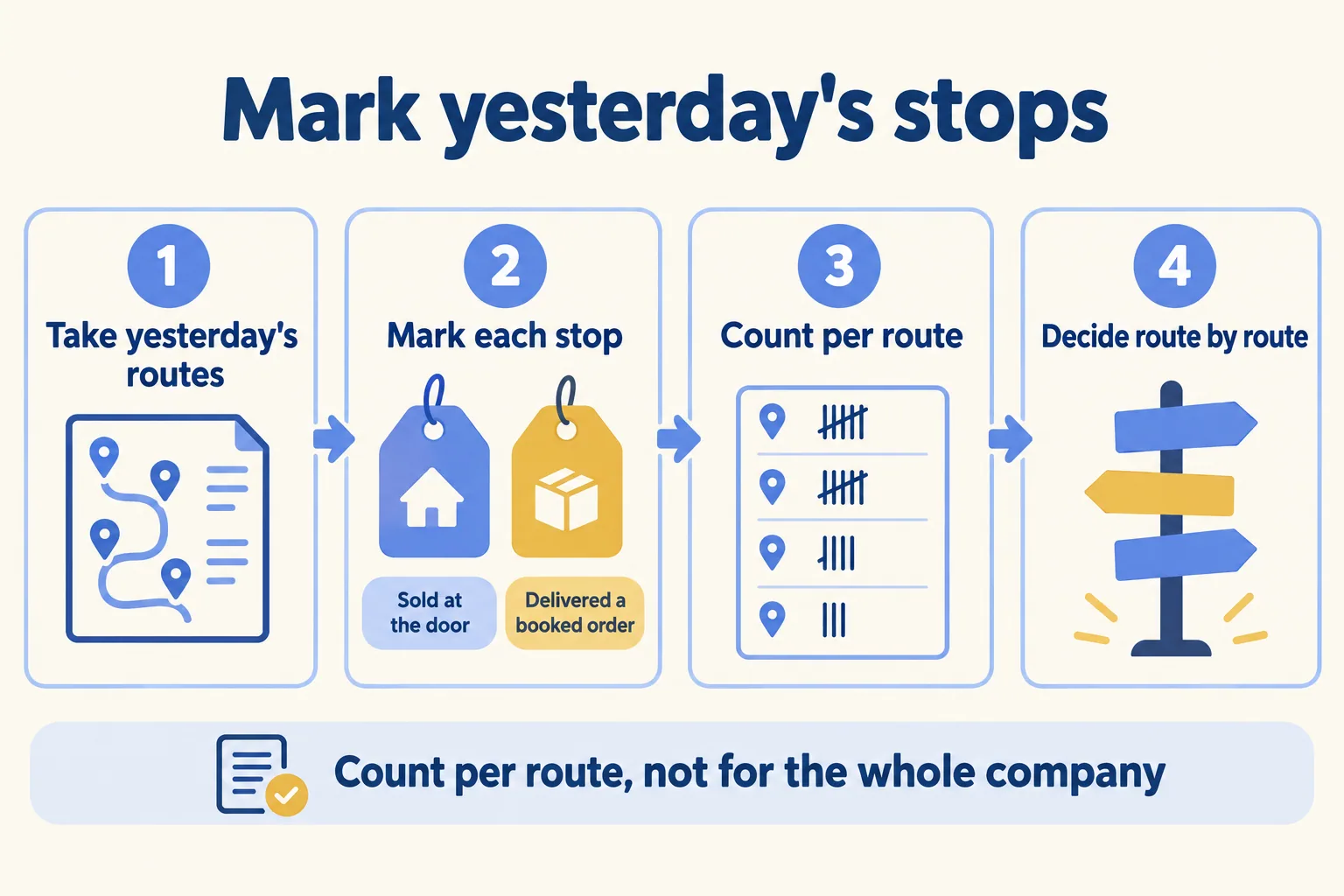
- Take yesterday's route sheets, or the dispatcher's WhatsApp group if that is where the day lives.
- Mark each stop with one of two labels. Sold at the door: the shop chose what to buy from what was on the van. Delivered a booked order: the quantity was agreed before the van left.
- Count the two labels per route, not for the whole company. A booked stop where the shop adds two cartons off the van counts as sold at the door; if that happens at most stops, the route is a van-sales route.
- Decide route by route.
Here is a sample, labelled as one, for a Dubai beverage and water distributor with four routes. It shows how the marking reads, not a client's day.
| Route | Stops | Sold at the door | Delivered a booked order |
|---|---|---|---|
| Al Quoz groceries | 26 | 24 | 2 |
| Deira cafeterias | 22 | 19 | 3 |
| Offices, Business Bay | 18 | 0 | 18 |
| Villas, Mirdif (5-gallon) | 31 | 2 | 29 |
The first two routes run van sales. The last two run deliveries against orders taken on the phone, on WhatsApp or by the office. This distributor needs both kinds of software, on different routes. One kind sold to all four routes would fit half of them.
Why is the van's stock the hard part?
Because on a van-sales route the warehouse is driving around. eBest, another vendor of van-sales software, puts it this way: "The moment a van leaves the depot, the brand's inventory is sitting in a vehicle." Its evening check is one line: "load-out minus sales minus returns should equal what is physically back on the van, and the cash collected should match the day's invoices."
TABSYST, a UAE vendor, describes what it looks like when the van's records and the books disagree: "the van reports 40 cases sold, the books show 38, and someone spends the start of every month reconciling the difference."
That is the tell. If stock leaves the depot unsold, the core of what you need is a stock ledger for each van. If every case on the van already belongs to an order, the night check is per order: delivered, proved, paid. A water route still counts its empties, and our Dispatch page has the driver log "bottles, cash or coupons with a photo at each gate", against the order.
When is a van-sales app the right buy?
When most stops on a route are "sold at the door", buy a van-sales app, and not from us. It is the right buy when:
- The shop decides at the counter. Groceries, cafeterias and baqalas that buy what they see on the van, in small daily quantities.
- The driver prints the tax invoice at the shop. The app has to hold prices, the customer's credit limit and the invoice, at the counter.
- Stock and cash have to settle every night. Load, sales, returns and damages per van, and cash per driver.
One vendor that sells both models prices them as separate tiers. Orderwerks' page, read on 27 November 2026, says that if your operation is "pre-sell (orders placed in advance, drivers deliver only)", its base delivery product covers you. Van selling is its Pro tier, with truck inventory, load sheets and end-of-day reconciliation: USD 150 a month plus USD 50 per driver, on top of a USD 60 office seat, against USD 150 plus USD 25 per driver for the delivery-only tier. The extra cost is the van's stock.
What if your routes run both?
Most do. TABSYST writes that "most UAE distributors run a hybrid": van sales for fast lines such as water, bread and dairy, pre-sales for larger baskets and slower lines.
The trade-off is throughput. Rework, which publishes route-to-market guides, gives an industry range: a van sales rep "typically visits 20-30 outlets per day versus 35-50 for a pre-sell rep", because each stop includes the delivery. That is their range, not Gulf data, but it explains why a distributor moves its bigger accounts to pre-sales as it grows.
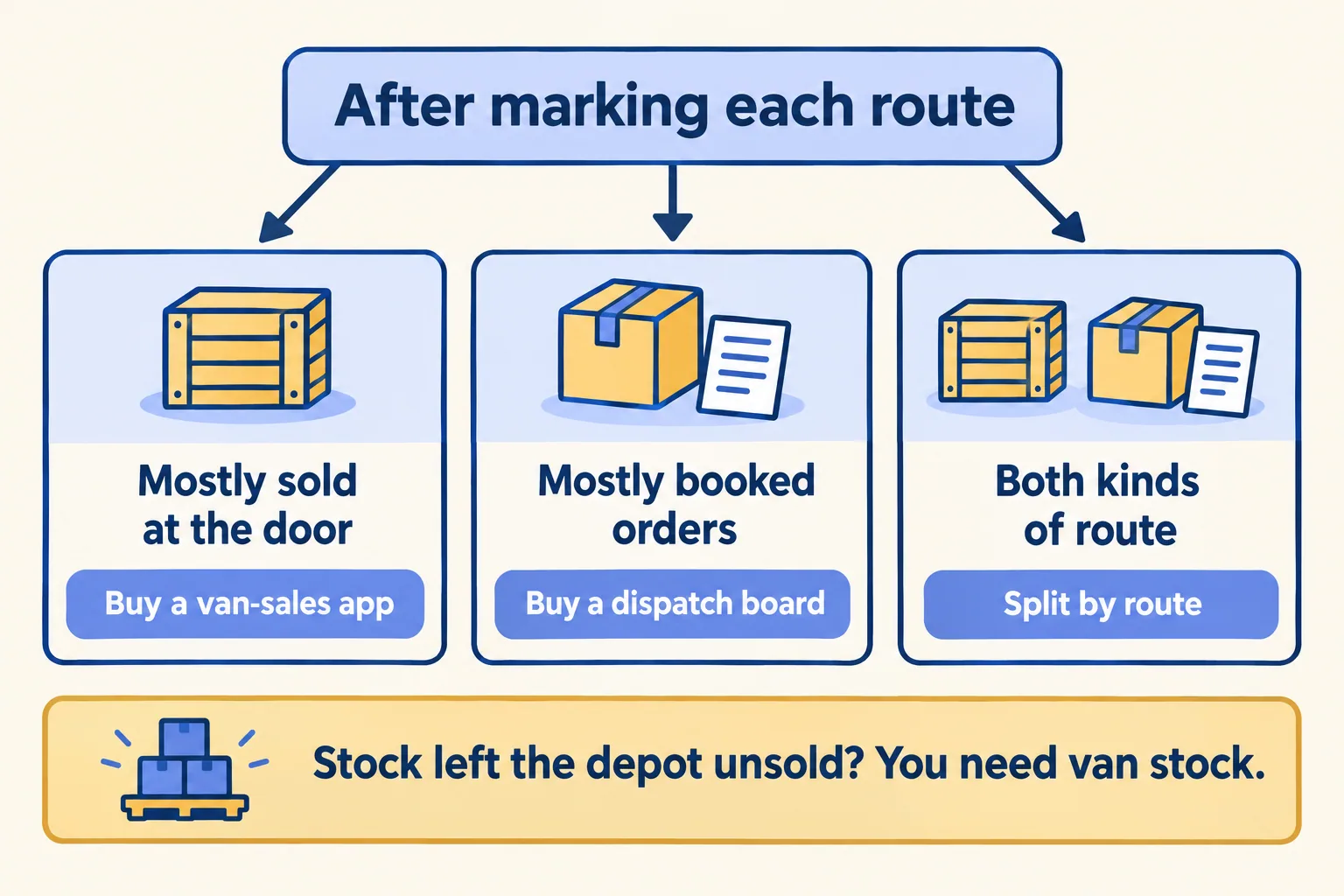
So the question for a hybrid distributor is which software runs which routes, and how the two meet at night. Each one should hand a per-driver cash total to the same accounts, so your accountant matches two exports, not two cash bags by hand. Ask both vendors to show that export before you sign. If your van-sales routes are the bigger business, start there. If the booked orders are where the calls, disputes and short cash come from, start with the board, and keep the van-sales routes on what they use today.
What does a dispatch board do with a booked order?
It carries an order that already exists to the door and closes it with proof and cash. Our Dispatch page states cash on delivery as working today: "Cash is recorded per order, and each driver's total is there before the van is back." Invoices are "billing from the orders themselves, passed to your ERP or e-invoicing provider". The page's FAQ adds that every status change is kept with its time, and the day exports to your ERP.
What the board does not do is the van-sales half. It keeps no stock on the van, has no load sheet, and prints no tax invoice at the shop counter. That is the line between the two, and it is why we tell van-sales routes to buy a van-sales app.
On the delivery routes, the usual losses are a disputed drop and short cash at night. We wrote about a customer who signs for 48 when the invoice says 50, and how to sort whether your losses sit on the van or the order.
Our method has a name, WhatsApp to dispatch board. The phone and WhatsApp orders go on one board first, then each driver gets the day's stops on a phone, then the proof and the cash close each order.
What would the board cost?
From our Dispatch page today, on the shared plan hosted in the UAE:
- Per driver, per month: AED/SAR 119 for drivers 1 to 10, then AED/SAR 59 for drivers 11 to 50. Each band applies only to the drivers inside it. Dispatchers, admins and finance users are free.
- Minimum: 3 drivers, AED/SAR 357 a month.
- Worked example on the page: 30 drivers pay 10 x 119 + 20 x 59 = AED 2,370 a month.
- Setup, one time, done with you: AED/SAR 7,500 up to 10 drivers, AED/SAR 14,900 for 11 to 50.
- Billed at cost: WhatsApp and SMS messages, Google Maps and payment gateway fees. Prices exclude 5% UAE VAT and 15% Saudi VAT. No per-order fees.
A hybrid distributor pays only for the drivers on the board. Drivers on van-sales routes stay on their van-sales app. Our delivery industry page shows where the board fits for distributors with their own drivers.
Who is this not for?
If most stops on your routes are "sold at the door", with stock on the van and the invoice printed at the shop, buy a van-sales app. A dispatch board will not settle your van stock at night.
If most stops are booked orders, tell us how many drivers run those routes and how the orders reach them today. Under WhatsApp to dispatch board, we reply with the setup plan and the monthly price per driver, in AED or SAR.
