

If you were quoted a fleet management system and your real losses are orders, proof and cash at the door, this is for you. It is not for a fleet with no customer orders to prove, such as leasing, rental or staff transport.
What does a fleet management system manage?
The vehicle. Wikipedia's entry on fleet management software describes tasks that run "from vehicle acquisition through maintenance to disposal". Its list of functions reads like a van's paperwork:
- The vehicle: maintenance, licensing and registration, insurance due dates, costs.
- The driver: licence records, penalty points and infringements.
- Incidents: accidents and fines, and which driver they belong to.
- Tracking: telematics, route planning, logbooks and alerts.
That is real work in Dubai. RTA's renewal page says vehicle ownership is valid for one year, and RTA checks that the insurance and the technical inspection are valid before it renews. Its FAQ says vehicles on a company's traffic file are inspected yearly. Miss the renewal by two months and the traffic file is blocked. With 20 vans, that is 20 dates a year that can take a van off the road.
What the list does not hold is the customer. No order, no proof that it arrived, no cash. A vendor that sells delivery software put the split plainly: "There is a real difference between knowing where a truck is and knowing whether a delivery happened. Telematics and GPS answer the first."
Which column do your losses sit in?
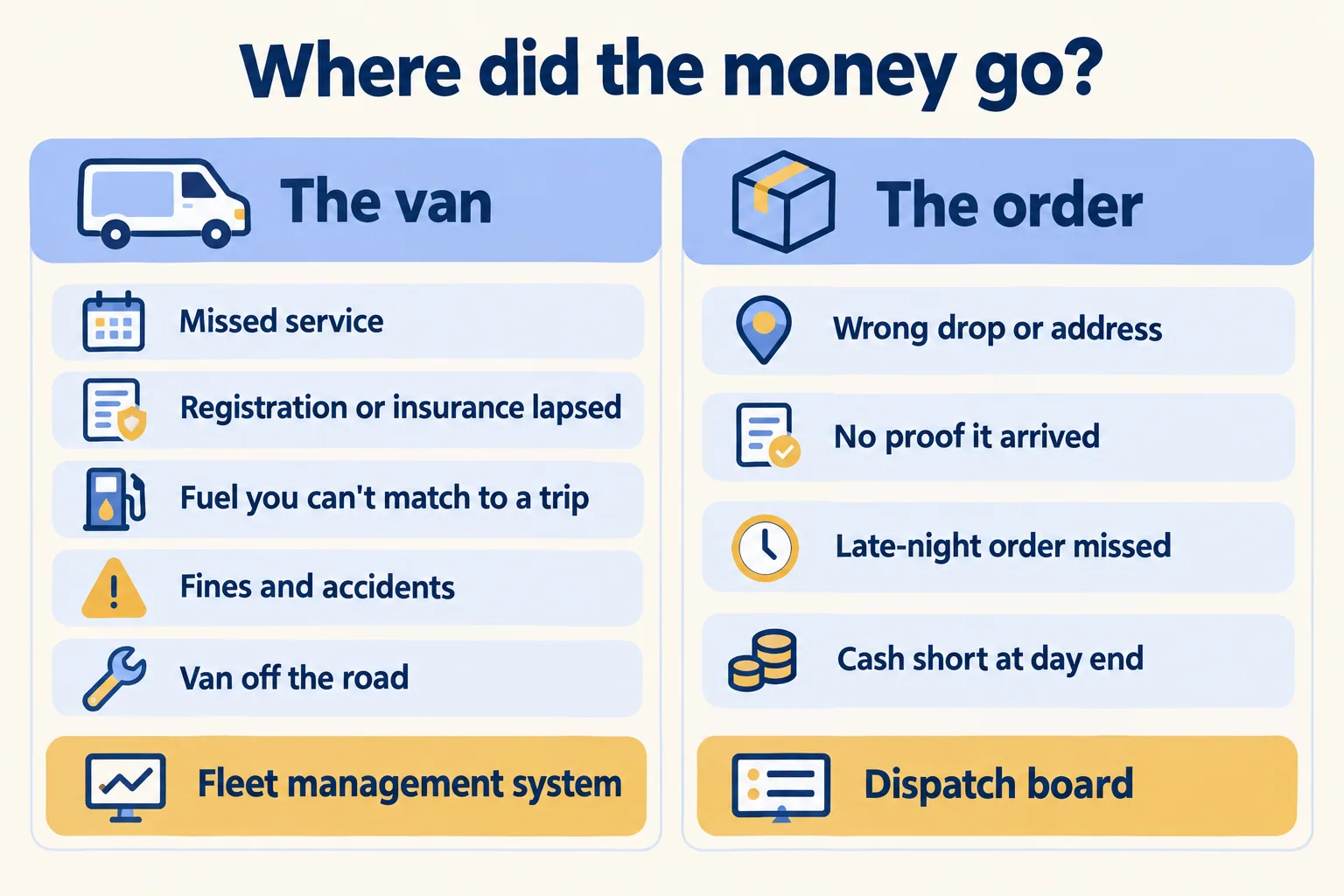
Two columns. Every loss you had last month belongs in one of them.
The van column. A service missed and an engine repair that followed. A registration or insurance renewal that lapsed. Fuel nobody can match to a trip. A fine that nobody can pin on a driver. A van off the road for a week.
The order column. The wrong drop or the wrong address. A customer who says it never arrived, and nothing but the driver's word. An order that came in on WhatsApp at 11 pm and was never delivered. Cash that does not match the day's orders.
The order column is where a distributor's money tends to leak quietly. In a case Khaleej Times reported in July 2024, a Dubai trading company's driver, who delivered goods and collected payments, kept Dh114,966 over more than two years. It came to light only when he went on leave and the replacement driver found that client payments did not match the company's records. A fleet system would have known exactly where that van was every day. It would not have matched one payment to one order.
How do you sort last month's five worst days?
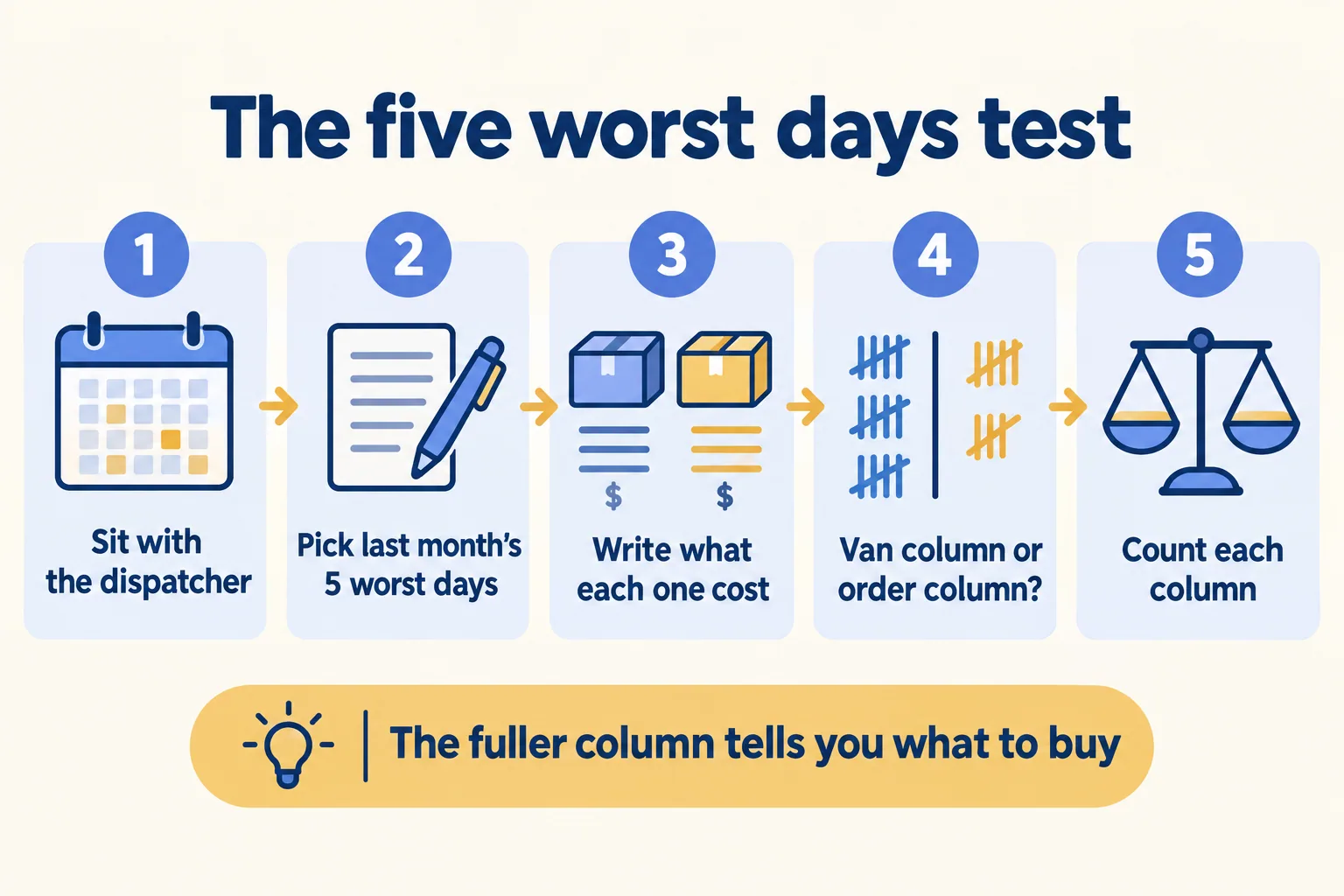
Our test, so you can run it this week:
- Sit with the dispatcher and last month's WhatsApp group.
- Pick the five worst days. The day the phone did not stop, the day a customer escalated, the day the cash was short.
- For each day, write one line: what was lost, in money or hours.
- Put each line in the van column or the order column.
- Count.
Here is a sample, labelled as one, for a Dubai water distributor with 14 vans. It shows how the sorting reads, not a client's month.
| Day | What went wrong | Column |
|---|---|---|
| 3rd | A villa says the bottles never came; the driver says he left them at the gate | Order |
| 9th | One van off the road: registration expired, inspection not booked | Van |
| 14th | Evening cash count short; nobody can say which orders were unpaid | Order |
| 21st | Three orders from the 11 pm WhatsApp messages missed on the morning route | Order |
| 27th | A coupon book disputed at the door, no photo | Order |
Four in the order column, one in the van column. This distributor is being sold a fleet system and needs a dispatch board. The one van day still matters, and the board's van records cover it.
When is a fleet management system the right buy?
When the van column is the full one, buy fleet software, and not from us. It is the right buy when:
- You have no customer orders to prove. Leasing, rental, staff buses, a sales team's cars. The vehicle is the whole job.
- Your losses are fuel, accidents and fines. You need fuel-card data, accident records and fines tied to drivers, and driver-behaviour scoring.
- You run a large fleet of leased or mixed vehicles with registrations, insurance and lease returns falling due every week.
If both columns are full, run both: fleet software for the vehicles, a dispatch board for the orders. They answer different questions, so they rarely fight.
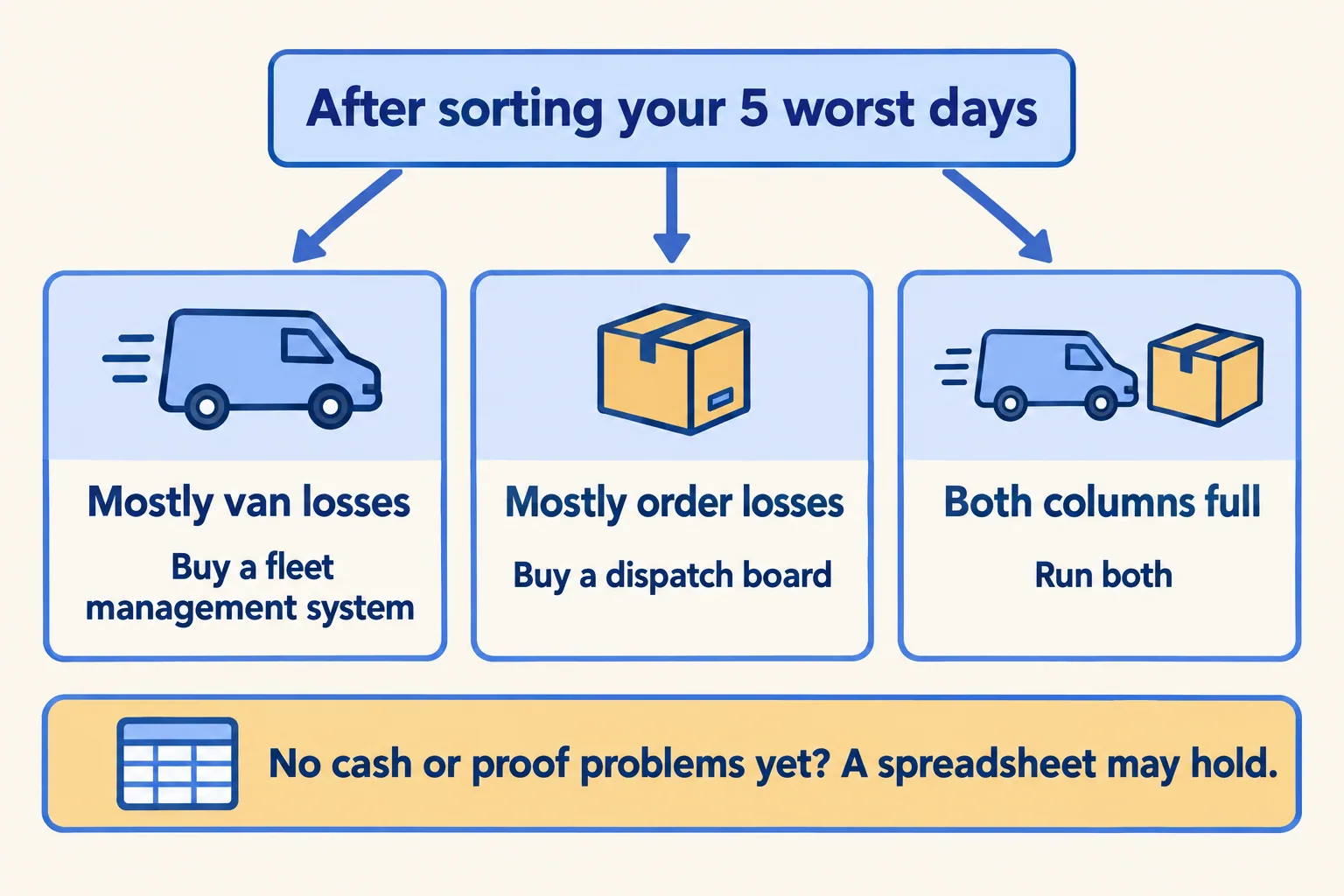
There is also a case for buying nothing yet. One delivery-software vendor argues that "under about ten vehicles, a spreadsheet plus a phone link genuinely does the job". That is a vendor's line, not a rule, and our own page starts at 3 drivers. The better test is still your five days: if none of them was about cash or proof, a spreadsheet may hold for now.
What does a dispatch board keep about the van?
Enough for a distributor whose losses are mostly orders. Our Dispatch page lists van maintenance as included: "Inspections, service schedules, fuel and each driver's licence number on file." Cash on delivery works today: "Cash is recorded per order, and each driver's total is there before the van is back."
What the page does not list is GPS hardware, fuel sensors, accident management or driver scoring. If those are your loss, a tracking or fleet vendor is the right call. We set out the tracker side, with a UAE vendor's prices, in GPS tracker or dispatch board. And if your order-column days were mostly "it never arrived", read how much proof each delivery needs first.
The page's own before and after for a water distributor is the evening cash count. Before: "coupon disputes at the villa gate and a cash bag counted at 10 pm." After: "the driver logs bottles, cash or coupons with a photo at each gate." Gas is the same column with a licence on top: the page notes that licensed gas suppliers in Dubai have to show who delivered which cylinder.
Our method has a name, WhatsApp to dispatch board, and it starts with the orders. The WhatsApp and phone orders go on one board first, then each driver gets the day's stops on a phone, then the proof and the cash close each order. The van records come along in the same setup.
What would the board cost?
From our Dispatch page today, on the shared plan hosted in the UAE:
- Per driver, per month: AED/SAR 119 for drivers 1 to 10, then AED/SAR 59 for drivers 11 to 50. Each band applies only to the drivers inside it. Dispatchers, admins and finance users are free.
- Minimum: 3 drivers, AED/SAR 357 a month.
- Worked example on the page: 30 drivers pay 10 x 119 + 20 x 59 = AED 2,370 a month.
- Setup, one time, done with you: AED/SAR 7,500 up to 10 drivers, AED/SAR 14,900 for 11 to 50.
- Billed at cost: WhatsApp and SMS messages, Google Maps and payment gateway fees. Prices exclude 5% UAE VAT and 15% Saudi VAT. No per-order fees.
Our delivery industry page shows where it fits for couriers and distributors with their own drivers.
Who is this not for?
If your fleet has no customer orders to prove (leasing, rental or staff transport), buy a fleet management system and skip the board. If your five worst days were all about fuel, accidents and fines, the same goes for you.
If they were about orders, proof and cash, tell us how many drivers you run and how orders reach them today. Under WhatsApp to dispatch board, we reply with the setup plan and the monthly price per driver, in AED or SAR.
