
If your HR team emails increment letters in December and updates the MOHRE contract only at visa renewal, this is for you. It is not for an employer whose staff sit in DIFC, ADGM or a free zone with its own contract rules: check with that authority first.
What is an increment letter, and what does it not change?
An increment letter is the employer's written notice of a new salary: the new amount, the date it starts, and what stays the same. Once the employee signs it, it is also the employee's acceptance on record.
What it does not do is change the contract registered with MOHRE. For a mainland employee, that registered contract holds the wage. A letter that says AED 14,000 sits beside a contract that still says AED 12,000 until someone changes the contract itself.
Search for "salary increment letter" and every top result is a template. None of them mentions the second step, which in the UAE is the part that decides whether payroll and the registered contract agree. So this post gives you an outline for the letter and spends the rest on the two steps outside it.
Which raises also change the MOHRE contract?
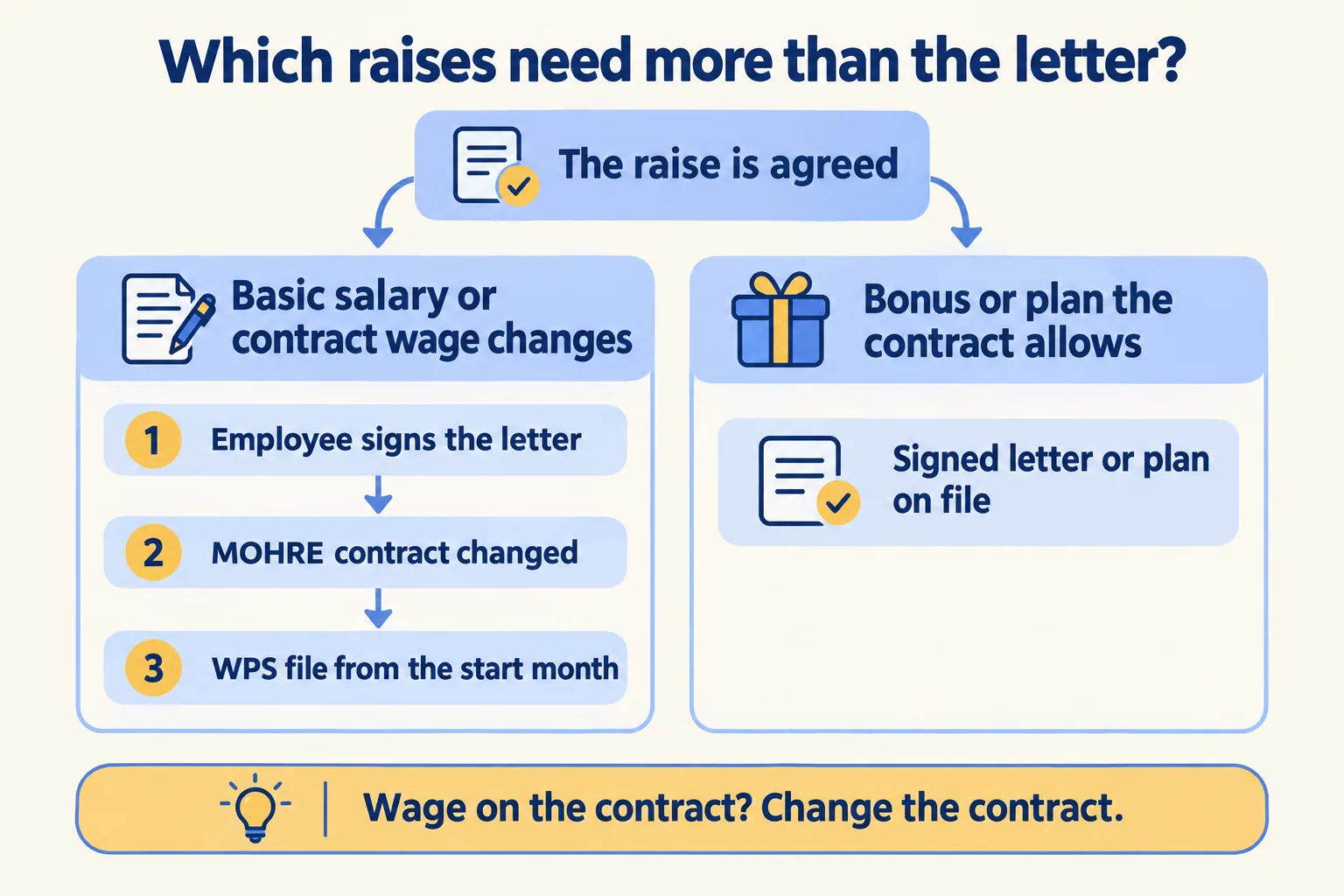
Our rule: if the raise changes the basic salary or the wage written on the registered MOHRE contract, the letter is step one of three. The employee signs the letter, your authorised signatory changes the MOHRE contract, and payroll pays the new figure through WPS from the month it starts.
A raise to housing or transport alone counts too, when the allowance is on the registered contract: Lexis Middle East's HR Alert names "any change to salary, allowances, or working arrangements (which impact salary)" (more on that below). A one-off bonus, or a commission or bonus plan the contract already allows, is different. A signed letter or signed plan is the record, and the registered contract does not change. Payroll still pays the bonus in the salary file for the month it is paid, as it does any other payment. If your contract writes commission or an allowance into the wage itself, changing it is a contract change. Ask your lawyer which side yours sits on.
The MOHRE route is its Modification of Work Permits / Employment Contracts service. Its page, read on 27 November 2026, lists:
Lawyers do not all read the rule the same way. A Dubai firm, Almaazmi, writes that "MOHRE does not currently mandate re-registration of every contract addendum", and in the same paragraph that a raise missing from the WPS file "can trigger a compliance flag, freezing the employer's ability to renew or obtain new work permits." We follow the stricter reading, because the cost of the change is two working days and AED 50, and the cost of a flag is your work permits. This is not legal advice; ask your lawyer about your own contracts.
Why waiting for the visa renewal costs more now
The old habit was to leave the registered contract alone until renewal. An employment lawyer, Natalie Jones of Mishcon de Reya, described it in Lexis Middle East's HR Alert in January 2026: "it has been more common, for employers when employees have received annual salary increases, to wait until the residence visa (if applicable) and work permit renewal time to update employment contracts." Work permits tend to run for two years, she adds, so "many registered employment contracts may have been inaccurate for at least part of that period."
That gap now shows up in payroll. The same article says WPS salary payments "are monitored and cross checked against detailed payroll data employers are required to submit and official employment contracts filed with the authorities." And: "Any change to salary, allowances, or working arrangements (which impact salary) must be updated in official systems before payroll is processed."
An HR software vendor, RadixHR, put the same point in its September 2026 guide to raise season: "The updated figure has to flow into the contract and the SIF for the cycle the raise takes effect." The SIF is the WPS salary information file your bank sends each month.
So a raise from 1 January that is still a letter in an inbox on payroll day is a mismatch: the bank pays one figure and the registered contract shows another.
What goes in the letter?
Fewer words than the templates use, and more figures. A written promise can bind you. Almaazmi's guide says a promise of a salary increase "whether in an email, a letter or a performance review document" can be a binding variation "if it is sufficiently certain in its terms and accepted by the employee." The other side of that is a letter vague enough to mean nothing. A Khaleej Times reader wrote in 2023: "At the time of joining, the company assured me that they would increase my salary and promote me after two years. But this didn't materialise despite my regular reminders."
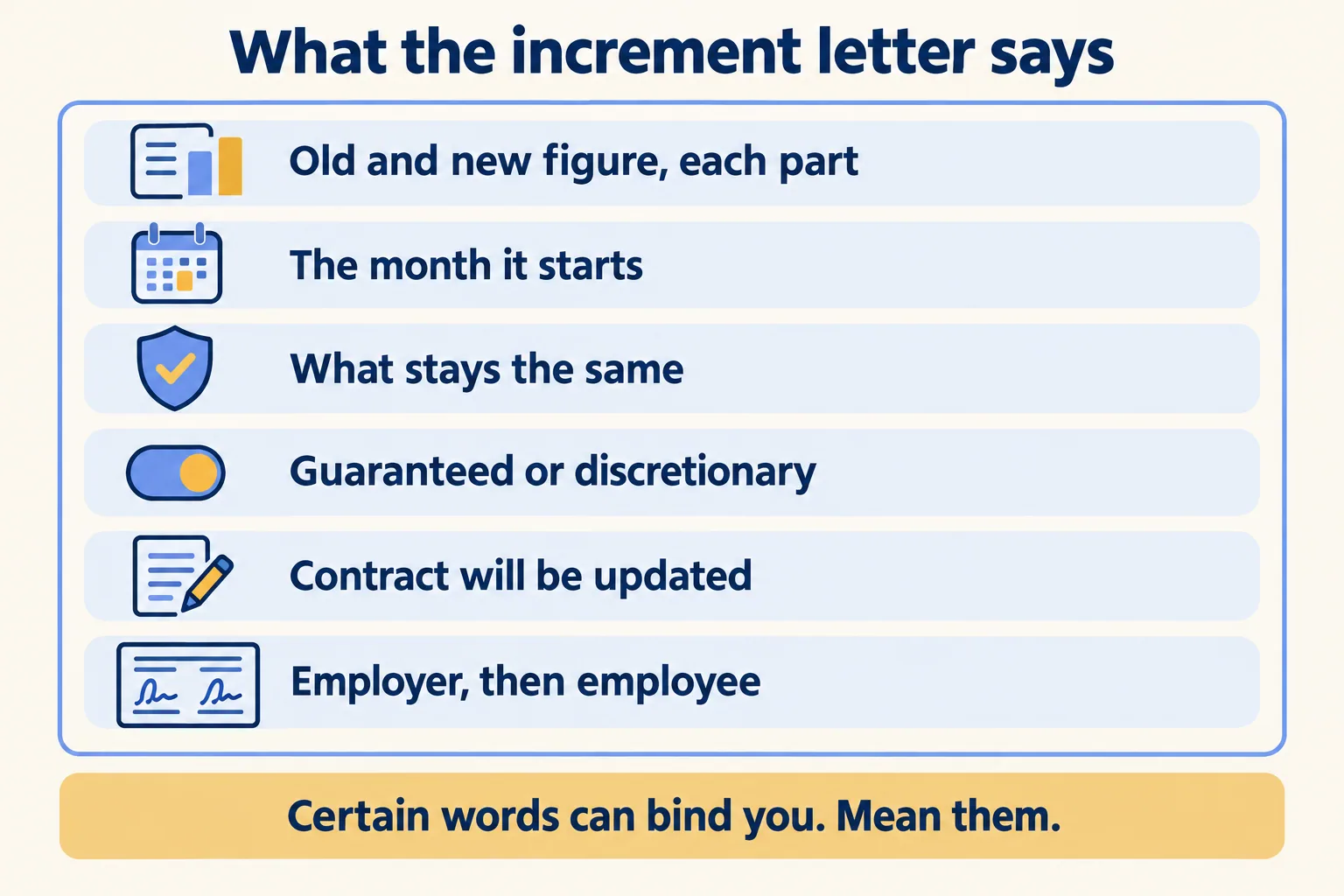
Our outline, for a letter that means exactly what you intend:
- The old and the new figure for each part: basic, housing, transport, any other allowance, and the total.
- The month the new figure starts, and the first payroll it lands in.
- What stays the same: title, hours, notice, and every other term of the contract.
- Whether any part is discretionary. Almaazmi suggests wording such as "at the sole discretion of the employer and forming no part of the guaranteed wage" for a bonus you do not mean to guarantee.
- One line saying the employer will update the registered contract to match.
- Two signatures: the employer's authorised person, then the employee.
The letter can go by link. Federal Decree-Law 46 of 2021 lets you use any form of electronic signature unless another law sets a form for that document, and the Sign page's law table puts your own letters on the link side: "The MOHRE offer and contract for mainland staff stay in the MOHRE process." The employee signs on a phone with no app or account, and HR gets the signed PDF with an audit log of every event.
The order we run on raise day
- 01Agree the figure and the month: basic, each allowance and the total, and the payroll month the raise starts.
- 02Send the letter as one link per employee. The signed PDF and its audit log are the acceptance.
- 03Your authorised signatory changes the MOHRE contract through MOHRE's modification service. MOHRE lists 2 working days.
- 04Payroll puts the new figure into the WPS salary file for the month the raise starts, not the month someone remembers.
- 05File the pair: the signed letter and the updated MOHRE contract, together, against the employee.
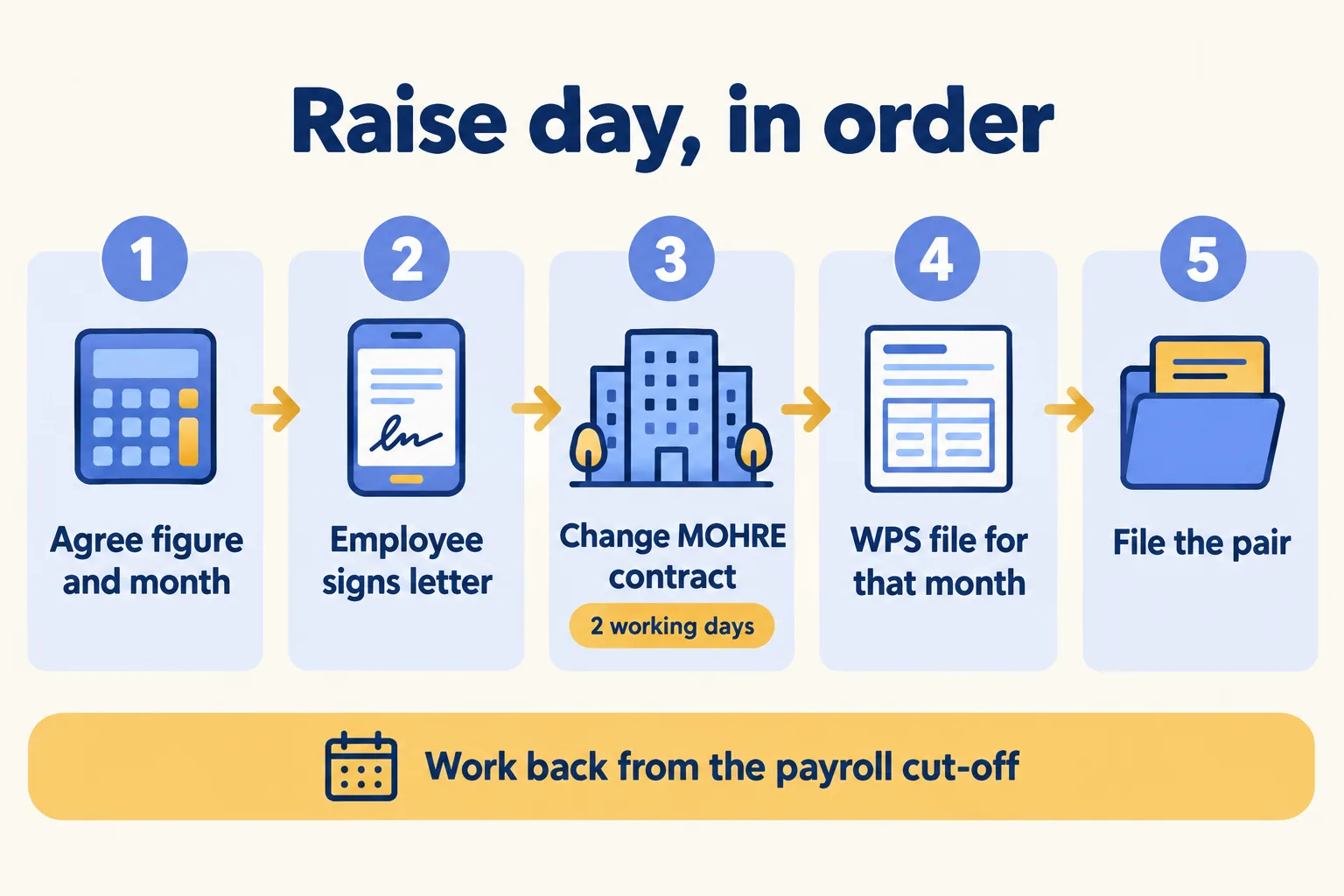
Work backwards from payroll. For a January raise, the letters go out early in December, so the MOHRE changes are done well before the January cut-off. MOHRE asks for the contract "signed by both the employer and employee", so the employee signs the contract change as well as the letter. A signed letter on file makes that conversation short.
We covered the other papers HR sends after the MOHRE contract, and which go by link, in MOHRE contract signed? What HR sends next. This post is about one event in that list: the raise.
Three tools, three jobs. Mindcat Sign sends the letter and records the signature. Mindcat People runs the monthly payroll that makes every slip and the WPS file. Mindcat Vault holds the signed copy. None of them files anything with MOHRE: the contract change stays with your authorised signatory in the MOHRE process.
Who can keep doing it by email?
A company that gives two or three raises a year, where one HR person already changes the MOHRE contract the same week. A link adds little at that size. Keep the routine, and use the letter outline above.
When raise season means dozens of letters in one month, our method is one link per signer: each letter goes to the employee as its own link, HR countersigns, and the signed PDF and audit log go on file before payroll. At Mindcat, we set up your copy and your senders in the quick start, with a guide to turning your increment letter into a template that HR fills per employee. Requests go by email; to send one on WhatsApp, HR copies the signer's link and pastes it. Automatic reminders, SMS codes, bulk sending from a spreadsheet and your logo on the signing page come from a paid upstream licence, quoted at cost.
The price, from the live page: AED 69 per sender a month for the first five senders, with a shared-plan monthly minimum of AED 349, so an HR team of one or two senders pays AED 349 a month. Employees who sign are free and unlimited, with no cap on documents. The quick start is AED 2,500, fixed, for up to 20 senders: we set it up for you. Prices exclude 5% UAE VAT.
Tell us which letters HR sends in raise season, and who signs each. We reply in writing within 24 hours with the setup plan and the monthly price per sender.
