
If you still print the company contract, the handbook sign-off and the NDA for every new hire after the MOHRE contract is done, this is for you. It is not for an employer who only needs the MOHRE forms, or for a free-zone employer whose authority runs its own contract form: check with that authority first.
Why is there a second contract at all?
Because the MOHRE contract is short on purpose. Clyde & Co's UAE guide on Mondaq puts it plainly: the MOHRE employment contract contains "only basic information and cannot be materially amended. It is therefore common for UAE employers to implement an additional English language company employment contract", covering duties, bonuses, incentives, confidentiality and what happens after the job ends.
The ministry allows that second layer. Ministerial Decree No. 46 of 2022, Article 2(1), tells the employer to use the approved standard contract and adds: "it is also permissible to add Annexes to the contract provided that it does not conflict with the provisions of the decree-law and its executive regulations."
So a mainland employer usually ends up with one contract registered in MOHRE and a handful of papers beside it. The question for HR is not whether those papers are allowed. It is which of them can go out as a link to the employee's phone, and which belong back in MOHRE.
Which papers can go by link?
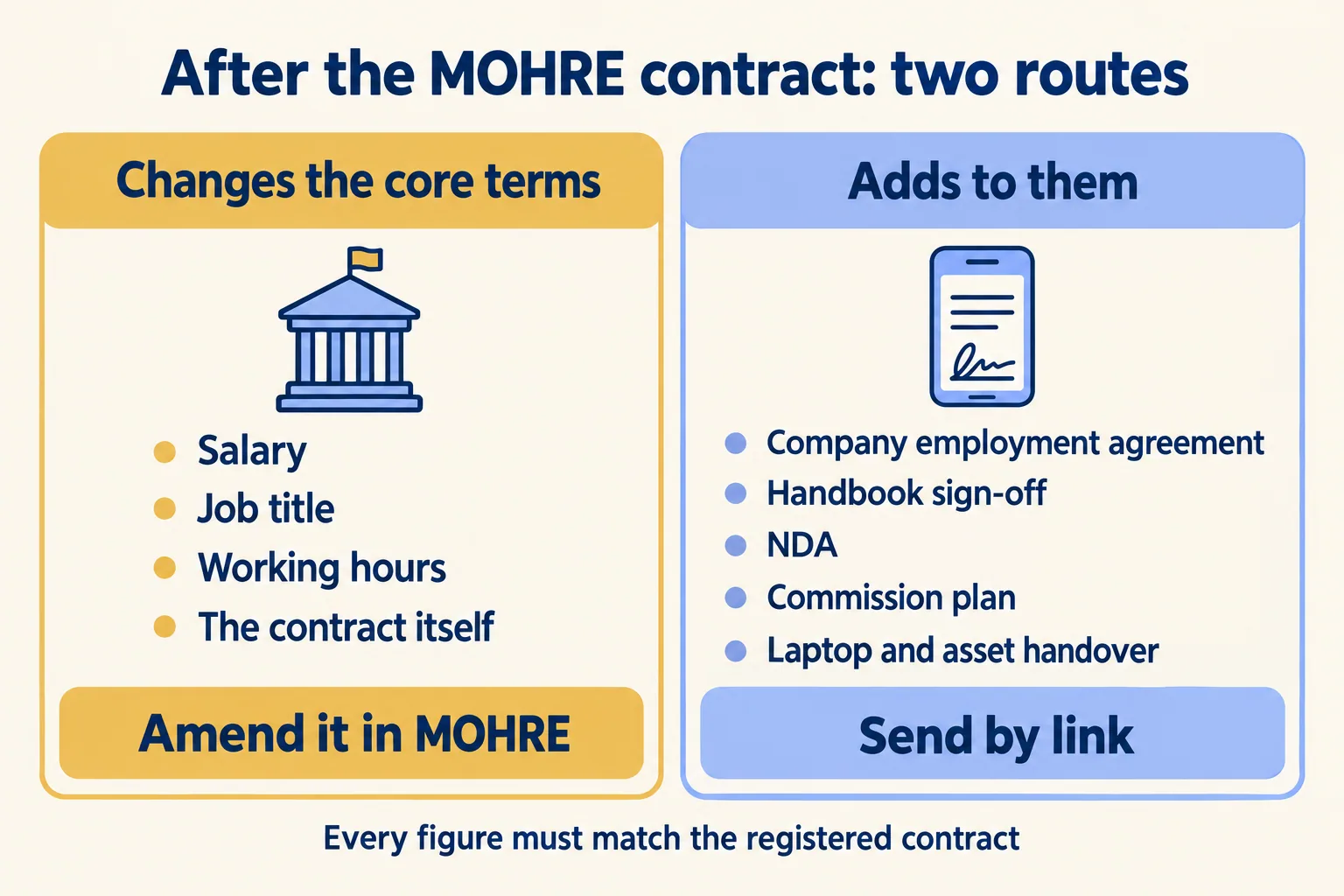
Our rule: a paper that adds to the MOHRE contract without contradicting it can go by link. A paper that changes what the MOHRE contract says cannot.
That puts these on the link side, for most mainland employers:
- The company employment agreement: duties, confidentiality, intellectual property, post-employment terms.
- The handbook or policy acknowledgement.
- The NDA.
- The commission or bonus plan, with its targets and conditions. If the commission is written into the MOHRE contract as part of the wage, changing it is a MOHRE amendment instead. Ask your lawyer which side your plan sits on.
- The laptop, phone and access-card handover form.
On the Mindcat Sign page, the law table says the same in one line: offer letters, NDAs and policy sign-offs, "Yes. The MOHRE offer and contract for mainland staff stay in the MOHRE process." The same table cites Federal Decree-Law 46 of 2021, which lets you use any form of electronic signature unless another law sets a form for that document. Each signer signs on a phone with no app or account, and HR gets the signed PDF with an audit log of every event on it.
The hire itself comes first. We covered which offer letter the ministry wants, and why its numbers must match, in offer letter by email or MOHRE. This post starts the day after that contract is registered.

What has to change in MOHRE instead?
A raise, a new job title, new working hours, or the contract itself. These are core terms, and a side letter that says otherwise does not change the registered contract.
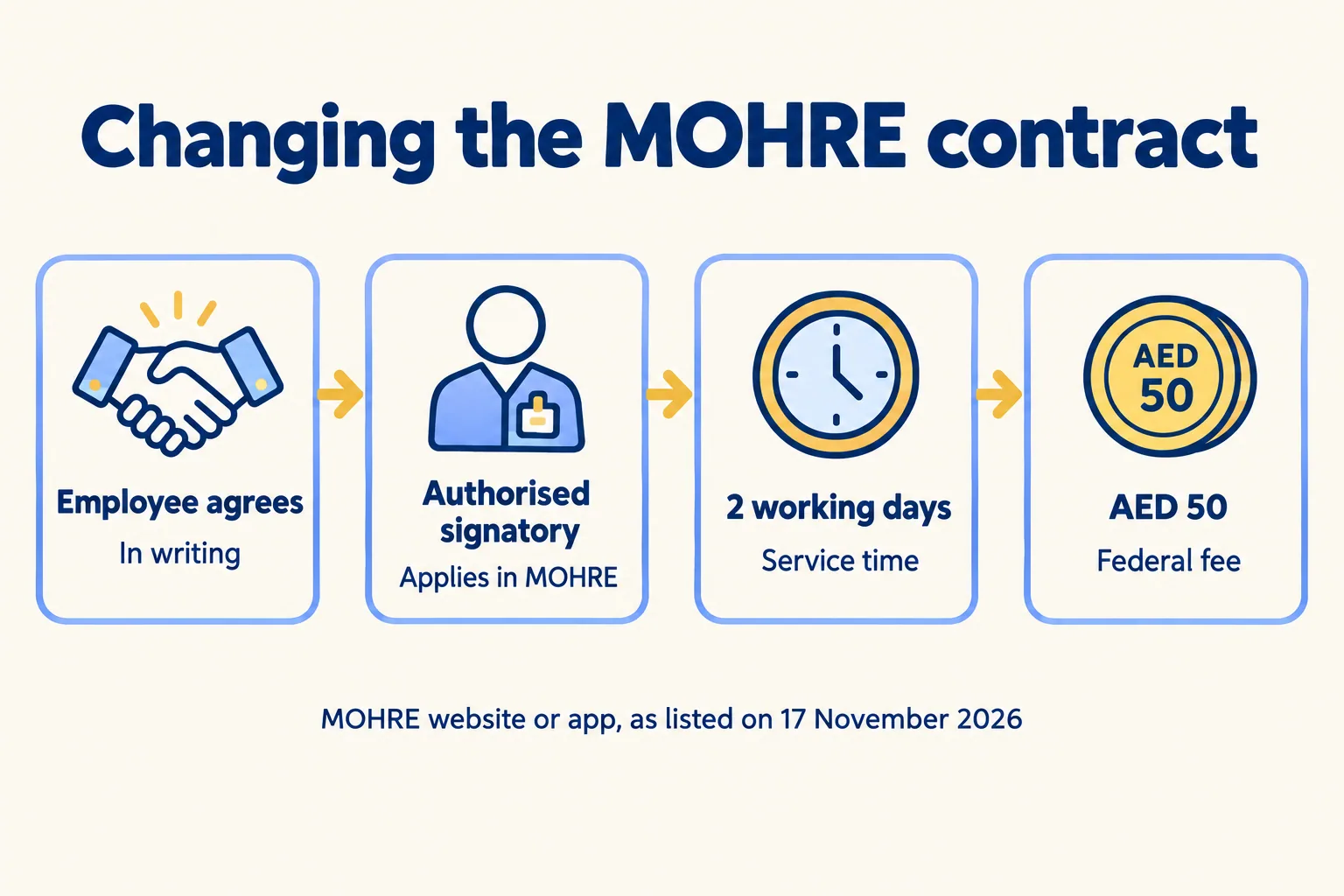
The u.ae portal sets three conditions for amending a registered contract: the worker's rights are not undermined, both parties agree, and MOHRE approves. The route is MOHRE's own Modification of Work Permits / Employment Contracts service. Its page, read on 17 November 2026, lists:
Two working days and AED 50 is not the hard part. The hard part is that nobody starts it. The raise goes out as an email, payroll pays the new figure, and the registered contract still shows the old one. Fees change, so check the page on the day you apply.
Where do the papers drift apart?
After the hire, not at it. A business writer at Bizpreneur Middle East described the pattern in September 2026: "Promotions, salary increases, commission plans, remote-working arrangements and new responsibilities are often confirmed over email or WhatsApp but never incorporated into the employee's documentation." And the result: "The offer letter says one thing, the MOHRE contract another, the employment agreement a third, and payroll follows a fourth."
From the employee's side it looks like this, from a question on Legal Advice Middle East: "In the offer letter, designation is given Buyer with a salary of AED 30000/month. However, in the MOHRE contract, the designation is mentioned as 'Industrial Electrician' and the salary is mentioned as AED 10000/month." The lawyers who answered agreed the registered contract would be treated as the official document.
When two contracts disagree, the employer does not get to pick. Clyde & Co: "Where there is a discrepancy between the terms of two employment contracts, a UAE labour court will typically apply the term which is more beneficial to the employee."
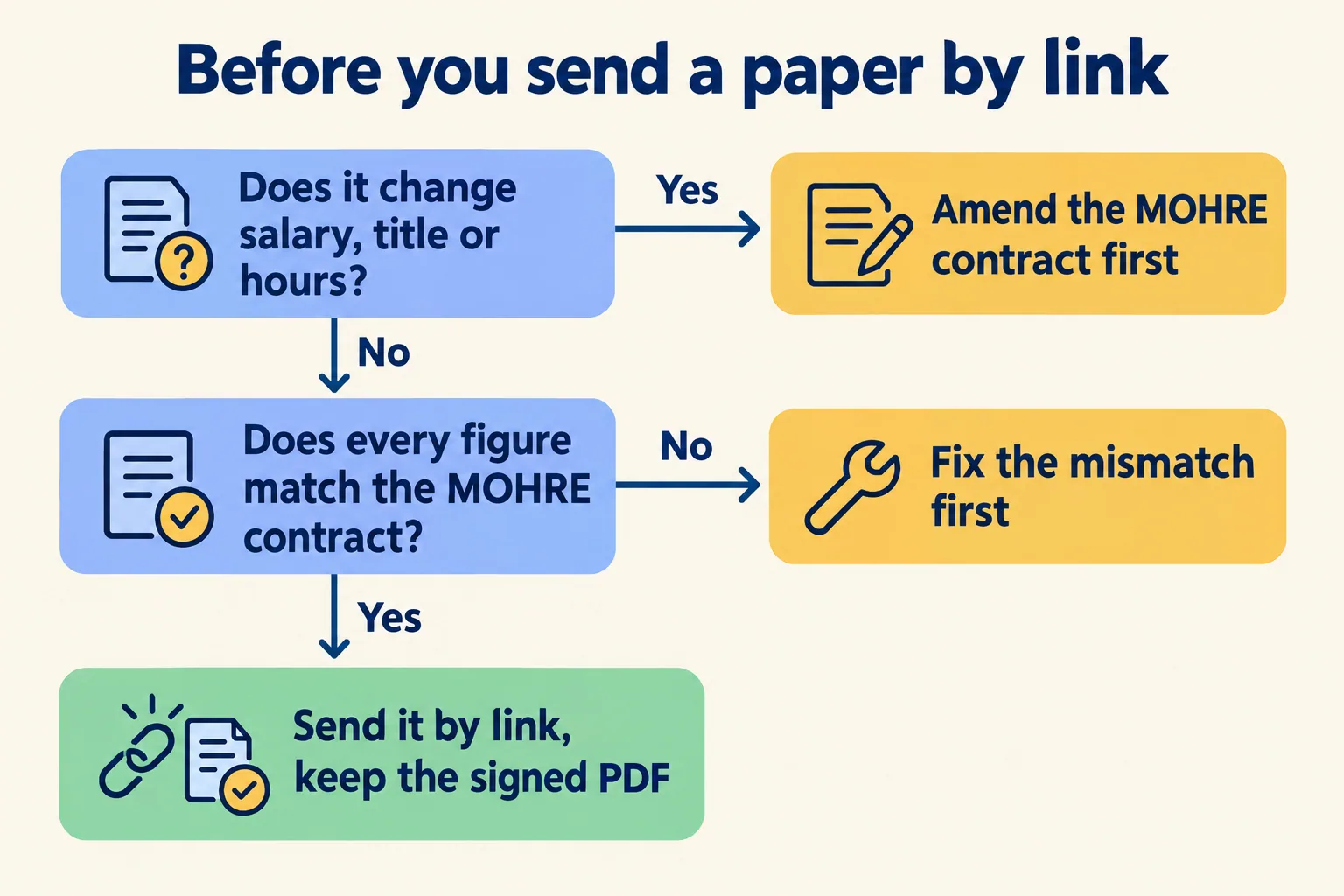
So the check we run before any HR paper becomes a template is one question: does every figure in this paper match the registered contract? Salary, allowances, title, hours, notice. If not, fix the registered contract first, then send the paper that depends on it. A signing link makes a paper faster to sign. It does not make a wrong figure right.
What do you keep, and for how long?
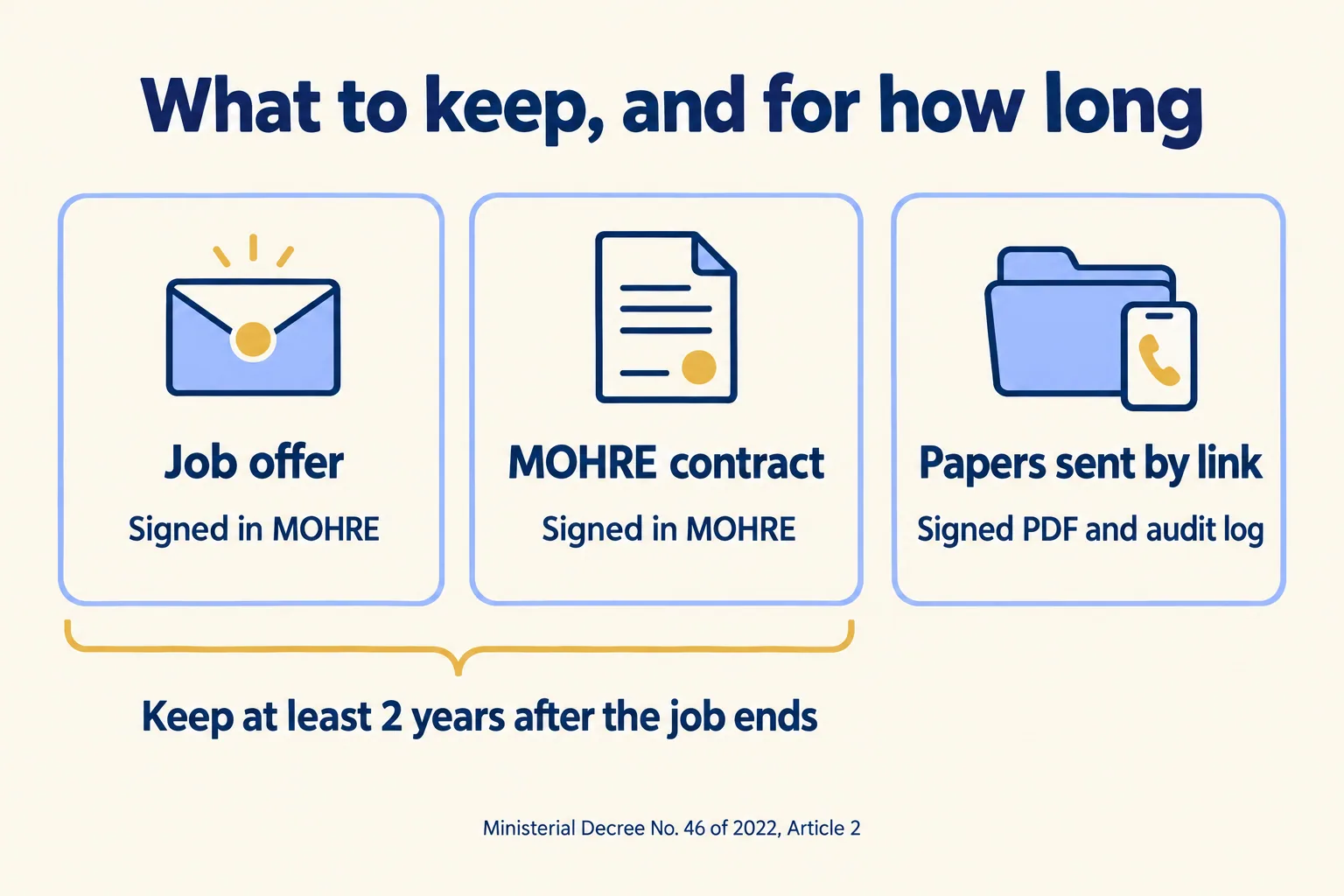
Decree 46 of 2022, Article 2(2), asks the employer to keep "a digital or hard copy of both the job offer and the employment contract for no less than two years from the date of expiry or termination of the employment relationship."
Keep the papers you sent by link the same way, as signed PDFs with their audit logs, filed against the employee. When a commission dispute or an end-of-service claim comes, the question is which version the employee signed, and on what date. A scan from a WhatsApp thread cannot answer that. A signed PDF with its log can.
Three tools, three jobs. Mindcat Sign sends the paper and records the signature. Mindcat Vault holds the signed copy and tracks its dates. Mindcat People runs attendance and payroll. None of them files anything with MOHRE: the registered contract and its changes stay in the MOHRE process. This is not legal advice; ask your lawyer about your own contracts.
Who should keep doing it on paper?
A company that hires two or three people a year, with one HR person who already has a filing routine that works. Printing four pages for each hire costs little at that size, and a new tool would cost more than the paper. Keep the routine; just run the figure check above before each paper goes out.
When the papers do go by link, our method is one link per signer: each paper goes to each person who signs it, in order, and HR keeps the signed PDF and audit log. At Mindcat, we set up your copy and your senders in the quick start, with a guide to turning your own company agreement, NDA and handbook sign-off into templates, so HR sends a link instead of a print run. Requests go by email; to send one on WhatsApp, HR copies the signer's link and pastes it. Automatic reminders, SMS codes and your logo on the signing page come from a paid upstream licence, quoted at cost.
The price, from the live page: AED 69 per sender a month for the first five senders, with a shared-plan monthly minimum of AED 349, so an HR team of one to five senders pays AED 349. New hires and staff who sign are free and unlimited. The quick start is AED 2,500, fixed, for up to 20 senders: we set it up, with no call. Prices exclude 5% UAE VAT. In our earlier post on signing online, we covered the other side of this: asking the receiver what they accept before you send.
Tell us which papers HR sends after the MOHRE contract, and who signs each. We reply in writing within 24 hours with the setup plan and the monthly price per sender.
