
If your training plan is the client's course list copied into a sheet for every trade, this is for you. If you run one trade on one site and the client checks its own fixed list, it is not.
What is a training needs analysis for a contractor?
It answers two questions per trade: which gaps in knowledge or skill get in the way of this work, and which of them a course can close.
The Arab Union for Human Resources Development puts the first part plainly in its October 2026 guide: "A training need is a verified gap in the knowledge or skill required to perform specific work, rather than simply a wish to attend a course." Its stated aim is to help organisations "move from lists of course titles to learning plans linked to performance."
For a contractor with scaffolders, electricians, welders, painters, cleaners and drivers on three sites, the output is short: the first course for each trade, in order, and a separate list of gaps that need a different fix.
Why isn't the client's course list the analysis?
The client's list is what the auditor will check. Keep every course on it. But copied unchanged into every trade's row, it does two kinds of damage.
Sertin, a Canadian vendor of safety-program software, describes both from the reviewer's side: "Reviewers notice a program set that lists every hazard in the catalog. They notice one that misses an obvious hazard just as fast. The first says the documents are generic. The second says nobody read them." Its rule is that the specialised set "is driven by the hazards you actually work with, not by your job title."
A UK contractor's procedure, Derry Building Services, lists "Client / Contractor Requirements" as one input to its training matrix among several. The client's list belongs in the plan. It is not the whole plan.
Which three lists do we start from?
Before anyone books a course, we ask the contractor for three lists it already holds:
- The client's rules. The contract's training clauses, the site rules and the client's induction. These are fixed. Every course here stays in the plan.
- The hazards each trade works with on this contract. Not the job title. Two electrical crews can have different needs: one works live at height, the other does service work at ground level.
- Last year's incidents and near misses. By trade and by site. Where people got hurt, or nearly did, is where the plan is thin.
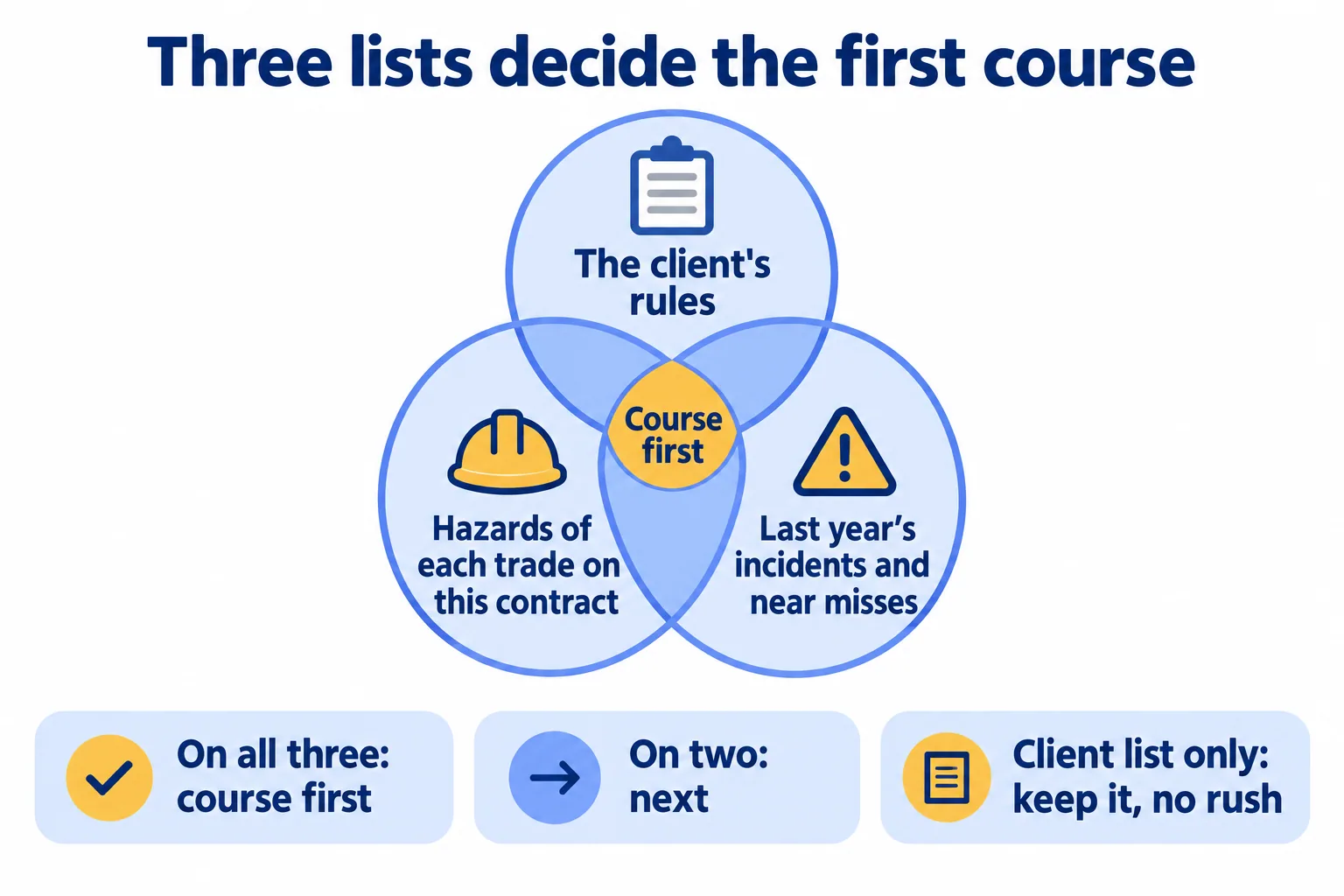
A gap that shows on all three lists gets a course first. A gap on two lists comes next. A course that sits only on the client's list stays in every row the client names, because the auditor checks it, but it does not jump the queue.
If your near-miss log is not split by trade, start with what it does say: the site, the task and the date. Then ask each site supervisor to add the trade to every entry from their site.
In the first week we work in this order: pull last year's incidents and near misses, mark the hazards per trade on each contract, line both up against the client's list, then rank. The plan comes out of that, row by row.
Which gaps are not training gaps?
The Arab Union guide sets a decision gate: "is training the solution?" It says to check whether people can do the task "when clear instructions, a suitable tool, enough time, and adequate authority are available." Then: "If they know the method and can perform it in a test but cannot do so at work, look for a system, procedure, incentive, or workload barrier."
The CDC's training guide says the same in its own words: "Your analysis will help you learn if training is a solution that can address the gap." It lists language, technology and location among the barriers to check before training goes out.
On a site, the non-training gaps look like this:
- The crew knows the permit rule, but the permit takes too long to sign, so work starts without it. Fix the permit route.
- The right fall-arrest kit or gas detector is not on that site. Fix the store.
- The job is planned with no time for the isolation step. Fix the plan.
- The supervisor never checks. Fix the supervision.
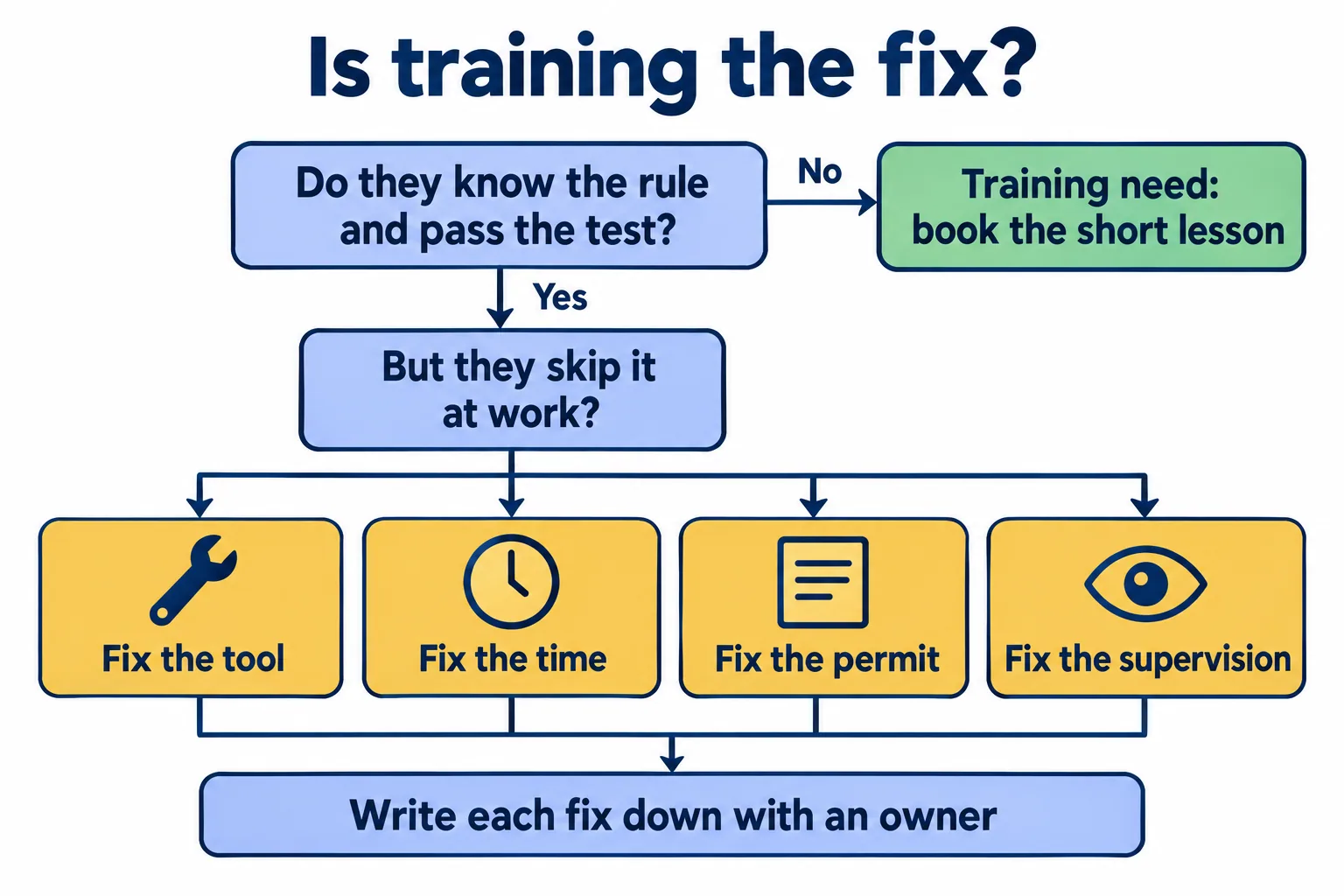
Write each of these down with an owner, next to the course list. The Arab Union guide calls it a gap register that separates "training-related causes from organizational barriers." Sending the crew on a second course for a rule they already know only adds a certificate.
A sample plan for six trades
This is a sample, laid out the way we lay out a first plan. Your three lists will change every row.
| Trade | From the three lists | First course | Not a course |
|---|---|---|---|
| Scaffolders | Client list, work at height, a near miss on a ladder | The provider's scaffolding course, then the site's own scaffold rules on the phone | Tags missing on site: fix the inspection round |
| Electricians | Client list, isolation on live boards | The site's isolation and permit steps, short and in each worker's language | Locks not issued: fix the store |
| Welders | Client list, hot work near stored materials | Hot work permit and fire watch rules for this site | Fire watch not planned into the shift |
| Painters | Work at height on mobile platforms, solvents | The provider's platform course; a short lesson on the site's solvent storage | Platform not inspected before use: fix the pre-use check |
| Cleaners | Chemicals, wet floors, night shifts | Chemical labels and mixing rules, in the language they read first | Labels missing on refill bottles |
| Drivers | Reversing at the gate, a near miss with a pedestrian | The site's traffic plan and banksman signals | No banksman at the gate at shift change |
The training matrix comes after this table. Our post on a training matrix for many sites covers how to keep the record of who is due, by site, once the courses are chosen.
When should you run it again?
Do it at each change, as well as once a year. A UAE site checklist from Site Safety UAE lists, among its training checkpoints: "Training needs analysis conducted for new plant, materials or methods introduced." That is the checklist's wording, and it is a good rule.
So we run it again when:
- A new contract starts, with its own client rules.
- New plant, materials or a new method arrive on a site.
- An incident or near miss points at a trade.
- A new crew or subcontractor joins.
Each re-run is short. You check which rows changed, not the whole plan.
What stays with the provider, and what do you run?
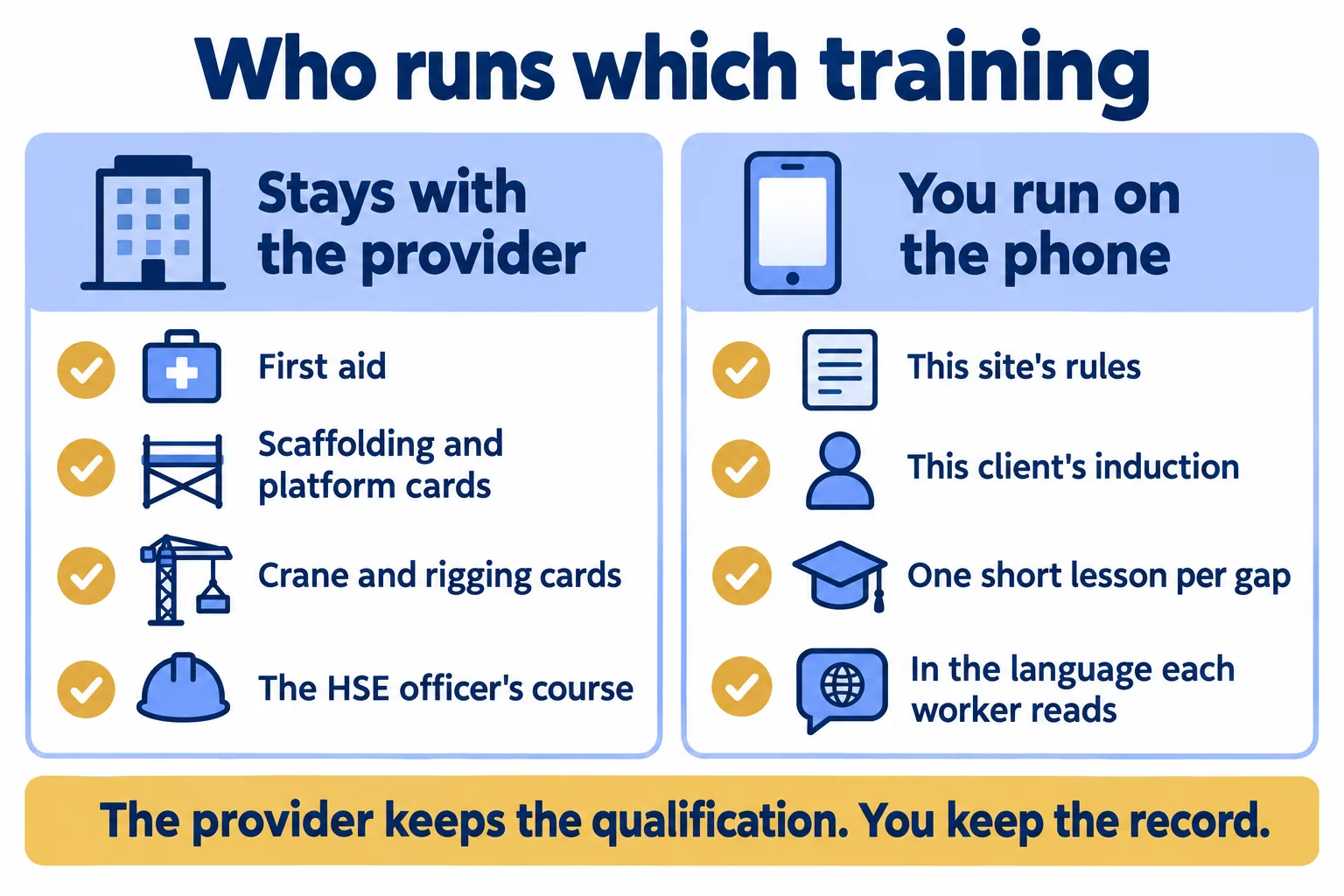
External qualifications stay with the training provider: first aid, scaffolding, platform and crane cards, and the HSE officer's course. Our post on who goes on which external course covers that split.
What the contractor runs itself is the part no provider knows: this site's rules, this client's induction, and the short lesson that closes one gap for one trade, in the language each worker reads first. The morning toolbox talk stays. The phone lesson is the version a worker can take again, and the record shows who took it. Our post on the toolbox talk or a phone lesson covers which job each one does.
What Mindcat Learn does, and what it does not
Mindcat Learn carries the part you run yourself. The coordinator uploads the worker list with name, site, trade and language from the HR spreadsheet, and each worker joins the group for their site. Each group gets its course, one copy per language: Hindi, Urdu, Arabic or English. Workers open it in the phone's browser, pass a short quiz, and the report by site shows who passed, when, and who is still behind.
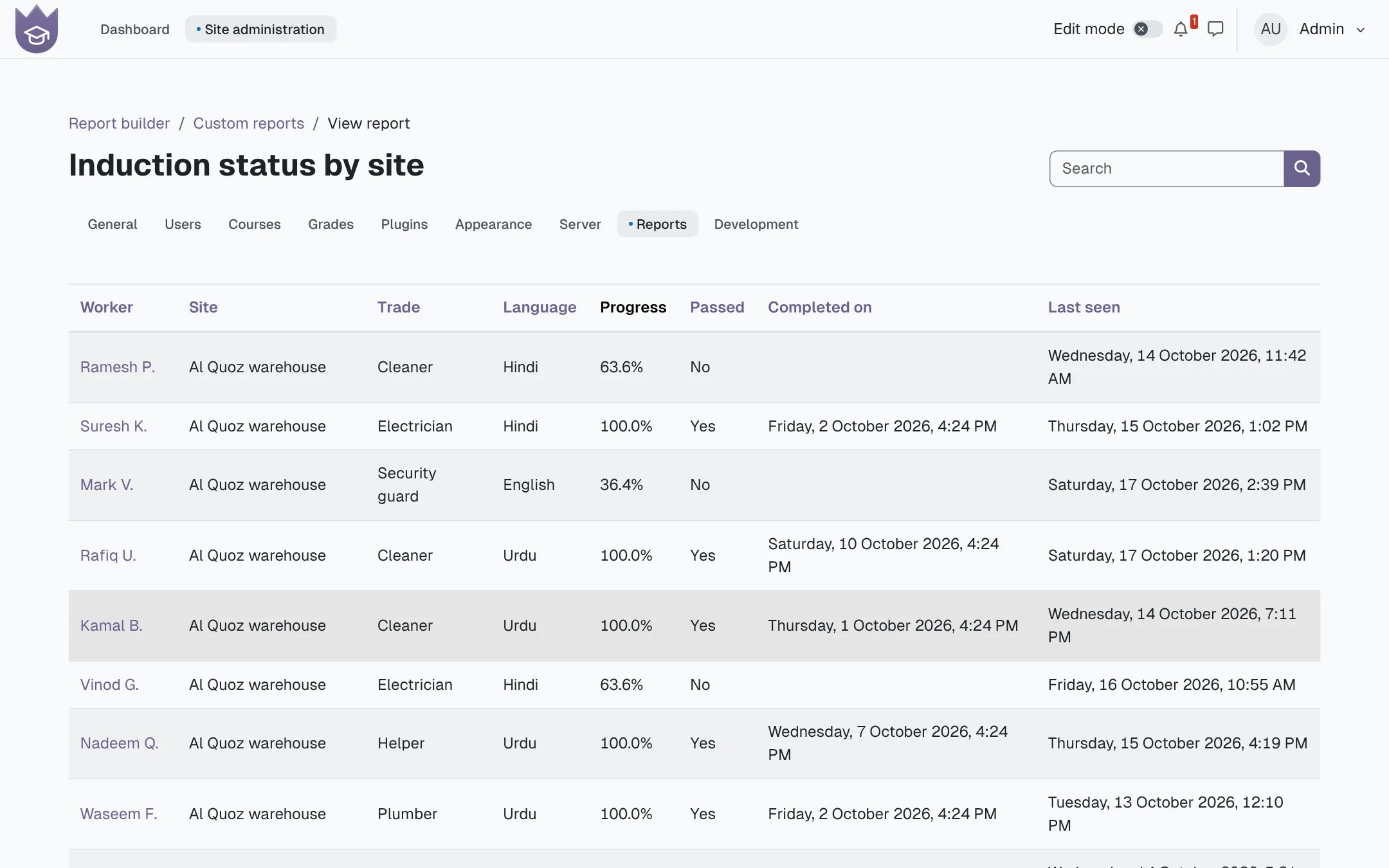
What it does not do: Learn does not run the analysis, score competence or write a needs report. Those are decisions you make, with us if you want. Reminders go inside the site or by email, not on WhatsApp. Re-enrolment when a course lapses is not automatic; a yearly re-enrolment by group is added during setup or as extra work. Lessons in a worker's language are written by you or by us during setup, and human translation is billed at cost.
What would it cost?
Learn is priced per active learner a month, meaning anyone who signs in that month: AED/SAR 15 each for learners 1 to 50, then AED/SAR 10 each for 51 to 200. A contractor with 120 workers who sign in pays AED 1,450 that month. Below about 50 active learners the shared plan's minimum of AED/SAR 749 a month applies. Trainers, coordinators, supervisors and admins are free. The quick start is AED/SAR 2,500 once, fixed, for 1 to 200 active learners: we set up your copy, add your people from our spreadsheet template grouped by site, and give you our induction template with a short quiz and one certificate. Prices exclude VAT; the full bands are on the Learn page, and contractor and FM setups are on our facilities contractors page.
This is not for a contractor with one trade on one site whose client hands over a fixed course list and checks it itself: the client's list is the plan.
We call our method Induction on every phone: the site's own rules and the short lessons on each worker's phone, in the language they read first. Tell us who you train and in which languages. We reply with the setup plan and the monthly price per active learner, in AED or SAR. Tell us about your crews.
