

If your training certificates are PDFs in a shared folder and the gate supervisor cannot check one on a phone, this is for you. It is not for a contractor whose client issues and checks every induction card itself: keep using theirs.
Why does a PDF in a folder fail at the gate?
It is 6:15 at the gate and a crew bus has just pulled in. A worker holds up a phone with a PDF that says he passed the site induction. The supervisor cannot tell whether the PDF is his, whether the course was the current one, or whether anyone made the file at all. The person who knows is the HSE officer, and he is at another site.
The folder has the same problem one step later. Sospita, an HSE software vendor, puts it plainly: "A full folder answers the wrong question. It shows that documents were received. It does not show whether they are the right documents, whether anyone checked them, whether they are still valid". WSH Peer, another vendor, describes where the files end up: "Certificates live in several places at once. HR holds some, the site office holds others, and a few exist only as photos on a supervisor's phone."
When a client's auditor asks for proof that every worker on the tower did the induction, the folder answers with files. The auditor wants a check that someone who was not in the room can make.
Whose certificate is it? How we decide
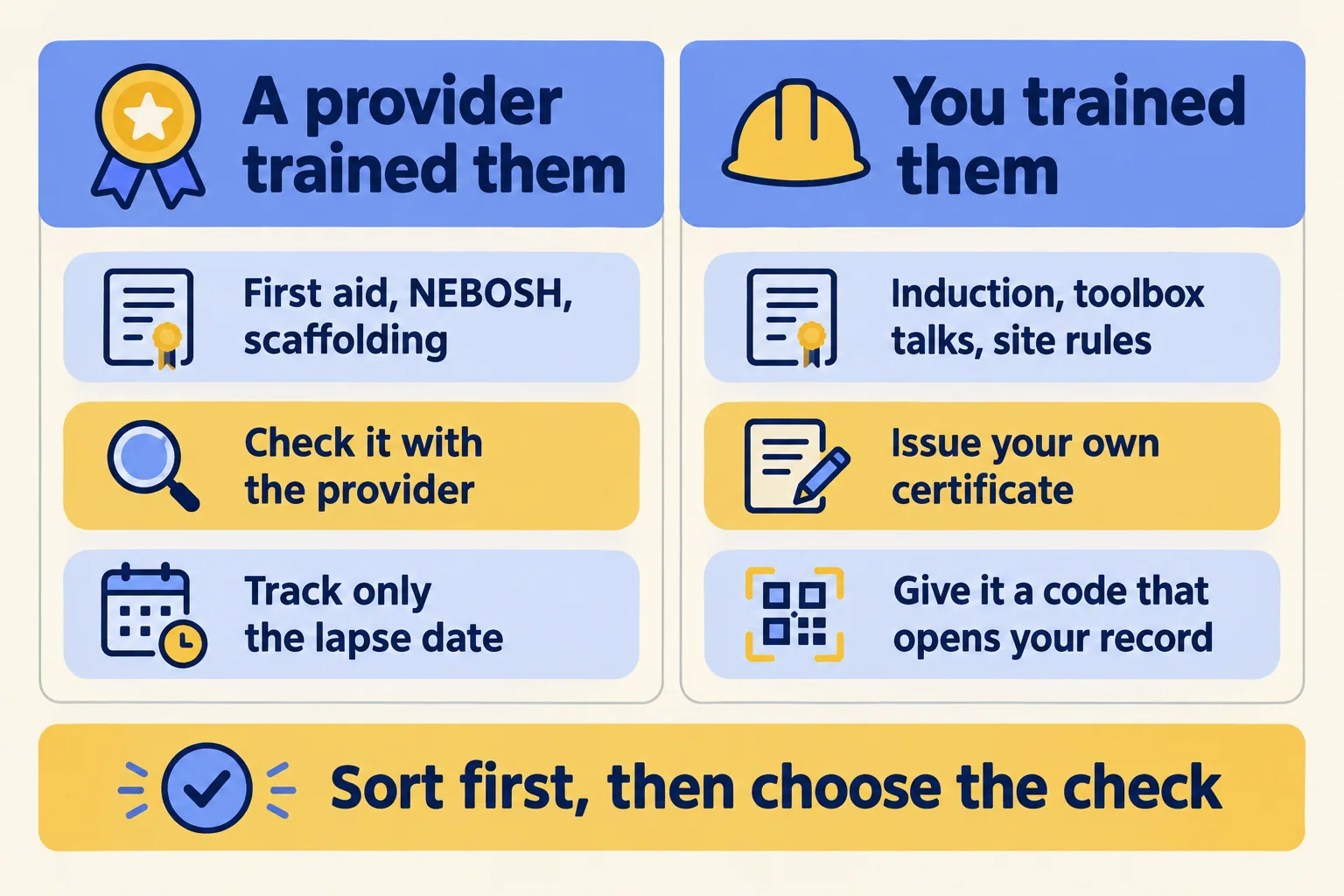
Before we change anything, we sort every certificate a crew carries into two piles. The pile decides how it gets checked.
- A provider's qualification. First aid, NEBOSH, scaffolding, a crane operator's card. Someone else trained and assessed the worker, so that issuer is the one who can say it is real. Keep the provider's certificate, check it through the provider's own route, and track only the lapse date by worker and site.
- Training you run yourself. The site induction, toolbox talks, the heat briefing, your site rules. Nobody else can vouch for these. Issue your own certificate, with a code that opens your own record.
The provider pile does not need a new tool. NEBOSH's guide for employers shows what a serious provider expects: scan the QR code on the certificate or enter its details on NEBOSH's verification page, and "the person who achieved the qualification will receive an email asking them to authorise the request. Authentication will not be confirmed without the learner's approval." Formal verification comes back within two working days. NEBOSH also asks employers to compare the personal details with another form of identification, and to delete a scanned copy "once the relevant checks have been completed".
So the provider's check belongs at hiring or at mobilisation, not at the gate at 6:15. What the gate needs is your own record that the check was done and when the qualification lapses.
What makes a certificate code worth checking?
A code is only as good as the page it opens. HSECore, a vendor writing on gate checks, makes the point bluntly: "A QR code that contains the text 'Ahmed, rigger, valid until 2027' proves nothing. Anybody can generate a code with any text in it, in seconds, for free." The answer has to come from the issuer's own page when the code is checked.
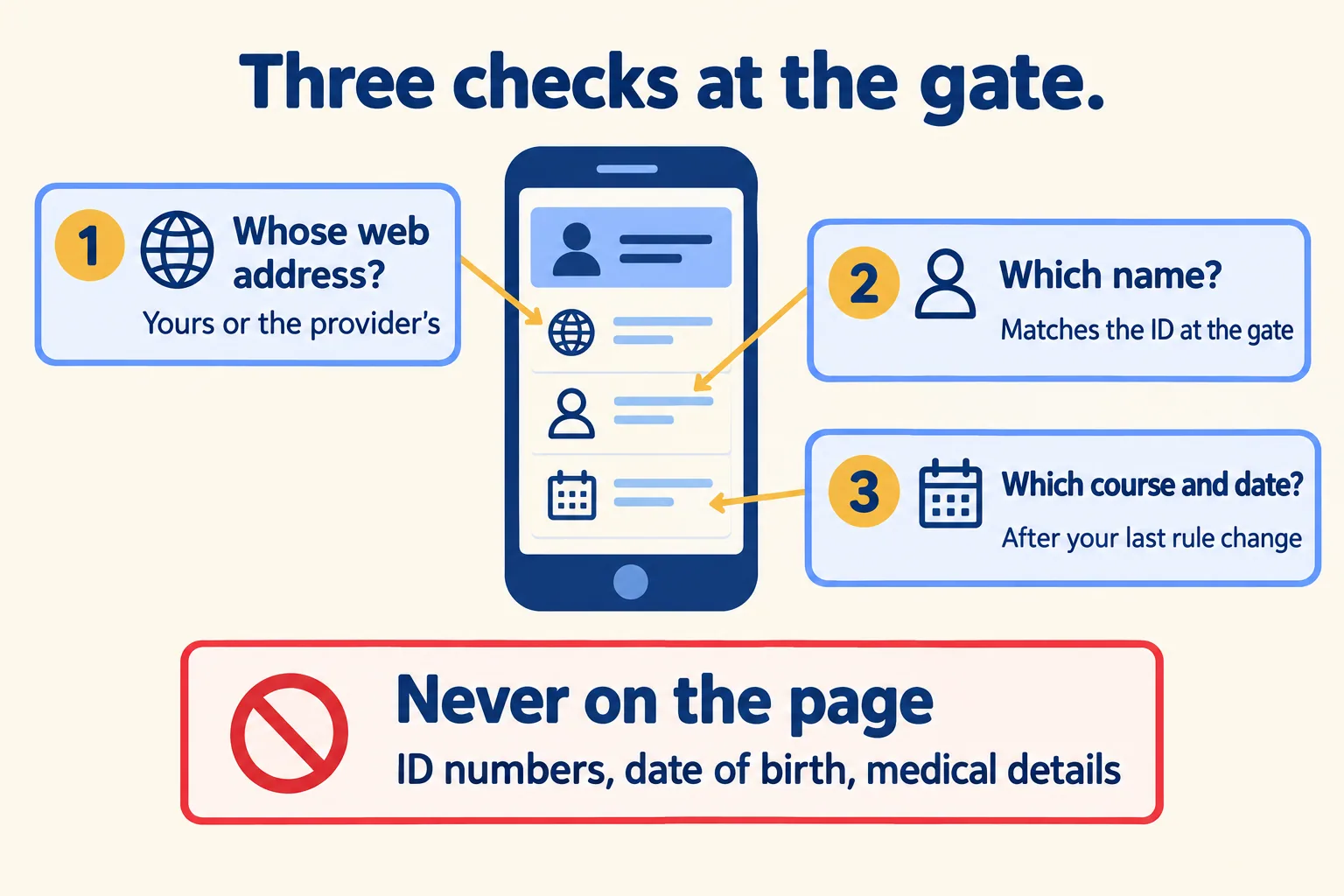
That gives the gate supervisor three things to read:
- Whose web address. The page must open on your company's own address, or the provider's. A lookalike address means not verified, whatever the page says.
- Which name. The name on the record must match the worker standing there, checked against the ID the gate already asks for.
- Which course and date. The course on the record must be the induction for this site, dated after its current version started. Put that start date on the gate briefing sheet, so the supervisor does not have to ask.
Keep the page small. HSECore lists what a verification page should never show: phone numbers, national ID, passport or residence permit numbers, date of birth and medical details. A gate needs to know whether this worker did this course. It does not need his Emirates ID number.
A laminated card works the same way if the code is printed on it: the supervisor types the code. The check needs a signal, so keep a printed list of cleared workers at the gate for the hour the network fails.
Is this the same as KHDA attestation?
No, and the two get mixed up in search results. In Dubai, KHDA's "Attest Training Institute Certificate" service lets training institutes request attestation of certificates for registered trainees on KHDA-authorised courses at private training institutes. That is a course provider's job.
A site induction your own HSE manager runs is your company's record that a worker heard your site rules. It is not an institute's course certificate. If you are unsure whether a course you run counts as one, ask KHDA before you rely on your own reading.
The five-worker gate test
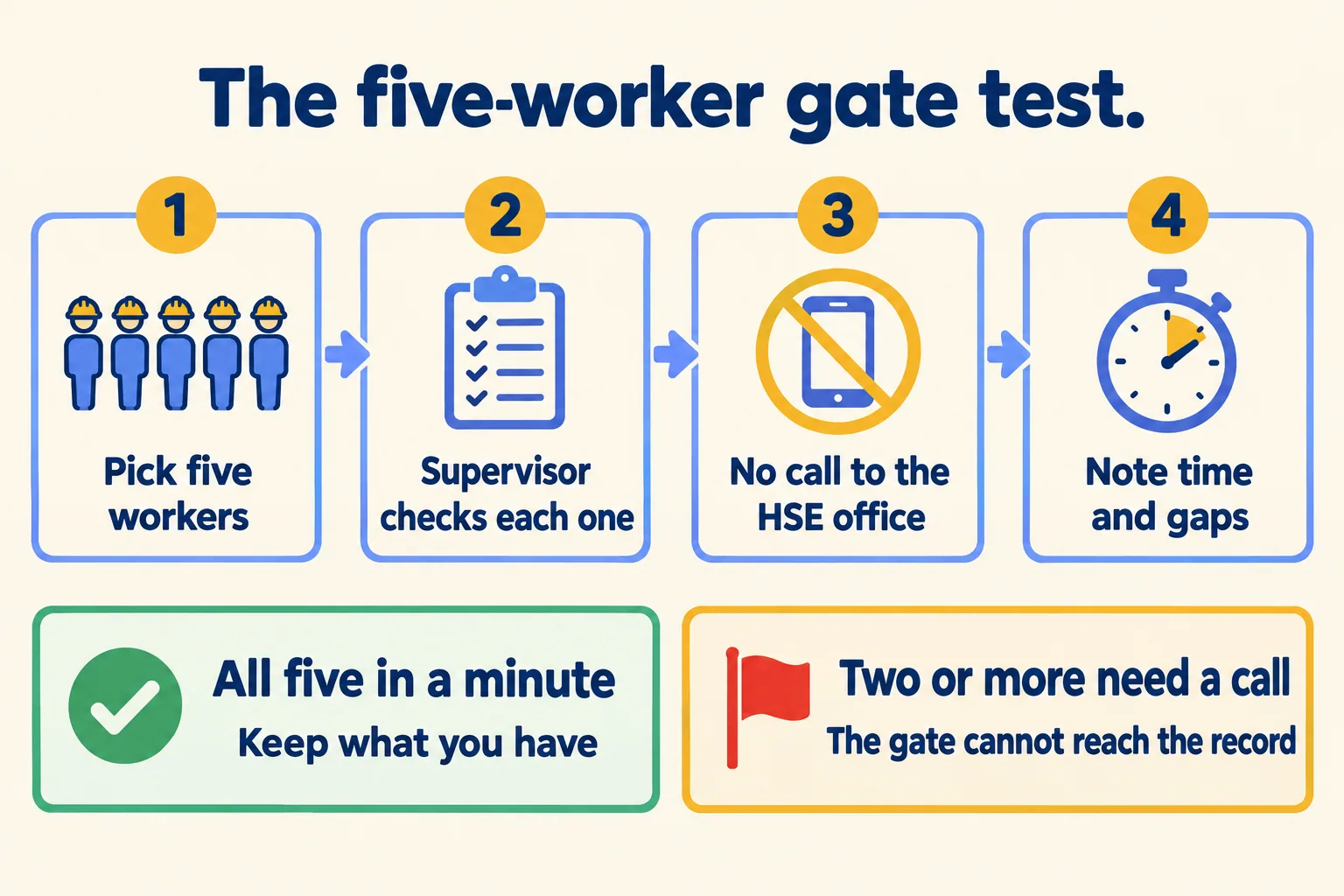
Run this before you buy anything. It takes one shift change.
- Pick five workers as they arrive, from different crews, including at least one subcontractor.
- Ask the gate supervisor to confirm, for each one, that the worker did the current site induction.
- The supervisor may use the phone, the folder or a list, but may not call the HSE office.
- Write down how long each check took and which ones the supervisor could not confirm.
- Then pick one provider certificate, a first aid card for example, and find its lapse date in your records.
If all five pass in a minute each and the lapse date is on file, your records already work. Keep them. If the supervisor needs the HSE officer for two or more, the gap is not the PDF. It is that nobody at the gate can reach the record.
When is a PDF in a folder enough?
More often than vendors say. Stay on PDFs while you run one site, one HSE officer checks every card at the gate in person, and your client has not asked to check records without calling you. The officer is the verification.
Move to coded certificates when one of three things happens: a second site opens and the officer cannot be at both gates, a subcontractor's crew arrives with certificates you did not issue, or a client's auditor asks to check records on their own. Tracking who is due for which course across sites is a separate job, covered in one training sheet, many sites. Running one induction across four sites is covered in one induction for every site or one per site.
What Mindcat Learn issues, and what stays with you
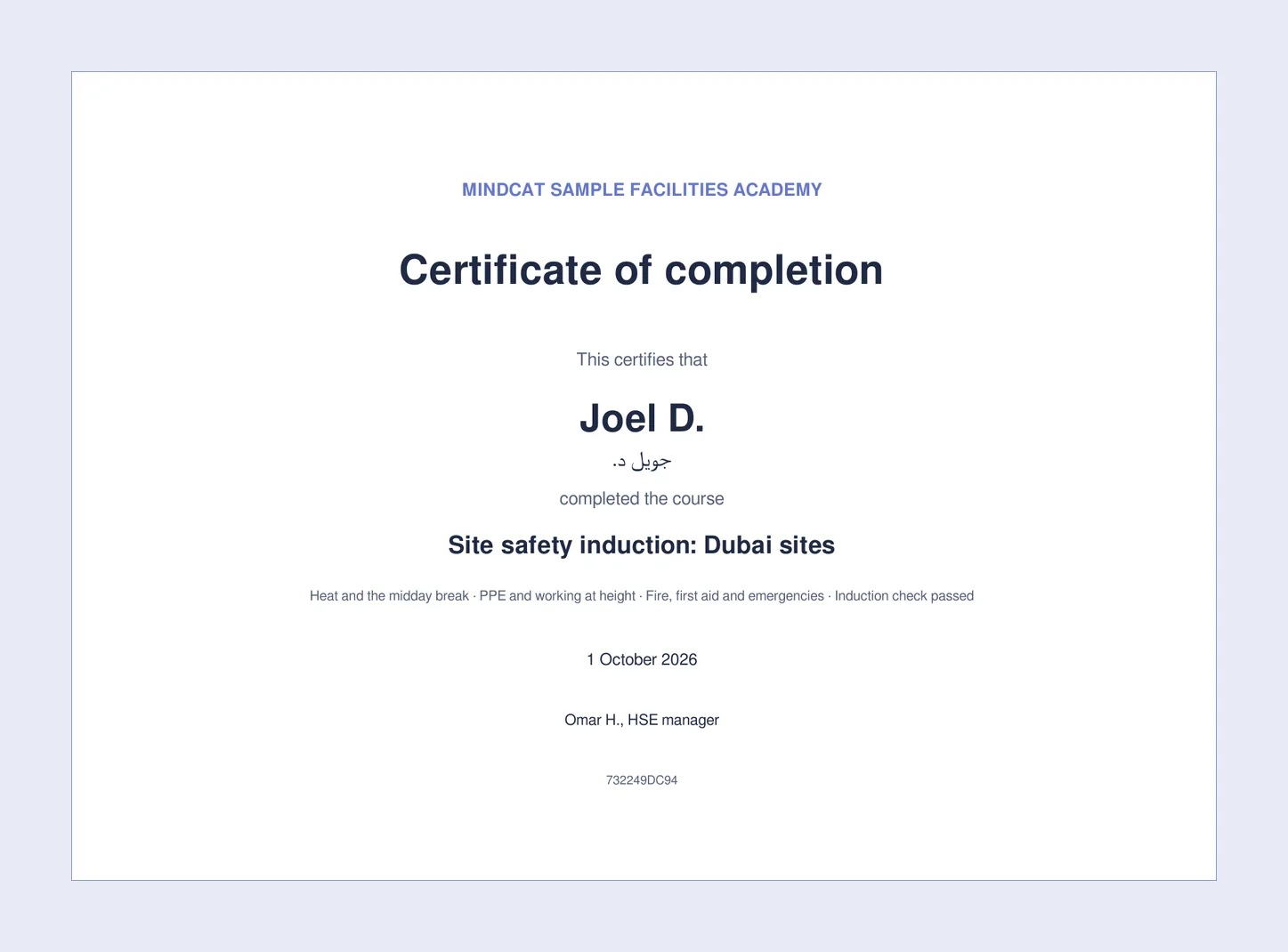
When a worker completes a course on Mindcat Learn and passes the check, he downloads a PDF certificate with his name, the course, what it covered, the date, your HSE manager's name and a code anyone can check. A client or a gate supervisor types the code into a page to see that it is real. The course opens in the phone's browser in Arabic, Hindi, Urdu or English, so there is nothing to install.
Know its limits before you plan around it:
- Learn issues certificates for the courses you run on it. It does not check other providers' certificates. Those stay with the provider's own route.
- A subcontractor's workers you enrol on your induction count as active learners in the month they sign in, the same as your own crew.
- It does not renew certificates by itself. Your coordinator sets the next date, and any reminder goes by email.
- Whether your client's auditor accepts the record is the auditor's call. Ask for their rules in writing.
- Hindi and Urdu screens are mostly translated, and a few still show English. Arabic reads right to left.
Here is what our page says today. You pay per active learner a month, meaning a worker who signs in that month: AED or SAR 15 for the first 50, 10 for 51 to 200, 7 for 201 to 1,000 and 5 above that. Trainers, supervisors and admins are free. Below about 50 active learners, the monthly minimum of AED or SAR 749 on the shared plan applies, so nobody pays AED 15 for a single worker. The page's own example: 120 workers who sign in cost 50 × 15 + 70 × 10 = AED 1,450 a month.
Up to 200 active learners on the shared plan, the quick start is a fixed package we set up for AED or SAR 2,500, one time: your people loaded from our CSV template and grouped by site, our induction course template with a short quiz, one certificate template and the report by site. Above 200 active learners, or on your own servers, we set it up with you to a written plan, from AED or SAR 4,900 one time. Storage above 50 GB and outside services such as human translation are billed at cost. Prices exclude 5 percent UAE VAT and 15 percent Saudi VAT.
If your client checks every induction card itself, or your one HSE officer checks every card at your one gate, you do not need us for this. We call the method Induction on every phone. Contractors can start from the facilities contractors page. Otherwise, tell us who you train and in which languages, and we reply with the setup plan and the monthly price per active learner, in AED or SAR.
