

If your overtime reaches payroll as photos of site sheets and someone works out 125 percent by hand, this is for you. It is not for a firm whose staff all work office hours in one place, or one whose attendance already feeds payroll and is signed daily.
What does the law fix?
The rate, the cap and the base. Not the record.
u.ae, the UAE government portal, sets out the overtime rule from Federal Decree-Law No. 33 of 2021 for the private sector. Normal hours are 8 a day or 48 a week, and u.ae says they drop by 2 hours a day in Ramadan, so the point where overtime starts moves that month. Extra hours are paid at the normal-hours wage, calculated on basic salary, plus at least 25 percent. From 10 pm to 4 am it rises to at least 50 percent. u.ae adds that this night rule does not apply to workers on shifts.
Rest days have their own rule. A worker who works the off-day in the contract gets a substitute rest day, or that day's wage plus at least 50 percent of basic.
MOHRE's employer guide sets the cap: no more than two extra hours a day, and total working hours of no more than 144 every three weeks.
These are mainland rules. DIFC and ADGM have their own employment laws. Check with your free zone authority before you rely on anything here.
How does MOHRE work out the hourly rate?
With one line that many calculators call a convention. MOHRE prints it.
The guide, "Additional Working Hours, Wages, Leaves", gives the hourly wage as basic salary ÷ 30 ÷ 8. Then it multiplies by the hours and the rate for the kind of hour: 1.25 on normal days, 1.50 from 10 pm to 4 am, 1.50 on a rest day that is not given back as another day off, and 2.50 on official holidays.
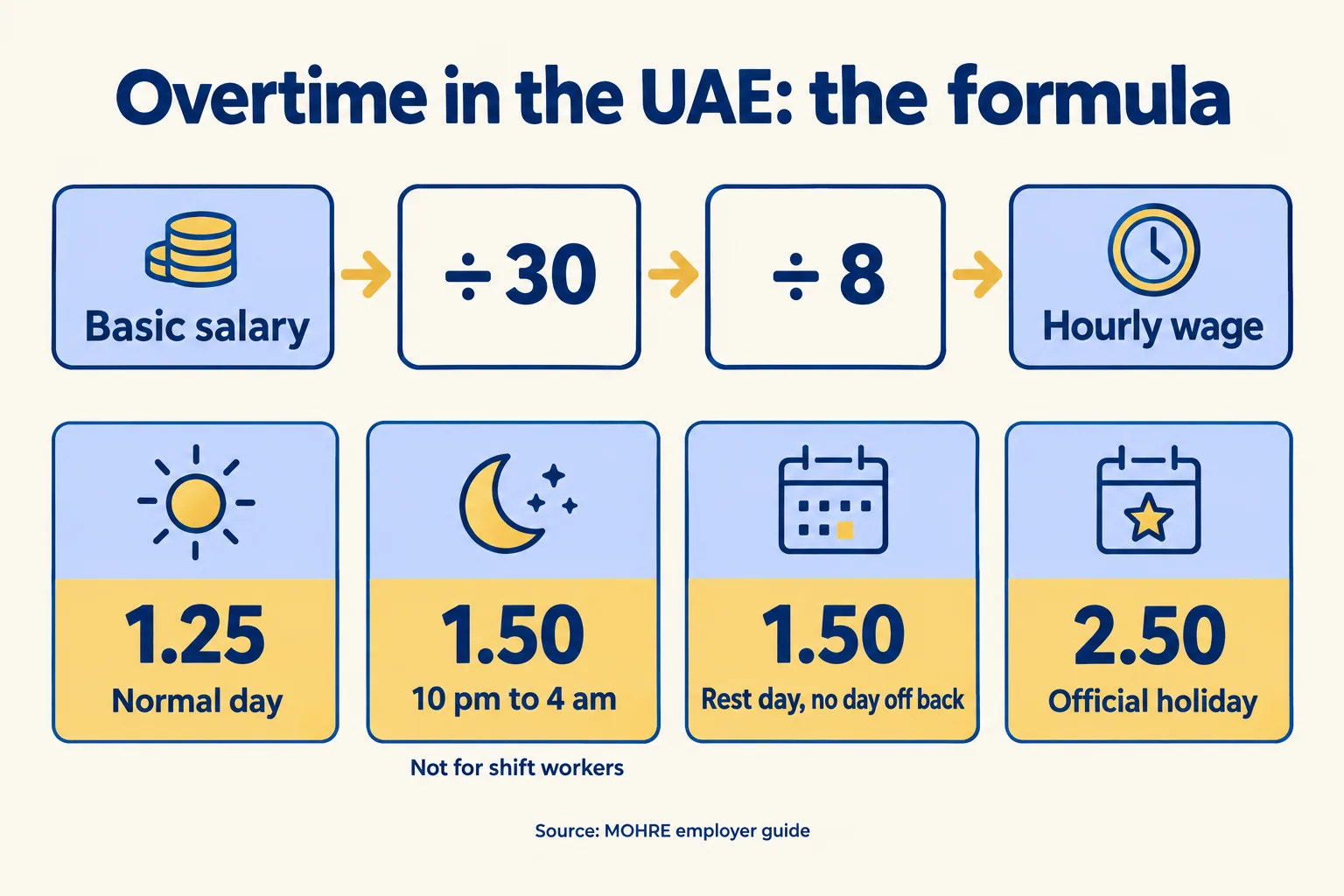
Write the divisor into your work regulations. Afridi & Angell's 2025 overview notes that employers with 50 or more employees must set internal work regulations, including daily working hours, under Article 14 of the Executive Regulation. A 60-person contractor already owes that document. Put the formula, the rates and the name of whoever signs the hours in it, so nobody argues about the divisor at month end.
Basic or gross: what does the slip show?
Basic. The first slip error we check for is overtime priced on the whole salary.
Here is the sample slip on our People page: a plumber on a Dubai Hills site, AED 1,700 basic, housing, transport and AED 159.38 overtime, AED 2,709.38 gross. The arithmetic: 1,700 ÷ 30 ÷ 8 = AED 7.08 an hour. At 1.25 that is AED 8.85 an hour, so AED 159.38 is 18 hours at the normal-day rate, priced on basic only.
Price the same 18 hours on the AED 2,550 of basic, housing and transport, and the line reads AED 239.06. That is AED 79.69 too much for one worker in one month. Multiply by a crew and a year, and the gap is real money paid against no rule. That is arithmetic on a sample slip, not a client case.
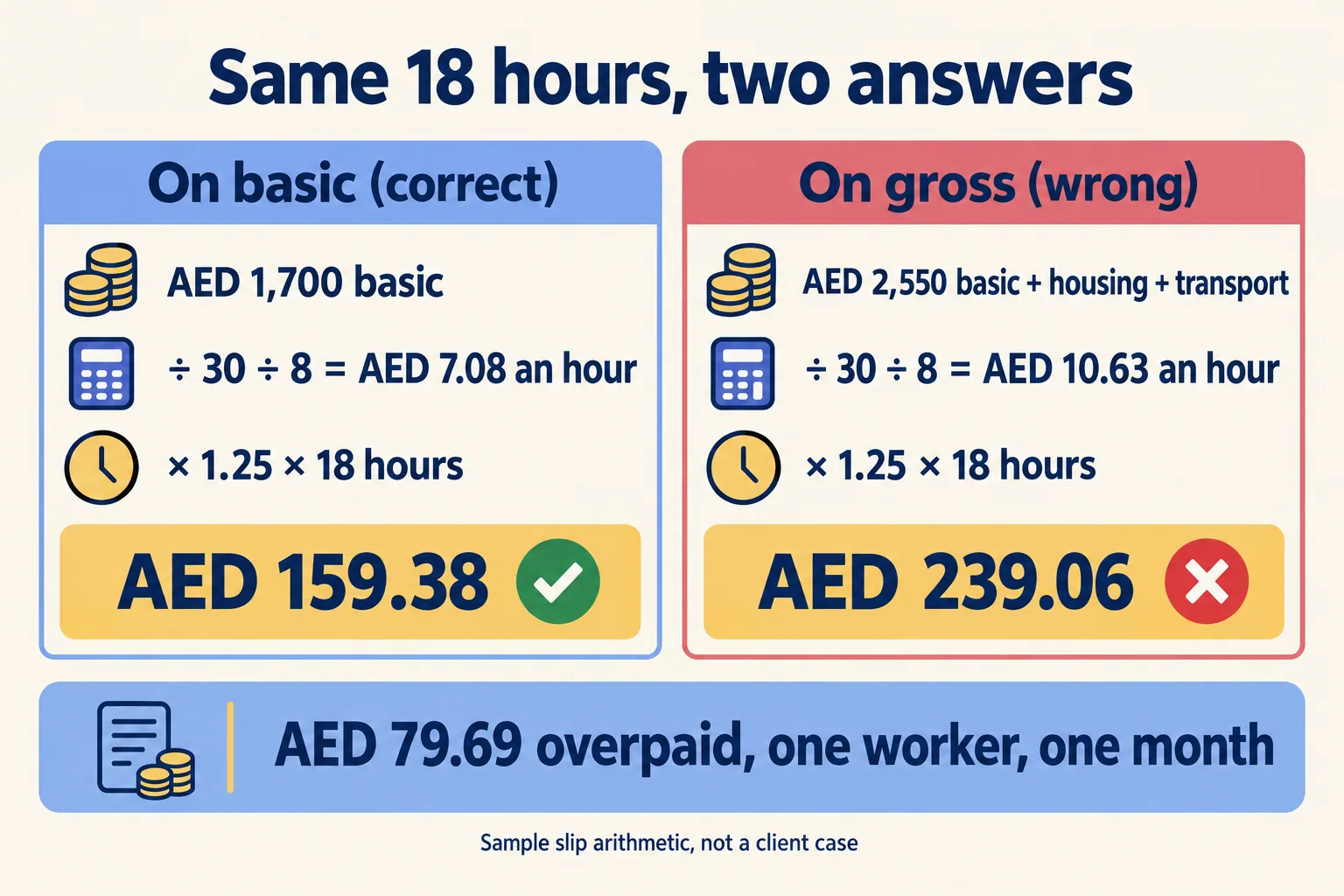
Keep night hours and rest-day hours as their own lines on the slip, each with its hours and rate. When a worker asks why this month's overtime is lower, the slip answers before anyone opens a sheet.
Who signs the hours, and when?
One named supervisor per site, every day, on the day. A supervisor who covers three sites names a deputy on each, so no site waits for one person.
A photo of a sheet on the 28th covering the whole month is a guess with a signature on it. By then nobody remembers whether Tuesday ran past 10 pm, or whether the rest day was given back later. A WhatsApp line saying "approved 3 extra hours" has the same problem: payroll cannot see the date, the times, or whether part of the shift crossed into the night rate.
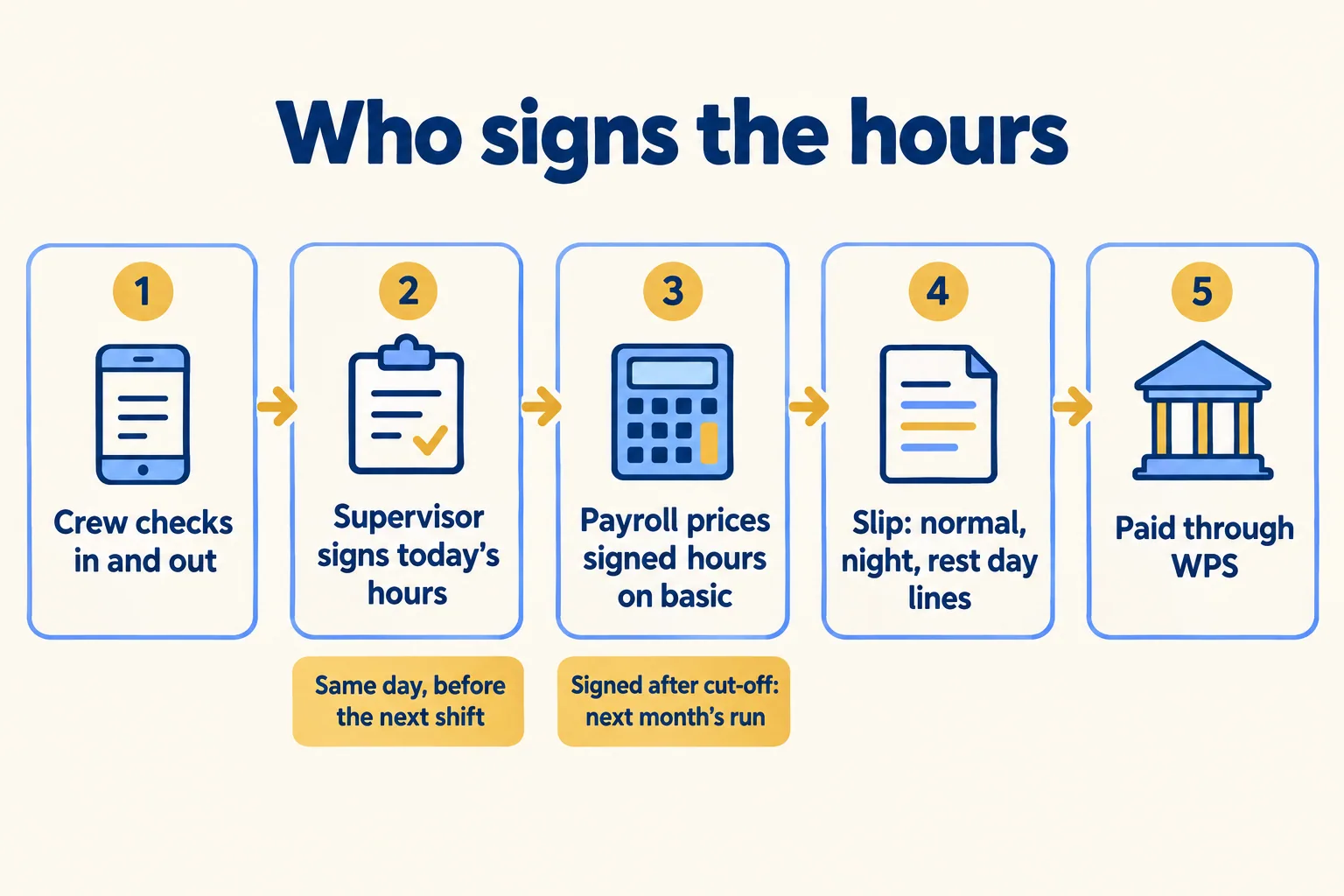
So we set four rules. The crew's times come from a check-in, on a phone or a biometric clock at the gate, not from memory. The supervisor signs that day's hours before the next shift. Payroll prices only signed hours. Hours signed after the payroll cut-off go into the next month's run, and the slip says which days they cover.
That last rule matters because pay has a clock. Salaries go out through WPS on a fixed date, so the run cannot wait for a missing signature. Late signatures do not stop the run. They push the worker's overtime to the next one, so check the current WPS payday with MOHRE before you set your cut-off.
Whether a particular role is a shift worker, or a supervisor outside the overtime rules, is a legal question. Check the Executive Regulation (Cabinet Resolution No. 1 of 2022) and ask MOHRE or a lawyer for a specific role.
Sheet or system: how do we decide?
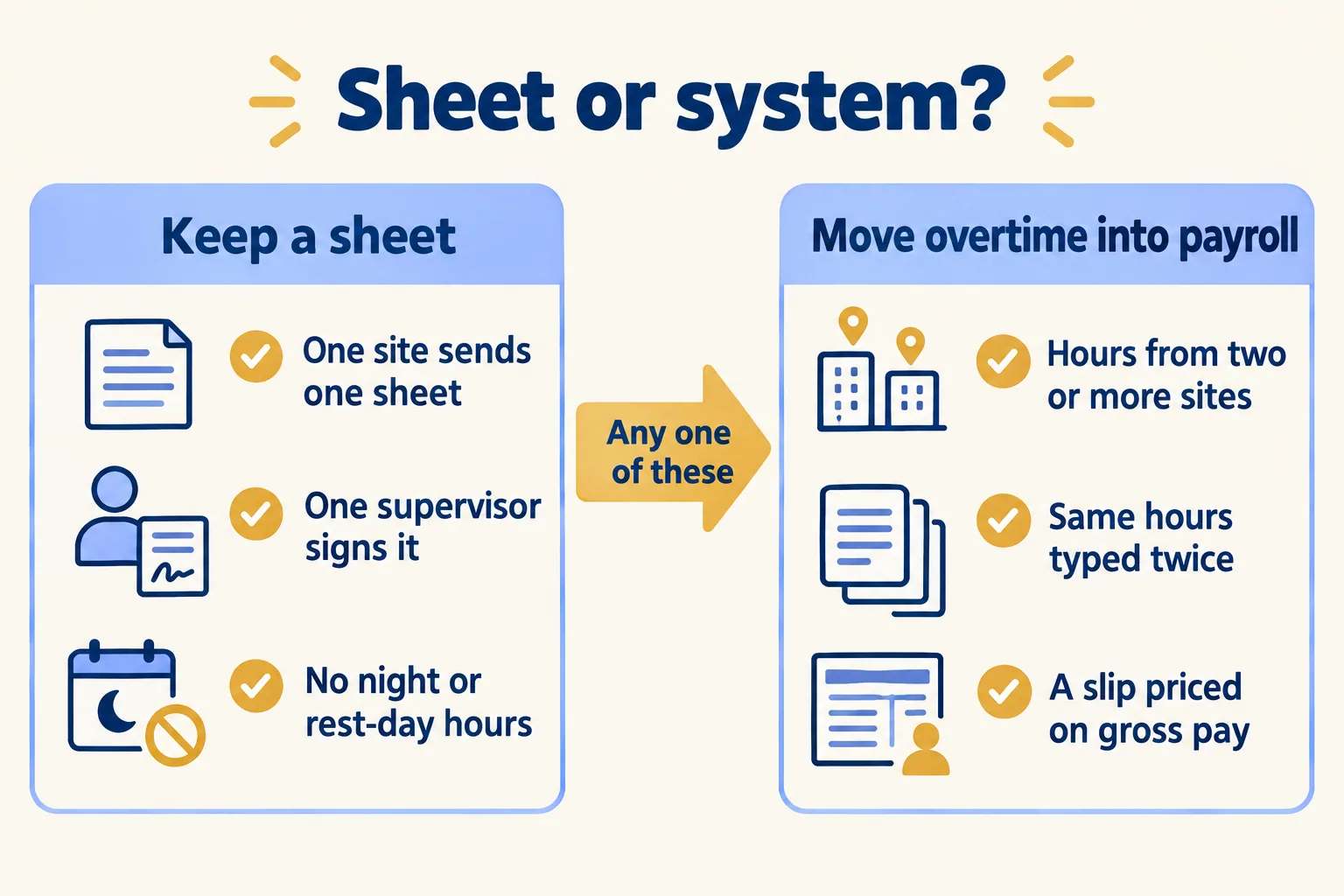
At Mindcat, we ask three questions before we say. How many sites send hours? How many times are the same hours typed? Has a slip already gone out with overtime priced on gross pay?
Keep a sheet while one site sends one sheet, one supervisor signs it, and nobody works past 10 pm or on a rest day. Give it columns for name, date, check-in, check-out, extra hours, kind of hour (normal, night, rest day, holiday) and who signed. A sheet costs nothing and works while one person keeps it.
Move overtime into the system that makes the slip when hours come from two or more sites, when the same hours are typed twice (once from the photo, once into payroll), or when a gross-pay slip has gone out once. At that point the hours and the run live in two places, and they drift.
What does a system not do?
It does not decide who is a shift worker, and it does not file anything with MOHRE. Our People page says overtime at the UAE rates is set during setup: a formula from attendance hours at 125 or 150 percent, added to the slip. The biometric clock is connected during setup too, and the clock itself is yours.
A person still signs the hours. The system makes sure payroll prices only what was signed, on basic pay, with each kind of hour on its own line.
What would it cost?
Here is what the People page says today. You pay per employee on payroll a month, AED or SAR: 29 for the first 50, 18 for 51 to 200, 12 for 201 to 500, 8 above. The shared plan has a minimum of AED/SAR 990 a month. HR, finance and manager logins add nothing.
By that list, a 60-person contractor is 50 x 29 + 10 x 18 = AED 1,630 a month. That is arithmetic on the page's prices, not a quote. Above 50 employees the setup is managed: AED/SAR 9,900 up to 200 employees, including one parallel payroll month before you switch. Your bank or exchange house charges its own WPS fees. Prices exclude 5 percent UAE VAT and 15 percent Saudi VAT.
Our method is called One run, one file. Tell us how many employees you pay, from how many sites, and how overtime reaches payroll today. We reply with the setup plan and the monthly price per employee, in AED or SAR.
