

If the extras on your fixed-fee projects are agreed on WhatsApp and nobody logs them, this is for you. It is not for a firm that bills every hour on time and materials, because there the client already pays for the extras.
Who pays for the extra hours?
The fee proposal said 200 hours. The project closes at 280. In the review, the partner asks what happened, and the answers are all true: the client asked for a second round on the report, the site visit moved twice, the Arabic version was "just a translation". Nobody can say how many of the 80 hours came from those asks and how many came from a quote that was too low.
On a fixed fee, that question decides who pays. Wonit, a vendor that writes for fixed-fee agencies, puts it plainly: "If you estimate 200 hours and the project takes 300, you eat the 100 hours." You can only send some of them back to the client if you can show they were asked for.

What does scope creep mean on a fixed fee?
PMI's Pulse of the Profession 2018 defines scope creep as "the uncontrolled expansion of product or project scope without adjustments to time, cost, and resources". In that survey of 4,455 practitioners, 52 percent of projects completed in the previous 12 months had scope creep or uncontrolled changes, up from 43 percent five years earlier. PMI's own split: 33 percent for its best performers, 69 percent for its worst. These are corporate projects, so use them as the shape of the problem, not as your number. You may also see "72 percent, per PMI" quoted; North, a research note that traced it, found it nowhere in the Pulse reports.
The part of the definition that matters for a consultancy is the second half. A client changing the brief is normal. It becomes scope creep when the hours move and the fee does not.
Which hours tell you the cause?
An overrun has two causes, and they need different fixes. Wonit's rule: "If you blew the estimate on in-scope work, that's a pricing problem to fix next quote. If extra deliverables crept in, that's billable." Hyphen Digital, a vendor writing for architecture practices (June 2026), says where to look: "budget versus actuals at the task level, not just across the project as a whole."
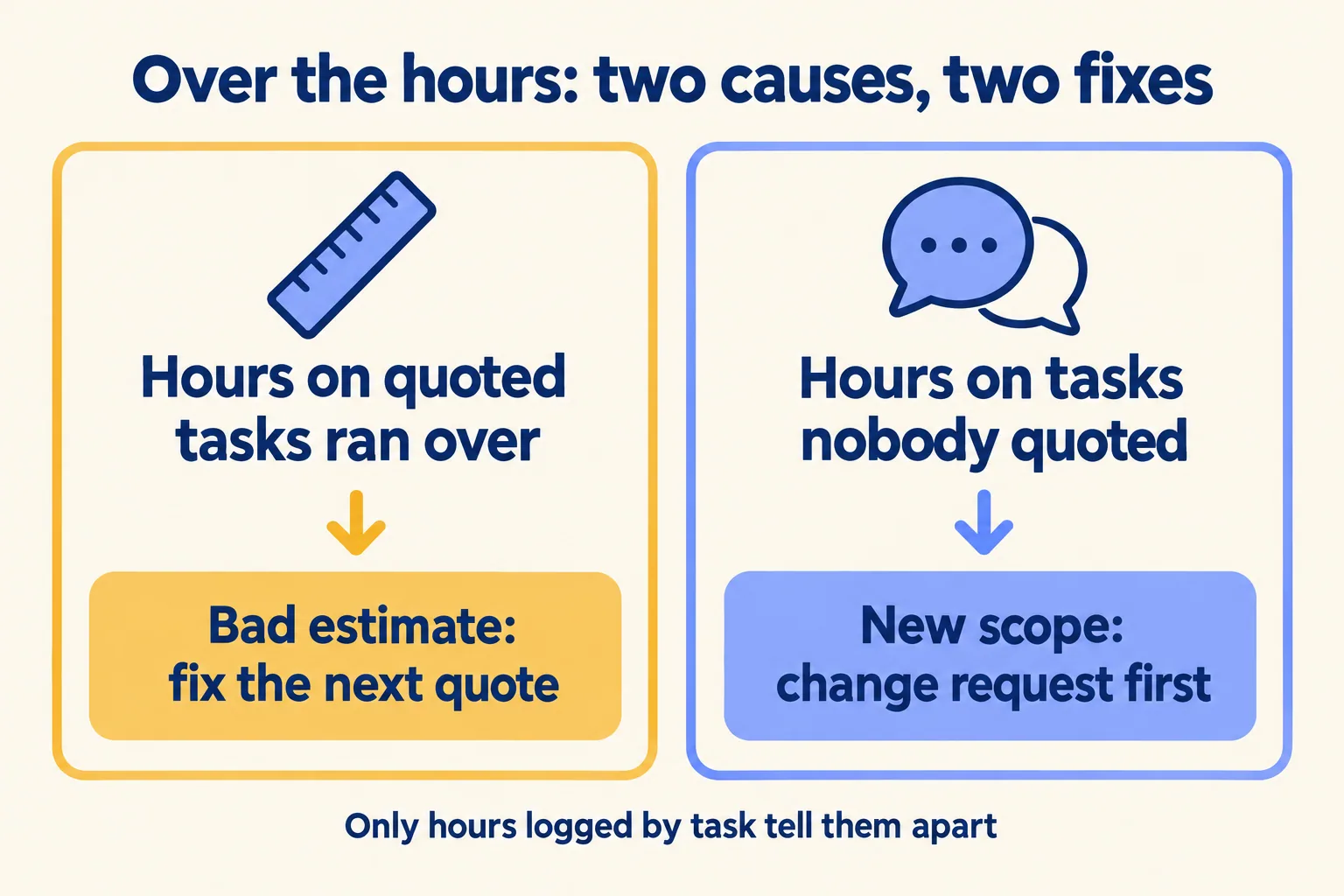
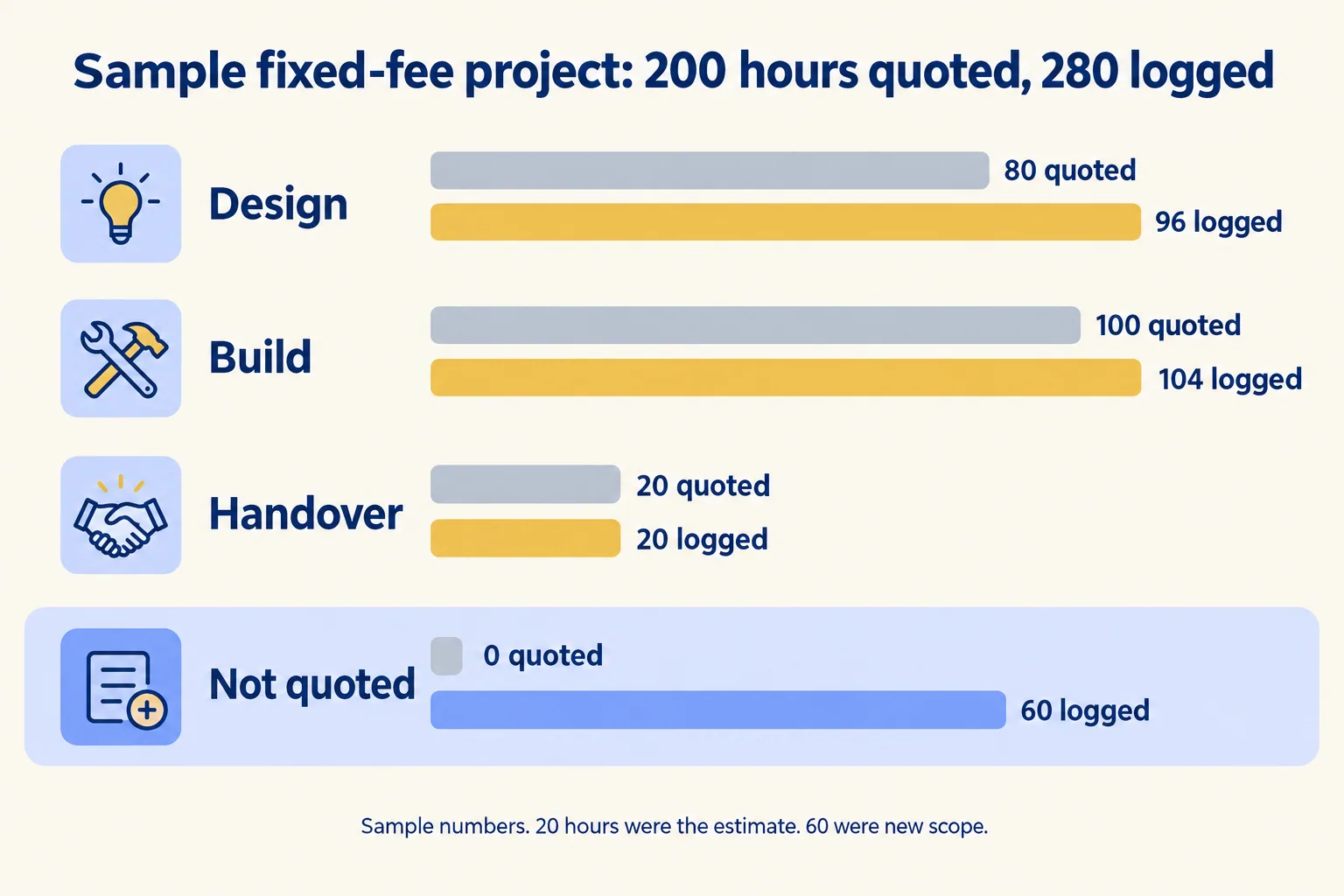
Our rule follows from that: you can only call it scope creep if the hours were logged against something nobody quoted. Here is the same 280-hour project, logged by task. The numbers are a sample to show the shape.
Logged as one total, this project is 80 hours over and the conversation with the client goes nowhere. Logged by task, 20 hours were your estimate, so you absorb them and fix the next quote. Sixty hours were work the client asked for, and they have names and dates.
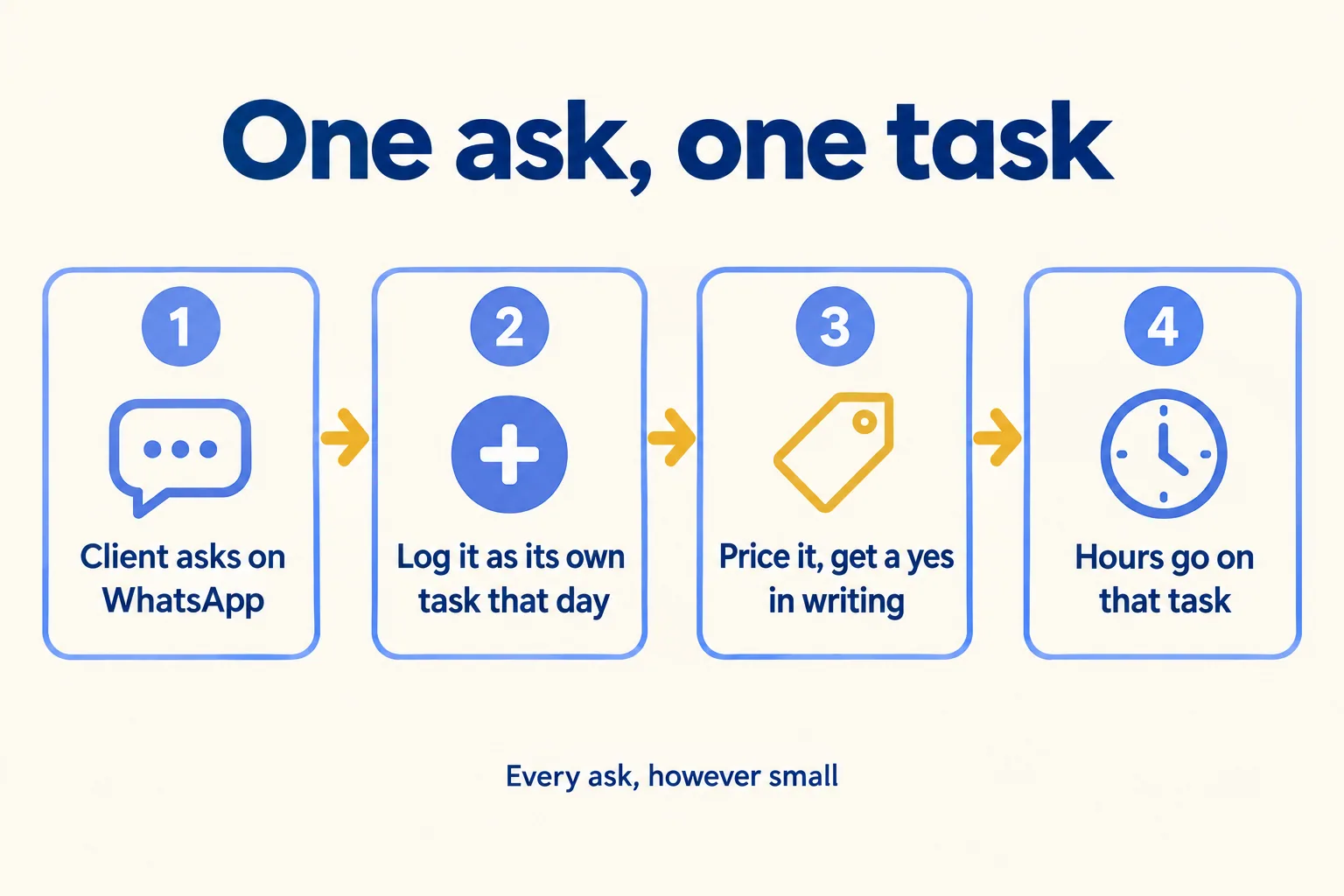
The split only works if each ask became a task the day it arrived. Varun Dubey, who runs a WordPress agency, describes the alternative: by the end of one project, "we had delivered roughly three times the original scope for the original price." Each ask was small. None of them was written down as its own piece of work.
- 01The client asks, often on WhatsApp or in a meeting.
- 02The project lead adds it as its own task that day, named in the client's words.
- 03If it is outside the quote, the lead sends the hours or the price and gets a yes in writing.
- 04The team logs its hours against that task, never against Design or Build.
When should someone look?
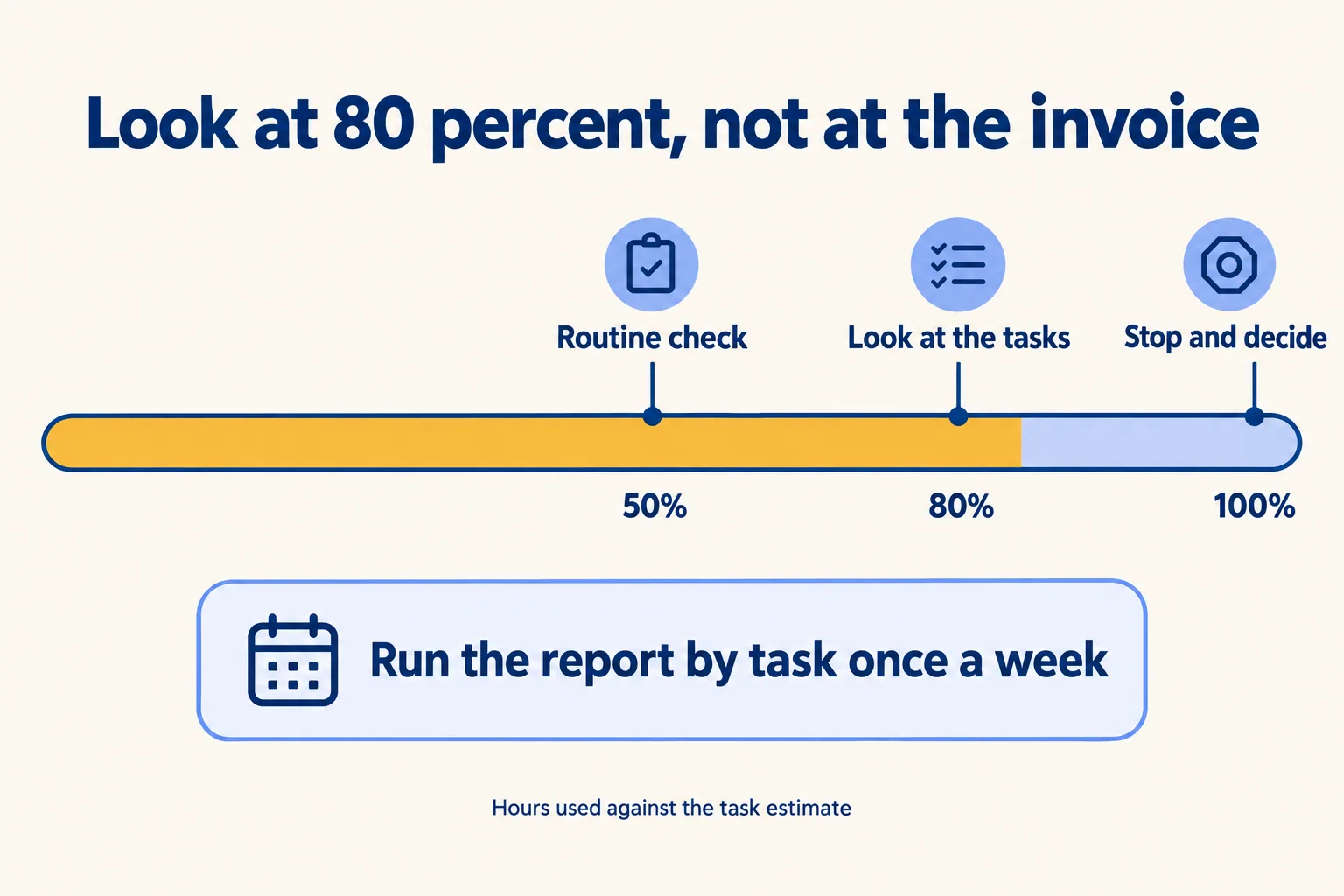
At the invoice it is too late to ask the client anything. Wonit uses three points on each deliverable's budget: at 50 percent a routine check, at 80 percent flag it to the project lead, and at 100 percent with work left, "stop and assess". We use the same 80 percent mark as the moment to open the report by task. If the hours are going into quoted tasks, tell the partner the estimate is slipping. If they are going into new asks, send the change request now, before more hours go in.
What does the client see?
Show the client the hours by task, not a total. A total of 280 against 200 reads as your problem. A line that says "Arabic version of the summary, asked 14 October, 18 hours" reads as their request. The wording of the change request itself belongs in your contract, so have a lawyer write that clause.
If your work is a monthly retainer rather than a fixed fee, the same problem has a different fix; we wrote that up in our post on retainer agreements and WhatsApp extras.
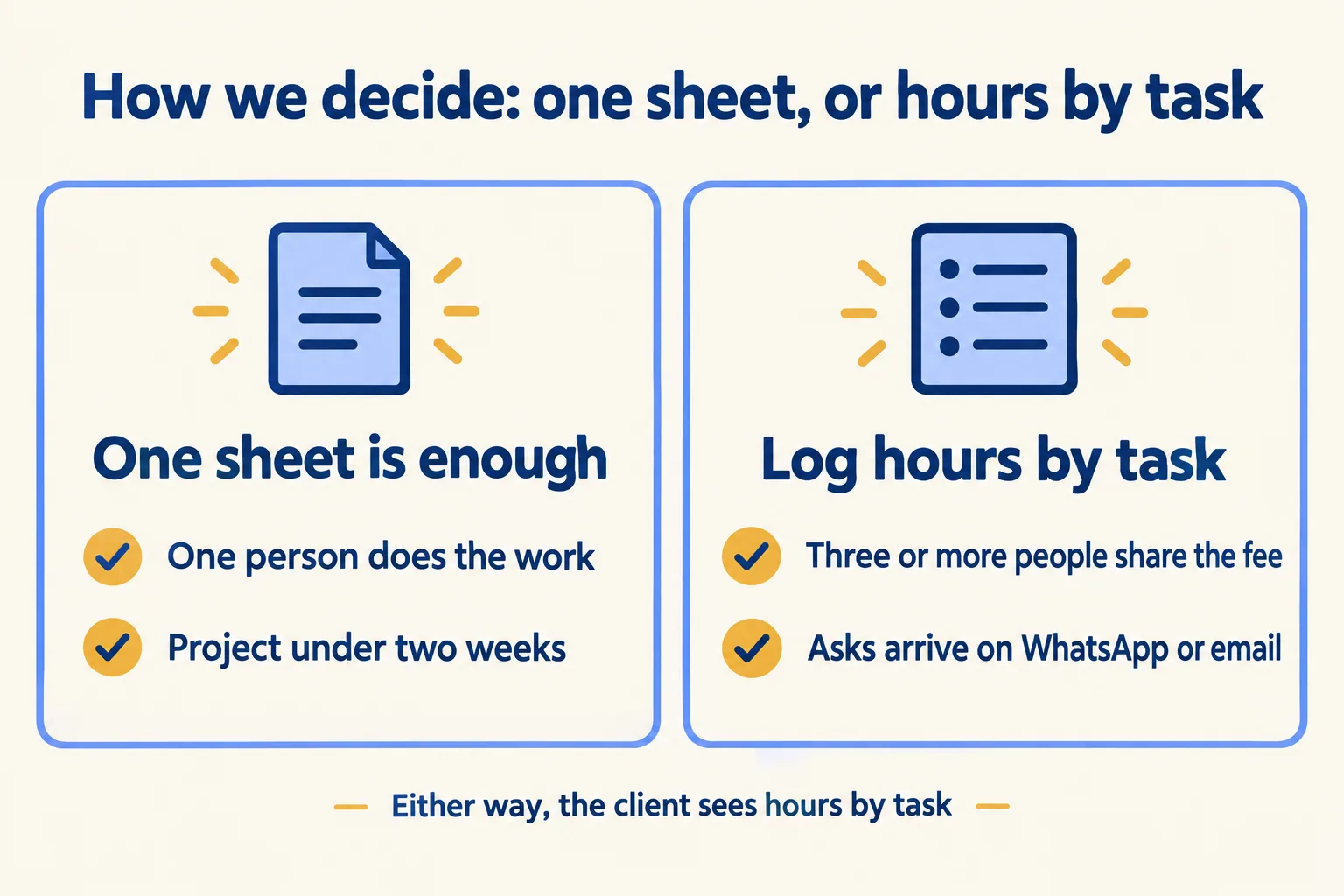
How we decide: one sheet, or hours by task
Our method is called Log it, price it, show it. Before setup we ask for one recent fixed-fee project: the quote, the hours it took, and the asks you remember. Then we apply one rule.
If you are still choosing between a spreadsheet and software at all, start with our post on timesheet templates for Dubai agencies.
What Mindcat Hours does here, and what it does not
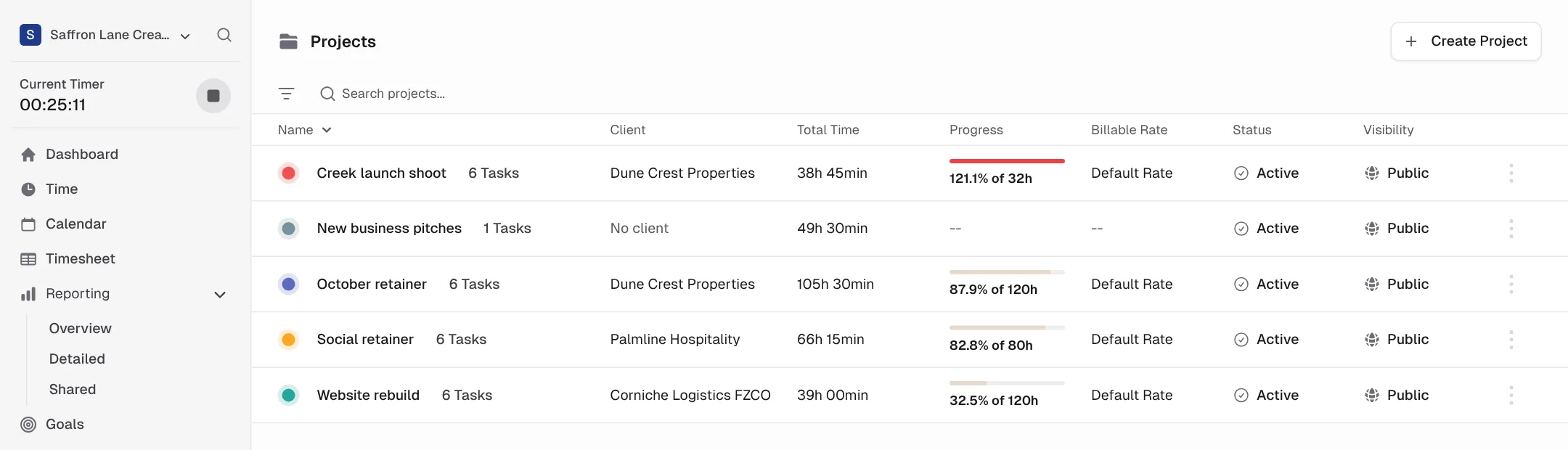
In Mindcat Hours, each project and each task can carry an hour estimate. The project list shows hours used against it, and the bar turns red past 100 percent. Entries carry a task and a tag, and the report groups hours by client, project, task, person or tag, with PDF and Excel export. At the end of a phase you save a report for the client and send the link; they open it with no login, and links can expire. The screen below is from our page, with sample data.
What it does not do:
- It sends no alert when a task passes 80 or 100 percent. Someone runs the report by task each week.
- It has no change-request or client approval step. The yes lives in your email or chat; copy it into the task's entries.
- It does not raise invoices. Priced hours go to Mindcat Accounts for the VAT invoice, or out as an export.
- There is no phone app to install. On a phone, Hours runs in the browser, so an ask that arrives at 10 pm can still be logged that night.
- The screens are in English. Your team can type tasks and entries in Arabic.
- It takes no screenshots and scores nobody. It records the time people log.
Plans and dates belong in Mindcat Projects; Hours is the time you bill against them.
What does it cost?
From the Hours pricing, per user a month on the shared plan: AED/SAR 39 for users 1 to 20, then AED/SAR 29 for users 21 to 100. The shared minimum is AED/SAR 690 a month, which covers up to 17 users, so a team of eight pays the minimum, not eight seats. The page's example: 25 users pay 20 × 39 + 5 × 29 = AED 925 a month. Clients who open a report link pay nothing.
Up to 50 users, the quick start is a fixed AED/SAR 2,500: we set up your organisation and import your clients, projects and rates. Above 50 users, setup is managed. Prices exclude 5 percent UAE VAT and 15 percent Saudi VAT.
This is not for you if you bill every hour on time and materials, or if one person does each project in a week or two; a sheet will do. If you run fixed fees with a team and the asks arrive on WhatsApp, more on the firms we work with is on our digital agencies page. Tell us how many people log time, how you bill clients and what you track time in today. We reply with the setup plan and the monthly price per user, in AED or SAR.
