

If the extras your account lead agrees on WhatsApp never reach a timesheet, this is for you. This is not for you if two or three of you log time in one shared sheet and nobody has ever asked for the hours behind an invoice: the template is enough.
When is a timesheet template enough?
A timesheet template is a spreadsheet with a row per piece of work: date, person, client, task, hours, billable or not. For a small agency it is a good tool, and the people who sell time-tracking software say so. TMetric's guide (9 January 2026) says a template is enough "when your team is small and disciplined, and when reporting requirements are light".
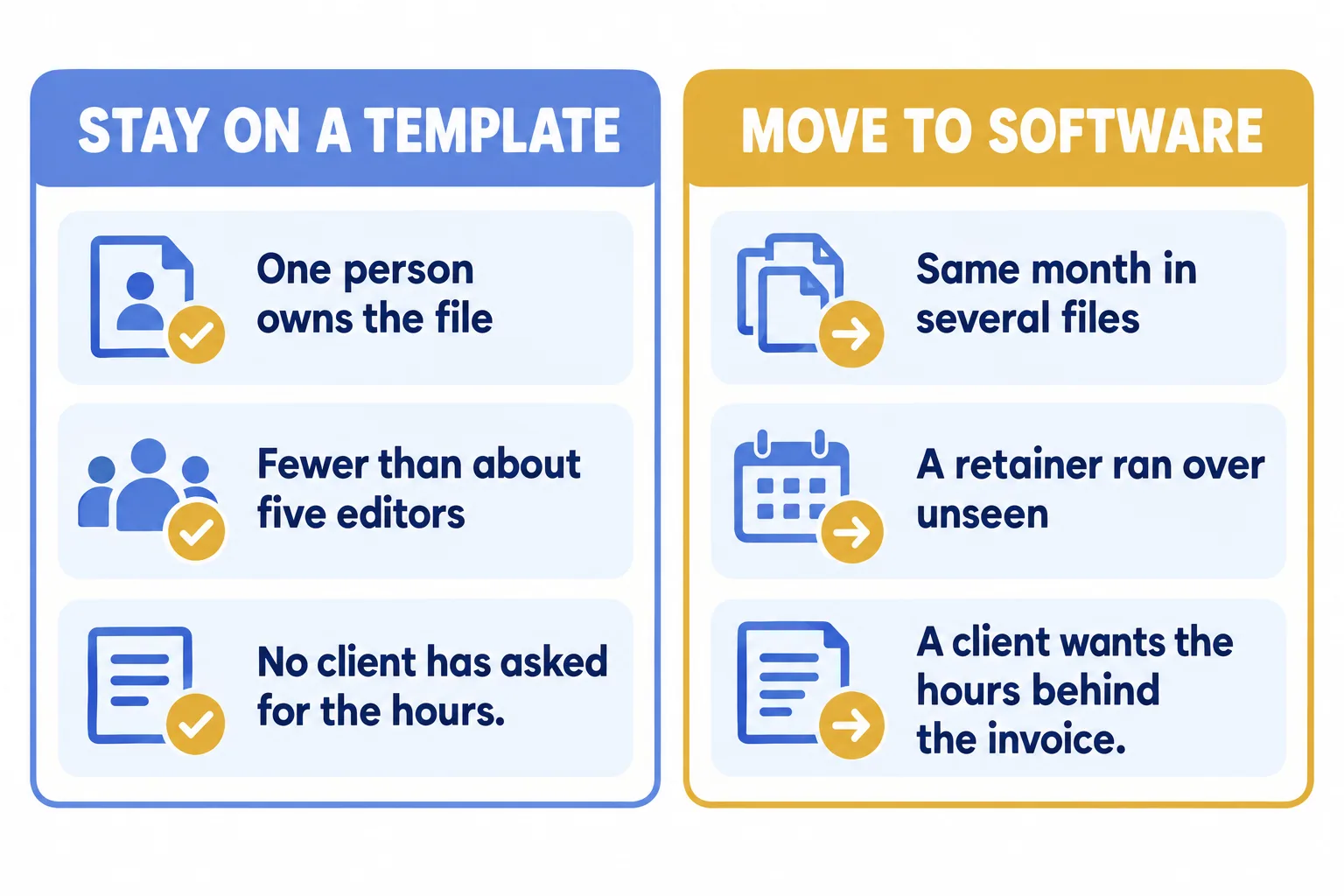
Our rule is this. Stay on a template while all three are true:
- One person owns the master file.
- Fewer than about five people edit it.
- No client has ever asked for the hours behind an invoice.
That is our rule, not TMetric's. The count is a judgment, and a disciplined team of six can pass it. The third line is the one that matters in Dubai: the day a client's project manager asks what the 40 hours on a time-and-materials invoice were, the file has to answer.
What does a template break on?
Three things, and each one is visible before it costs you money.
The same month in several files. TMetric puts it plainly: "If multiple people edit separate copies, you can end up reconciling duplicates and outdated versions at billing time." In an Ask HN thread from 25 August 2021, a commenter at a healthtech firm wrote that the firm used Excel for one to three people, then moved to a tracker because "it was becoming a nightmare to record all our billable hours". It is an old, US anecdote. It matches the same threshold.
A retainer that ran over unseen. A sheet shows hours when someone sums them. Nobody sums a retainer on the day the fourth extra is agreed on WhatsApp. You see the overrun at month end, when the client already has the invoice.
Rounding, row by row. MinuteDock, which gives away a free template, states that "each row rounds separately. At six-minute increments, two 7-minute calls bill 0.4 hours in total." Two calls of 7 minutes are 14 minutes, or 0.23 hours. A template that rounds each row bills them as 0.4. Pick one rule per client and write it on the sheet, or the invoice will not match the client's own count.
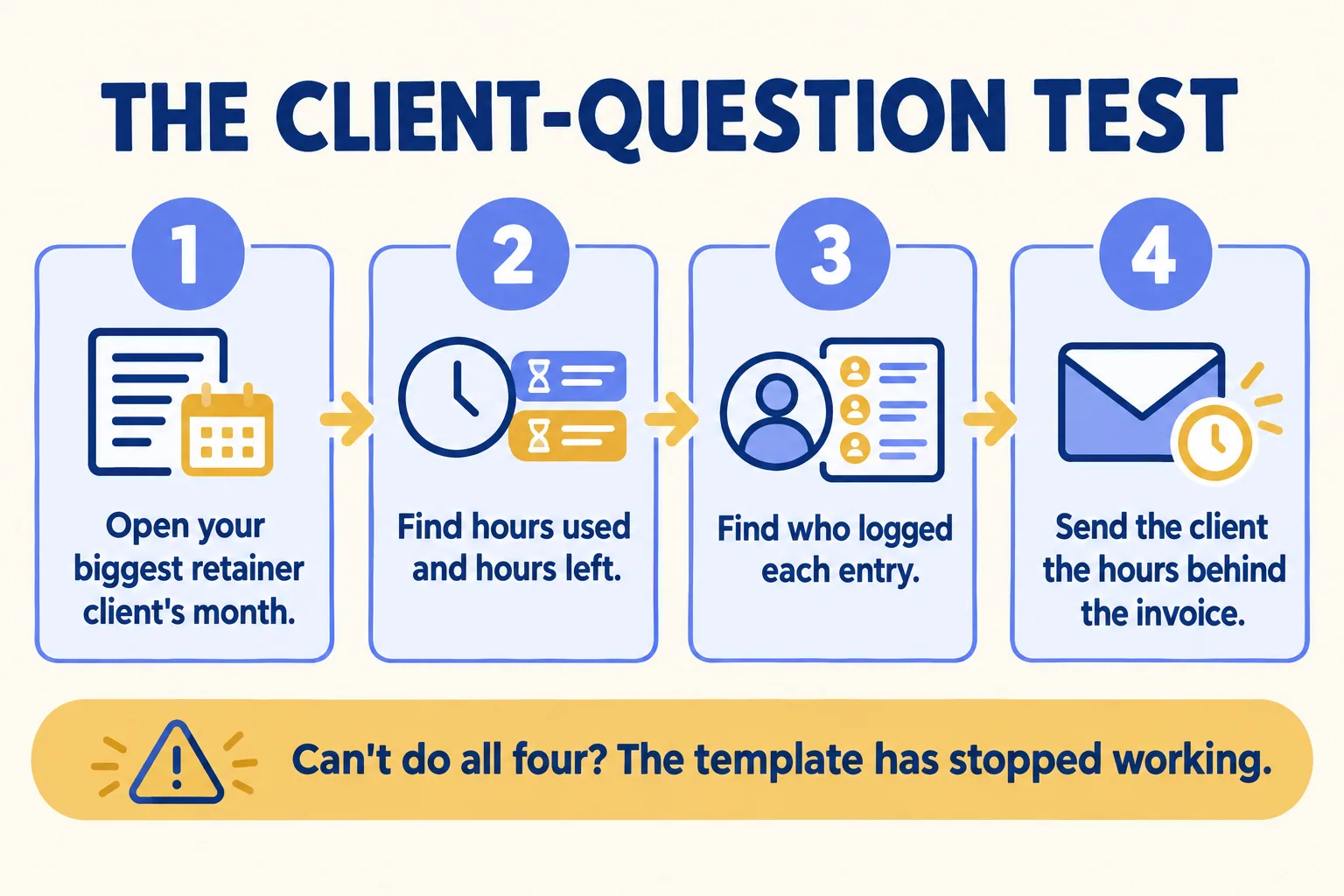
Test it in five minutes, on your biggest retainer client.
- 01Open your biggest retainer client's month.
- 02Find the hours used so far, and the hours left on the retainer.
- 03Find who logged each entry, and which entries were extras.
- 04Send the client the hours behind the invoice, as they would read them.
If you cannot do all four before your coffee gets cold, the template has already stopped working for that client.
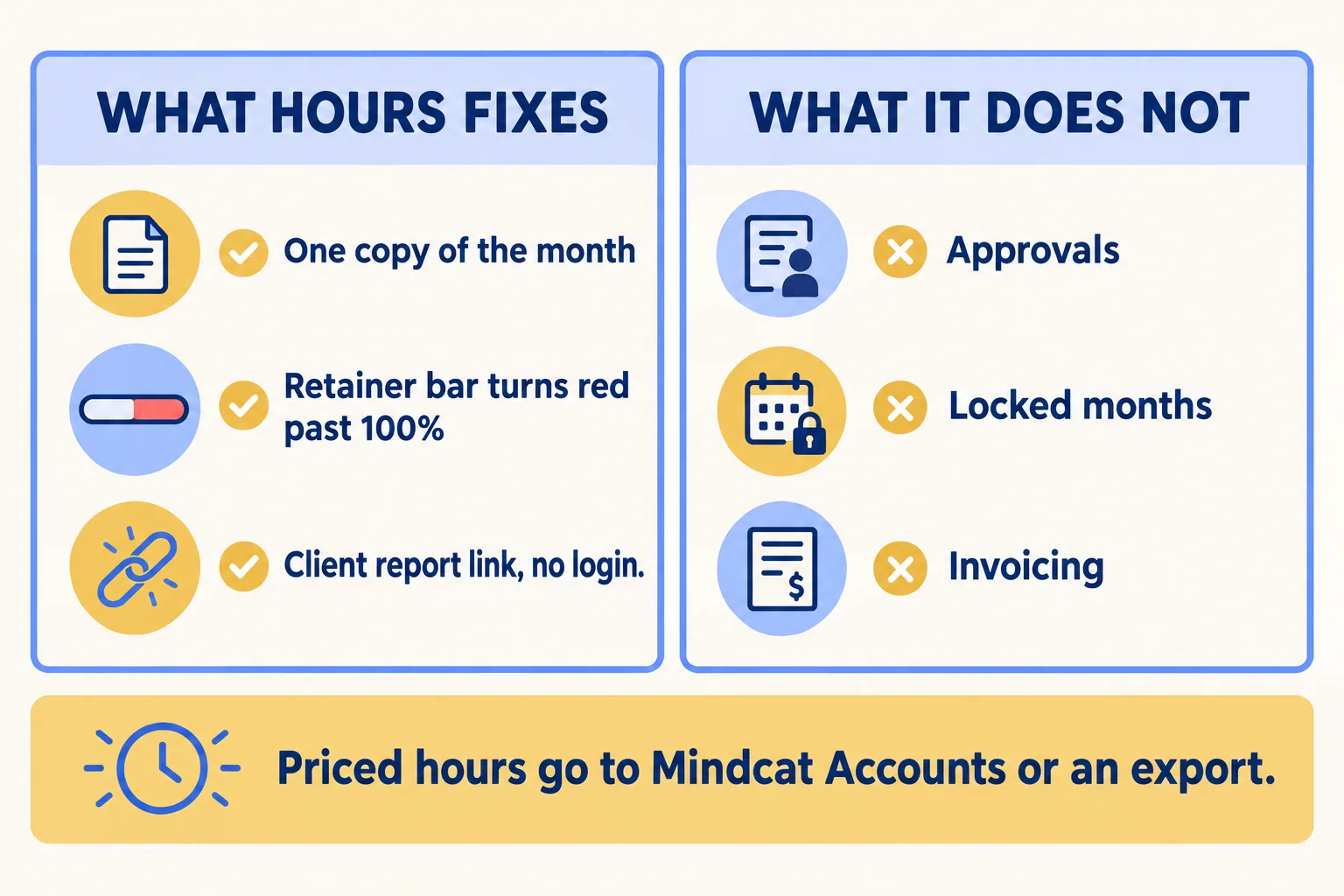
What does software add, and what does it cost?
Software keeps one copy of the month, shows the retainer as it is used and gives the client something to read. The price on a pricing page is not the whole price. actiTIME, a vendor that sells a time tracker, compared 16 tools in a press release dated 29 October 2026, with prices checked on 21 October 2026. Entry plans ran from USD 3.99 to USD 10.90 per user a month on annual billing, with a median of USD 7.59. It also found that at 5 of the 6 tools it priced for a 10-person team, "timesheet approvals and profit reports require a mid- or top-tier plan". It is a vendor study in US dollars with no regional prices, so read it as a question to ask, not a Gulf number.
The question: which of approvals, a profit report and an invoice do you need before you compare a price? Write the three down. Then compare tools on those, not on the entry price.
Hours is a plain case. It has no approval step. If you need a manager to sign off each timesheet before it counts, Hours is not the tool, and you should say so before anyone pays.
What will Hours not fix?
Say it before the price. Mindcat Hours does not do these today:
- Approve or lock a timesheet. There is no approval step and no locked months.
- Make an invoice. Priced hours go to Mindcat Accounts, which issues the VAT invoice, during managed setup, or out as an export for your accounting system.
- Show Arabic screens. The screens are in English today; entries can be typed in Arabic.
- Cost less than the rest. Every tool in the comparison on the Hours page costs less per user than we do, and Zoho also keeps data in the region. Hosting in the UAE or Saudi Arabia is not our edge.
It does not watch your staff either. It records and reports the time your team logs, with no screenshots and no scoring.
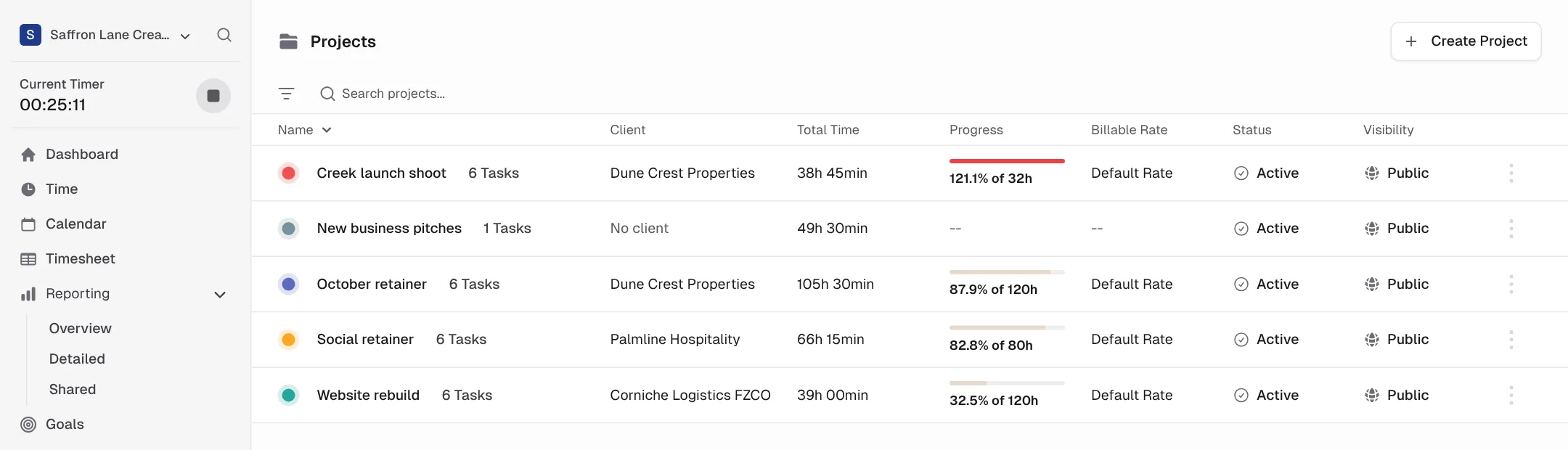
Hours is for billed client time. Attendance and payroll for your staff are Mindcat People. Plans and dates are Mindcat Projects. Mindcat Accounts raises the VAT invoice. Software houses billing time and materials will find the same pattern on our software industry page.
How do we decide with an agency?
Our method is called Log it, price it, show it. We start with the client-question test on your biggest retainer client. We read how many people edit the file today, where the extras are agreed and what a client would need to see. Then we say whether you should stay on a template, and we do not quote when you should.
If you move, a clients-projects-and-rates import comes from our spreadsheet template or a Clockify, Toggl or Harvest export. We import your history and set rates per person and project. If a template is all you need, tell us anyway and we will say so.
What does Mindcat Hours cost?
Here is what the Hours page says today. You pay per user a month: anyone with a login who tracks time or manages it. Clients who open a report link pay nothing.
- Users 1 to 20: AED or SAR 39 each. 21 to 100: 29. 101 to 300: 19. Above 300: 12.
- The shared plan has a minimum of AED/SAR 690 a month, which covers up to 17 users. A team of 10 is 10 x 39 = 390, which is below the minimum, so the minimum is the price. That is arithmetic on the page's list, not a quote.
- A 25-user agency pays 20 x 39 + 5 x 29 = AED 925 a month.
- The quick start is a fixed AED/SAR 2,500 that we set up, for the shared plan up to 50 users. The payment link follows within 24 hours.
Annual prepay takes 15 percent off the part above the minimum. Prices exclude 5 percent UAE VAT and 15 percent Saudi VAT. See prices and the comparison on the page.
Tell us how many people log time, how you bill clients and what you track time in today. We reply with the setup plan and the monthly price per user, in AED or SAR.
