

If two of your tenant's rent cheques came back and you are not sure what the Rental Disputes Centre will ask you for, this is for you. It is not for a landlord whose tenancy is not registered on Ejari: register it first, because the Centre asks for the Ejari copy.
This is how we decide, not legal advice. Mindcat does not serve notices or file at the Centre. We keep the record the file rests on. The Centre's pages are quoted as they read on 18 November 2026; take your own file to a UAE lawyer before you act.
Do you want the rent, or the flat back?
Answer that first, because the Centre treats them as two routes.
A landlord wrote to The National in 2016 with the situation most of these files start from: "The tenant left the country and the cheques provided bounced. However, the tenant's family are still occupying the apartment and have refused to pay (basically giving false promises and not retuning calls)." The letter is ten years old and the rules have moved since, so read it for the situation, not the route. The question it asks is still the right one: what do I want out of this?
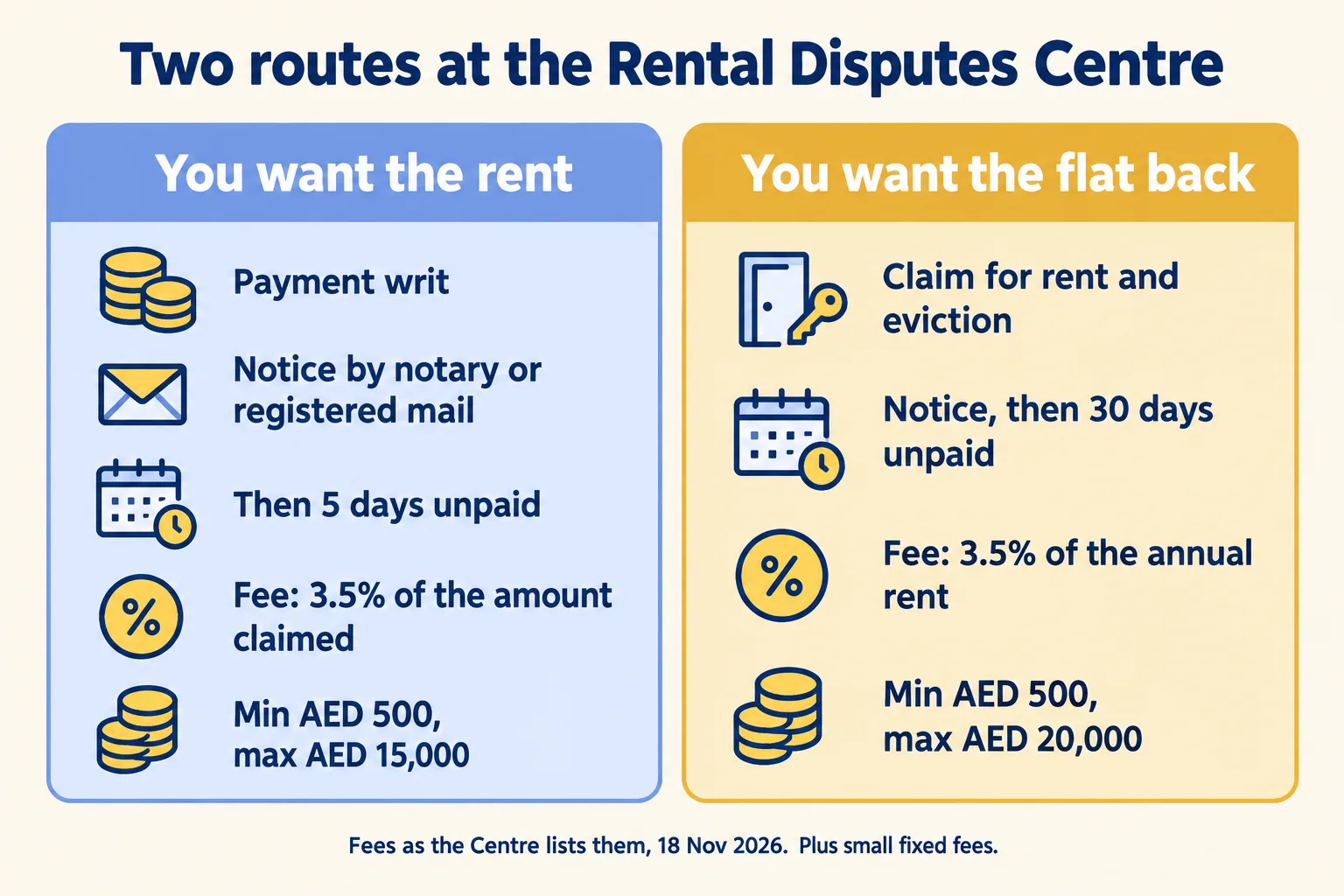
If you want the money and the tenancy can carry on, the Centre has a summary route for the debt alone. Its payment writ page calls it a petition "requesting Summary Actions Judge to issue a writ of payment to settle the due amount". If you want the tenant out, that is a full claim, which our eviction notice post covers: notice, thirty days, then a claim for the arrears and the eviction together.
On a sample file of two returned cheques of AED 20,000 each, the writ fee is 3.5 percent of AED 40,000, so AED 1,400, plus AED 120 in fixed fees. The sample is an example, not a market figure. The Centre's page lists one business day to complete registration; the judge's decision comes through its website after that.
What does the Centre ask for before a payment writ?
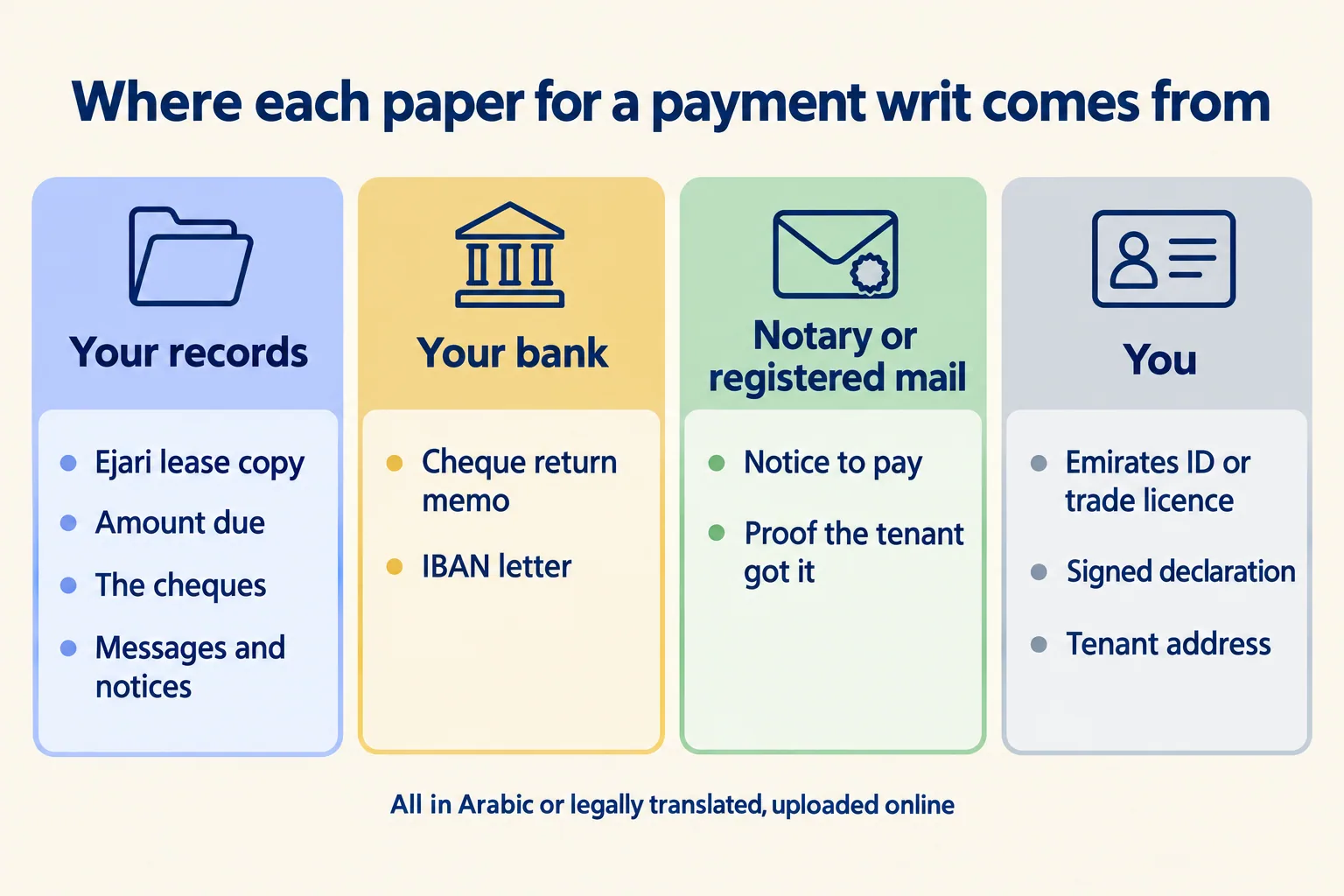
Ten papers. The list is on the Centre's service page, and most landlords meet it for the first time on the day they want to file. Sorted by who produces each one, it looks less like a legal task and more like a filing job.
If you manage the flat for an owner, the power of attorney and the management contract sit in that last row. Settle with your lawyer, before the notice goes out, whose name the petition is filed in.
The Centre adds two conditions. Every document is submitted in Arabic or legally translated into Arabic. And everything is uploaded on its website, because "no hard copies shall be entertained".
Which three papers stop a file?
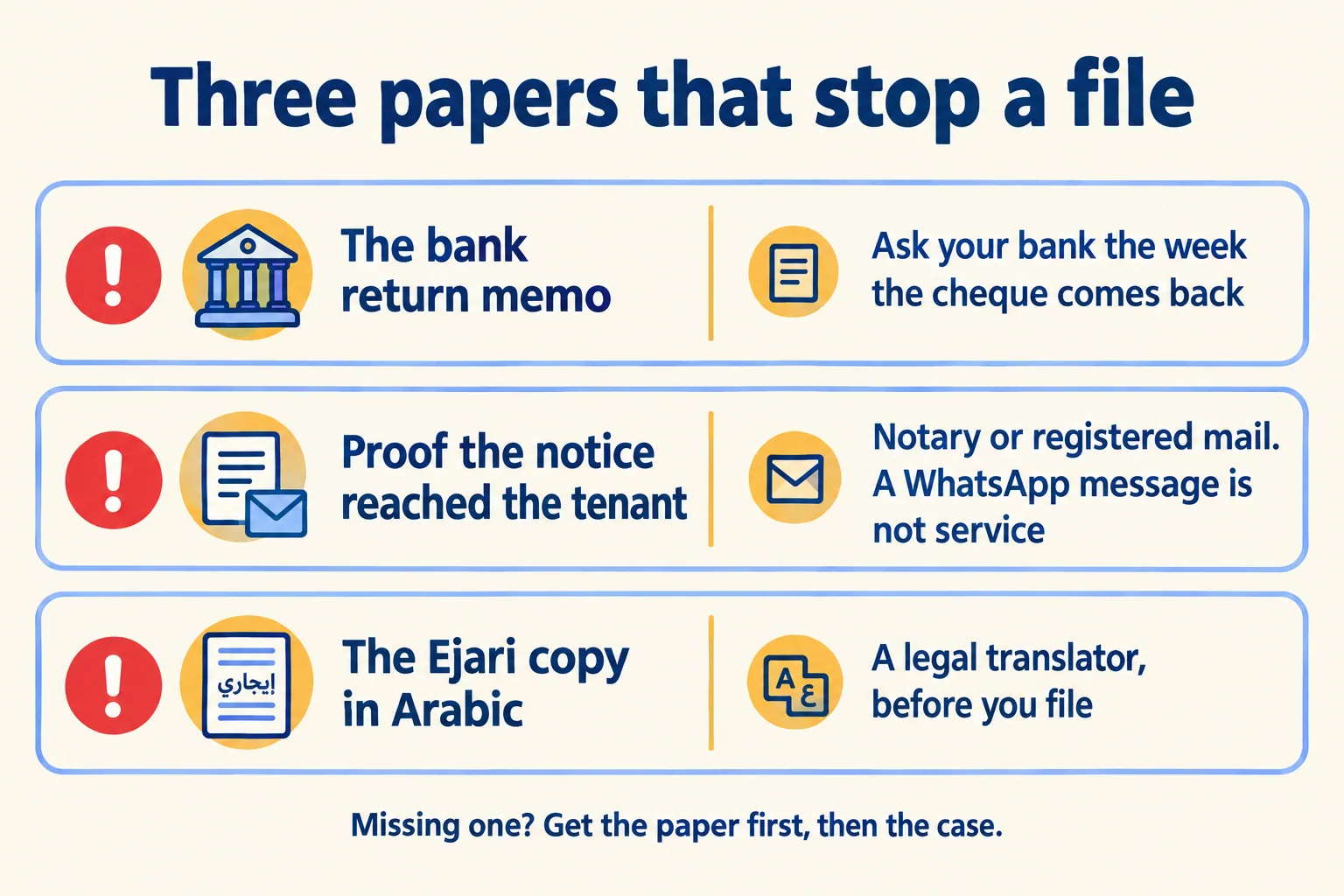
The ID, the declaration and the IBAN letter take an afternoon. Three papers take longer, and they are the ones we check first.
- The bank's return memo. It comes from the bank, not from you, and the cheque itself does not replace it. Ask for it the week the cheque comes back, while the branch still has the item in front of it. A landlord in our eviction notice post found the bank would not issue one at all for a cheque it had not processed.
- Proof the notice reached the tenant. The Centre's terms name a notary public or registered mail. A Dubai guide by Truhauz says what that proof looks like: the notarised notice with the officer's report, or the registered post with its acknowledgement of receipt. A WhatsApp message is neither. The Centre's FAQ does say WhatsApp messages and email can count as evidence "provided that the disputing parties are questioned about them and acknowledge them in the case record". So the chat goes into the file as evidence, and the notice goes the way the Centre names.
- The Ejari copy in Arabic. The Centre asks for the latest copy of the lease (Ejari) "with Arabic translation". If your lease is in English, a legal translator is a step with its own wait. Book it before you need it.
How we decide: paper first, case second
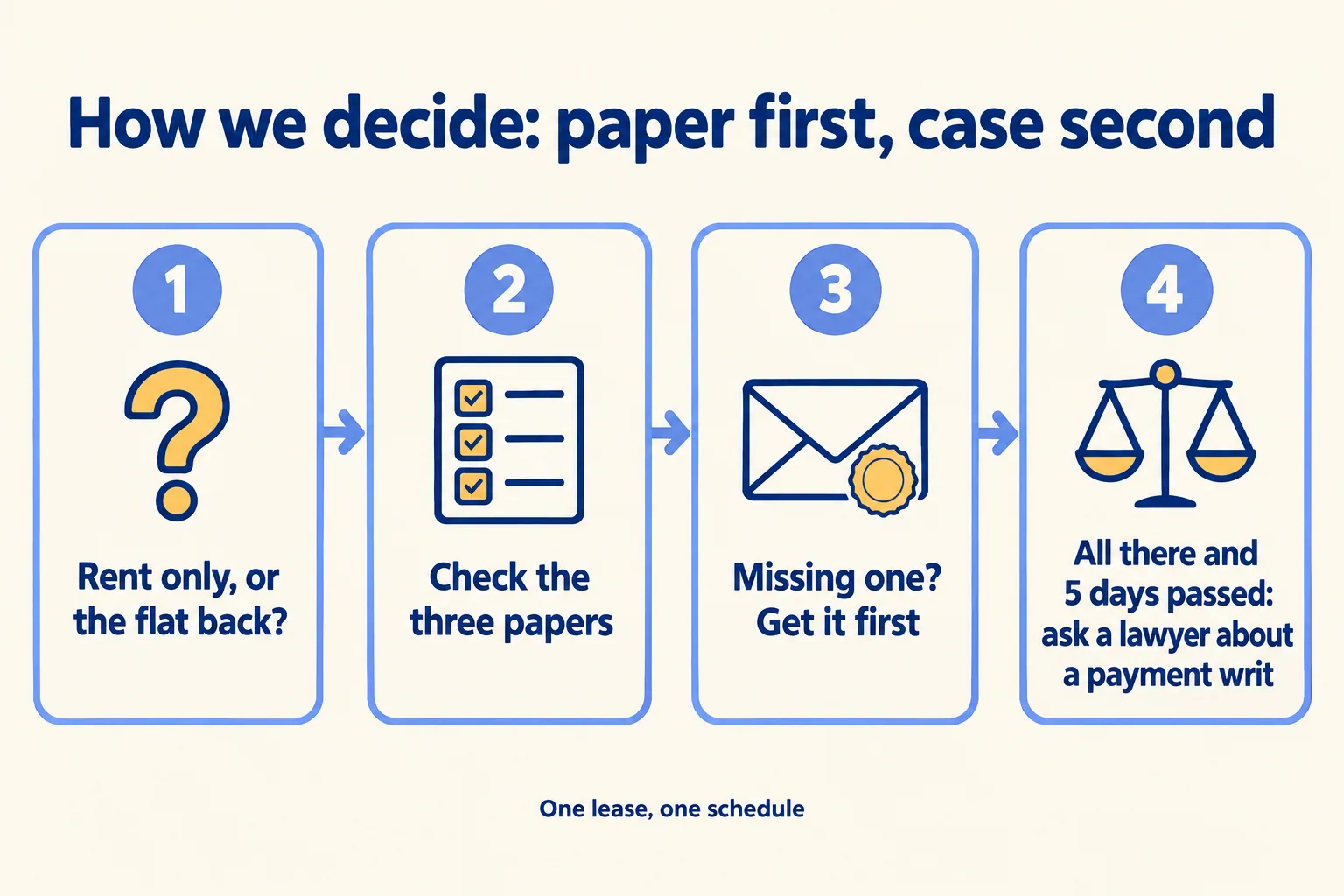
Our rule: if you want the rent and not the flat back, and you hold the Ejari copy, the bank's return memo and proof that a notice reached the tenant, a payment writ is the route to put to your lawyer. If any of those three is missing, the first job is the paper, not the case. If you want the tenant out, it is a full claim, with a lawyer.
- 01Decide what you want: the rent only, or the flat back. The routes, the waits and the fees differ.
- 02Check the three papers: the bank's return memo, proof the notice reached the tenant, the Ejari copy in Arabic.
- 03If one is missing, get it first: ask the bank, send the notice through a notary or registered mail, book the translator.
- 04With all three in hand and five days passed unpaid since notice, ask a UAE lawyer about a payment writ.
The order matters for a plain reason. A file that reaches the Centre with a gap waits for the gap to close. A file assembled in the week the cheque came back waits for nothing.
What Mindcat Lease keeps, and what stays with your lawyer
One lease, one schedule. In Mindcat Lease each lease carries its tenant, unit, rent, deposit and Ejari number, and one row per cheque with its number, bank, date, amount and status: held, deposited, cleared, returned or replaced. A returned cheque stays at the top of Cheques to Deposit with its reason until you mark it replaced. That covers the paper the Centre calls written proof of the amount due, and it tells you which cheques the bank memo must cover. Leases, cheques, invoices and payments export as CSV whenever you want them.
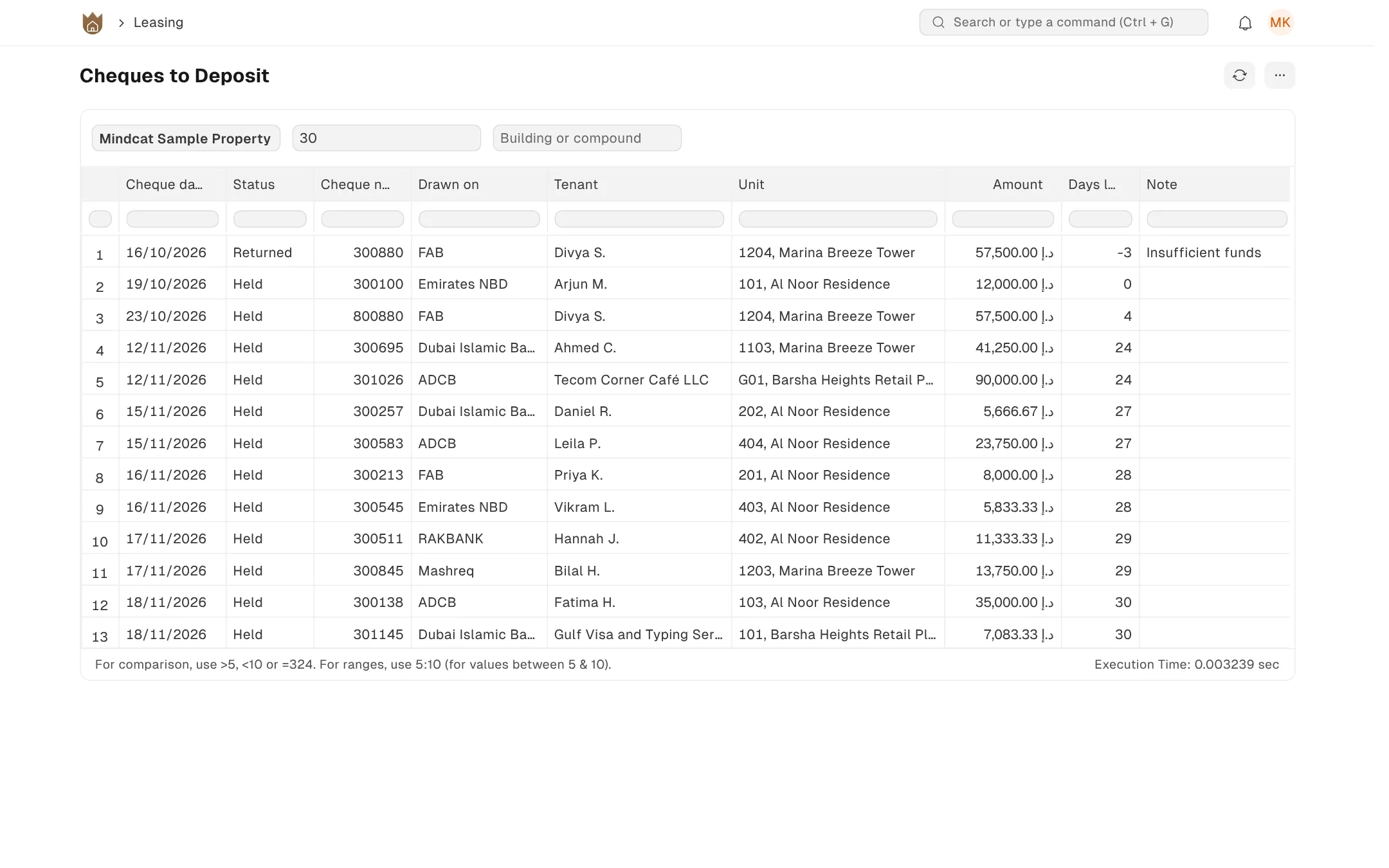
The rest stays where it is. Mindcat Lease does not give legal advice, serve a notice, file at the Rental Disputes Centre, register Ejari or translate documents. Ejari registration stays on DLD's channels; the number and its status sit on the lease. Bank charges for a returned cheque are your bank's, and the Centre's fees are the Centre's.
The owner's side of the same file (what was collected, what is unpaid, what the owner nets) is in our note on the service charge file per unit.

Who should not start here?
A landlord with a handful of units. Under about 10 units, our page says, a spreadsheet and a calendar reminder do the job, and our minimum would cost you more than the problem. Keep the cheques, the memo and the notice in one folder per lease and you have most of the list.
Above that, the price is per unit a month, from the live Lease page: AED/SAR 15 for units 1 to 100 and AED/SAR 8 for units 101 to 500, each band applying only to the units inside it, with a shared-plan minimum of AED/SAR 990 a month (which covers up to 66 units). Up to 100 units the quick start is AED/SAR 2,500, fixed: we set up your copy and import your leases and cheque schedules from our CSV template. Above 100 units it is managed setup to a written plan. Prices exclude VAT. Our property management page shows the same screens with sample data.
Tell us how many units you manage and how your tenants pay. We reply with the setup plan and the monthly price per unit, in AED or SAR.
