
If your Dubai leases say the tenant pays the service charge, and your own file cannot show whether the building was paid, this is for you. Not for an owner with one flat and an agent who pays the building for them: ask the agent for the statement of account.
This is how we decide what to keep, not legal advice. The law and the sources below are quoted as they stand today. For a dispute over your own charges, take the file to a UAE lawyer.
Who does the building look to when the tenant pays?
You. A lease can say the tenant pays. It cannot take the bill off the owner.
Dubai Law No. 6 of 2019, on jointly owned property, says it in one paragraph. Article 16(b): "Unless otherwise stipulated in the Unit lease agreement, the Owner will be liable to pay the Service Charges and Usage Charges. In all events, the Owner may not be discharged from his liability to pay the Service Charges and Usage Charges if the tenant fails to pay the same."
The Rental Disputes Center, the Dubai Land Department's judicial arm, repeated the rule on 6 January 2020. Its chairman added that "the invoices approved by the Real Estate Regulatory Agency (RERA) shall be the reference points in the event of disputes over the charges."
So the lease decides who sends the money. The law decides who answers for it. When the two differ, the building still looks to the owner, and so does the file you will be asked for.
Two more articles explain why the file matters. Article 28 says an owner "may not refrain from paying the Service Charges or Usage Charges approved by RERA." Article 32 says the management entity must ask an owner who has not paid to do so within 30 days of a written notice approved by RERA. After that, its claim can be enforced by the execution judge at the Rental Disputes Settlement Centre. The same article gives the management entity a lien on the unit: it "may not be disposed of unless these charges are paid." What that means for your unit is a question for your lawyer. What it means for your records is plain: you need to show what the building billed and what reached it.
What goes in the file for each unit?
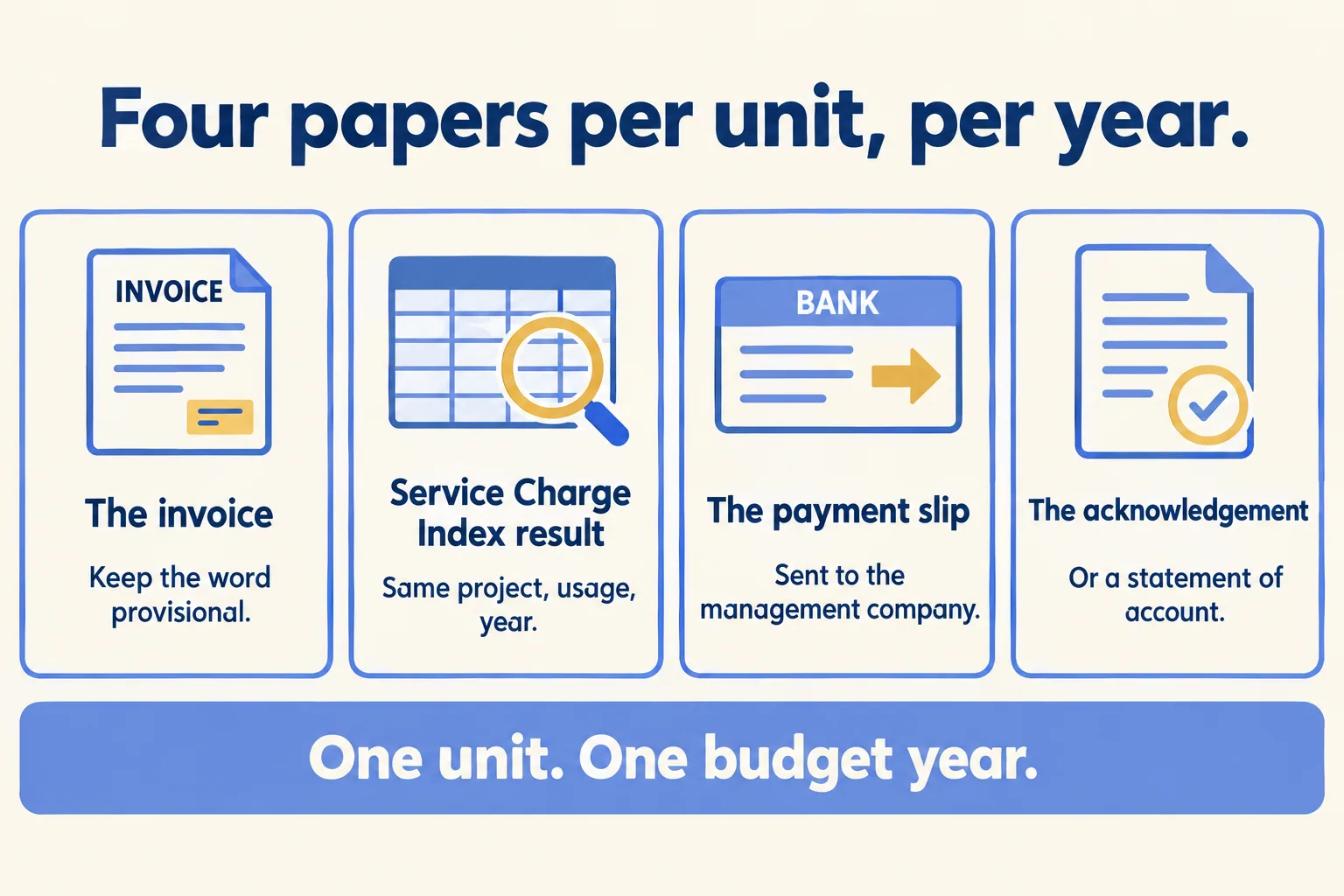
Four papers, for each unit and each budget year. Izirento, a property software maker, set out the list on 6 October 2026, and it matches what the law and Mollak, the Land Department's service charge system, point to.
Compare the index rate with the current charge, not with the total due. The total can include a previous balance or an adjustment, as McCone Properties' guide to the invoice explains line by line.
The tenant's lease, the Ejari certificate and the security deposit receipt sit in the lease file, not this one. Izirento makes the same split: a move-out permit or a deposit receipt is not a service charge receipt.
How do you know the tenant's payment reached the building?
Not from a WhatsApp message saying "paid". McCone Properties puts it simply: "the proof that it landed is the balance in the app, not the transfer confirmation." Izirento says a bank photo of a transfer "is not the receipt until that slip is presented."
There are two ways a tenant pays, and each needs a different check.
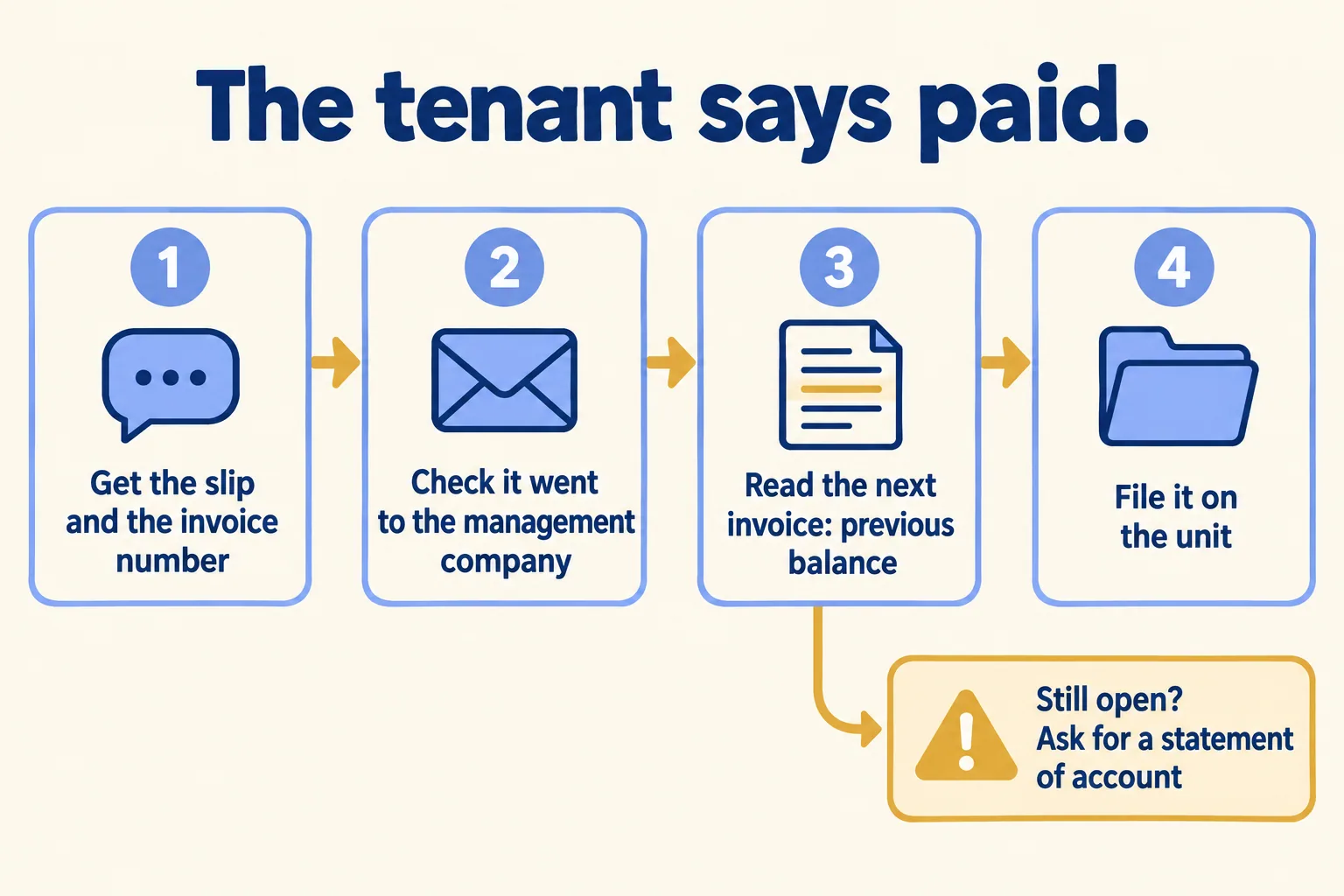
- The tenant pays the building directly. Ask the tenant for the payment slip and the invoice number it quotes. One WhatsApp line does it: "Please send the bank slip for the service charge and the invoice number you quoted." Check the slip was sent to the management company. When the next invoice arrives, read its previous balance line. If it shows the amount still open, ask the company for a statement of account and send it the slip. If the slip quotes another unit's invoice, ask the company to match it to yours and keep its reply.
- The tenant pays you, and you pay the building. Record two things: what the tenant sent you, against the lease, and what you paid the building, against the unit. Then the four papers above, as for any unit you pay yourself.
Do this at the same rhythm as the rent. If you check rent every month and the service charge once a year, you learn about a gap when the next invoice shows it as a previous balance.
When is a folder enough, and when does a ledger pay?
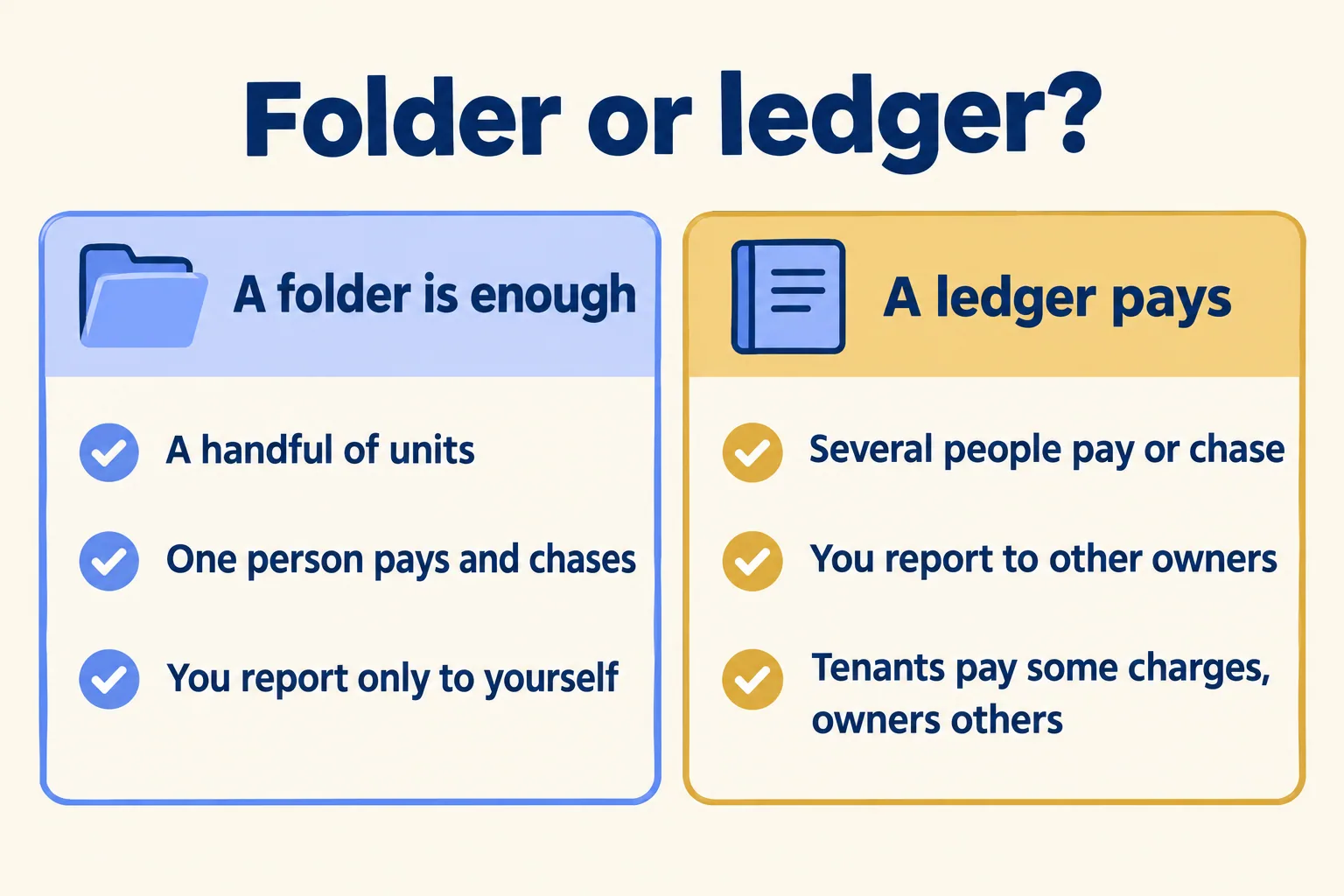
Here is how we decide. Take a sample: a landlord with six flats in three buildings, collecting the rent alone. That landlord needs a folder per unit with the four papers, and one sheet with a row per unit. The row holds the invoice period, the amount, who pays under the lease, the date the slip went in and the balance on the next invoice. Software would cost more than the problem.
A ledger starts to pay when one of these is true:
- More than one person pays or chases. The folder lives with one of them, and the others ask in a chat group.
- You report to owners who are not you. A management company has to show each landlord what was collected and what is unpaid, unit by unit.
- Tenants pay some charges and owners pay others. The sheet stops being one row per unit and becomes a reconciliation.
In those cases the lease, the tenant's balance and the owner's statement should come from one record. The building's papers still sit beside it.
We made the same call on who should do the rent work in flats on cheques: a manager or a ledger.
What does Mindcat Lease keep, and what stays in your folder?
One lease, one schedule. Mindcat Lease keeps each lease with its tenant, unit, dates, rent and cheque schedule. Each unit sits under its building, with its owner, area and title deed. Tenant balances show who owes what, and the owner statement shows each landlord the rent invoiced, collected and unpaid, your fee and the net.
The building's side stays in your folder. Mindcat Lease does not connect to Mollak, pay the service charge, store the building's invoices as a feature or match a payment slip. If you want the tenant's share of a service charge tracked on the lease, tell us how your leases word it and we will say in the setup plan whether it fits.
The price is per unit a month: AED 15 for units 1 to 100, falling in bands above that. The shared plan has a minimum of AED 990 a month, which covers up to 66 units, so nobody buys one unit at the unit rate. Up to 100 units, the quick start is a fixed package we set up for you for AED 2,500, one time. Prices exclude VAT. The service charge itself is the building's, paid to the management company, and Ejari fees are DLD's.
If you hold a handful of units and collect the rent yourself, a folder and a sheet do the job, as the Lease page says for anyone under about 10 units. We call the method One lease, one schedule. Tell us how many units you manage and how your tenants pay. We reply with the setup plan and the monthly price per unit, in AED or SAR.
